

2-Time Champ as Player, Haut Putting Further Imprint on SMCC as Coach
By
Doug Donnelly
Special for MHSAA.com
August 16, 2022
MONROE – After leading the Monroe St. Mary Catholic Central volleyball team into the Division 3 championship match last season, coach Cassie Haut had to apply for the Kestrels coaching job.
 That’s because when SMCC reached the Finals in 2021, Haut was officially the co-head coach with Karen O’Brien.
“Oh, yeah, I had to go through the interview process and everything,” Haut said. “I met with the athletic director and other school officials. I was excited when I got the job.”
Haut certainly earned it.
SMCC officially billed Haut and O’Brien as co-head coaches when the 2021 season began. Haut was in charge of the team’s day-to-day activities and O’Brien – who led SMCC to Division 3 Finals titles in 2019 and 2020 – would help out as often as possible after being diagnosed with ovarian cancer for the fourth time.
O’Brien ended up being around the program often, including during the Kestrels’ postseason run.
When the season ended, however, O’Brien stepped aside, paving the way for a new coach to lead the ultra-successful SMCC program that has reached 10 Finals since 2003, and won seven of them.
Haut doesn’t feel added pressure as the next SMCC coach to maintain that level of success.
“I love it,” she said. “I’m honored to be able to be part of this legacy.”
Haut played basketball, softball and volleyball at SMCC and was part of two championship volleyball teams – in Class C in 2012 and 2014 – under head coach Diane Tuller. The 2015 SMCC grad also had an outstanding career at Eastern Michigan University, earning all-freshman team honors for the Mid-American Conference and twice being named first team all-MAC. In 2018 she was named the MAC Tournament MVP.
Soon after Haut’s college graduation, O’Brien – who was an SMCC assistant during Haut’s high school senior year – called her and asked if she wanted to be part of the program now as a coach.
“It was something that I always thought of doing,” Haut said. “After graduating, I remember thinking ‘What’s next?’ Coaching was something I felt I wanted to do. It helps keeps me part of the game that I love.”
SMCC graduated several seniors from the 2020 championship squad and had to do some rebuilding in 2021. O’Brien was there to put together some of the pieces, then helped mentor Haut as she guided the team through much of its 36-12 run. During the MHSAA Tournament run, O’Brien would funnel postgame questions to Haut, preferring to stay out of the limelight.
It was still, however, a dual coaching role until Haut took over the job.
“I was building up practice plans and ideas for the season just in case I was hired,” Haut said. “I had some things in my mind that I wanted to do. It’s nothing too crazy, but I just added my own touches.
 Last year, for example, it was O’Brien who organized summer practices and helped build the regular-season schedule.
“I missed out on those parts of it, so it was something I was looking forward to this year,” Haut said. “It was exciting. We’re still in the same great tournaments that SMCC loves to go to.”
Haut is meshing the experiences she had as a player and coach to form her own coaching style and program.
“All of the coaches I’ve played for and coached with have a slightly different idea of the game,” she said. “The game has evolved in different ways. As I have gone through high school and college as a player, I felt like I learned more depth to the game every year. Then, since I’ve been coaching, I feel like it’s gone to another level.”
Before this season started, Haut had her players write down their goals.
“I want to learn everything I can about the girls,” she said. “It’s not just about volleyball, but life. My college coach really believed that. I’m excited to be part of these girls’ lives.”
Haut comes from an athletic family and has been around sports all her life.
Her father Chris played baseball at the University of Toledo. Her sister Mikayla was a four-time all-state volleyball player and Miss Volleyball finalist, and is coming off a Metro Atlantic Athletic Conference (MAAC) Rookie of the Year award at Fairfield University in Connecticut. Sister Maddie earned all-conference honors and helped Ave Maria University win its conference title a year ago. Brother CJ was an outstanding basketball player for the Air Force Academy.
SMCC is primed for more success this year. Haut welcomes back a solid senior group that has already showed off its leadership skills. The Kestrels will be among favorites as they seek to make a fourth-straight trip to Battle Creek.
“From the time we got into the gym, they have been leaders,” Haut said.
Two freshmen played key roles a year ago, McKenna Payne and Jessica Costlow. Payne rang up 465 kills, 360 digs and 86 aces during her ninth-grade season while Costlow had 414 kills, 275 digs and 59 blocks.
Last year, SMCC lost in the Division 3 Final to Reese. After taking a 2-0 lead in the match, the Kestrels dropped the final three games 25-15, 25-21, 16-14.
“I like a lot of what I saw in the scrimmage. It was good to get some different lineups together, and we have a deep bench,” Haut said. “I see a ton of potential with this team.”
 Doug Donnelly has served as a sports and news reporter and city editor over 25 years, writing for the Daily Chief-Union in Upper Sandusky, Ohio from 1992-1995, the Monroe Evening News from 1995-2012 and the Adrian Daily Telegram since 2013. He's also written a book on high school basketball in Monroe County and compiles record books for various schools in southeast Michigan. E-mail him at [email protected] with story ideas for Jackson, Washtenaw, Hillsdale, Lenawee and Monroe counties.
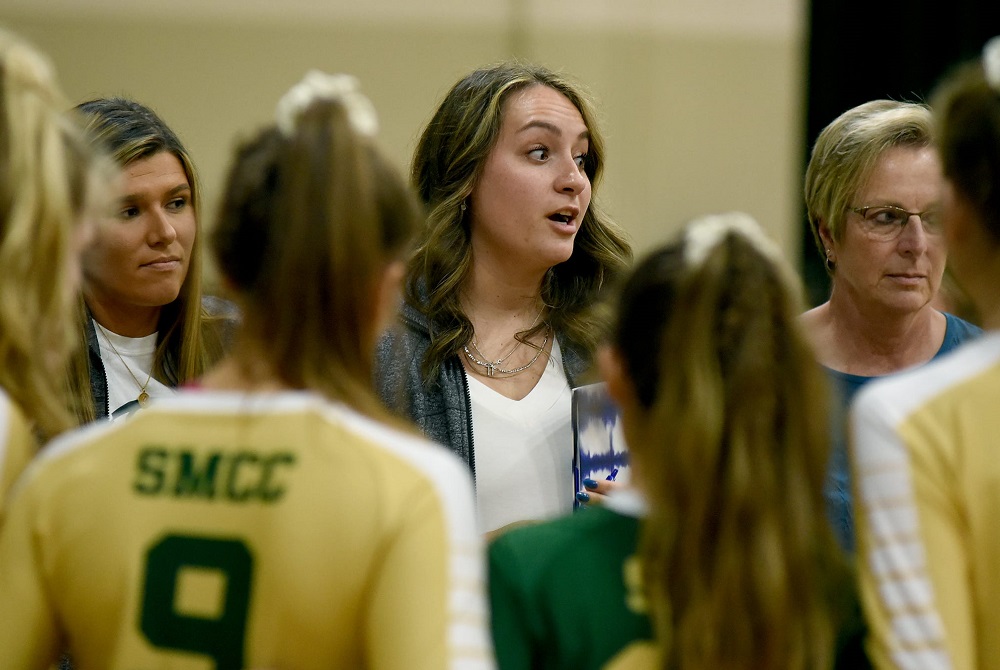
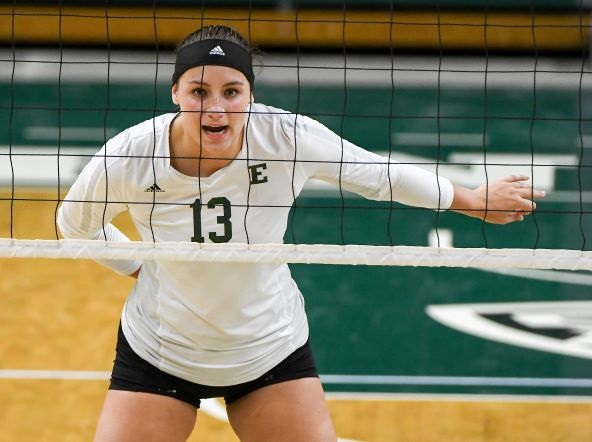
PHOTOS (Top) Cassie Haut, middle, talks with her Monroe St. Mary Catholic Central team last season as co-varsity coach with Karen O’Brien, right. (Middle) Haut signals to her teammates while starring at Eastern Michigan. (Top photo by Tom Hawley. Middle photo courtesy of the EMU athletic department.)
Kestrels Prove to be Champions Again
November 17, 2012
By Geoff Kimmerly
Second Half editor
BATTLE CREEK – Taylor Vuich and her teammates have learned to ride the wave of a good omen.
And so, when her hotel room was the first among Monroe St. Mary Catholic Central’s to wake up Saturday morning, and their favorite song was playing when they flipped on the radio, the Kestrels just knew “today was the day.”
Saturday was the day St. Mary got back the MHSAA Class C championship after coming within three points of a second-straight title one year ago.
The Kestrels claimed their second championship in three seasons and fourth overall with a 25-14, 24-26, 25-10 and 25-9 win over first-time finalist Traverse City St. Francis at Kellogg Arena.
“We got all the way here last year, (played) two and half hours, and then it just slipped away from us,” Vuich said. “They were a great team, but I think we knew this year that this is what we wanted. We wanted to prove to everyone that we’re state champions.”
It’s fair to call the 2011 Class C Final epic. All five games were decided by three or fewer points, with Morley-Stanwood claiming the last 15-12.
With now five championship game appearances over the last 11 seasons, it’s also fair to say the Kestrels (49-6) set high expectations heading into every fall – even if that might’ve turned a little dangerous earlier this week.
“When we talk about goals at the beginning of the year, they talk about getting back here,” St. Mary coach Diane Tuller said of her players. “I talk about the first game of the season, (that) this is where we want to be midway and this is where we want to be toward the end; this is what we need to keep working on. That’s the important thing to me. They set those goals, and I have to keep bringing them back.
 “I think we overlooked the team we played in the Quarterfinals (Auburn Hills Oakland Christian). It was our worst game of the year. Everything shut down. … (But) our senior captains really wanted it, and they kept them focused. I gave them the job of keeping this team together.”
And they got back together quickly after the Gladiators took a close second set.
St. Mary scored the first 10 points of the third game and then jumped out to a 10-1 lead in the fourth.
And when junior McKenzie Todd and sophomore Cassandra Haut combined to simultaneously crush the winning point straight into the floor, it was a strong lasting impression of how those last two games had gone.
Haut, an all-state honorable mention as a freshman, finished with a team-high 16 kills from her powerful right arm. Vuich, swinging a hammer with her left, added 13 kills and eight digs, and Todd had 10 kills.
Senior Claire McMillan had 46 assists, tied for ninth-most in a Final since the beginning of the rally scoring era in 2004-05. Junior Kelsey Geiman – beating the previous record by five (and the record from before rally scoring by seven).
"We are really deep, in all our players. We have a lot of good hitters on our team,” Haut said. “We can always count on anyone on our team.”
St. Francis finished 42-8-3, impressive all the more because co-coaches Heather Simpson and Rita Jones didn't take over until a month before practice began.
They moved up from coaching the junior varsity after the former varsity coach resigned to take another full-time job.
“Our kids don’t quit, and I don’t think how we played today is really a reflection of how good we were, or are,” Simpson said. “From that aspect, it’s disappointing. But hats off to them. They’re a good team, and we are too, but we couldn't match them.”
St. Francis senior Bridget Bussell just missed getting into the Finals records as well, with her 18 kills just two short of that list. She also had six digs, and senior setter Katilyn Hegawald had seven and 26 assists.
“We just never got into our groove, except for the game we won,” Bussell said.
(But) we knew we were here for a reason, so we tried as hard as we could to keep pushing.”
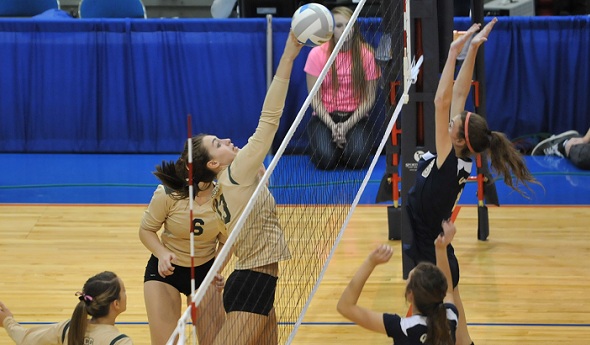
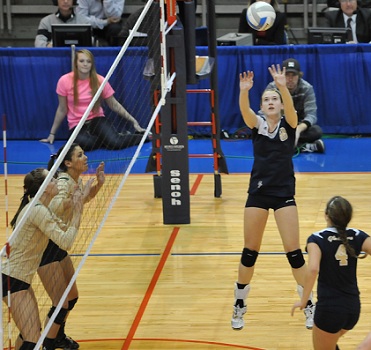
PHOTOS: (Top) Monroe St. Mary sophomore Cassandra Haut (13) covers a kill attempt by Traverse City St. Francis during the Class C Final. (Middle) St. Francis senior Kaitlyn Hegawald (9) prepares to set up teammate Olivia Hardy (4).