

Junior Hitter's Spirit, Skill Give Lawton Lift
By
Pam Shebest
Special for MHSAA.com
September 25, 2019
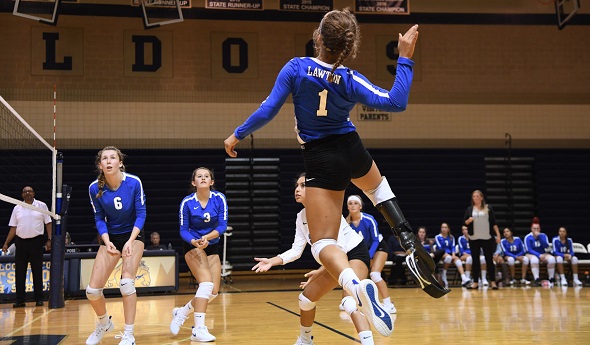
LAWTON — Olivia Cramer wears her friends proudly — on her leg.
 When she is not wearing a blade to play volleyball or basketball, the Lawton High School junior wears a prosthetic, but it’s not just any leg.
“I’ve had pictures of my friends on it for a couple years, and there’s the homecoming court my freshman year, softball game, at work,” she said.
While the decoration of the prosthetic leg is a novelty, the need for the limb certainly isn’t.
Cramer was born with non-genetic proximal femoral focal deficiency (PFFD), a condition that has resulted in her right leg measuring inches shorter than her left.
It is an uncommon condition that affects about 1 in every 200,000 children, according to statistics from the Children’s Hospital of Philadelphia.
The prosthetic leg assists with everyday life. But when it comes to athletics, she wears a blade, similar to those worn by runners.
“We call it my running blade,” Cramer said. “Mine is designed a little differently than an amputee because I still have my leg bones and foot.”
The custom-made blade, officially called the Freedom Innovations Catapult, is made of carbon fiber and has a rubber tread on the bottom so it will not damage the court.
“It’s about a two-week process and it was a little bit of a challenge to make,” said Tim Darling, a certified prosthetist at Hanger Clinic in Kalamazoo who fashioned the leg and blade.
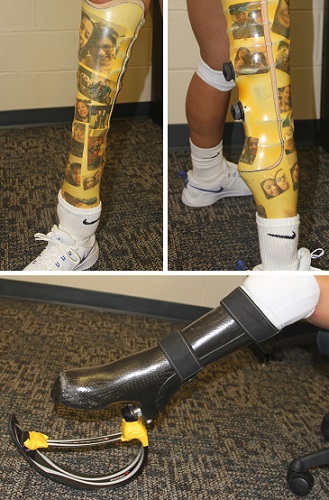 He also was instrumental in adding the photos. “She provided the photos printed on a T-shirt and we used materials to reinforce it and then used an acrylic lamination,” Darling added.
Instead of Velcro straps to keep the leg attached, Cramer has two dials that tighten the leg.
“It has string made of Kevlar and you can tighten them so I don’t have to have straps covering my leg anymore,” she said. “Before, it was just Velcro and came loose a lot.”
Darling said it is a relatively new process for a prosthetic.
100 Percent
“Working with her is humbling,” Lawton volleyball coach Megan McCorry said. “When you see someone with a physical disability like that and you see that same person is also the most positive and most encouraging, it really makes you do a gut check.
“It gives you some perspective in life that what you have going on may not really be that bad, and you need to work harder at putting your best foot forward.”
Cramer was pulled up from junior varsity during the District last year and practiced but did not play.
This season, she sees court time and, “She’s honestly one of those kids that you can’t not have on your team,” McCorry said.
“I mean she is always 100-percent positive. She is going to be the loudest one on the court, loudest one on the bench. She’s always supporting her team, and she’s just so determined to get better individually and make her teammates better.”
Since she jumps off her stronger left leg, the blade does not give Cramer any advantage, but at least once caused a gaffe.
“During a match, my friend Madison Lawson and I were going for a block on the outside and we fought for the block and we came back down,” Cramer said. “Madison landed on my blade and snapped it.
“We didn’t know what happened at first because there was this huge (sound) right in the middle of the match and I was like, ‘What just happened?’ We even stopped playing because of it. I went to step and my leg didn’t spring like it usually does.”
 The junior said her teammates are very supportive.
“She holds herself accountable for everything she does,” senior Gabi Martinez said. “Everything she does basically makes us realize she can do everything we can do. It doesn’t stop her from anything.
“We do watch out for her leg to make sure she doesn’t hurt it, but usually even if she falls down, she gets right back up and she’s usually the one picking everybody else up.”
Cramer’s mother, Megan Cramer, said when she was pregnant, her first ultrasound showed an abnormality in the leg, so she was prepared when Olivia was born.
When learning to walk, Olivia would walk on her short leg and balance on the knee of her good leg, her mother said.
As Olivia grew older, doctors gave her mother two choices: amputation or rotationplasty (fusing the knee on her shorter leg and rotating her foot around to where her knee joint would be). That new joint is where her prosthetic would have connected.
Her mother chose neither.
“I was a young mother, and I was scared to death and I was, ‘You’re not cutting her foot off,’” she said.
They visited several hospitals and finally went to the Shriners Hospital for Children in Chicago.
“That was the first place we went where they said let her be,” Megan said.
That is what her mother did.
“I am glad that they never had it amputated, and I never had rotationplasty,” Olivia Cramer said. “My condition is pretty rare, and because I didn’t do any of the amputation that makes me even more special than it already was, so I really appreciate it.”
She goes to the Shriners Hospital every six months for checkups and gets a new leg and blade when she outgrows the old ones.
Driving and Striving
Golf is Cramer’s true love, and she hopes to pursue it in college.
When playing, she wears her regular prosthetic, not the blade, and, last year, was captain of the school’s boys team (Lawton has no girls team).
 She also played the Lakeshore Junior Golf Association tour during the summer, carrying a 12 handicap and winning the 16-18 girls division.
“Those accomplishments are all special, of course,” Lawton golf coach Barry Shanley said. “But what makes her truly remarkable is her spirit. If you didn't see her prosthetic, you would never know she even has one.
“For now it's actually an advantage for her college goal to play on a high school boys team. The boys play from the men's tees, which is the typical length for collegiate women, so college coaches know her scores now already match what length their own players are using.”
Shanley said the only way her prosthetic affects her swing is that her hip alignment can be a little unbalanced.
“Once she stops growing and her prosthetic is matched to her other leg permanently, there won't be any issue at all,” he said.
“Because it's difficult to keep them matched, which now can cause her some pain if she walks the typical 5.6 miles in 18 holes or the 2.8 miles for 9 holes, we wrote and received permission from the MHSAA to let her take a golf cart during matches.”
Right now, though, Cramer is focused on volleyball, with her team’s record 13-9 midway through the season. The Blue Devils will host an MHSAA Division 3 District beginning Nov. 4.
Other players on the volleyball team are senior Jessica Grear, juniors are Mackenzie Nickrent, Kiana Auton, Caitlen Romo, Josie Buchkowski, Wendy Guerra and Dezare’ Smith; and sophomores Sarah Dekoning and Lily Grear.
No matter the sport, Cramer said she follows her grandfather’s advice.
“My grandpa always has said, ‘Don’t ever say “can’t” in this household. That’s a word that’s not in our dictionary.’
“I guess that’s shaped me into who I am today, being able to persevere through all the difficulties, even though I like to think I have it just as fair as everybody else does, that we’re on an equal playing level.”
Cramer has one hope:
“I hope that if anybody sees this and is down in the dumps for any kind of condition they have, just persevere through it and prove to other people that you are better than they can ever think that you can be.”
 Pam Shebest served as a sportswriter at the Kalamazoo Gazette from 1985-2009 after 11 years part-time with the Gazette while teaching French and English at White Pigeon High School. She can be reached at [email protected] with story ideas for Calhoun, Kalamazoo and Van Buren counties.
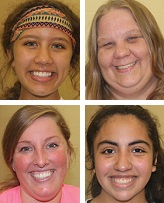
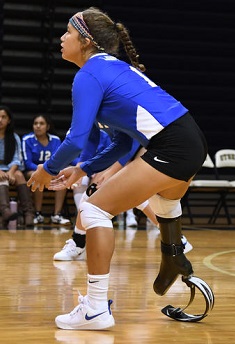
PHOTOS: (Top) Lawton’s Olivia Cramer loads for a kill attempt during a match this fall. (Middle top) Cramer’s prosthetic leg, front and back, and the blade she wears for sports. (Middle) From top left: Olivia Cramer, mother Megan Cramer, teammate Gabi Martinez and volleyball coach Megan McCorry. (Below) Cramer awaits the opponent’s serve. (Action photos by Gary Shook; prosthetic photos and head shots by Pam Shebest.)
Block Party: 2026 Girls Volleyball Week 7 Report
By
Geoff Kimmerly
MHSAA.com senior editor
October 7, 2026
Just as the girls volleyball regular season begins speeding toward its conclusion, clicks on our Michigan Power Ratings (MPR) page are sure to accelerate over the next three weeks.
District play begins Nov. 2, and brackets will be announced eight days earlier on Oct. 25. MPR is used to seed the top two teams in every District, and although there’s only one example below, references to how teams stack up on those lists will become more prevalent in our weekly reports as we close in on the start of the playoffs.
Records below are those reported and tracked on this website, and rankings referred to below reflect the latest polls posted by the Michigan Interscholastic Volleyball Coaches Association (MIVCA).
Week in Review
The countdown of last week’s five most intriguing results:
1. Saginaw Valley Lutheran d. Plymouth Christian Academy (25-21, 25-17) The Division 3 top-ranked Chargers (36-4-1) finished 6-0 at the D3/D4 Showcase, with this win arguably the most notable as Valley Lutheran remains No. 1 statewide this week but PCA (21-6-4) bumped up from honorable mention to No. 2.
2. Grand Rapids Christian d. Hudsonville (25-19, 25-19) Division 2 top-ranked Christian (22-3) avenged a pool play loss to Division 1 No. 5 Hudsonville (26-3) at the Jenison Invitational to win this rematch in the championship round.
3. Orchard Lake St. Mary’s d. Detroit Country Day (25-19, 25-16, 25-23) The Division 1 honorable mention Eaglets (13-8-1) continued their climb with a sweep of the two-time reigning Division 2 champion and current No. 2 Yellowjackets (12-6-1).
4. Kingsley d. Elk Rapids (25-15, 25-17, 25-11) This Northern Shores Conference matchup saw a pair of ranked teams face off and the Division 2 No. 5 Stags (29-3-1) prevail over the Division 3 No. 5 Elks (13-7-3).
5. Muskegon Western Michigan Christian d. Hart (24-26, 27-25, 25-18) While Division 3 No. 3 WMC went on to defeat Fruitport and Muskegon Mona Shores to win the latter’s Best of the West tournament, this win over No. 10 Hart (19-10-3) sticks out as well as the Warriors (23-2) came back after losing the first set.
Watch List
With an eye toward November, here are two teams in each division making sparks:
DIVISION 1
Grand Rapids Forest Hills Northern (22-8) The honorable mention Huskies opened this week with a notable four-set victory over honorable mention East Grand Rapids, which is listed ahead of FHN in Division 1 MPR. Six of Forest Hills Northern’s losses have come against top-10 teams in Division 1, and six wins have come against opponents ranked or honorable mentions in Divisions 1 or 2, including Division 1 No. 4 Byron Center.
Hudsonville (26-3) The No. 5 Eagles were runners-up at the Jenison Invitational thanks to a split with Division 2 top-ranked Grand Rapids Christian, but that championship match defeat broke a 13-match winning streak. The Eagles’ only other losses have come versus Brighton and Division 1 No. 2 Bloomfield Hills Marian, and Hudsonville has defeated No. 8 Lowell, honorable mention Forest Hills Northern twice, No. 4 Byron Center, No. 9 Grand Haven, No. 7 South Lyon East, honorable mention South Lyon twice and GR Christian another time as well.
DIVISION 2
Ann Arbor Father Gabriel Richard (25-3-2) The Irish are an honorable mention in Division 2 and finished second in the Catholic High School League AA to Dearborn Divine Child, thanks to early-September back-to-back league losses to the Falcons and Jackson Lumen Christi. FGR’s only other defeat came to No. 3 Parma Western during opening weekend, and the Irish have won 16 straight matches and their last three tournaments.
Edwardsburg (21-5) The No. 7 Eddies defeated honorable mention Marshall and Division 1 honorable mention Zeeland East over four wins to claim the Portage Central Tournament title on Saturday, and their win over the host Mustangs also avenged Edwardsburg’s most recent loss from Sept. 19. A championship at the Gull Lake Invitational to start this season included a win over Niles, which ended the Eddies’ 2025.
DIVISION 3
Calumet (14-9-1) After opening the season 0-4 at the Cadillac Invitational – which included defeats against Division 1 honorable mention Zeeland East, Division 3 No. 8 Cass City and honorable mention Manton – the honorable mention Copper Kings are 8-2-1 against in-state opponents. They’ve defeated Division 4 No. 7 Crystal Falls Forest Park and went five sets before losing to Division 4 No. 9 Hancock, and they saw more of the state’s best taking a loss but also tying Division 3 No. 2 Plymouth Christian Academy at the D3/D4 Showdown.
Plymouth Christian Academy (21-6-4) The Eagles returned to the Quarterfinals a year ago and are in the midst of an 8-1-1 surge this fall that’s sent them back up to No. 2 in the weekly coaches poll. Their D3/D4 Showdown weekend included the above-noted loss to No. 1 Valley Lutheran but also wins over No. 5 Clinton, No. 8 Cass City and honorable mention Calumet among others. Only two other losses this season came to Division 3 or 4 opponents.
DIVISION 4
Crystal Falls Forest Park (26-3-1) The Trojans reached the Semifinals last season for the third time in four years and haven’t slowed down, falling only to No. 4 Traverse City Christian, No. 9 Hancock and Division 3 honorable mention Calumet. They’re up to No. 7 in the Division 4 rankings while riding a 14-match winning streak and coming off a 6-0 day at the Escanaba Invitational. An opening-weekend trip downstate included the loss to TC Christian but also a win over No. 10 Onekama and tie versus No. 3 Mount Pleasant Sacred Heart.
Traverse City Christian (23-5) The No. 4-ranked Sabres have strung together two straight trips to the Quarterfinals and won their first 10 matches this fall including a three-setter over Division 3 top-ranked Saginaw Valley Lutheran. The losses are pretty impressive as well, to Division 3 No. 3 Roscommon, twice to Division 3 No. 7 Traverse City St. Francis, and then to Division 4 No. 3 Mount Pleasant Sacred Heart and No. 10 Onekama. A home match against Division 3 No. 5 Elk Rapids on Oct. 15 will be another important test.
Can’t-Miss Contests
Be on the lookout for results of these matches and tournaments coming up:
Thursday – Baraga (19-0) at Hancock (17-2-1) – The undefeated Vikings have an opportunity to establish themselves among Division 4 teams to watch with this trip to meet the No. 9 Bulldogs.
Saturday – Motor City Power Series Championship at UWM Sports Complex – The finale of this season’s series begins with power brackets, and the most intriguing includes Division 1 No. 6 Utica Eisenhower, honorable mention Orchard Lake St. Mary’s, Rochester Adams and Division 2 No. 9 North Branch.
Saturday – Hanover-Horton Invitational – An impressive field of 12 teams includes Division 2 No. 3 Parma Western, Division 3 No. 2 Plymouth Christian Academy, No. 6 Grass Lake, No. 7 Traverse City St. Francis and the honorable mention Comets, and Division 4 top-ranked Adrian Lenawee Christian and No. 2 Battle Creek St. Philip.
Monday – Roscommon Quad – Mount Pleasant (20-8-2), Essexville Garber (22-11-4) and Division 3 No. 7 Traverse City St. Francis (21-9-1) will join the No. 3-ranked Bucks (26-6-5) for a high-powered night.
Monday – Midland Dow Quad – Another impressive group will visit the Chargers (31-4-4), with Bay City Central, Division 2 No. 4 Frankenmuth (17-0) and Division 3 No. 1 Saginaw Valley Lutheran (36-4-1) taking the court.
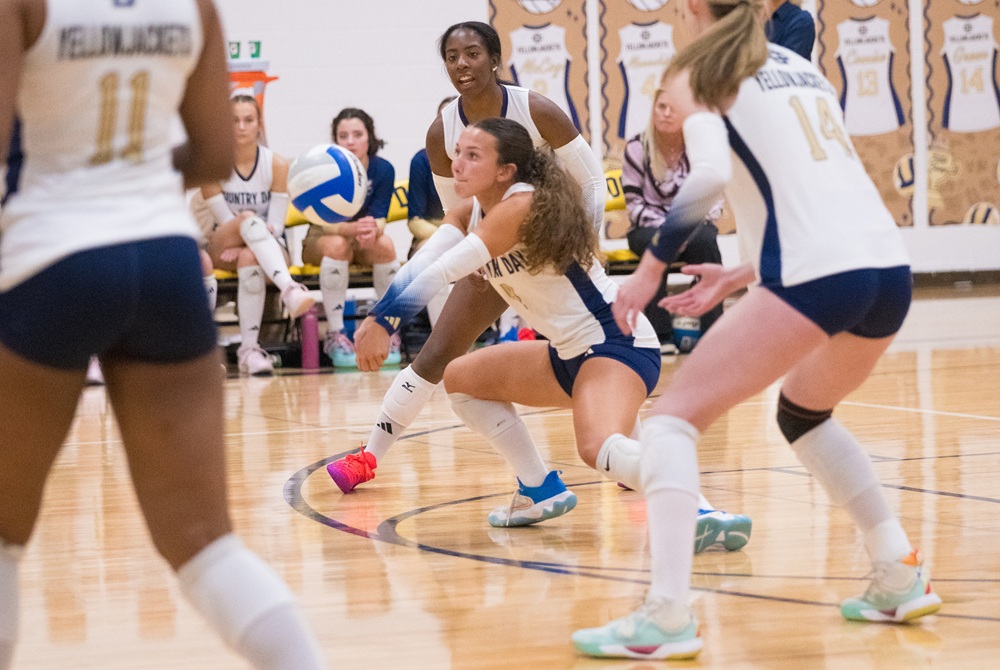
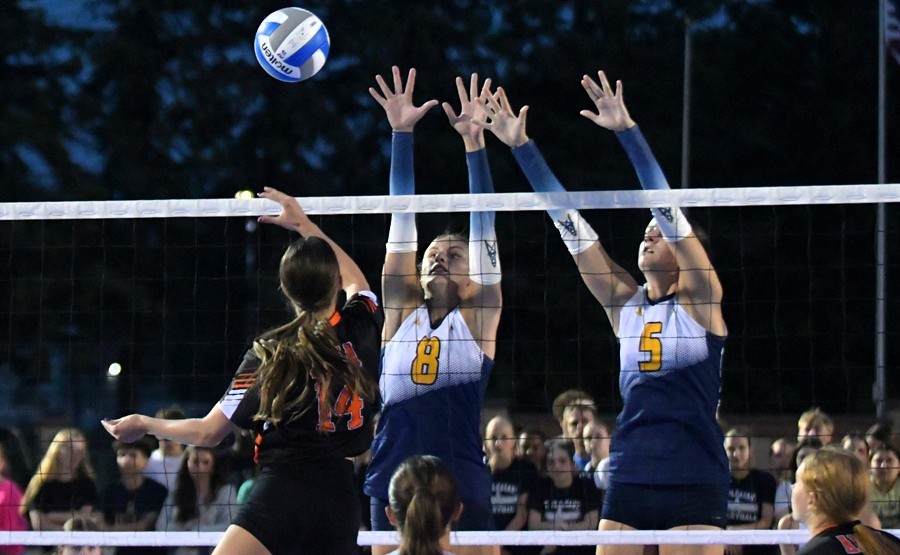
PHOTOS (Top) Detroit Country Day’s Sienna Musachio (14) gets positioned to play the ball during her team’s sweep of Macomb L’Anse Creuse North on Monday. (Middle) A pair of Mount Pleasant blockers rise above the net during an outdoor match against Alma this fall. (Country Day photo by TCP Photography. Mount Pleasant/Alma photo by High School Sports Scene.)