

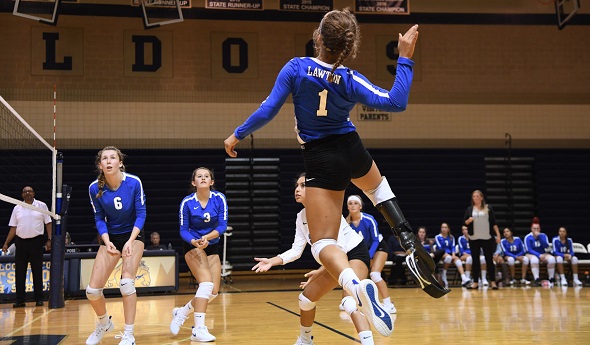
Junior Hitter's Spirit, Skill Give Lawton Lift
By
Pam Shebest
Special for MHSAA.com
September 25, 2019
LAWTON — Olivia Cramer wears her friends proudly — on her leg.
 When she is not wearing a blade to play volleyball or basketball, the Lawton High School junior wears a prosthetic, but it’s not just any leg.
“I’ve had pictures of my friends on it for a couple years, and there’s the homecoming court my freshman year, softball game, at work,” she said.
While the decoration of the prosthetic leg is a novelty, the need for the limb certainly isn’t.
Cramer was born with non-genetic proximal femoral focal deficiency (PFFD), a condition that has resulted in her right leg measuring inches shorter than her left.
It is an uncommon condition that affects about 1 in every 200,000 children, according to statistics from the Children’s Hospital of Philadelphia.
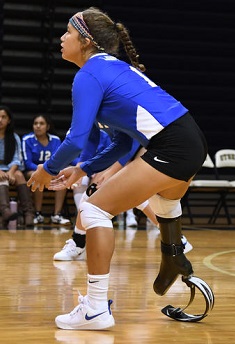
The prosthetic leg assists with everyday life. But when it comes to athletics, she wears a blade, similar to those worn by runners.
“We call it my running blade,” Cramer said. “Mine is designed a little differently than an amputee because I still have my leg bones and foot.”
The custom-made blade, officially called the Freedom Innovations Catapult, is made of carbon fiber and has a rubber tread on the bottom so it will not damage the court.
“It’s about a two-week process and it was a little bit of a challenge to make,” said Tim Darling, a certified prosthetist at Hanger Clinic in Kalamazoo who fashioned the leg and blade.
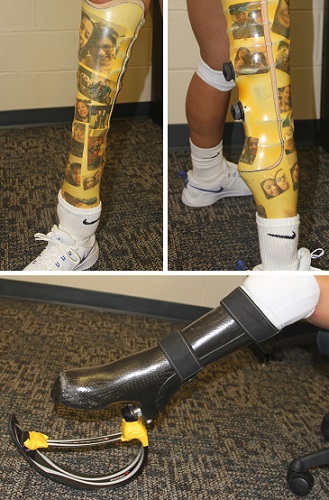 He also was instrumental in adding the photos. “She provided the photos printed on a T-shirt and we used materials to reinforce it and then used an acrylic lamination,” Darling added.
Instead of Velcro straps to keep the leg attached, Cramer has two dials that tighten the leg.
“It has string made of Kevlar and you can tighten them so I don’t have to have straps covering my leg anymore,” she said. “Before, it was just Velcro and came loose a lot.”
Darling said it is a relatively new process for a prosthetic.
100 Percent
“Working with her is humbling,” Lawton volleyball coach Megan McCorry said. “When you see someone with a physical disability like that and you see that same person is also the most positive and most encouraging, it really makes you do a gut check.
“It gives you some perspective in life that what you have going on may not really be that bad, and you need to work harder at putting your best foot forward.”
Cramer was pulled up from junior varsity during the District last year and practiced but did not play.
This season, she sees court time and, “She’s honestly one of those kids that you can’t not have on your team,” McCorry said.
“I mean she is always 100-percent positive. She is going to be the loudest one on the court, loudest one on the bench. She’s always supporting her team, and she’s just so determined to get better individually and make her teammates better.”
Since she jumps off her stronger left leg, the blade does not give Cramer any advantage, but at least once caused a gaffe.
“During a match, my friend Madison Lawson and I were going for a block on the outside and we fought for the block and we came back down,” Cramer said. “Madison landed on my blade and snapped it.
“We didn’t know what happened at first because there was this huge (sound) right in the middle of the match and I was like, ‘What just happened?’ We even stopped playing because of it. I went to step and my leg didn’t spring like it usually does.”
 The junior said her teammates are very supportive.
“She holds herself accountable for everything she does,” senior Gabi Martinez said. “Everything she does basically makes us realize she can do everything we can do. It doesn’t stop her from anything.
“We do watch out for her leg to make sure she doesn’t hurt it, but usually even if she falls down, she gets right back up and she’s usually the one picking everybody else up.”
Cramer’s mother, Megan Cramer, said when she was pregnant, her first ultrasound showed an abnormality in the leg, so she was prepared when Olivia was born.
When learning to walk, Olivia would walk on her short leg and balance on the knee of her good leg, her mother said.
As Olivia grew older, doctors gave her mother two choices: amputation or rotationplasty (fusing the knee on her shorter leg and rotating her foot around to where her knee joint would be). That new joint is where her prosthetic would have connected.
Her mother chose neither.
“I was a young mother, and I was scared to death and I was, ‘You’re not cutting her foot off,’” she said.
They visited several hospitals and finally went to the Shriners Hospital for Children in Chicago.
“That was the first place we went where they said let her be,” Megan said.
That is what her mother did.
“I am glad that they never had it amputated, and I never had rotationplasty,” Olivia Cramer said. “My condition is pretty rare, and because I didn’t do any of the amputation that makes me even more special than it already was, so I really appreciate it.”
She goes to the Shriners Hospital every six months for checkups and gets a new leg and blade when she outgrows the old ones.
Driving and Striving
Golf is Cramer’s true love, and she hopes to pursue it in college.
When playing, she wears her regular prosthetic, not the blade, and, last year, was captain of the school’s boys team (Lawton has no girls team).
 She also played the Lakeshore Junior Golf Association tour during the summer, carrying a 12 handicap and winning the 16-18 girls division.
“Those accomplishments are all special, of course,” Lawton golf coach Barry Shanley said. “But what makes her truly remarkable is her spirit. If you didn't see her prosthetic, you would never know she even has one.
“For now it's actually an advantage for her college goal to play on a high school boys team. The boys play from the men's tees, which is the typical length for collegiate women, so college coaches know her scores now already match what length their own players are using.”
Shanley said the only way her prosthetic affects her swing is that her hip alignment can be a little unbalanced.
“Once she stops growing and her prosthetic is matched to her other leg permanently, there won't be any issue at all,” he said.
“Because it's difficult to keep them matched, which now can cause her some pain if she walks the typical 5.6 miles in 18 holes or the 2.8 miles for 9 holes, we wrote and received permission from the MHSAA to let her take a golf cart during matches.”
Right now, though, Cramer is focused on volleyball, with her team’s record 13-9 midway through the season. The Blue Devils will host an MHSAA Division 3 District beginning Nov. 4.
Other players on the volleyball team are senior Jessica Grear, juniors are Mackenzie Nickrent, Kiana Auton, Caitlen Romo, Josie Buchkowski, Wendy Guerra and Dezare’ Smith; and sophomores Sarah Dekoning and Lily Grear.
No matter the sport, Cramer said she follows her grandfather’s advice.
“My grandpa always has said, ‘Don’t ever say “can’t” in this household. That’s a word that’s not in our dictionary.’
“I guess that’s shaped me into who I am today, being able to persevere through all the difficulties, even though I like to think I have it just as fair as everybody else does, that we’re on an equal playing level.”
Cramer has one hope:
“I hope that if anybody sees this and is down in the dumps for any kind of condition they have, just persevere through it and prove to other people that you are better than they can ever think that you can be.”
 Pam Shebest served as a sportswriter at the Kalamazoo Gazette from 1985-2009 after 11 years part-time with the Gazette while teaching French and English at White Pigeon High School. She can be reached at [email protected] with story ideas for Calhoun, Kalamazoo and Van Buren counties.
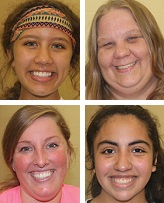
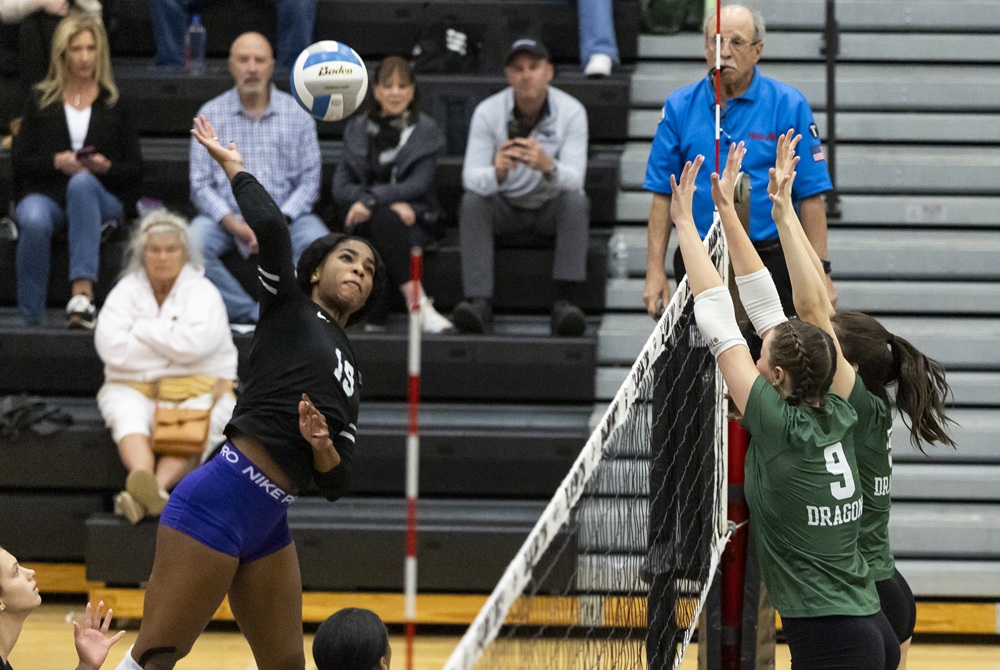
PHOTOS: (Top) Lawton’s Olivia Cramer loads for a kill attempt during a match this fall. (Middle top) Cramer’s prosthetic leg, front and back, and the blade she wears for sports. (Middle) From top left: Olivia Cramer, mother Megan Cramer, teammate Gabi Martinez and volleyball coach Megan McCorry. (Below) Cramer awaits the opponent’s serve. (Action photos by Gary Shook; prosthetic photos and head shots by Pam Shebest.)
'On the Map:' Nwabueze Hitting Rising Bloomfield Hills Into Championship Mix
By
Keith Dunlap
Special for MHSAA.com
October 30, 2025
BLOOMFIELD HILLS – Those who have kept an eye on the Division 1 state volleyball rankings this season may have done a double take at least a few times throughout the fall.
 Was that Bloomfield Hills consistently ranked among the top five and now No. 2 in the latest coaches poll? Ahead of state powers such as Farmington Hills Mercy and Bloomfield Hills Marian?
Yes, that has been the case.
“I think we’ve put ourselves on the map this year,” said senior Kayla Nwabueze.
To those more familiar with Bloomfield Hills, it’s easier to see the biggest reason why the Blackhawks have become such a force – Nwabueze’s transcendent talent.
A finalist for the Miss Volleyball Award, she just surpassed 2,000 career kills, 1,000 career digs and 1,300 career receptions, and owns the school record for kills (2,013 heading into Wednesday’s match against Rochester).
Nwabueze has excelled at multiple positions on the court throughout her high school and club careers. But this season, first-year Bloomfield Hills head coach Brian Kim decided to put Nwabueze exclusively at outside hitter, and she had delivered with 547 kills heading into that Rochester match.
“It allowed her to have a more defined role in our offense,” Kim said. “Middle is her primary position, and she is extremely strong and capable in the middle. But we moved her to the outside to help out our offense.”
Nwabueze didn’t start club volleyball until age 12. But that didn’t mean she didn’t have skills already developed. Nwabueze has an older sister, Ashlea, who played the sport, and the two would constantly do drills and have practice sessions together before Kayla got into club ball.
 “We definitely were playing outside,” Kayla said. “She definitely taught me to play volleyball in the backyard and helped me grow in volleyball.”
As much of a surgeon as Nwabueze is on the court – showing exceptional precision with her hitting – she wants to be an even better one off the court one day.
Nwabueze will play college volleyball at Harvard, where she wants to study medicine and ultimately become an orthopedic surgeon.
Nwabueze carries a 4.0 grade-point average attending the prestigious International Academy in Bloomfield Hills, which doesn’t have sports programs and allows students to play sports in the Bloomfield Hills district.
While she had overtures to play for more prominent college volleyball programs, the academic side of things was more of a priority – making Harvard the fit.
“I was just thinking about more than just volleyball and what I wanted to do after the fact,” said Nwabueze, who also considered Yale. “Harvard really had a nice plan for me.”
But there is more business to be taken care of in the coming weeks before Nwabueze starts focusing on that part of her future.
First, she is a legitimate candidate to become the first player in school history to win the Miss Volleyball Award.
More importantly, she wants to help Bloomfield Hills continue what’s been a historic season.
The Black Hawks will play in a District next week at Troy Athens, where a likely District Final matchup with No. 4-ranked and neighbor Bloomfield Hills Marian awaits.
Each team has a bye into Wednesday’s semifinal round, and barring major upsets, they should get through to face each other on Nov. 7.
“It is special to know that I broke some of the records here and set that bar,” Nwabueze said. “We have done so good this year, and we are still going and are still playing hard. I hope we can go farther.”
 Keith Dunlap has served in Detroit-area sports media for more than two decades, including as a sportswriter at the Oakland Press from 2001-16 primarily covering high school sports but also college and professional teams. His bylines also have appeared in USA Today, the Washington Post, the Detroit Free Press, the Houston Chronicle and the Boston Globe. He served as the administrator for the Oakland Activities Association’s website from 2017-2020. Contact him at [email protected] with story ideas for Oakland, Macomb and Wayne counties.
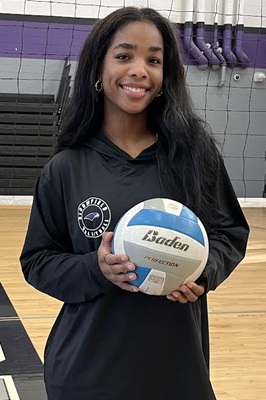
PHOTO (Top) Bloomfield Hills’ Kayla Nwabueze (19) winds up for a kill attempt this season against Lake Orion. (Photo by Kristina Sikora/KMS Photography. Headshot by Keith Dunlap.)