


Wrestling’s Next Big Thing
August 13, 2013
“The next big thing” is what marketers often seek. But it’s what school sports administrators usually dread because the “next big thing” is routinely a problem.
And so it is with the sport of wrestling which, at the high school level, has had an admirable record of solving the big issues that have threatened the sport’s existence.
School-based wrestling addressed unhealthy practices for weight loss, first with rules about what could not be done – e.g., rubber suits were banned from practices – and then with rules about what must be done, including a weight management program.
Twenty years ago, MHSAA member schools became one of the early adopters of policies and procedures that include the training of skinfold assessors who are employed to do measurements of all wrestlers, from which each wrestler learns his/her lowest allowed weight and the rate at which he/she may descend to that weight and still remain eligible to compete. These rules, and a nutrition education program, saved interscholastic wrestling from much public criticism and, possibly, from continuing drops in participation.
In addition, the Wrestling Committee has been unique among MHSAA sport committees in recognizing that a season that is too long is neither healthy for nor desired by student-athletes; and the committee has reduced the length of season and number of matches. All of this, combined with the MHSAA team tournament, have greatly increased the sport’s popularity among both participants and spectators.
But in spite of all this, the sport of wrestling is “one communicable skin disease outbreak from extinction,” according to those discussing the state of high school wrestling at a national meeting in June. We’ve already seen an outbreak lead to the suspension of all interscholastic wrestling for two weeks in Minnesota during the 2006-07 school year.
To avoid this next big thing, the rule makers have banned taped headgear, because tape can’t be properly cleaned. The NFHS Sports Medicine Advisory Committee, which is the MHSAA’s advisory body as well, is urging schools to mandate that all participants shower or perform an antiseptic wipe-down after every match.
The MHSAA will make this issue a point of special emphasis in its online, print and face-to-face communications this fall. In addition, an excellent free webinar is provided by the National Wrestling Coaches Association. Click here for the webinar.
Roseville's Williams Earns Elusive Title with Explosive Finals Flourish
By
Paul Costanzo
Special for MHSAA.com
March 1, 2025
DETROIT – Jay’Den Williams almost got too amped up Saturday.
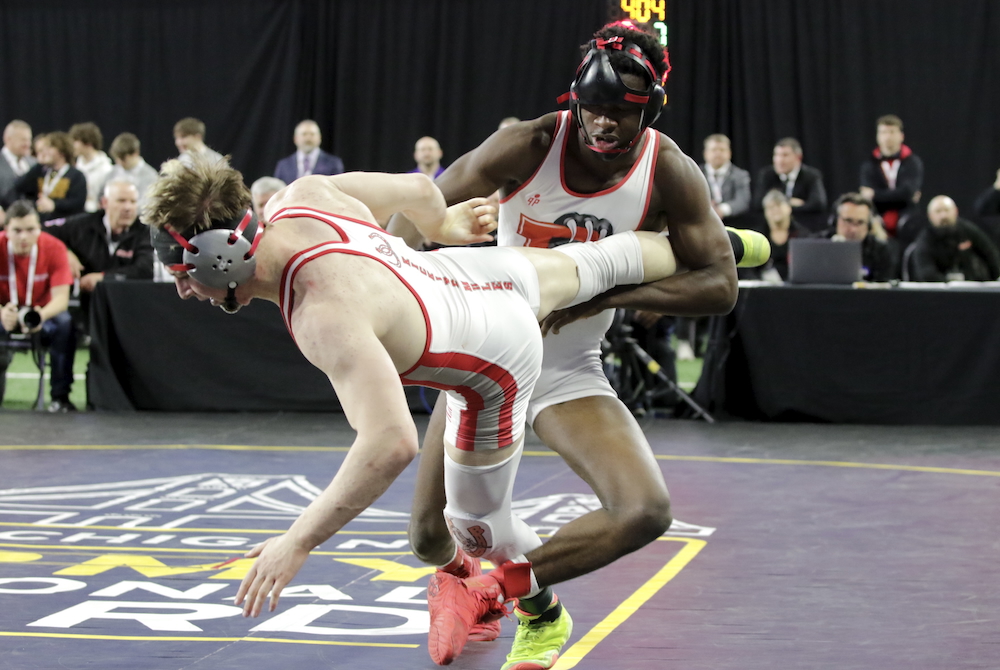
The Roseville junior, who had much of Ford Field in awe with his big-move ability, nearly got put to his back in the 165-pound title match at the Division 1 Individual Wrestling Finals.
But he shook it off on his way to a 23-8 technical fall victory against Temperance Bedford’s Zach Miracle to claim his first championship.
“You see, I got too excited,” Williams said with a laugh. “I was excited and tried to force things. But my energy went up after that.”
Williams finished off a perfect season (53-0) after placing second the past two Finals. He became Roseville’s first champion since Bobby Nash won in 2009.
“I’m building up a lot of awards, a lot of records, and I got a little brother (Kyrie), he’s going to be coming in,” Williams said. “I want him to be the one to beat it, so I’m going to set it high.”
Williams won all four of his matches on the weekend by technical fall, ending the first three in the first period, before going 1 minute, 22 seconds into the second against Miracle.
He came out aggressive in the Final, getting three takedowns in the opening 1:16 before hitting a seven-point throw late in the period and drawing a large reaction from the crowd.
Not long after that, Miracle (57-4) was able to score a takedown and nearly get nearfall points, but that was all the offense he’d be able to get as Williams closed the match out with a pair of takedowns in the second period.
“It feels amazing,” Williams said. “Coming out here, being able to win a state title in front of all these people, knowing that you just came off a runner-up, it feels amazing.”
106
Champion: Cyrus Woodberry, Detroit Cass Tech, Fr. (51-2)
Decision, 2-1 (OT), over Jameson Wood, Brighton, Soph. (45-3)
Woodbury became the first Finals champion in Cass Tech history with a dramatic overtime victory.
After riding Wood out in the first 30-second frame, he scored an escape 12 seconds into the second to claim the victory. All three points in the match were scored on escapes, as neither wrestler was able to break through the other’s defense.
“It’s indescribable – it’s great,” Woodbury said. “I always thought I’d be here. I didn’t know how much time was left on the clock, I just thought about all the years I prayed for this, and just had to become a dog.”
113
Champion: Layne Martin, Rockford, Soph. (48-3)
Major Decision, 16-4, over Brice Lafleur, Saline, Jr. (47-3)
Martin fell behind early in the first period before putting on a dominant performance on his way to a first Finals title.
He scored the final 15 points in the match, helping make up for what he felt was a disappointing freshman year, which ended with him outside the top eight.
“I was just like, ‘Stay calm,’” Martin said. “I knew I could get some of my offense, work him on top. (A second period nearfall) was really big, really good for my mind to know I could give up a few points if I needed to.”
120
Champion: Wyatt Lees, Detroit Catholic Central, Jr. (38-5)
Decision, 3-0, over Ryan Totten, Detroit Catholic Central, Soph. (47-11)
Lees got all he could handle from his teammate, clawing his way to a third-straight Finals title. He had won at 106 in 2023 and 113 in 2024.
“It kind of sucks having to wrestle your teammate,” Lees said. “I think both of us out there didn’t care who it was, we were going to wrestle the same. At the end of the day, we’re still brothers. We both know what the other person wants. It’s been the same match the last three weeks, kind of.”
The only points in the match were scored when Lees got a takedown midway through the first period. The two Shamrocks fought to a draw from there, but it was enough for title No. 3.
126
Champion: Archer Anderson, Clarkston, Sr. (46-2)
Decision, 14-9, over Deacon Morgan, Rochester Adams, Soph. (45-6)
A year after wrestling one of his Clarkston teammates to claim his first Finals title, Anderson had to square off with a club teammate Saturday.
As he did in 2024, the Clarkston senior came out on top in this one, winning the final two periods 10-3 to pull away for the victory.
“As a freshman, I didn’t really expect it to go like this,” said Anderson, who was runner-up at 113 as a sophomore. “Funny joke, I go to the same club as (Morgan), so he is a teammate. I can’t get away from teammates. I think I spent the night at his house like a week ago. We knew – I knew he was going to be at the Finals. He’s great; he’s probably going to be a champion next year.”
132
Champion: Bohdan Abbey, Hartland, Jr. (49-1)
Technical Fall, 18-3, over Dominic Perez, Davison, Sr. (27-12)
Abbey returned to the top of the podium with a dominant performance. The junior was a champion at 113 as a freshman before finishing second at 126 a year ago.
“It was a hurting feeling for a while, so it’s good to kind of get my get-back, but not really,” he said. “But it feels good. I made sure I took in the moment and didn’t take it for granted this year.”
Abbey finished with four technical falls in the tournament.
138
Champion: Jace Morgan, Rochester Adams, Sr. (47-0)
Major Decision, 10-0, over Preston Lefevre, Clarkston, Sr. (48-2)
Morgan closed out a perfect season with a dominant performance Saturday. A takedown 37 seconds into the match set the tone, and he kept pushing the rest of the way against LeFevre, who was also a runner-up a year ago.
“Throughout my whole career, they’ve been with me, my teammates, helping me and pushing me,” Morgan said. “They’ve been helping me get better, helping me get to this point and achieving what I have today.”
Morgan became the first Adams wrestler to win a title since 1999.
144
Champion: Grayson Fuchs, Detroit Catholic Central, Soph. (42-2)
Major Decision, 14-2, over Tanner McDunnah, Davison, Sr. (34-9)
In a matchup of finalists from a year ago, Fuchs put his foot on the pedal and didn’t let up.
The now two-time Finals champion scored a takedown 13 seconds into the match, and only allowed a pair of escapes against McDunnah, who was runner-up at this weight a year ago as well.
Saturday’s match was a far cry from a week ago, when Fuchs won a tight decision at the Division 1 Team Finals.
“I was pushing the pace more, getting to my ties,” Fuchs said. “Last week, I was more wrestling into his ties and he was holding onto me. This time, I was just moving my feet more, getting my ties, my shots, moving him. I was moving my hands and my feet more, that was pretty much it.”
Fuchs, who won at 126 a year ago, got to the Finals with a trio of technical falls in the opening three rounds.
150
Champion: Dallas Korponic, Hartland, Jr. (50-4)
Decision, 1-0, over Julius Pacheco, Davison, Soph. (34-9)
Korponic claimed his second-straight title with a second-period escape holding up as the match’s lone point.
“It feels pretty good getting a second one,” he said. “It means just as much as the last one. I’ve been working all year for it, so it felt good. I know my conditioning was going to work for me. I was looking for another opportunity to score, but also just keeping that win.”
Korponic, who won at 132 pounds as a sophomore, cruised to the Finals, winning by technical fall in each of his first three matches.
157
Champion: Braylenn Aulbach, Rockford, Sr. (49-2)
Decision, 9-8, over Kyle Jelinek, Davison, Sr. (31-7)
Aulbach battled back in the third period, scoring seven points after falling behind 7-2. Jelinek suffered a leg injury late in the match, but continued on.
“He was dealing with something with his knee, which sucks,” Aulbach said. “It’s kind of mean, but you have to take advantage of that kind of thing. He’s long. I struggled to get to his legs, and he’s easily going to grab mine. I think it just comes down to pace.
“As a freshman, I never really thought I’d get to this point. This year, it was really like, ‘Wow, I can do it.’ To get it done and beat a good kid, it’s a dream come true.”
175
Champion: Michael Baldwin, Saginaw United, Sr. (33-2)
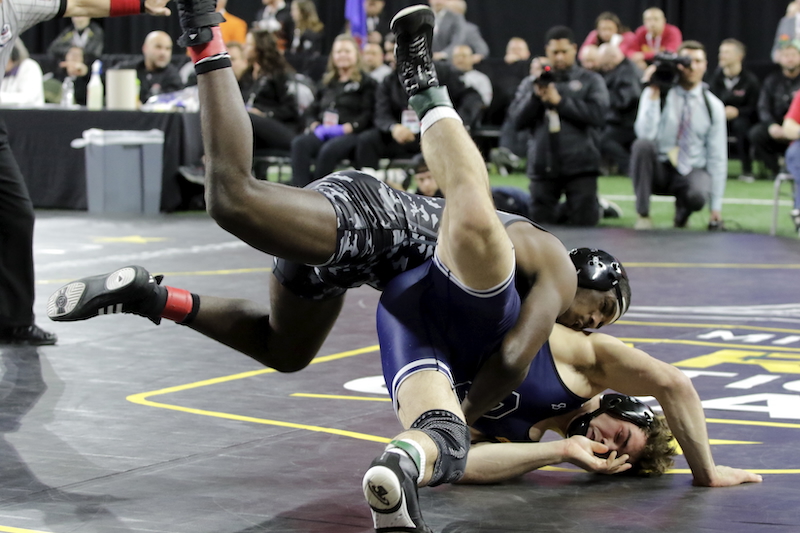
Decision, 7-6 (UTB), over Luke Johnson, Oxford, Sr. (45-4)
After splitting their matches in the District and Regional Finals, Baldwin and Johnson put on a classic Saturday night.
Baldwin won on a technical point, as Johnson grabbed his singlet in a last-gasp move during the ultimate tiebreaker period.
“It’s unreal,” Baldwin said. “My family’s here, it feels like half of my city is here. It’s like we did it, we finally did it. It’s the first year with the new school, I’m the first-ever state champ. I set the standard, doing the right things, leaving it all out on the mat. I want another kid to come through and do the same thing.”
Johnson had forced overtime with a third-period takedown, and held off a Baldwin attempt at the buzzer.
190
Champion: Lee Krueger, Detroit Catholic Central, Sr. (41-8)
Major Decision, 11-0, over Thomas Jaynes, Romeo, Jr. (53-7)
Krueger has watched as so many Catholic Central wrestlers have won Finals titles, so to join that group was a special moment.
“It’s surreal,” he said. “Four years I’ve been here and watched guys I’ve looked up to do it, and now it’s finally my time and I did it. It’s completely surreal. As a freshman I was like a JV, borderline varsity guy, but my coaches and my teammates pushed me all the way up to where I am now.”
Krueger broke open what was a tight match with a takedown and nearfall late in the second period to take an 8-0 lead into the third.
215
Champion: Connor Bercume, Detroit Catholic Central, Sr. (48-0)
Major Decision, 10-2, over Sean O’Keefe, Brighton, Sr. (38-2)
Bercume closed out his illustrious Catholic Central career with a third Finals title. He also helped the Shamrocks win the past three Division 1 team titles.
“It feels pretty awesome,” he said. “I can’t believe how blessed I am to be part of this team for four years and have all these great teammates. I just feel really honored to be part of such a great program with such a great legacy.”
The Harvard-bound senior scored three takedowns in the first period to blow the match open, and controlled O’Keefe over the final four minutes to win title No. 3.
285
Champion: Logan Tollison, Grand Ledge, Jr. (45-0)
Decision, 8-1, over Anton Barynas, Jenison, Sr. (35-5)
After finishing as runner-up at 215 a year ago, Tollison had offseason surgery on his shoulder.
Those setbacks set up an incredible comeback, and he finished off an unbeaten season Saturday with his first Finals title.
“I’ve worked hard this season, so I deserved it, I think,” he said. “I was really driven, especially since I had to take six months off after I had shoulder surgery, so I had to really get after it when I got back.”
Tollison led 2-0 heading into the third period against Barynas, who was the runner-up at 285 a year ago. But the Grand Ledge junior scored a pair of takedowns in the final two minutes to pull away for the victory.
PHOTOS (Top) Roseville’s Jay’Den Williams, right, locks the legs of Temperance Bedford’s Zach Miracle during their championship match at 165 pounds Saturday. (Middle) Saginaw United’s Michael Baldwin, top, takes Oxford’s Luke Johnson to the mat at 175 pounds. (Click for more from High School Sports Scene.)