

10 to Remember from 2011-12
By
Geoff Kimmerly
MHSAA.com senior editor
July 11, 2012
Second Half's mission in this, its first school year, was to tell the best stories behind the scores and highlights of MHSAA competition.
Of course, every score and especially every championship has a story behind it. The MHSAA awarded 127 team and many more individual championships in 2011-12. Obviously we can't reflect on them all. But these 10 performances were loaded with prestige, drama and accomplishment that made them incredible stories for high school sports fans regardless of hometown or allegiance.
10. Grand Ledge gymnasts earn No. 5
The Comets had to fend off a charge by Canton, but won their fifth-straight MHSAA team title by 0.825 of a point with a final score of 149.400. The fifth-straight title tied the record set by Ludington from 1975-79 and extended Grand Ledge's first-place streak to 75 consecutive events. The next day, senior Christine Wilson and junior Sara Peltier swept the Division 1 and 2 individual titles, respectively.
9. West Bloomfield's Erin Finn joins elite
The Lakers junior said after her Division 1 cross country win that she'd dreamt of winning that title since she learned how to walk. She finished fourth as a sophomore before winning the championship by a little more than a second. After establishing herself as one of the top distance runners in the country in competitions over the winter, Finn finished the school year by winning the 3,200-meter run at the Division 1 Track and Field Final.
8. More and more Morley Stanwood
The Mohawks girls pulled off a rare feat this school year -- after winning their second MHSAA volleyball title in the fall, they added a first-ever girls basketball championship. Both efforts were keyed by seniors Alexis Huntey and Bailey Cairnduf, who had the most and second-most kills in the Class C Volleyball Final and then combined for 45 points and 25 rebounds in the basketball championship game.
That argument was made after Lansing Sexton claimed its second-straight Class B boys basketball championship in dominant fashion. The Big Reds finished 27-1, their only loss by a point to Detroit Pershing, and have won 74 games over the last three seasons -- tied for sixth-most in MHSAA history for that long of a stretch. Guards Denzel Valentine (Michigan State), Anthony Clemmons (Iowa) and Bryn Forbes (Cleveland State) all signed to play at Division I colleges this fall, with junior Jalen Hayes and freshman Trevor Manuel likely joining them in a few years.
Coyotes junior Sami Michell established herself as one of the top hurdlers in MHSAA history at the Division 3 Final by becoming the first Lower Peninsula girl to win four events at a championship meet since Mason County Eastern’s Maria Shoup in 1979. She set Division 3 records in the 100 hurdles, 300 hurdles and long jump, and her 300 time also was the best in MHSAA Finals history, regardless of division or class. She also won the 200.
Top-ranked Grand Haven's latest run at an MHSAA championship seemed all but over when Grosse Pointe South led the Class A final by 18 points with just under 10 minutes to play. But Shar'Rae Davis' fullcourt sprint and score that began with 12 seconds to play gave the Buccaneers a 54-53 win and their first title. It was the third-longest comeback in MHSAA Girls Basketball Finals history.
Livonia Ladywood had been a favorite to win its first MHSAA title all season -- with four-year pitcher Briana Combs in the circle. But when Combs couldn't finish the Semifinal because of an injury, rarely-thrown sophomore Lauren Hayes stepped in. All she did was finish that game and throw a three-hitter against Saginaw Swan Valley in the Final, while also getting three hits and driving in two of the team's four runs in the championship win.
St. Johns senior Taylor Massa finished off one of the most celebrated careers in MHSAA wrestling history with his fourth championship and not one loss during his high school career. Massa claimed the title at 171 pounds this year to go with others at 145, 152 and 160. He became the 15th in MHSAA history to win four titles, ranks 20th with 221 wins and seventh in the national record book for consecutive victories.
Grosse Pointe South's girls running teams had arguably the most dominant school year in MHSAA history, first winning the Division 1 cross country title before doing the same this spring in track and field. And the Blue Devils did it with mostly the same nucleus contributing to both -- particularly juniors Hannah and Haley Meier, sophomore Kelsie Schwartz and freshman Ersula Farrow. Those four combined to run a national record time of 8:48.29 in the 3,200 relay at the Division 1 Final this spring.
1. Short walk, championship run
Second Half was created as a place to tell great stories, Cass Tech made it easy on the first day of the Football Finals. The Technicians arrived at Ford Field after a short walk from their school. They had never played in a Final before and were unranked entering the postseason. They arrived with a strong group of seniors, but also a freshman quarterback named Jayru Campbell who ended up throwing five touchdown passes in a 49-13 win over No. 2 and perennial powerhouse Detroit Catholic Central.
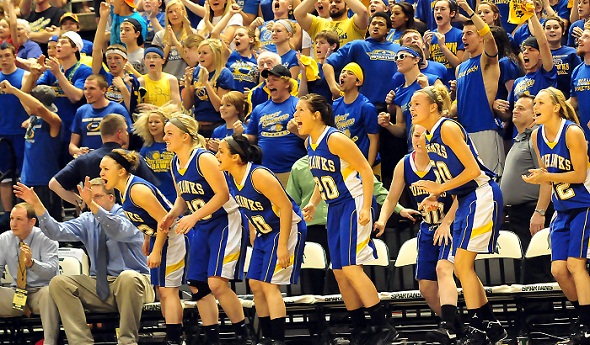
PHOTO: The Morley Stanwood girls basketball team prepares to celebrate as the final seconds tick off in the Mohawks' Class C Final win. (Click to see more photos from High School Sports Scene.)
Rep Council Wrap-up: Spring 2019
May 8, 2019
By Geoff Kimmerly
Second Half editor
The addition of seeding at the District level in basketball and soccer and multiple adjustments to the process used to select the playoff field for 11-player football were among the most notable actions taken by the Representative Council of the Michigan High School Athletic Association during its annual Spring Meeting, May 5-6 in Gaylord.
The Spring Meeting of the 19-member legislative body of the Association’s more than 1,500 member schools is generally the busiest of its three sessions each year. The Council considered 26 committee proposals and dealt with a variety of eligibility rule, postseason tournament and operational issues.
Beginning with the 2019-20 school year, girls and boys basketball and soccer will employ a seeding process to place the top two teams in every District on opposite sides of that bracket, guaranteeing those two teams could not play each other before the District championship game.
The two teams to be seeded in each District will be determined using a Michigan Power Ratings computer formula based on regular-season results against other MHSAA Tournament-eligible teams and opponents’ strength of schedule. (Games against out-of-state or non-MHSAA opponents will not count in the MPR formula.) The MHSAA will draw all brackets two weeks before the start of District play. After the top seeds are determined and separated to opposite sides of the bracket, the draw process will place the remaining teams on the bracket based on a randomly-selected order determined earlier in the season. However, the draw process does not guarantee the seeded teams will receive byes or serve as home teams.
The MPR is being used this spring to seed the Boys Lacrosse Tournament. Separate seeding proposals were recommended to the Council by the MHSAA committees for both soccer and basketball.
The changes to the 11-Player Football Playoffs selection process were proposed by the MHSAA Football Committee and are designed to reward teams that play more successful opponents. Beginning with the 2020 season, eight divisions will be determined before the season, and 32 playoff qualifiers from each division will be selected at the end of the regular season based on playoff-point average – there no longer will be automatic qualification based on win total. The adjusted playoff points formula will award bonus points for all opponents’ wins, regardless of whether the team beat or lost to those opponents. Currently bonus points are awarded only if the team defeated an opponent. More points also are awarded for defeating teams from larger divisions. The Football Committee proposed these changes believing the bonus points received for a “good loss” – combined with the elimination of automatic qualifiers – will be enough incentive for teams to schedule more successful opponents, easing the annual difficulty in football scheduling and taking away arguably the most cited reason for the breakup of leagues and conferences.
Also on recommendation by the Football Committee, the Council approved an enrollment limit of 215 students for teams to be eligible for the MHSAA 8-Player Playoffs. This too will take effect for the 2020 season. Currently, a school must be Class D to be eligible for the postseason, or in a one-year grace period if it grew larger than Class D for the current school year. While the Class D enrollment line changes annually, the 8-player line of 215 students will remain static year to year. The grace period also will remain for schools that might receive a one-year enrollment bump before falling back below 215 students.
The Council also approved a committee recommendation to add limited video review of scoring plays or potential scoring plays, or of turnovers or potential turnovers at MHSAA Football Finals for both the 11 and 8-player formats. This process will be available at Finals only because of the availability of camera coverage provided by broadcasts of those highest-level games of the tournament. Although all scoring and turnover plays could be reviewed, a play will be reversed only when there is indisputable video evidence showing the original call was incorrect.
Continuing its focus on safety in football, the Council also approved a committee recommendation to adopt revised definitions and limits on contact allowed during preseason practices and practices after games have begun. Beginning with this 2019 football season, teams will be allowed no more than six hours of full-pads collision contact per week during the preseason and no more than 30 minutes of collision contact during a week of in-season (after games begin) practice. “Collision” is defined as contact at game speed, with the execution of full tackles at a competitive pace, taking players to the ground.
However, while “collision” contact will be limited, “thud” contact will be unlimited. “Thud” is defined as full speed but above the waist only, with no player taken to the ground and no winner or loser. Thud contact is not considered collision contact. The revised definitions of “collision” and “thud” and related time limitations are products of collaboration between the MHSAA, Michigan High School Football Coaches Association and Practice Like Pros, a national movement dedicated to safety in high school football. The recommendation was brought to the Football Committee by leadership of the Michigan High School Football Coaches Association and further defines the degree and amount of practice contact following similar practice safety changes approved by the Council for football in 2014 and 2017.
The new sport-specific transfer rule will take effect with the 2019-20 school year, and the Council approved a series of corresponding changes. Most notably, the Council approved a change to the athletic-related (links) rule to not grant immediate eligibility with a residential change if a student follows a coach from his or her former school to a school where the coach has been newly hired. The Council also approved a sport-specific penalty for the athletic-motivated transfer rule so that a student would not be eligible during the current school year in the sport played the previous school year if that student was confirmed to have made an athletic-motivated transfer.
The Council additionally approved clarifications under the sport-specific transfer rule for multi-school districts which have schools that are both geographical boundary schools and schools which are district-wide, for students transferring to nonpublic or charter schools and for students who have taken part in international student exchange programs and chosen to stay in Michigan.
To provide consistency for officials’ jurisdiction across all sports, the Council approved the addition of wording that allows an official to disqualify a student or coach following the conclusion of a contest – but before the official has left the facility and/or grounds – if that student or coach commits an offense worthy of ejection and disqualification against the official. (Example: A player or coach verbally berates an official while following that official to his or her vehicle.) This penalty also would include the next-day-of-competition suspension. This does not apply if the official has remained at the facility and encounters the offense while as a spectator for another event.
Here is a summary of other notable actions taken by the Representative Council at the Spring Meeting, which will take effect during the 2019-20 school year unless noted:
Regulations
• The Council approved an increase from $25 to $40 as the maximum value for any award (trophies, medals, plaques, etc.) that an athlete may receive for participation in an athletic event without conflicting his or her amateur status.
Sport Matters
• In track & field, the Council approved a Cross County/Track & Field Committee recommendation to allow Upper Peninsula and Lower Peninsula Regional competitions to be conducted on Thursdays, in addition to the current Fridays and Saturdays, to provide for more flexibility for tournament hosts and participants when up against other school activities and college entrance exam testing dates.
• Also in track & field, the Council approved a recommendation to allow for use of a double waterfall mark and step-up start in the 800, 1,600 and 3,200 meters, beginning in 2020 when those events will begin employing a one-turn stagger.
• In golf, a committee recommendation was approved allowing golfers to use cell phones during play in four circumstances – to call a coach or tournament administrator for a health and safety issue, for use in inputting scores for live scoring or other scoring applications, to contact a rules official with questions, and for use as a distance-measuring device.
• The Council approved a Golf Committee recommendation setting the maximum allowable score at 12 strokes per hole, in part to help improve pace of play.
• The Council also approved a Golf Committee recommendation to allow for a Lower Peninsula Regional to be played any day, Monday through Saturday, during the week reserved for that round of the tournament. Similar to track & field, this allowance was made to increase scheduling flexibility.
• In girls competitive cheer, the Council approved a committee recommendation allowing for non-braced static inversions at the high school level only with the following stipulations: the original base or spotter maintains constant contact with the flyer, prior to the static inverted position the flyer must originate from below shoulder level, and the inversion must dismount to the cheering surface, cradle, any waist-level position or a non-inverted stunt at shoulder level. Also, twists from inversions and inversions released to extended level are illegal.
• The Council also approved a recommendation to allow for the review and possible restructuring of the girls competitive cheer format as early as the 2020-21 season, keeping athlete safety and efforts to increase participation as the primary focuses.
• In girls gymnastics, the Council approved a committee recommendation solidifying language stating that when four judges are contracted for a meet in which two events are conducted simultaneously, a total of 28 gymnasts may compete per event in a double-dual or quad meet, with up to 14 per school per event (for schools with A and B teams).
• In boys lacrosse, the Council approved a committee recommendation allowing for a multi-team tournament option of playing two full games (four 12-minute quarters) with a possible four-minute sudden-victory overtime period, instead of three running-time games (25-minute halves) with no overtimes allowed.
• In soccer, the Council approved a recommendation to allow for multi-team tournaments to be played not only on non-school days, but on days not followed by a school day.
• The Council also approved a committee recommendation in soccer removing a rule that previously required District and Regional Finals to begin after 5 p.m. on SAT and ACT national testing days.
• In diving, the Council approved a Swimming & Diving Committee recommendation requiring divers who enter MHSAA Qualifying Meets to provide a name of a designated MHSAA-certified coach to serve on the judging panel. After volunteers are accepted from the list, a random draw of those designated coaches will fill out the rest of the seven-judge panel.
• In tennis, the Council approved two committee recommendations regarding MHSAA Tournament play. The first requires any lineup substitution be made before the end of the last scheduled coaches meeting prior to play to allow for the automatic redrawing of a bracket if a seeded player is unable to play. The Council also approved the allowance of three coaches on the first day of MHSAA Finals, when play often takes place at many courts and at multiple sites. In the case of multiple sites, an additional coach may be added for each site (all coaches must continue to meet MHSAA coaching requirements). On the second day of the Finals, only two coaches are allowed.
• Additionally in tennis, the Council approved a committee recommendation allowing coaches who are on-court for coaching purposes during matches to text coaches or players not engaged in matches, as long as it is not disruptive to play. The Council also approved a committee recommendation allowing coaches at the subvarsity and middle school levels to offer coaching at any time during a match as long as the coach remains off court and does not disrupt the flow of play.
In an effort to increase recruitment of young officials, the Council approved a staff proposal to expand the Student Officials Legacy Program to include freshman and sophomore students at least 14 years of age. These underclassmen will be allowed to officiate with a mentor official at the junior high/middle school level only.
The Council also discussed various other topics, including work by the Multi-Sport Task Force toward a possible awards program and the MHSAA’s growing efforts as a presenting sponsor at junior high/middle school events and at high school events that have ties to MHSAA member schools but are not MHSAA-sponsored sports (that is by competition rules, governance, etc.).
The Council also reviewed reports on membership, with 750 senior high schools and 810 junior high/middle schools in 2018-19 plus 56 elementary schools with 6th-grader participation; cooperative programs, with 313 programs for 552 teams during 2018-19; eligibility advancement applications, which totaled three for this school year; the use of Educational Transfer Forms, out-of-state practice requests, school violations, attendance at athletic director in-service workshops and Coaches Advancement Program sessions, officials’ registrations, rules meetings attendance and officials reports submitted for the past three sports seasons. The Association’s $11.9 million budget for the 2019-20 school year also was approved.
The Representative Council is the 19-member legislative body of the MHSAA. All but five are elected by member schools. Four members are appointed by the Council to facilitate representation of females and minorities, and the 19th position is occupied by the Superintendent of Public Instruction or designee.
The MHSAA is a private, not-for-profit corporation of voluntary membership by more than 1,500 public and private senior high schools and junior high/middle schools which exists to develop common rules for athletic eligibility and competition. No government funds or tax dollars support the MHSAA, which was the first such association nationally to not accept membership dues or tournament entry fees from schools. Member schools which enforce these rules are permitted to participate in MHSAA tournaments, which attract more than 1.4 million spectators each year.