


Did you see that? (10/15-10/21)
October 22, 2012
Three MHSAA fall sports came to an end over the weekend, and the tournament for a fourth has begun. Those finishes highlight the non-football best from the week that was Oct. 15-21.
Golf
Rankings play out: The Lower Peninsula girls season came to a close with all four top-ranked teams claiming championships. Plymouth won its first MHSAA title in any sport in Division 1, while Mona Shores became the first Lower Peninsula girls golf team to win four straight by doing so in Division 2. Ada Forest Hills Eastern made it two titles in three seasons by winning Division 3, and Lansing Catholic won its third straight in Division 4. Second Half covered them all. (Division 1) (Division 2) (Division 3) (Division 4)
Tennis
Dynasties continue: Three of four top-ranked teams also won MHSAA Lower Peninsula Boys Tennis Finals over the weekend, with the other champion hardly unfamiliar with first place. Ann Arbor Huron was ranked only No. 3 before winning Division 1 for the third time in five seasons. Midland Dow won its fourth straight Division 2 title and Ann Arbor Greenhills won its fifth straight in Division 4. But the biggest headline goes to Detroit Country Day, which tied Ann Arbor Pioneers’ dominance in 2002 with 39 points in claiming the Division 3 title. Second Half also covered all four of these Finals.(Division 1) (Division 2) (Division 3) (Division 4)
Cross country
One streak ends, another begins: The Upper Peninsula season came to an end with its Finals for three divisions. Calumet’s Tara Kiilunen led her team to the Division 1 girls title by winning the individual championship for the fourth consecutive season. On the boys side, Sault Ste. Marie won its first title in 11 years thanks to the individual Division 1 championship of freshman Parker Scott, who finished this season undefeated. Second Half covered all the races. (Girls Finals) (Boys Finals)
Soccer
Powers emerge in Division 1: Lower Peninsula Districts whittled the number of teams still alive down to 64 – 16 in each of four divisions. And the two toughest Districts to navigate were arguably in Division 1. Top-ranked East Kentwood beat Caledonia 6-0 to win that District, but only after the Falcons knocked out No. 2 Rockford in a semifinal and the Rams did the same to No. 7 Okemos in an opener. Rochester Stoney Creek, ranked No. 4, emerged from a district at Rochester that included No. 9 Utica Eisenhower and honorable mention Troy Athens by beating Rochester Adams 2-1 in the title game – after Adams upset Eisenhower in a semi. (Grand Rapids Press) (Oakland Press)

All-Staters Tetil, Herron Spark Each Other's Pursuits to Push Pace for Caro XC
By
Paul Costanzo
Special for MHSAA.com
September 9, 2026
Luke Herron opened the 2026 cross country season with a dominant win at the Mike Jackson Invitational at Croswell-Lexington.
 But after winning by 55 seconds, the competition wasn’t quite over for the Caro senior. He still had to beat his friend and classmate, Violet Tetil.
“We did kind of come up with a little joke,” Herron said. “I said, ‘You know, Violet, I beat the second-place guy by like a minute, so you have to see if you can beat the second-place runner by a minute, so we can see who can have the better winning margin. I think she was like somewhere over 30 seconds, and I was a little under a minute, so it was close.”
Tetil won her race by 41 seconds, giving Caro a sweep of the individual titles, and Herron a slight second victory.
But more importantly, both were well ahead of themselves on the same course a year ago with times of 15 minutes, 49.2 seconds and 19:10, respectively. That bodes well for another special season from the returning all-state runners.
“That’s kind of a testament to them, the commitment to putting time in during the summer,” Caro coach Jeff Schember said. “That makes the difference for kids that are going to be really good. They’re pretty fit right now. They’ve got a lot of work under their belt.”
Beyond the times they are putting up, and titles they are winning, the duo is also providing a blueprint for their teammates.
“They can relate to it,” Schember said. “I have sophomore boys, and Luke as a freshman, low 17s was his best time. They’re like, ‘If I can get into the low 17s, I have the potential with that work ethic to get there.’ I hope they see that. Violet went on a whole other level the past couple years. So, I hope they see that and are driven to wanting to be like that.”
Herron and Tetil already have established themselves as two of the best distance runners in Caro history.
Tetil, who placed 12th at the Lower Peninsula Division 3 Final a year ago, is the school-record holder with her time of 18:50.5, run at Ubly in October of 2025. She also holds the track records in the 3,200 meters (11:30.82), 1,600 (5:10.61), 800 (2:15.01) and 400 (58.63).
She was runner-up in the 800 and sixth in the 1,600 at the LP Division 3 Track & Field Finals this past spring.
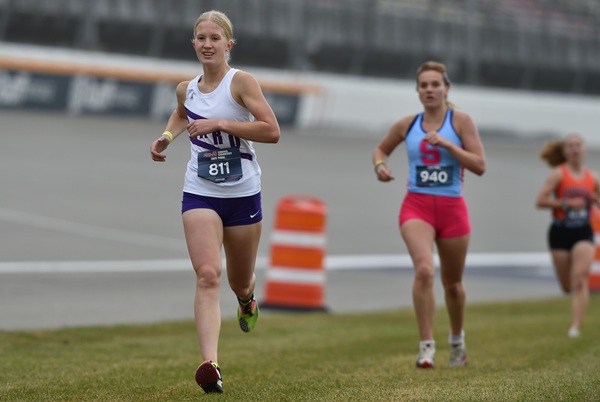 “I think that I was more motivated from (track), but I did have a later start to my summer (cross country) training because I went to the New Balance Nationals,” Tetil said. “I think doing that also motivated me a little more, like, ‘Oh, I’m actually pretty decent.’ I didn’t get a PR, but I was really close to my PR (in the 800). The atmosphere was amazing.”
When she was able to turn her focus back to cross country, Tetil came at her training not just with motivation from her success, but also from a new angle.
“I added a few things like weightlifting and strength training that made me a little bit stronger and able to withstand more mileage,” she said. “Last year, I kind of had a hard time with a positive mindset in races, so I think I kind of built up a more positive mindset, and that helped me get through the (Mike Jackson) race. I didn’t really set myself any goals or anything, I just wanted to go out and race and see how I could do. I didn’t even know what time I was running until the last mile of that race, so that was pretty cool to see that I was able to run a minute faster than last year.”
Watching Tetil get to this point has been motivating for Herron.
“Her perseverance in the sport has been amazing to see,” he said. “It’s crazy how she’s been able to take it all on and get better. She has a winter sport, she plays basketball, so it’s been amazing to see her balance all of that.”
Herron was sixth at the 2025 Division 3 Cross Country Final, and has the second-fastest cross country time in school history with his personal best of 15:39.1. That’s about 10 seconds off the school record set by three-time Finals champion Yami Albrecht. Passing Albrecht would certainly be a thrill for Herron, who didn’t start running competitively until his freshman year. But he isn’t letting that chase define him.
“It would be pretty awesome, I think, to be able to do that,” Herron said. “But I will say, I run for myself, and I’m not running for a record. I know that would be great, but I would love to just be able to be pleased with what I’m able to do. (The record) is not a thing that I lose sleep over, but I will say the state meet is something that I’ve always looked forward to. Yami was a three-time state champ, so I obviously can’t win three state championships anymore, but I’m getting closer to just being better than I was last year. My goal is to just better myself each and every year and prepare myself for what the next steps are.”
He hopes those next steps involve running collegiately, and he appears to be on track for that. He said Hillsdale College and Cedarville University are the two schools he’s most interested in at the moment. Tetil also has had interest from Hillsdale, as well as Wayne State and Bowling Green.
Before they take that leap, however, they still have plenty of work to do in a Caro uniform, as both are eyeing a top-five finish (or better) at the Division 3 Finals on Nov. 7 at Michigan International Speedway.
“I think it would mean a lot because we’re really good friends and we talk to each other all the time,” Tetil said. “So, I think it would be very motivating (to see Herron run well), because I mean even at some of the smaller races, if I finish on top, he’ll tell me good job, and then I’ll say, ‘Well, now you gotta beat that.’ So, yeah, there’s always motivation in that.”
 Paul Costanzo served as a sportswriter at The Port Huron Times Herald from 2006-15, including three years as lead sportswriter, and prior to that as sports editor at the Hillsdale Daily News from 2005-06. He can be reached at [email protected] with story ideas for Genesee, Lapeer, St. Clair, Sanilac, Huron, Tuscola, Saginaw, Bay, Arenac, Midland and Gladwin counties.
PHOTOS (Top) Caro’s Violet Tetil, left, and Luke Herron run their races at the 2025 Lower Peninsula Cross Country Finals at Michigan International Speedway. (Middle) Tetil (811) charges toward the finish line. (Click for more from RunMichigan.com.)