


Did you see that? (9/3-9/9)
September 10, 2012
School is back in session, and MHSAA teams should be hitting their best strides as league competition gets underway in most sports.
Here's a look at some of the highlights from the first full week of September, with links to additional coverage.
Volleyball
Spikes under the sun: Muskegon Mona Shores finished 3-0 in its home invitational Wednesday against a strong field of Grand Haven, Fruitport and Spring Lake. That's reason to celebrate on its own. But the best part of this story is where the Sailors did their damage -- on two portable courts stretched across the school's football field. (Muskegon Chronicle)
St. Philip takes Cereal City: Despite being one of the smallest schools in the state, it's rare that Battle Creek St. Philip doesn't leave a tournament as champion -- especially in its home town. But the Tigers hadn't won the Cereal City Invitational since 2007, until it did so with a two-set win over Class A honorable mention Temperance-Bedford this weekend. (Battle Creek Enquirer)
FHE is No. 1: Ada Forest Hills Eastern more than justified its ranking as best in the state in Class B by besting many of the best from the Grand Rapids area at the East Kentwood Invitational. Among others in the field were Class A No. 8 East Grand Rapids and reigning MHSAA Class A champion Rockford. (Grand Rapids Press)
Put them in the book: Johannesburg-Lewiston swept Gaylord St. Mary on Tuesday, thanks in part to 10 aces by junior Brittany Cherwinski, a total which will qualify for the MHSAA record book once documentation is submitted. In the team's previous match, junior Julia Nieman qualified for most assists in a match. (Gaylord Herald Times)
Cross Country
Harbor Springs rules the mud: Both the Harbor Springs boys and girls teams won their Charlevoix Classic Mud Runs on Saturday on a course that featured standing water and hay bales among other obstacles. It was the 21st year of the race. (Charlevoix Courier)
Running to records: Sault Ste. Marie has a freshman to watch in Parker Scott, who won his school's Bill Lynn Trails race Saturday in a time of 16:36 -- at least 26 seconds faster than any of the three first-place times from last season's MHSAA Upper Peninsula Finals. The time was a school record. (Soo Evening News)
Swimming and Diving
West Ottawa wins West Michigan: Facing many of the biggest and best from that side of the state, Holland West Ottawa won the West Michigan Relays after finishing third in the event each of the last three seasons. Among those also in the field was reigning MHSAA Division 2 champion Holland. (Holland Sentinel)
Tennis
Dow rises again: The Division 2 top-ranked Midland Dow tennis team remained perfect this season by winning its third tournament of the fall, at Grosse Pointe North. Among others in the field were No. 2-ranked Portage Central and No. 3 Grand Rapids Forest Hills Central (Midland Daily News)
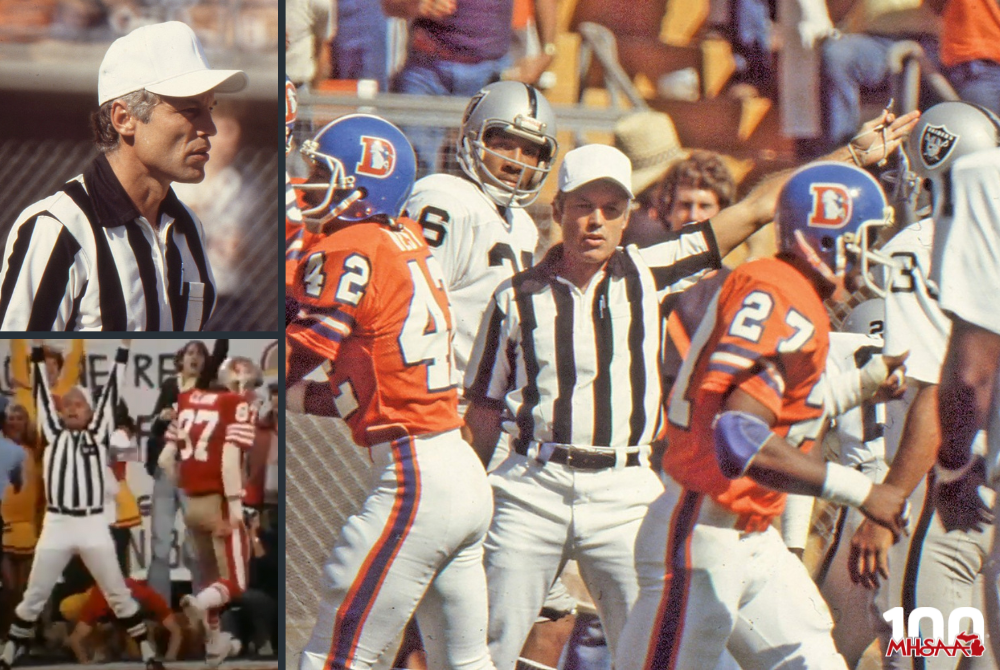
Flashback 100: Multi-Sport Star Look Becomes Super Bowl Officiating Legend
February 6, 2025
In 1960, Dean Look was drafted by both the Chicago White Sox of Major League Baseball and the Denver Broncos of the American Football League. For those familiar with Look’s athletic career at Lansing Everett and Michigan State University, his professional prospects in multiple sports came as no surprise.
A standout in football, baseball, and track, Look instead would make his most memorable pro sports mark as one of the NFL’s top officials.
At Everett during the mid-1950s, Look played a key role in leading his school to two state track & field championships (1954 and 1956) under legendary coach Archie Ross. Look also captured three individual state titles – two as part of 880-meter relay teams (1954 and 1956) and one in the pole vault (1956). In addition to his track achievements, Look was a star performer for Everett’s football and baseball teams.
After high school, Look continued his multi-sport career at Michigan State, excelling in both football and baseball. He finished sixth in the 1959 Heisman Trophy voting and was a key contributor to MSU’s shared football national championship in 1957.
Following college, Look signed with the White Sox, turning down an opportunity with the Broncos. After a brief stint in professional baseball, he returned to football, playing for the AFL’s New York Titans in 1962.
However, it was as an NFL official that Look truly left his legacy. Over a 29-year officiating career (1972–2001), he was assigned to three Super Bowls – Super Bowl XIII (1979), Super Bowl XV (1981) and Super Bowl XXVII (1993). One of his most iconic moments came during the 1981 NFC Championship Game, where he signaled "touchdown" after Joe Montana's legendary pass to Dwight Clark – forever known as “The Catch.”
Listen to Look discuss that historic play here: Watch on YouTube.
Athletic talent ran in the family, as Dean’s brother Bruce Look also played professional baseball, spending time with the Minnesota Twins.
Michigan has produced several notable Super Bowl officials, including brothers Carl, Dino, and Perry Paganelli from Wyoming Rogers High School. Carl officiated in Super Bowls XXXIX, XLI, XLVI, and XLVIII. In Super Bowl XLI, he and Perry made history as the first brothers to work on the same Super Bowl officiating crew. Perry also officiated Super Bowl LII, while Dino has been part of three Super Bowls – XLVII, LV, and LVII. Remarkably, at least one Paganelli has officiated in eight of the 59 Super Bowls.
This year’s Super Bowl referee is Ron Torbert, a fellow Michigan State graduate who has been an NFL official since 2010. Like Look and the Paganellis, Torbert also got his start officiating Michigan high school football.
For more information on becoming an MHSAA official, visit the MHSAA Officials page.
Previous "Flashback 100" Features
Jan. 31: Johnson Family Put Magical Stamp on Michigan High School Hoops - Read
Jan. 24: Future Hall of Famers Face Off First in MHSAA Class A Final - Read
Jan. 17: First-Ever WNBA Draft Pick Rocked at Salem, Won Titles at Tennessee - Read
Jan. 10: Despite Launching Before 3-Point Line, Smith Still Tops Scoring List - Read
Jan. 3: Edison's Jackson Earns Place Among State's All-Time Elite - Read
Dec. 20: Future Olympian Piper Leads Grosse Pointe North to Historic Heights - Read
Dec. 13: The Other Mr. Forsythe in Michigan School Sports - Read
Dec. 6: Coleman's Legendary Heroics Carry Harrison Through Repeat - Read
Nov. 29: Harbaugh Brothers' Football Roots Planted in Part at Pioneer - Read
Nov. 22: 8-Player Football Finals Right at Home at Superior Dome - Read
Nov. 15: Leland Career Helps Set Stage for Glass' International Stardom - Read
Nov. 8: Future Baseball Pro Led Escanaba's Legendary Football Title Run - Read
Nov. 1: Michigan High School Baseball Trio Provide World Series Voices - Read
Oct. 25: Before Leading Free World, Ford Starred for Champion GR South - Read
Oct. 18: Mercy Links Legend Becomes World Golf Hall of Famer - Read
Oct. 11: Fisher Races to Finals Stardom on Way to U.S. Olympic First - Read
Oct. 4: Lalas Leaves High School Legacies on Ice & Pitch - Read
Sept. 27: Tamer's History-Making Run Starts in Dexter, Continues to Paris - Read
Sept. 20: Todd Martin’s Road to Greatness Starts at East Lansing - Read
Sept. 13: James Earl Jones, Dickson High Hoops to Hollywood Legend - Read
Sept. 6: Pioneers' Unstoppable Streak Stretches 9 Seasons - Read
Aug. 30: Detroit dePorres Rushes to 1995 Class CC Football Championship - Read
(Photos courtesy of Referee Magazine.)