


Did you see that? (9/3-9/9)
September 10, 2012
School is back in session, and MHSAA teams should be hitting their best strides as league competition gets underway in most sports.
Here's a look at some of the highlights from the first full week of September, with links to additional coverage.
Volleyball
Spikes under the sun: Muskegon Mona Shores finished 3-0 in its home invitational Wednesday against a strong field of Grand Haven, Fruitport and Spring Lake. That's reason to celebrate on its own. But the best part of this story is where the Sailors did their damage -- on two portable courts stretched across the school's football field. (Muskegon Chronicle)
St. Philip takes Cereal City: Despite being one of the smallest schools in the state, it's rare that Battle Creek St. Philip doesn't leave a tournament as champion -- especially in its home town. But the Tigers hadn't won the Cereal City Invitational since 2007, until it did so with a two-set win over Class A honorable mention Temperance-Bedford this weekend. (Battle Creek Enquirer)
FHE is No. 1: Ada Forest Hills Eastern more than justified its ranking as best in the state in Class B by besting many of the best from the Grand Rapids area at the East Kentwood Invitational. Among others in the field were Class A No. 8 East Grand Rapids and reigning MHSAA Class A champion Rockford. (Grand Rapids Press)
Put them in the book: Johannesburg-Lewiston swept Gaylord St. Mary on Tuesday, thanks in part to 10 aces by junior Brittany Cherwinski, a total which will qualify for the MHSAA record book once documentation is submitted. In the team's previous match, junior Julia Nieman qualified for most assists in a match. (Gaylord Herald Times)
Cross Country
Harbor Springs rules the mud: Both the Harbor Springs boys and girls teams won their Charlevoix Classic Mud Runs on Saturday on a course that featured standing water and hay bales among other obstacles. It was the 21st year of the race. (Charlevoix Courier)
Running to records: Sault Ste. Marie has a freshman to watch in Parker Scott, who won his school's Bill Lynn Trails race Saturday in a time of 16:36 -- at least 26 seconds faster than any of the three first-place times from last season's MHSAA Upper Peninsula Finals. The time was a school record. (Soo Evening News)
Swimming and Diving
West Ottawa wins West Michigan: Facing many of the biggest and best from that side of the state, Holland West Ottawa won the West Michigan Relays after finishing third in the event each of the last three seasons. Among those also in the field was reigning MHSAA Division 2 champion Holland. (Holland Sentinel)
Tennis
Dow rises again: The Division 2 top-ranked Midland Dow tennis team remained perfect this season by winning its third tournament of the fall, at Grosse Pointe North. Among others in the field were No. 2-ranked Portage Central and No. 3 Grand Rapids Forest Hills Central (Midland Daily News)
Preview: Pitch to Provide No Shortage of History-Making Possibilities
By
Geoff Kimmerly
MHSAA.com senior editor
November 1, 2024
Byron Center and Plymouth Christian Academy will make school history Saturday just by showing up for their first MHSAA Boys Soccer Final. Pontiac Notre Dame Prep can make some as well with a first championship victory.
Grand Ledge High School also will host the second-most successful program in this sport’s postseason history – Muskegon Western Michigan Christian will play in its 17th Final, tying Detroit Country Day for the most title game appearances.
Saturday’s first Final will be Division 4 at 10 a.m., followed by Division 3 at 12:30 p.m., Division 2 at 3:30 and Division 1 at 6 p.m. Tickets cost $11 and may be purchased online only at GoFan. All four Finals also will be broadcast and available with subscription on the NFHS Network.
Division 1 | Division 2 | Division 3 | Division 4
Below is a glance at all eight contenders, with statistics through Regionals:
Division 1
BYRON CENTER
Record/rank: 19-4-1, unranked
Michigan Power Rating: No. 35
Coach: Chad Bays, second season (36-7-3)
League finish: First in Ottawa-Kent Conference Green
Championship history: Has never played in an MHSAA Final.
Players to watch: Luke Philo, sr. GK; Kaleb Smith, jr. MF; Brendan Walker, sr. D (Statistics not submitted).
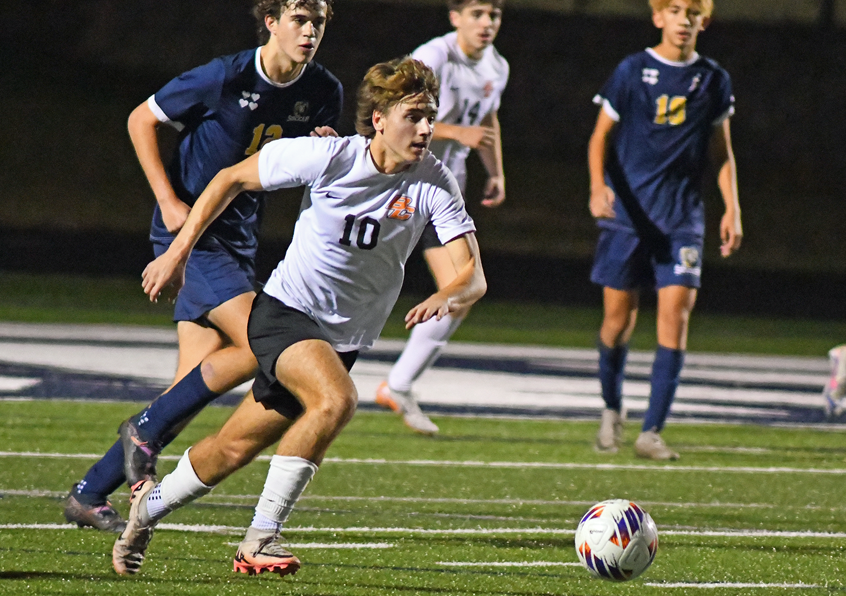
Outlook: Byron Center has added its first Finals run to its first Regional championship won last week. Bays also led the Bulldogs to a 17-3-2 record in his first season last fall after previously coaching the junior varsity. The team advanced in part with shootout wins over Grand Haven and No. 4 Oxford and also defeated top-ranked Portage Central during this postseason. Smith is the team’s leading scorer, and only three seniors start – so this could be just the start of a run at the top of Division 1. Philo earned an all-state honorable mention last season.
ROCHESTER ADAMS
Record/rank: 17-2-4, No. 5
Michigan Power Rating: No. 5
Coach: Josh Hickey, 16th season (188-94-62)
League finish: Second in Oakland Activities Association Red
Championship history: Two MHSAA titles (most recent 2022), two runner-up finishes.
Players to watch: Anthony Page, sr. W (7 goals, 7 assists); Alex Rosin, sr. M (15 goals, 17 assists), Logan Lilla, sr. W (13 goals, 6 assists).
Outlook: Adams is making its second championship match appearance in three seasons and playing for the OAA Red’s third-straight title after Troy Athens won Division 1 a year ago. Any team emerging from that league will be prepared; in addition to Adams, Troy finished the regular season ranked No. 3, Oxford was No. 4, Troy Athens was No. 8 and Berkley No. 12 in Division 1. Adams defeated Troy in overtime, No. 10 Utica Eisenhower and No. 11 Saline in a shootout during this playoff run. Senior Reid Dennis has been a force in goal, giving up 0.4 goals per game with 12 shutouts heading into this week. Page earned an all-state honorable mention last season.
Division 2
GRAND RAPIDS FOREST HILLS NORTHERN
Record/rank: 19-4-3, No. 7
Michigan Power Rating: No. 19
Coach: Juan Torres, fourth season (59-18-7)
League finish: First in O-K White
Championship history: Division 2 champion 2019, two runner-up finishes.
Players to watch: Drin Mandija, soph. F (12 goals, 6 assists); Almedin Hoxha, jr. M (14 goals, 6 assists); Beau Lincoln, jr. M (7 goals, 14 assists).
Outlook: Forest Hills Northern has done some impressive damage on the way to the season’s final weekend, among others defeating top-ranked Fruitport, No. 12 Grand Rapids Forest Hills Central, 2023 champion Grand Rapids Christian and No. 8 Bay City John Glenn during the playoffs – the first three on the list in shootouts. Junior Lukas Darling has been in goal for all of it, with eight shutouts this season while giving up just 1.2 goals per game. The Forest Hills Central win avenged a 3-0 loss in the regular-season finale. Total, 18 players had scored at least once entering this week.
WARREN DE LA SALLE COLLEGIATE
Record/rank: 19-3-1, No. 2
Michigan Power Rating: No. 4
Coach: Thaier Mukhtar, 36th season (594-143-97)
League finish: Second in Catholic High School League Central
Championship history: Five MHSAA titles (most recent 2005), one runner-up finish.
Players to watch: Andrew Corder, soph. F (16 goals, 6 assists); Daniel Makara, sr. D (9 goals, 8 assists); Joshua Ross, sr. M (13 goals, 8 assists).
Outlook: The Pilots rode a 3-1 win over No. 5 Mason into their first championship match since 2005. Mukhtar is the winningest coach in MHSAA boys soccer history and has directed the program to all five of its Finals titles. He began this season with three all-state first-teamers from last year in Makara, Ross and Corder, while junior midfielder Nikolai Zacharko (6 goals/4 assists) made the third team last season and sophomore keeper Dominic Baldarotta earned an honorable mention. Baldarotta has played the majority in net this season, with a 1.21 goals-against average and eight shutouts heading into this week.
Division 3
ELK RAPIDS
Record/rank: 18-6-1, No. 10
Michigan Power Rating: No. 13
Coach: Nate Plum, 17th season (275-116-34)
League finish: Tied for first in Northern Shores Conference
Championship history: Two MHSAA titles (most recent 1998), three runner-up finishes.
Players to watch: Jayden Hresko, jr. F (14 goals, 11 assists); Mason Hilley, soph. M (3 goals, 7 assists); Tyler Standfest, soph. F (16 goals, 9 assists).
Outlook: After reaching the Semifinals for the sixth time under Plum’s leadership, Elk Rapids broke through to get back to championship weekend for the first time since its last title was won in 1998. The Elks have given up just three goals over six postseason games and no more than one in any match going back to Sept. 7; they haven’t lost since Sept. 9. They defeated No. 4 Kingsford, No. 9 Hartford and No. 12 Traverse City St. Francis during this run, and junior Jacob McManus has played most in net with a 0.79 goals-against average and 10 shutouts over the course of the fall. Hresko, Hilley and junior midfielder Carter Denoyer (6 goals, 1 assist) earned all-state honorable mentions last season.
PONTIAC NOTRE DAME PREP
Record/rank: 22-2, No. 1
Michigan Power Rating: No. 1
Coach: Rob Suffredini, 10th season (111-80-35)
League finish: Does not compete in a league.
Championship history: Division 3 runner-up 2000.
Players to watch: Benjamin Liparoto, jr. M (8 goals, 4 assists); Will Lanham, sr. F (28 goals, 14 assists); Jack Kilpatrick, jr. M (12 goals, 13 assists).
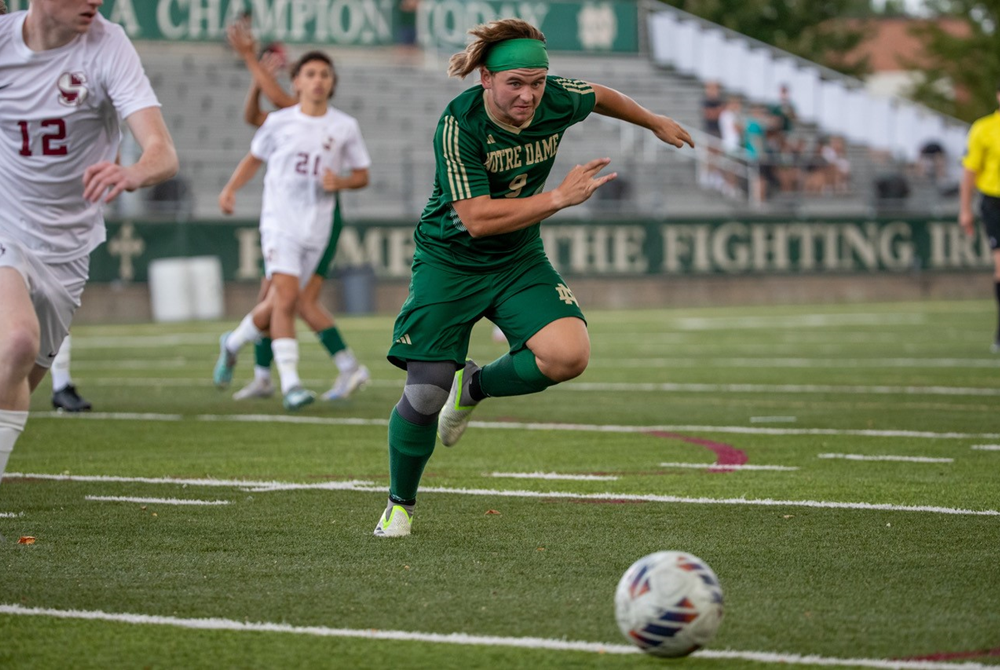
Outlook: Aside from stumbles against No. 5 Detroit Country Day and Division 1 No. 3 Troy, Notre Dame Prep has put together one of the most dominating runs in the state in any division – and the Fighting Irish avenged the Country Day loss with a shootout win in the District Final. They also downed No. 2 Flint Powers Catholic and No. 13 Williamston during this postseason, the latter in their 12th shutout of the fall. Lanham made the all-state first team last year, and Kilpatrick made the third team. Four others had at least five goals scored entering this week.
Division 4
MUSKEGON WESTERN MICHIGAN CHRISTIAN
Record/rank: 14-7-3, No. 8
Michigan Power Rating: No. 10
Coach: Ben Buursma, fifth season (73-32-12)
League finish: Does not compete in a league.
Championship history: Nine MHSAA titles (most recent 2023), seven runner-up finishes.
Players to watch: Dan Minasian, sr. GK (1.04 goals-against average, 9 shutouts); Tekalegn Vlasma, sr. F (27 goals, 5 assists); Cole DeJonge, sr. M (5 goals, 24 assists).
Outlook: WMC is seeking its third-straight Division 4 title, and earning it would have to make this run one of the program’s most impressive over its highlight-filled history. The Warriors have yet to give up a goal over five postseason games against Ravenna, No. 6 North Muskegon, No. 13 Harbor Springs, No. 2 Leland and No. 5 Grandville Calvin Christian. Minasian, senior defender Ben Visser and DeJonge all made the all-state first team last season, while Vlasma made the second team and was the star of last year’s championship match with two goals in finishing 2023 with 26 total.
PLYMOUTH CHRISTIAN ACADEMY
Record/rank: 15-5-3, unranked
Michigan Power Rating: No. 24
Coach: Ryan Thompson, second season (21-10-9)
League finish: Second in Michigan Independent Athletic Conference Blue
Championship history: Has never played in an MHSAA Final.
Players to watch: Caedmon Whipple, sr. M (23 goals, 12 assists); Mac MacDonald, sr. M (3 goals, 1 assist); Grant Ramseyer, soph. F (12 goals, 11 assists).
Outlook: Coming off a solid regular season, PCA has put together a stunning playoffs outscoring its six opponents by a combined 21-5. The two most recent victories came over No. 3 Royal Oak Shrine Catholic and No. 4 Lansing Christian and are part of a 13-0-2 streak going back to Sept. 13. Whipple made the all-state third team last season, and MacDonald earned an honorable mention, and they are two of only four seniors total. Sophomore midfielder Leo Lavigne also had scored 12 goals entering this week.
PHOTOS (Top) Pontiac Notre Dame Prep’s Edziu Lis (9) pursues the ball during a regular-season victory over Birmingham Seaholm. (Middle) Byron Center’s Kaleb Smith (10) pushes the attack during Wednesday’s Semifinal win over Oxford. (Top photo by Adam Sheehan; middle photo by John Johnson.)