

Tales of Teams, Trophies & Trinkets - Vol 2
By
Ron Pesch
MHSAA historian
February 9, 2017
A picture may be worth a thousand words – but often, we can learn as much from a traveling trophy, game ticket, and even an old megaphone.
Michigan’s high school sports history is more than a century old and filled with legends passed on of games, teams and athletes and the roles they played as our communities rolled forward toward present day. Following up last year’s “Tales of Teams, Trophies & Trinkets,” we present a second chapter highlighting artifacts that tell some of those stories.
|
1909 |
Saginaw vs. Saginaw Arthur Hill |
Football Trophy |
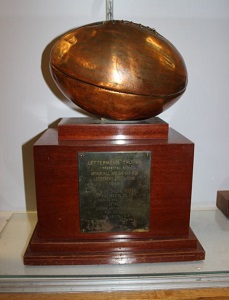 This bronzed football was the original used in the 1909 Thanksgiving Day contest played between Saginaw High and Saginaw Arthur Hill, and won by Saginaw, 5-0 at Burkart Park. In 1948, the ball was stylized into a trophy by the Letterman’s Associations of the rival schools, designed to travel between schools as the reward for winning the annual contest. When the Lumberjacks of Arthur Hill ripped off 24 straight victories beginning in 1971 (the teams played twice in 1974), ownership of the trophy was mostly forgotten. When talk of closing Saginaw High School mounted, the trophy was placed on display at Saginaw’s Castle Museum, then donated to the Saginaw County Sports Hall of Fame.
According to Jeffrey Cottrell, the multi-media specialist at the Historical Society of Saginaw County, when plans to close Saginaw High did not materialize, “it was decided amongst the Saginaw County Sports Hall of Fame and the Arthur Hill Letterwinners Association that it was time to put it back into use. This past fall, the Sports Hall of Fame awarded the trophy to Saginaw High when they beat Arthur Hill 40-0.”
Going forward, the Letterman's Trophy will continue to be presented to the winner of the football game between the Trojans and the Lumberjacks.
|
1921 |
Detroit Cass Tech vs. Flint Central |
Football Program |
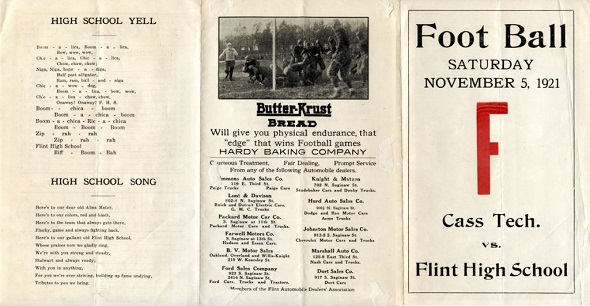
A crowd of 2,500 was on hand for this contest as Detroit Cass Tech downed Flint Central, 34-20, in an aerial battle between the squads. The Detroit Free Press arraigned for a special interurban run, with special railcars earmarked for Cass Tech students interested in attending the Saturday game at Flint. Between 200 to 300 made the trip to cheer their team to victory.
Flint Central completed 14 of 34 passes for 176 yards, but was intercepted on six occasions. Cass Tech arms were accurate on only 7 of 24 attempts for 160 yards, with four interceptions, but two completions went for touchdowns of 18 yards and 50 yards. A third pass of 35 yards helped set up the visitor’s first score. Bruno Murkobred, Cass Tech’s speedy quarterback, was the star of the contest, scoring three of his team’s five touchdowns.
|
1939 |
Kalamazoo Central vs. Battle Creek Central |
Basketball Program |
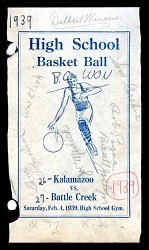 This tattered memento, from a scrapbook kept by historian Dick Kishpaugh, illustrates the modest design of a high school basketball program back in 1939. Likely created by the high school print shop, this single sheet, printed specifically for distribution at the game, features autographs gathered by its owner. Wes Clark, one of the names captured on the cover, led Battle Creek Central with 10 points, including a pair of buckets in the final minute to secure a 27-26 win by the Bearcats.
Newspaper reports from the time indicate that halftime of the contest would feature “a table tennis exhibition between Helen Van Dyke of Flint, four-time state champion, and Floyd Painter, Battle Creek champion.” Miss Van Dyke was a sophomore at Olivet College at the time.
|
1940 |
Lansing Eastern vs. Lansing Central |
Football Program |
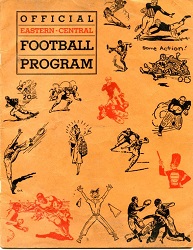 This is the program cover from the 13th annual Football Classic between the Quakers of Eastern and the Big Reds of Central. Fans were requested to “refrain from making unnecessary noise as they drive away from the stadium … due to the nearness of Sparrow Hospital.”
At the time of the 1940 contest, Lansing Central led the series with six wins against five defeats. The series featured a single tie, a 6-6 result in 1935.
Eastern’s 1940 squad, coached by Walter Graff, was able to knot the series at six wins apiece with a thrilling 7- 6 victory over the crosstown rivals, coached by Al Bovard.
The 16-page document was hand set and printed by the Eastern and Central High School Vocational Printing Classes, and included rosters, messages from the two school principals and athletic directors, as well as comments from each member of the coaching staffs, team captains, student council presidents and numerous team members from each school with their views on the game. Of course there is a photograph of each high school football team, but also photos of each band, their directors, and a list of the band members for both Eastern and Central. Finally, there are photos of the Eastern and Central Yell Leaders, nine for the Quakers and six for the Big Reds.
It is a true work of art.
|
1950 |
Central Michigan College Relays |
Track Medal |
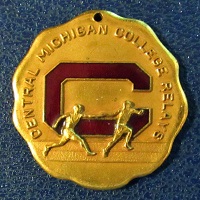 More than 2,300 athletes from 97 high schools descended upon Mt. Pleasant for the Tenth Annual Central Michigan Relays. Ecorse in Class B and Flint School for the Deaf in Class D earned team titles on Friday, May 5th while on Saturday, the 6th, Flint Northern and Milan won Class A and Class C, respectively. Six event records fell during the two-day event, three in the broad jump.
This medal, honoring a member of the winning Class C sprint relay team, was awarded at the event. The winning team, and therefore, the name of the individual awarded the medal, remain a mystery.
|
1962 |
Saginaw Sacred Heart |
Megaphone |
 As at the majority of schools across the state at the time, athletic competition against other schools was not an option for Gloria Groll and her female classmates during her days as a student at Saginaw Holy Rosary High School. So, from the fall of 1959 until her graduation with 27 other students in the spring of 1962, she was a cheerleader for the Greyhounds. This beautiful megaphone, donated by Groll to the Saginaw County Sports Hall of Fame, is a memento from those times.
Holy Rosary was one of nine Catholic high schools operating in the Saginaw area in the 1950s and 1960s. Population shifts from the cities to the suburbs over the coming years would impact enrollment figures at schools nationally. In Saginaw, the opening of the Buena Vista School District in 1956 directly impacted Holy Rosary. In 1970 the school closed. A year later only three schools – SS Peter and Paul, St. Mary and Saginaw St. Stephen – remained. In 1984, those schools were consolidated to form Saginaw Nouvel Catholic Central.
|
1963 & 1930 |
Grosse Pointe St. Paul |
League Trophies |
 On the left, we find the trophy awarded to Grosse Pointe St. Paul's after winning the 1963 city championship. Bob Martin, a 6-foot-6 junior who earned first division all-Catholic honors, scored 14 of his 22 points in the fourth quarter to lead the Lakers to a 55-46 upset-victory over Detroit Pershing. The game was played at University of Detroit Memorial before 6,979 spectators. It was the first time since 1958 that the Catholic League won the annual matchup with the champions of the Public School League.
To the right is the trophy awarded to St. Paul for winning the first golf tournament of the South Michigan Catholic High School League. The school's four golfers shot 710 over 36 holes on the day, 69 fewer strokes than second-place Detroit St. Rose. Played at Clinton Valley, the event saw Bill Beaupre win individual honors with a total of 158, including 76 in the morning. His cousin and teammate, Harold Beaupre, finished second with 169, while Peter Bononis of Detroit Holy Name was third with 171 strokes.
|
1965 |
Fennville vs. Kalamazoo Hackett |
Ticket Stub |
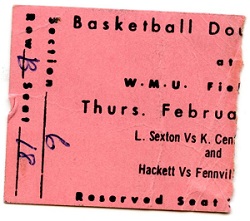 This ticket stub from a doubleheader hosted at Western Michigan University’s Read Fieldhouse on February 18, 1965 was the first chance for many to witness lightning in a bottle. A capacity-plus crowd of 9,100 fans slid through the gate to watch a rumor.
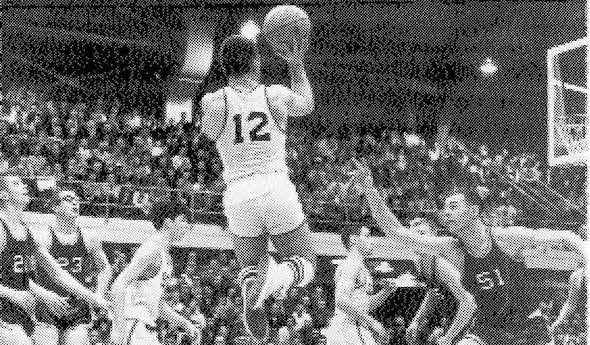
The antics of 5-foot-7½ guard Richie Jordan had been talked about around the Kalamazoo area, but few had actually seen him play. His skills were on full display on this Thursday night, as he netted a fieldhouse scoring record with 49 points in a come-from-behind 76-72 win over a much taller team from Kalamazoo Hackett. Jordan’s output during the evening’s second game eclipsed the 45 points Manny Newsome scored for Western Michigan University against Toledo, just over a year before.
The evening hadn’t started well. According to the Kalamazoo Gazette, “Jordan hit only six of his 13 field shots in the first half and threw the ball away eight times. Trailing Hackett by 17 points, 50-33, with two minutes to play in the third quarter, the Blackhawks were able to cut the deficit to 13, 60-47 as the teams entered the final frame.
Quickly, everyone in the fieldhouse knew who was getting the ball during the comeback attempt. Jordan grabbed control; with his drives for layups and “softly-arched” jump shots against intense pressure, he hit seven of nine field goals, wowing the crowd. With 2:36 to play, Jordan nailed a pair of free throws to tie the game at 72 all. Then, with 57 seconds left, the “Fennville Flash” nailed the go-ahead basket, followed by two insurance free throws to seal the win. For many, his 24 points in the fourth quarter sealed his journey from rumor to legend and, no doubt, inspired the single-sentence first paragraph of the next morning’s coverage in the Gazette.
“Yes, there is a Richie Jordan!”
(P.S. – Kalamazoo Central upset eighth-ranked Lansing Sexton, 67-57, in the evening’s opening contest).
 Ron Pesch has taken an active role in researching the history of MHSAA events since 1985 and began writing for MHSAA Finals programs in 1986, adding additional features and "flashbacks" in 1992. He inherited the title of MHSAA historian from the late Dick Kishpaugh following the 1993-94 school year, and resides in Muskegon. Contact him at [email protected] with ideas for historical articles.
PHOTO: Fennville's Richie Jordan pulls up for a jumper, showing off the form that's become iconic when recalling the high school phenom. (Photos of Letterman's Trophy and Megaphone were provided by Jeffery Cottrell, and photo of Grosse Pointe trophies was provided by Bill Roose.)
Inside Selection Sunday: Mapnalysis '18
October 21, 2018
By Geoff Kimmerly
Second Half editor
For a fading moment, we thought we saw the Big Dipper floating through the second floor of the MHSAA office Sunday morning.
Michigan’s northernmost high school in Calumet held the handle – but the only place the rest of the Region pointed was to questions about how we could come up with such a disjointed scenario for this season’s Division 6 Playoffs.
Below – as has become an annual tradition – we’ll answer that question and a few more about this year’s selection process.
Our mission Sunday was to map 213 automatic qualifiers for 11-player football – and a record 43 additional qualifiers with 5-4 or 4-4 records – plus our top 32 8-player teams across 10 divisions of playoffs that will conclude with the latter Nov. 17 at Northern Michigan University and 11-player Nov. 23-24 at Ford Field.
As often noted in the past, this process didn’t start Sunday morning – but months and in some cases more than a year ago when athletic directors began scheduling games for this fall. We make sure all are loaded into our system by early summer, and then follow every score/cancellation/forfeit/additional change through Week 9’s final games – including this season those for 46 teams from other states or Ontario that played Michigan schools and needed to be followed as well because their successes affected MHSAA teams’ strengths of schedule.
Now that the maps are drawn, we line up all that will come with the next five weeks of games including assigning officials, gathering potential Semifinal sites and continuing our work with our Finals hosts to create memorable experiences as teams play for championships.
So we’re off. For those familiar with our playoff selection process, or who have read this report in the past and don’t want a refresher on how we do what we do, skip the next section and go directly to the “Observations & Answers: 2018.” For the rest, what follows is an explanation of how we selected the playoff pairings during the morning hours Sunday, followed by how we made some of the toughest decisions plus a few thoughts on the breakdown of the field. Go to this page on MHSAA.com to see the pairings in full.
Ground Rules
Our past: The MHSAA 11-player playoff structure – with 256 teams in eight divisions, and six wins equaling an automatic berth (or five wins for teams playing eight or fewer games) – debuted in 1999. An 8-player tournament was added in 2011, and in 2017 a second division of 8-player football was introduced.
The first playoffs were conducted in 1975 with four champions. Four more football classes were added in 1990 for a total of eight champions each fall. Through 1998, only 128 teams made the postseason, based on their playoff point averages within regions (four for each class) that were drawn before the beginning of the season. The drawing of Districts and Regionals after the end of the regular season did not begin until the most recent 11-player playoff expansion.
In early years of the current process, lines were drawn by hand. Dots representing qualifying schools were pasted on maps, one map for each division, and those maps were then covered by plastic sheets. Districts and Regionals literally were drawn with dry-erase markers.
Our present: After a late Saturday night tracking scores, we file in Sunday morning for a final round of gathering results we may still need (which can include making a few early a.m. calls to athletic directors and coaches). Re-checking and triple-checking of enrollments, what schools played in co-ops and opted to play as a higher class start a week in advance, and more numbers are crunched Sunday morning as the fields are set.
As noted above, this season there were 213 automatic qualifiers for the 11-player field by win total with the final 43 additional qualifiers then selected, by playoff-point average, one from each class in order (A, B, C, D) until the field was filled. There were only five Class D additional qualifiers with 5-4 or 4-4 (playing eight games) records from which we could choose – so with those five we added 13 teams from Class A and B and 12 from Class C.
Those 256 11-player teams are then split into eight equal divisions based on enrollment, and their locations are marked on digital maps that are projected on wall-size screens and then discussed by nearly half of the MHSAA staff plus a representative from the Michigan High School Football Coaches Association. Only the locations themselves are marked (by red dots) – not records, playoff point averages or names of the schools or towns. In fact, mentions of those are strictly prohibited. Records and playoff points are not part of the criteria. Matchups, rivalries, previous playoff pairings, etc. also DO NOT come into play.
The 8-player process is different for team selection and similar for designation of Regionals. We take the top 32 teams in 8-player based on playoff point average as our field, then re-sort those 32 by enrollment – the 16 biggest make up Division 1, followed by the next 16 in Division 2. There are no automatic qualifiers by record for 8-player.
Geography rules: This long has been rule number one for drawing MHSAA brackets in any sport. Travel distance and ease DO come into play. Jumping on a major highway clearly is easier than driving across county-wide back roads, and that’s taken into consideration. Also, remember there’s only one Mackinac Bridge and hence only one way to cross between peninsulas – and boats are not considered a possible form of transportation. When opponents from both peninsulas will be in the same District, distance to the bridge is far more important than as the bird flies.
Tradition doesn’t reign: Every group of 32 (or in 8-player, 16) dots is a new group – these 32 teams have not been placed in a bracket together before. How maps have been drawn in the past isn’t considered – it’s hard to say a division has been drawn in a certain way traditionally when this set of 32 teams is making up a division for the first time.
Observations & Answers: 2018
We always start with CONGRATULATIONS: And this season they go first to Detroit Community, Detroit Public Safety Academy and Dexter, which made the MHSAA Football Playoffs for the first time. Of 611 football varsities across the state, all but 12 have made the playoffs at least once. Rockford missed out on an automatic bid with a Week 9 loss, but received an additional qualifier berth to set the record by making the MHSAA Playoffs for the 24th straight season. Crystal Falls Forest Park (22 seasons), Stevensville Lakeshore (21), Macomb Dakota (18), Climax-Scotts (16) and Grand Rapids West Catholic (16) also extended their stays on the list for longest MHSAA playoff streaks.
Break the tie: We again had to break a tie (actually two for District rounds) as teams that will or could meet ended up with the same playoff point averages. Ties are broken by head-to-head competition first – if the teams played each other during the regular season – followed by opponents’ winning percentage as the second criteria and then a coin flip if those two won’t do it. Our tie-breaks this season both took place in Division 4 – Grand Rapids South Christian received a home game against Wyoming Godwin Heights this week and St. Clair will host North Branch if they meet in a District Final. There are more possible meetings of teams with same averages in later rounds, and those ties will be broken the same way.
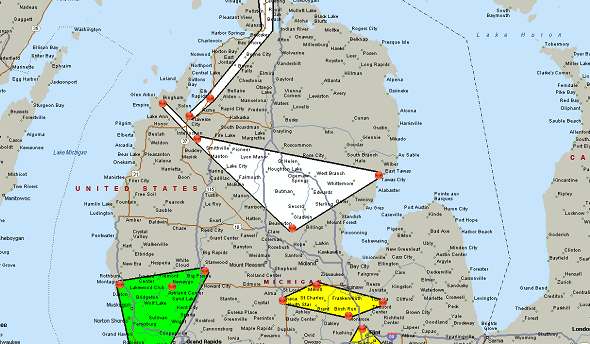
What is up with Division 6: Last year I had a “worst map ever,” and two of them this year would be in contention. Division 6 is the first – but the explanation for how we came up with what we did is simple. Region 1 is made up of two Districts with six schools from the northern Lower Peninsula and two from the Upper Peninsula. So however the Districts were sliced, two Lower Peninsula schools had to go with the U.P. And we settled this one strictly by comparing highway mileages of those Lower Peninsula teams to Mackinac Bridge (again, the only way to travel between the peninsulas). In the end, we placed Elk Rapids (93 miles) and Traverse City St. Francis (124) with Escanaba and Ishpeming Westwood because they are closest to the Bridge – followed by Kingsley (126), Maple City Glen Lake (144), Beaverton (161) and Tawas (168). The optics are strange – it may look like Glen Lake is driving past Elk Rapids and St. Francis on the way to Beaverton this week and potentially Tawas next. But Glen Lake’s route still travels south of those two schools this week (and depending on its chosen route on the way to Tawas as well), making everything fit – strangely looking, but nonetheless.
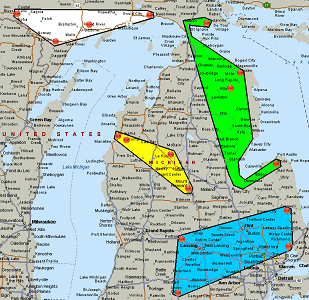 Lake Huron tour: You could see most of the American side by checking out this week’s Region 2 games in 8-player Division 2. This map also looks odd – there’s a bridge crossing and a drive around Saginaw Bay. Yet, after drawing this at least two more ways, we settled here – although Region 2 looks a little odd, all four teams are east of I-75 and north of Bay City.
Get your zoom on: We don’t enjoy splitting up teams that live next door to each other, but sometimes it’s a must. In Division 7 we were able to keep all eight Detroit-area and southeastern schools in Region 4, but the distance between its Districts came down to a few miles along I-96. In Division 2, we had to factor in outliers Port Huron Northern and Temperance Bedford – and the resulting Districts ended up splitting Livonia Churchill and Livonia Franklin.
At the end of the day …
I include this every year, but we draw the maps not knowing which schools are represented by the dots. At one point Sunday morning, I was wrong about which division we were considering at the time – and that’s a good thing. For the map drawing portion, it doesn’t matter.
But now that we know who is going where, here’s a glance at some stories that might emerge this week:
• We’ve got rivalries, like Portage Northern at Portage Central and Birmingham Groves at Birmingham Seaholm in Division 2, St. Johns at DeWitt and Haslett at East Lansing in Division 3, Constantine at Schoolcraft in Division 6 and Waterford Our Lady at Clarkston Everest Collegiate in Division 8 – plus Kingston at Deckerville in 8-player Division 1. There are many more we could mention – and some potential feuds renewed in two weeks as well depending on who wins this round.
• The Macomb Area Red, generally considered one of the strongest leagues annually in the state, sent four of six teams to the Division 1 playoffs – and they’re all in the same District. Champion Clinton Township Chippewa Valley (9-0) takes on Utica Eisenhower this week, and with a win would face either Macomb Dakota or Romeo after defeating both by just seven points during the regular season.
• Perhaps the most intriguing opener statewide is River Rouge (8-1) at Detroit Martin Luther King (7-2) in Division 3. Neither gets tested much during their league seasons, but both played tough nonleague opponents and the winner will be considered a favorite to make it to Ford Field.
• Farmington Hills Harrison holds the records for most MHSAA Finals appearances (18) and titles (13) and will play its final playoffs in Division 4 after finishing Division 3 runner-up a year ago. The school is closing next spring. Coach John Herrington is the winningest in state history with 441 wins and counting against only 111 losses (and a tie).
• There are a few annual powers not in the bracket this season – most notably Lowell, Muskegon Catholic Central and Menominee – and others like Rockford, Mendon and Grand Rapids West Catholic got in as additional qualifiers. West Catholic has won five straight Division 5 championships and opens at Hudsonville Unity Christian. The Falcons won the 2013 title after also entering as a 5-4 team.
• There are 34 teams entering the playoffs unbeaten, but only four Districts have multiple – Manistee and Reed City share one in Division 5, Traverse City St. Francis and Calumet in Division 6, Reading and Ottawa Lake Whiteford in Division 8, and Wyoming Tri-unity Christian and Morrice in 8-player Division 1. All of those potential matchups would happen in 11-Player District or 8-Player Regional Finals.
• This will be the eighth year of the 8-player tournament, and in Division 1 only Deckerville in 2012 has won an MHSAA championship in this format. In Division 2, reigning champion Crystal Falls Forest Park opens with 2015-16 back-to-back champion Powers North Central.
• In 8-player, three teams with 5-4 records didn’t make the field of 32, and two teams with 4-5 records advanced. This is the reality of measuring by playoff point average. Fife Lake Forest Area and Webberville are the 4-5 teams, and their opponents this season won more than 61 percent of their games. The three teams at 5-4 and one at 4-4 had opponents’ winning percentages between 38-56 percent.
Every school and every community can tell a story of making these playoffs, and over the next five weeks the fortunate will continue to write chapters filled with moments that will never be forgotten. We’re looking forward to watching them all unfold.
PHOTOS: (Top) The Division 6 map shows an odd-looking scenario with two Traverse City-area teams in the same District as two from the Upper Peninsula. (Middle) The 8-player Division 2 map shows how schools are connected to a District along the Lake Huron shoreline.