

Unified Sports: Unified Goal, Unified Effort
By
Mark Uyl
MHSAA Executive Director
April 11, 2019
The following publisher's note and cover story were featured in this winter's edition of the MHSAA benchmarks magazine.
At its best, sport breaks down barriers and differences through promoting teamwork, inclusiveness and humility. At its worst, we’ve seen sport do the opposite.
Obviously those involved in school sports aim to create a culture within every school which fosters the best of what all of us can be. Those places that do this best have created a culture in every hallway, classroom, playing field and gymnasium filled with diverse students pulling for one another and working together regardless of the different backgrounds, races, religions, abilities, physical stature or academic acumen of each person. A culture of understanding and acceptance is what we strive for in each of our school communities.
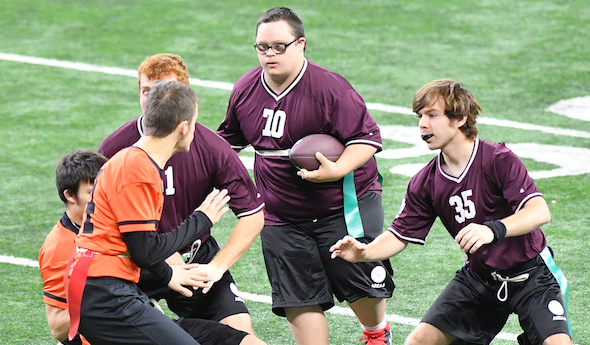
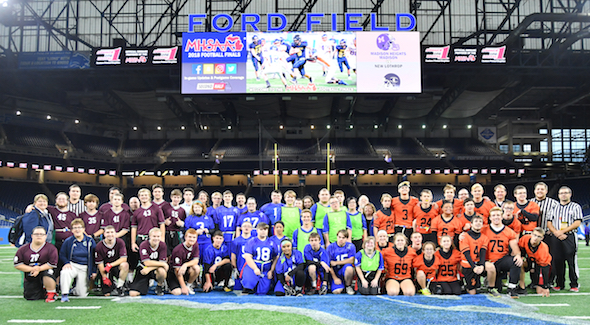
On Nov. 24, such a scene played out on the grand stage of the playing surface at Ford Field in Detroit. In what we hope will be the launching pad for many more such events, Unified Sports competitors from four MHSAA member schools competed simultaneously in two games prior to the MHSAA Division 7 Football Final.
Unified Sports is an inclusive sports program within Special Olympics which pairs students with and without intellectual disabilities as teammates for training and competition.
From the time competitors walked through the tunnel to perform in front of family, friends, and the appreciative crowds from New Lothrop and Madison Heights Madison awaiting kickoff for the 10 a.m. game, the enthusiasm was unmatched.
Following competition these Unified teams were given tours of the facility, including a visit to the Detroit Lions locker room. We intended to deliver a day filled with an experience and memory for a lifetime for our guests, and feedback suggests that was accomplished. But, make no mistake, the session left lasting impressions on the staff here at the MHSAA, as well.
Brighton, Holt, Mason and Sparta – schools represented at the 2018 Football Finals – are among the 300-plus schools statewide which are Special Olympics Unified Champion Schools®, and it is our hope that the number continues to grow around Michigan and throughout the country.
The MHSAA and Michigan Special Olympics have a wonderful relationship, and we will continue to plan with our valued partner for future events as opportunities present themselves.
There is no limit to the benefits of these games and such a partnership. And, no limit to the enthusiasm of its participants who are helping to redefine school cultures by helping us break down barriers and build inclusive school communities around this great state.
***
By Rob Kaminski
MHSAA benchmarks editor
The pass was lofted high, and floating toward the end zone nearest the tunnel where teams enter the playing surface at Ford Field.
As players from both teams converged, the intended receiver came away with the ball, clutching his prize and raising his arms in jubilant triumph.
It was arguably the best catch of the Thanksgiving weekend football feast in Detroit, and undoubtedly a memory this player will never forget. Moments later, the ear-to-ear grin remained as he high-fived spectators and family members on the way to the tunnel and up to the locker room.
And all of this happened before the second day of MHSAA 11-Player Football Finals kicked off Saturday, Nov. 24.
The play was one of many memorable moments to take place during the first-ever Unified Champion School event held in conjunction with the MHSAA Football Finals. If this year’s exhibition was any indication, it will be the first of many to come.
“The event far exceeded our expectations, and in discussions with the students, coaches and parents involved, I think it exceeded their expectations as well,” said MHSAA Executive Director Mark Uyl. “The feedback was positive, and the thanks and appreciation we received was overwhelming.”
Special Olympics Unified Champion Schools® (UCS) is an education-based project that uses sports and education programs to activate young people to develop school communities where all youth are agents of change – fostering respect, dignity and advocacy for people with intellectual disabilities.
Last summer, as Uyl was settling into his role as executive director at the MHSAA, Tim Hileman was acclimating himself to a similar role with Michigan Special Olympics. Both were replacing long-time leaders – Jack Roberts at the MHSAA and Lois Arnold at Special Olympics, who both had served their organizations for more than three decades.
The similarities brought Uyl and Hileman together, and they began to nurture seeds that had been planted by their predecessors.
“Mark reached out when the announcement was made that I was to become CEO of Michigan Special Olympics,” said Hileman. “We strongly believed in the benefits of a partnership between the two organizations. We talked about long-term plans and the goal of growing a culture of inclusion within our schools. A more immediate component was exploring existing opportunities to highlight a partnership, and what greater way to do that than at Ford Field during one of the most prominent weekends of the MHSAA sports season?”
The inaugural event included students from Brighton, Holt, Mason and Sparta school districts, each of which sponsor Unified teams.
Brighton, which has been in the game since 2016-17 and involves a combined 75 general education students and students with intellectual disabilities (I.D. students), recently earned national recognition for its Unified program.
“Andy Doupe, a faculty member who teaches special education here, brought the initiative to our district and it was a no-brainer that we needed to implement the program,” said John Thompson, athletic director at Brighton High School and a member of the MHSAA Representative Council. “It was a great opportunity to be supportive of all students in our community.”
Brighton Unified coach and faculty member Jody Renicker has helped take the lead.
“The foundation of Unified Sports is pretty simple,” Renicker said. “It's the idea that training and competing together is one of the fastest ways to friendship and understanding. The students discover that they are much more alike than they are different. This helps to dissolve the preconceptions and stereotypes often associated with people with disabilities.”
Just up the road in Holt, that community was gaining its own recognition, bringing home the Gold Medal from the USA Flag Football Championships in Seattle last summer. The lessons and experiences proved even more valuable.
“Athletes roomed with UCS partners,” said Val Suszko, a coach for the Holt/Mason program, which involves roughly 80 students with and without disabilities and is in its sixth year of existence. “The friendship that they developed over those 10 days was priceless. They are friends for life. They care for and protect each other. Without this experience, they wouldn’t have ever met.”
That’s the overriding goal of Unified athletics: to break down barriers within schools and communities while introducing young people to those with various challenges, offering opportunities to lead and assist.
 “The inclusion of special needs kids and how it makes them feel is a wonderful part of the school community and program,” Thompson said. “We have a young lady with a prosthetic leg who never wore shorts because she was embarrassed. Now, being part of our basketball team, she wears shorts all the time.
“Naturally there’s a huge upside for the special needs students, but the general ed kids are being provided an opportunity to grow and develop leadership skills. The experiences open some eyes and break down some divisions that exist to make for an improved culture throughout the school. The melding of kids with different backgrounds of any kind is always good for perspective.”
Unified programs offer increased participation opportunity for the general education population as well as the I.D. students. For students who may not make the cut for school teams, or prefer to focus on academics or part-time jobs, the Unified option provides just what they are seeking. Others are varsity athletes looking for competition outside their preferred sport seasons.
“We receive a lot of interest from those partners who might have wanted to play on freshman, JV, or varsity teams but couldn’t meet the eligibility requirements or physically do not make the cuts at those levels of team tryouts,” said Renne Wyman, Unified coach at Sparta High School. “So they wander into the gym and join us. What happens is, the level of play ratchets up a notch or two. These kids initially come here to play, not necessarily help the intellectually disabled kids.
“But, then they start giving shooting advice, or directing them where to move offensively or whom to cover defensively. Suddenly they are talking to each other, and no adult staged the mentoring. It carries on between quarters, at halftime, before games and practices. They start texting and offering a seat in the cafeteria at lunch. I’m talking about major culture change in our building.”
This type of interaction serves to reduce the number of negative incidents in the hallways.
“Statistics show that these programs have proven to reduce bullying of the intellectually disabled population,” said Suszko of Holt/Mason. “To have an organized sports team and school support team is invaluable. The students with intellectual disabilities gain so much. They train together, play together and develop friendships through sports with the general school population.”
With such important life lessons in the balance, and 300-plus schools around Michigan sponsoring school programs, the time was right to further shine a spotlight on the product. In the past, Unified basketball events have been showcased during MHSAA Hoopfest events in conjunction with the Boys Basketball Finals, and it was time to take the next step.
“A partnership between the MHSAA and Special Olympics is a natural fit, and our goal is to assist in promoting inclusiveness and leadership components of Unified Champion Schools as opportunities at our tournaments allow,” Uyl said. “These are such worthwhile endeavors, and the student-athletes involved truly symbolize the best in school sports.”
The Ford Field event provided a chance for some serious competition on the field, along with countless smiles – and some tears – from onlookers and support groups following the action.
“My favorite story from that day came as Mark (Uyl) was addressing the group in the Lions locker room and thanking them for being there,” Hileman said. “I looked into the corner of the room and there’s a man – pretty good sized, tough-looking – standing there with his wife, and they’ve got tears in their eyes. The dad came up and told me, ‘I never thought I’d see my son play any kind of sport, and here he is at Ford Field. I’ll never forget this, and never watch a Lions game without thinking of this.’
“So many of our athletes are told what they can't do. Special Olympics is about showing what they can do.”
 For Suszko, the highlights began earlier in the morning.
“The most memorable moment for me was watching the expressions on all of the athletes’ faces as they walked through the tunnel onto the field,” she said. “What a great opportunity. The hospitality that Mark Uyl, Nate Hampton, and the rest of the staff gave us was appreciated so much. The parents were excited. They loved seeing their athlete participating alongside the other high school football teams. Watching barriers being broken and teamwork being established is what inclusion is all about.”
There were plenty of emotions to go around, from the guests and the hosts.
“The kids and parents were over the moon when the invitation came. Ford Field, the MHSAA Finals, it really resonated with the kids, the school and families,” Thompson said. “Nate and Mark and all staff involved went out of their way to make it a wonderful and meaningful experience. They did more for the families and kids than anyone expected. We are very appreciative of the MHSAA continuing to work toward inclusion, and events like these help to spread the word.”
Spreading the word will help bolster an already strong movement both in Michigan and nationally. Hileman is excited for the future in partnering with the MHSAA for events like the one in November, which generate a high level of enthusiasm. In the near future, he has some more immediate goals.
“We are concentrating on expanding league play. That’s what sports are; athletes competing, and our athletes want to compete,” Hileman said. “We have league play in the O-K Conference, and in the Lansing area. Our goal and vision is to continue to build on the Unified conference experience; more competitions during the season.”
The Sparta program has been in place for four years, and numbers have increased from a handful to a total of 60 partners and Special Olympics athletes combined. Volunteers are a vital part of the initiative, and Wyman says hundreds of people donate their time at affiliated service projects held twice yearly. The school offers Unified flag football at the league/conference level each fall, Unified ski/snowboard on a smaller scale, Unified basketball at the league/conference level in the winter, and is looking to add Unified track & field at the league/conference level this spring.
Make no mistake; athletes of all kinds like to compete.
“My kids are learning the game like they never did before. The partners don’t dumb down the vocabulary or slow down what they teach. This occurs in real-time scrimmaging with a need to adjust quickly,” said Wyman. “So our Unified athletes are being coached and challenged to increase their skill and conditioning at a level I just can’t replicate in my Special Olympics Physical Education class where no partners are present.”
One also cannot replicate the related successes outside the gyms and away from the fields, where Wyman reports that I.D. students are now being offered rides to school for dances and athletic events, improving their grades to be eligible to participate in the program and becoming healthier through the activities, all while gaining confidence in themselves.
Renicker believes that seeing is believing, and encourages people to attend events in neighboring communities. The impression will likely spur action.
“My No. 1 suggestion would be to come and witness how special a Unified Game is,” Renicker said. “It will give you hope for our future and highlight some pretty amazing things that are going on in schools every day that don't make the front page of the newspaper. I feel so lucky to be part of a school community that values this program and the culture it has created.”
Hileman recently attended a national Special Olympics event and heard International Chairman of Special Olympics Dr. Timothy Shriver proclaim his dream: that just as every high school sponsors boys and girls athletic programs, he hopes that one day every high school in the country will become a Unified Champion School.
It is a big dream, but the slightest nudge can put things in motion, as Wyman has seen.
“It can start small. You only need one or two partners to commit and you can get something going,” Wyman said. “A lot of kids would love to help in supporting roles, whether it’s running sporting events, officiating, keeping stats, designing, or organizing. In the beginning, it is one person reaching out to one school seeing if they can get together and play the game.”
With that, the guidance of Special Olympics, and assistance from partners like the MHSAA, maybe the ball can keep rolling all the way around the state.
***
Inclusion is Primary Mission of Special Olympics UCS
Team sports bring people together. Special Olympics Unified Sports® teams do that, too, and much more.
About 1.4 million people worldwide take part in Unified Sports, breaking down stereotypes about people with intellectual disabilities in a really fun way. ESPN has served as the Global Presenting Sponsor of Special Olympics Unified Sports since 2013, supporting the growth and expansion of this program that empowers individuals with and without intellectual disabilities to engage through the power of sports.
Promoting Social Inclusion Through Sport
Special Olympics is dedicated to promoting social inclusion through shared sports training and competition experiences. Unified Sports joins people with and without intellectual disabilities on the same team. It was inspired by a simple principle: training together and playing together is a quick path to friendship and understanding. In Unified Sports, teams are made up of people of similar age and ability. That makes practices more fun and games more challenging and exciting for all. Having sport in common is just one more way that preconceptions and false ideas are swept away.
States Embracing Unified Sports
Young people with disabilities do not often get a chance to play on their school sports teams. More and more states are adopting the Unified Sports approach that Special Olympics pioneered.
Unified Sports is also an integral part of Special Olympics Unified Champion Schools, which was founded in 2008 and funded through the U.S. Office of Special Education Programs at the U.S. Department of Education to use Special Olympics as a way to build inclusion and tolerance in schools. Unified Sports are now in more than 4,500 elementary, middle and high schools in the United States. Seventy percent of Unified Champion Schools (Pre-K through Grade 12) are engaging in Unified Sports! Also 215 U.S. colleges and universities have Special Olympics College Clubs on campus, providing ongoing Unified and inclusionary activities for students and Special Olympics athletes. Seventy-three of the 215 U.S. colleges and universities activating Special Olympics College conduct ongoing Unified Sports on their campuses. Learn how to get involved at www.playunified.org.
Mission: Inclusion
As part of the Special Olympics-Lions Clubs International “Mission: Inclusion” partnership, the LCI youth network-Leos have become a strong global partner in expanding and implementing Unified Sports together with Special Olympics. The Leos have helped start and sustain Unified Sports in a number of nations worldwide, and serve as one of the movement’s strongest youth leadership networks in bringing inclusive programming to communities across the world. From Zimbabwe to Brazil and from California to India, the Leos continue to amplify the voice of athletes and embody the creed: Play Unified. Live Unified.
Major sports organization, league and event support to Play Unified
Many high-profile, professional sports organizations and events have also showcased Unified Sports as a vehicle to show the power of inclusive sports! This support includes:
• National Basketball Association (NBA)
• Major League Soccer (MLS)
• Union of European Football Associations (UEFA)
• National Collegiate Athletic Association, D-III
• ESPN's X Games Aspen
• National Federation of State High School Associations (NFHS)
• National Intramural-Recreational Sports Association (NIRSA)
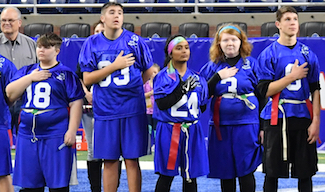
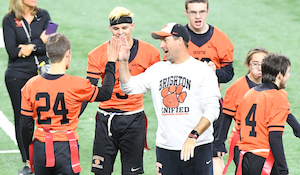
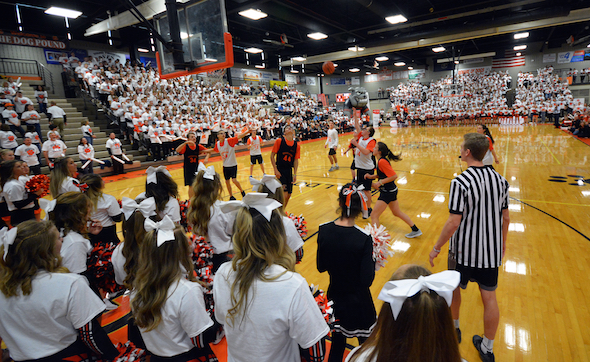
PHOTOS: (Top) Unified teams from Brighton and Mason/Holt play during the second day of the MHSAA 11-Player Football Finals at Ford Field. (Top middle) Participants from those three schools and Sparta took part in the morning's games. (Middle) Sparta athletes stand together for the national anthem. (Below middle) A Brighton coach and players exchange high fives. (Below) Brighton's Unified basketball team plays during a celebration for receiving national recognition last fall. (Photos by John Johnson.)
Wozniak 'Crew' Serves Together in Stripes
May 1, 2019
By Tim Miller
Mio teacher, former coach and graduate
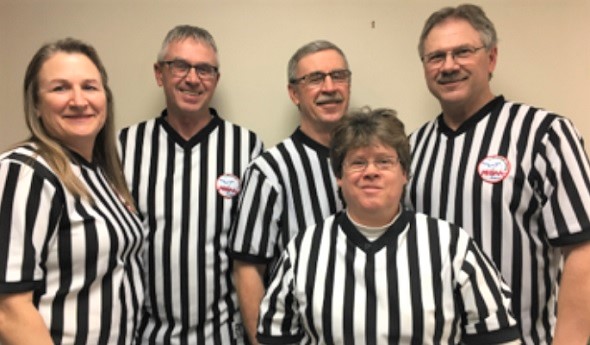
If you were to attend a high school basketball game in northeast Michigan, or watch the local sports highlights from the evening on TV, you might see a member of the Wozniak family running up and down the basketball court.
You won’t see them dribbling the ball, or pulling up for a jump shot. The pressure to get a rebound, or to play defense, is no longer part of the game plan for them. The red jersey they once wore so proudly in high school has been replaced by a black and white uniform that’s worn only by referees.
Take a drive north on M-65 and you will eventually reach the home of the famous Potato Festival, located in Posen, Michigan. Don’t expect to see a McDonald’s, Subway, or even a stoplight when you arrive. The town consists of a few small businesses, managed by a group of people who take pride in calling Posen their home.
One such family is Stanley and Virginia Wozniak, who just finished celebrating 68 years of marriage. During this time, they became the proud parents of Chuck, Ken, Cheryl, Frank, Donna, Mary Ellen, Michelle, and Linda.
Although I’ve never met Mr. and Mrs. Wozniak, it’s obvious to me, and anyone who knows their children, that they instilled some very important life lessons in them while raising them. One such lesson was getting involved. At one time Stanley was an official, so I guess it’s no surprise to see his children follow in his footsteps.
Living in northern Michigan during the winter can be brutal. Frigid temperatures and a large accumulation of snow can make it challenging. The key to surviving these long hard winters is staying busy. One such way is to attend a high school sporting event, and like so many people throughout the area, I watch as many games as I can.
Whether I’m attending a home game, or traveling out of town to an away game, it’s not uncommon to walk into a high school gym and see the Wozniak officiating crew from Posen standing courtside, patiently waiting to start the game.
What’s been striking to me over the years is to see them working as a unit, game after game. Rarely have I seen one of them working on another crew. Another lesson learned from home: family staying together. Years of experience has allowed them to officiate a regular-season game or much-anticipated playoff game with confidence.
When the game begins, I like sitting by myself. I look for the little things that players do or don’t do. I also watch the officials and compare my observations with their calls. Having watched them for many years in a variety of games, I’ve been impressed with their ability to call a game, regardless of whether it’s two teams battling to stay out of last place or a championship game packed full of screaming fans. Their passion for the game and commitment to getting it right has earned the respect of coaches, players and fans throughout northern Michigan.
They would be the first to admit they’ve made a mistake or missed a call here and there. Another lesson learned from home: be honest and stay humble. There have been games where the fans, players and coaches have disagreed with them, and a variety of facial expressions and comments have been made. It doesn’t stop them; they just keep moving forward.
They know this type of behavior comes with the territory, even though it’s the reason why so many officials have decided to quit. Another lesson learned from home: don’t give up.
 The same drive that earned Donna and Mary Ellen both Female Athlete of the Year at Posen Consolidated Schools – in 1978 and 1981, respectively – fuels them on the court. While attending a girls junior high game, I witnessed Donna put an end to a loud-mouth fan. She calmly stopped the game, walked over to him, looked him square in the eyes and said, “Are you done?”
To which he replied “yes.” After speaking with him and making her point, she continued to officiate the game all by herself. For some reason, she was the only official for the game. She didn’t complain or make excuses; she simply made the best of the situation in front of her. Another lesson learned at home: don’t complain and do your best.
I’ve also seen Mary Ellen straighten out a few coaches and players during her career. Like her sister Donna, she’s not afraid to put an end to poor sportsmanship during the game.
Being an official isn’t easy. They’re constantly under scrutiny and harassment by unruly fans, coaches and players. The sacrifices they make to officiate a game often go unnoticed or are rarely even discussed. I wonder how many dinners they’ve missed with their families.
The technology used at the games has changed over time. From the Kodak camera, to the 35 millimeter, to the camcorder. And now the popular cell phone, perhaps the best and worst device ever created. Now anyone can snap a picture or record a video of an official. Spend a few minutes adding disrespectful comments, and post it online. Even through this evolution of tasteless unwarranted behavior, the Wozniaks keep rolling on.
Like all officials, they don’t do it for the money! What little they make can’t possibly offset the cost of maintaining their vehicles, gas, tires and worn out parts along the way. They do it because they love and respect the game. As spectators, we often place the blame on officials when we lose. However, I’ve never heard anyone say we won because of the officials. In my 40-plus years of watching sports, I have never seen an official miss a free throw or turn the ball over during the game, nor have I seen an official play sloppy defense. I’ve never seen them get out-coached or out-hustled by the opposing team.
We also have a tendency to undervalue the officials. Instead, we put our focus on the coaches, players and the games. That all changes in a split second when we think a foul should be called. Then, all eyes are fixed on the official, and immediate results are expected. The official is expected to see everything, which is an unrealistic expectation.
As officials, the Wozniaks do an outstanding job. Running up and down the court with a whistle in your mouth can’t be easy. I wonder how many of us could do that. I can only imagine how many inadvertent calls would be made as we tried keeping up with the players. Trying to spot every rule infraction is impossible, and yet, they keep striving to do their best. They’re not perfect, nor would you ever hear one of them claim to be. However, they’re doing something that the majority of fans, coaches and players would never even consider! They’re willing to put that official’s uniform on and have the courage, determination and commitment to doing the best job they can.
Over the years, I’ve had the pleasure of getting to know them. They have the ability to look past those negatives. They choose to remember the big games, the respectful players, the quality coaches, the new friendships they made, and most important of all, spend time on the court with one another.
Here are some of their amazing accomplishments:
• Chuck has been an official for 46 years. During this time, he has officiated multiple playoff games for girls and boys basketball, including MHSAA Semifinal and Final games. He was the track coach at Posen Consolidated Schools for 38 years and is currently a member of the Posen Fire Department.
• Ken has been an official for 43 years. He has officiated multiple playoff games for girls and boys basketball as well, including Semifinal and Final games. He currently serves on the Posen Consolidated School Board and has for the last 19 years – 17 as school board president.
• Frank has been an official for 42 years and has been selected to work a Basketball Semifinal. He coached junior varsity boys basketball for four years and umpired youth softball and basketball for many more. He was also the director of the local softball tournaments in Posen for 13 years.
• Donna has been an official for 41 years, working multiple playoff games for girls and boys basketball including Semifinals and Finals – including a boys Semifinal. She may be one of the most respected officials in Michigan, at any level! She coached softball at Posen Consolidated Schools and coached youth softball and basketball in the community for many years.
 • Mary Ellen has been an official for 34 years and was selected to officiate a Girls Basketball Semifinal. She coached the varsity girls basketball team at Posen Consolidated Schools for nine years. She is currently an assistant coach for the Alpena Community College softball team.
• Linda officiated volleyball for 13 years. She volunteers at a variety of youth events throughout the community. She runs the scoreboard at athletic events, along with keeping the books. She is currently the class advisor for the graduating class of 2019 at Posen Consolidated Schools. She’s also involved in the chamber of commerce, where she served as treasurer for eight years.
• Although Cheryl doesn’t officiate, she’s involved in her community in many ways. She volunteers her time in the sports booster program and the little league programs. She was the secretary of the sports boosters for 15 years and selected as its “Volunteer of the Year.” She’s a strong supporter of promoting youth sports in her community.
• Michelle is also a strong supporter of youth programs in Posen and Alpena. She was selected as Female Athlete of the Year at Posen Consolidated Schools in 1983 and was appointed by former Governor Rick Snyder to serve on the Michigan Public Health Advisory Council. Like the rest of her siblings, she continues to stay involved in her community and volunteers in a variety of ways.
Aside from high school basketball games, the Wozniaks also have officiated other sports such as volleyball, track, and softball, and basketball at the college level.
I’m not sure how many more years the Wozniaks will continue to officiate. Hopefully for the coaches, players and fans, they’ll continue until they can’t run up and down the court anymore.
I can’t imagine how many whistles they’ve went through, or how many shoes they’ve bought along the way. The miles they’ve put on their vehicles, or the worn out tires they’ve replaced. The time they’ve missed with their families, or the TV shows they couldn’t watch. The quick meals eaten on the road, or the leftovers waiting at home.
Jonathan Lockwood Huie once said, “The path to your own happiness is usually found in service.” With all those years of officiating games and volunteering in their community, the Wozniaks understand the value of service. My guess is they’ve never heard of Johnathan Lockwood Huie, but his quote is deeply embedded in their DNA. They learned it from their parents; it’s the Wozniak way. Get involved, stay close to family and cherish your time together.
It’s the same formula that Stanley and Virginia used to spend 68 years together in marriage. So, Mr. and Mrs. Wozniak, thanks for teaching your children all those life lessons. To their spouses and families, thanks for sharing them. To the Wozniak crew, thanks for all the years you’ve dedicated to high school sports!
I can only imagine what they’ve seen and experienced during this time span. My guess is they could write a book filled with memories. The long drives, the late nights, the fall colors, the cornfields, the pumpkin patches, the icy roads, the snowstorms, the road construction, the price of gas, the vehicle mishaps, the missed deer, the big bucks, the coaches both good and bad, the great players and the not-so-great, the big games, the ejections, the technicals, the broken scoreboards, the athletic directors, the uniform styles, those ugly tube socks, the hairstyles, the rule changes, the news clips, the gyms, the good fans and the bad ones, the songs on the radio, the tickets, those aching body parts, who drove the most, who napped the most and the friendships made along the way.
Finding a family like the Wozniaks is rare. Becoming an official is one thing; doing it for 30 to 40 years is remarkable. What an impressive run – what a commitment to high school sports. So many games, so many stories, a lifetime of memories in the gym, on the track, at the softball field and in the car.
Eventually, the time will come when they decide to hang up their whistles for good. After it happens, I can picture them all sitting around the table on a cold winter night, drinking a cup of hot coffee, reflecting on their careers and all those games, all those memories, all those years, the stories, the laughs, and the time spent together as a family.
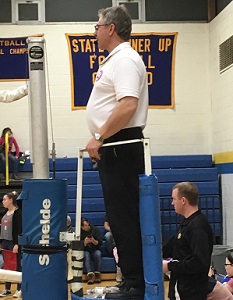
PHOTOS provided by Tim Miller.