

10 to Remember: Spring 2015
June 25, 2015
By Geoff Kimmerly
Second Half editor
The close of June officially ends of another school year. And this season’s MHSAA Finals provided another strong finish with a number of memorable moments sure to be recalled for years to come.
Below is one person’s list of the 10 most significant, drawn from the title-earning performances of 129 teams and hundreds of individuals this spring.
10. Rockford Holds On for Third Straight Girls Lacrosse Title
The Rams saw an 8-1 lead dissolve to a one-goal advantage after Bloomfield Hills Marian scored in the 22nd minute of the second half of their Division 1 Final. Rockford goalie Katie Elwell turned away a shot to tie the game with 55 seconds left, and her team won a jumpball deep on its side of the field with 36 seconds to play to hold on to a 10-9 victory – and claim a third straight MHSAA championship. Rockford is one of three programs to win four MHSAA titles during the 11 seasons of tournament sponsorship. Marian is a two-time runner-up.
9. Hartland Baseball Goes 10 Innings to Win First MHSAA Title
Hartland scored in the first inning of the Division 1 Final in pursuit of its first MHSAA championship in the sport – but then didn’t score again until the bottom of the 10th inning. Junior pitcher John Baker threw all 10 innings for the Eagles, allowing only five hits and striking out 11 batters, and he also had two hits and drove in the game’s first run. Portage Northern also was making its first MHSAA Final appearance in baseball.
8. Northville Girls Tennis Joins First-time Champs; Nguyen Joins Elite
The Northville girls tennis team was one of 32 teams over all sports that won their first MHSAA championships during the 2014-15 school year. The Wildcats finished an impressive five points ahead of Midland Dow, winning three doubles and two singles flights. Utica’s Davina Nguyen, meanwhile, finished as one of the most accomplished champions in MHSAA history, becoming only the sixth player to win at least three titles at No. 1 singles. Nguyen also won in Division 1 as a freshman and junior.
7. Cranbrook Kingswood Regains Boys Lacrosse Title on Last-Second Winner
Johnny Wagner scored 177 goals over his three-season varsity career for Bloomfield Hills Cranbrook Kingswood, but his last had to be the most spectacular. Three days after sending the Cranes to the Final with an overtime game-winning goal, Wagner scored in the Division 2 championship decider with 10.5 seconds to play to give his team the final edge in a 10-9 victory over Okemos. The winner was his fifth goal of the game.
6. Gull Lake Girls Soccer Wins Again on Shootout Success
The only shots to find the net in the Division 2 Final came during an overtime shootout won by Gull Lake to give the Blue Devils a 1-0 victory and their third straight MHSAA championship. That’s not to say the game lacked for excitement, with the teams combining for 37 shots. Gull Lake had also won its Regional Semifinal in a shootout and finished the spring 25-1-1. Fenton was making its first MHSAA Finals appearance in the sport, seeking its first title in any sport since 1993.
5. Warren Regina Softball Stuns After Slow Start
Teams that open 3-11 usually don’t finish as championship contenders – but those teams don’t have the MHSAA’s winningest coach, Diane Laffey, running the show to go with a strong group of upperclassmen who emerged from a competative Detroit Catholic League Central. Regina won its sixth MHSAA title and first since 2007 by downing favored Caledonia 5-0 in the Division 1 Final. Senior Marissa Tiano struck out nine batters in giving up only two hits after giving up only four hits in a 7-1 Semifinal win over Mattawan.
4. DeWitt Boys Golf Sticks Winning Shots; Carlson Goes All-Time Low
DeWitt senior Geoffry Croley birdied off the flagstick on the No. 18 hole at Forest Akers East to help the Panthers edge Cranbrook Kingswood 594-595 and claim the Lower Peninsula Division 2 title, its first since 2011. His younger brother, freshman Joey, made par on his final hole (No. 16) to also help secure the win. Meanwhile, Hamilton’s Nick Carlson finished his high school career with a second individual title and the all-time low 36-hole score in MHSAA Finals history, a 134, to edge Matt Harmon’s 135 for East Kentwood in 2001.
3. Saline Unbeatable in Claiming First Girls Soccer Title
The Hornets compiled one of the most impressive seasons in MHSAA girls soccer history in making their first Final and then winning it. Saline gave up a mere four goals – tied for third-fewest in MHSAA history – in 25 games and finished with a 22-0-3 record capped by a 4-0 win over Grand Blanc in the Division 1 championship game. The team’s 22 shutouts also rank tied for third in MHSAA girls soccer history. Senior Taylor Mulder set a school record with 43 goals this season with her second of this game.
2. Legend of Beaubien Grows with Monroe St. Mary Softball Title
Meghan Beaubien already was known by those who follow softball statewide – not many sophomores get a chance to commit to the University of Michigan so early. But what she and the Kestrels did in winning the program’s first MHSAA championship was pretty legendary. Monroe St. Mary Catholic Central outscored its postseason opponents by a combined 29-0 over seven games, beating Bronson 2-0 in the Division 3 Final with Beaubien taking a perfect game into the seventh inning and hitting a two-run homer.
1. Fisher, Saline Finish Strong in Boys Track and Field Final
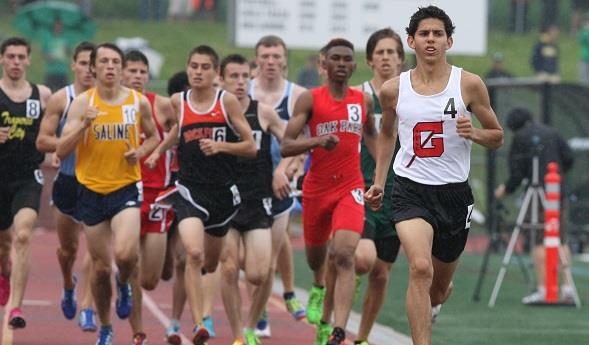
The Lower Peninsula Division 1 Final was filled with notable finishes – including a pair that will be listed in the national record book next month. Saline won its second MHSAA title in the sport and first since 2006, finishing ahead of East Kentwood – champion five of the last six seasons. The Hornets were keyed by a 3,200 relay of Logan Wetzel, Josiah Humphrey, Austin Welch and Kevin Hall that finished in 7:38.97 to rank among the best all-time in U.S. high school history Grand Blanc senior Grant Fisher posted the second-fastest 1,600 time in U.S. high school history, going 4:00.28.; he graduated with five individual MHSAA Finals titles. Grand Rapids Kenowa Hills’ Donavan Brazier also re-set the all-Finals record in the 800, running 1:48.98.
PHOTO: Grant Fisher, far right, set an MHSAA all-Finals record in the 1,600 that also ranks as the second-fastest in U.S. high school history. (Click to see more from RunMichigan.com. Photos by John Brabbs.)
Officials Eager for New Hockey Format
July 12, 2019
By Rob Kaminski
MHSAA benchmarks editor
Tuesday, Feb. 26, was a particularly busy day on the ice as the 2019 MHSAA Ice Hockey Tournament reached just its second day around the state.
On the slate that night were 27 Regional games, bringing the two-day total to 48 on the heels of Monday’s busy calendar.
As teams were busy setting their sights on the ultimate goal, so, too, was another group of accomplished skaters who toil with much less fanfare. Nonetheless, the games can’t start without them – the folks in the striped shirts who call the games.
Just as players and coaches will welcome the expanded playoff format in 2020, the officials are looking forward to the change as well.
“When we got to the first week of the tournament, it seemed like we were going every day,” said Jim Gagleard, who assigns officials for the Livonia Ice Hockey Officials Association. “There are only so many officials to go around in any sport. By allowing us as officials a day or two to catch our breath, it’s good. Good for us, and good for players more than anything.”
If it seemed like every day, well, it was. A total of 66 games were played over the first three days, and 89 over the first four. Considering each game at the Regional level has three officials, that computes to 267 officials needed during that span. On the busiest day, 81 had to take to the ice.
Given that there were a total of 302 playoff-eligible officials in 2019, filling those slots can be a logistical nightmare for assigners at times.
“Regional week will see a huge burden alleviated for officials and especially assigners. There will be so much more flexibility under the new format,” said Dan DiCristofaro, President of the Northeast Hockey Referees Association. “Last year, we were faced with so many doubleheaders at single sites, and the first games needed an early start so that the second games would not last late into the evening on school nights.
“At times, the most important factor for the assigner was scheduling those officials who could get to the arena for the early start times. Merit and ability sometimes had to take a back seat.”
Gagleard agrees, saying, “Assigning-wise, early games are the toughest to fill. Everyone has a job, and in order to work a game they have to tell the boss they’re leaving at 2:30 for a 5 o’clock game. You start to look for officials who are retired, or can get out of work, instead of the most qualified. That’s not fair to the teams playing.”
In the northern reaches of the Upper Peninsula, the problem is more acute.
Sean Jacques is the athletic director at Calumet, and also an experienced official, having skated the Division 2 Final in Plymouth in 2016.
“Not enough,” Jacques said, in reference to the number of playoff officials in the UP. “Not enough. When I get the list of eligible officials that is sent to tournament managers, I have to search and scramble to find three people within an 80-mile radius.”
Moving the Quarterfinals to the weekend will definitely help matters, and eliminating Regional doubleheaders should ease the scheduling anxiety as well.
 “With Regionals spread out more, without doubleheaders, officials potentially could work more days,” Jacques said. “And there should be more availability for the Quarterfinals. The last few years, it was in the Sault, and getting four guys to the Sault on a weeknight, whether from Escanaba or northern lower Michigan, was difficult. There were times I’d turn down a Quarterfinal because I just couldn’t get there and back and make it to work the next day. Saturday makes it easier.”
On the west side of the Lower Peninsula, assigner Randy Sheahan uses a mathematical approach to illustrate his challenges, even for the regular season. Sheahan calculates that 98.88 percent of all West Michigan games are scheduled for Wednesday, Friday, or Saturday. Breaking it down further, 84.39 percent skip Wednesday and schedule only Friday or Saturday.
With the shortened regular season coming in 2019-20 to allow for a three-week tournament window, Sheahan took a proactive approach.
“When the MHSAA announced the change to a three-week tournament, I emailed all West Michigan coaches, plus a handful of athletic directors and booster leaders who may be involved in team scheduling,” Sheahan said. “I encouraged them if they are having difficulty squeezing all their games into a window which is now one week shorter, to give further consideration to playing on Mondays, Tuesdays, or Thursdays to greatly alleviate some of the stresses we place on the West Michigan officiating staff.”
As for the MHSAA Tournament, Sheahan agrees with his brethren across the state in metro Detroit that the expansion will benefit assigners, officials, and teams.
“I only see positives,” Sheahan said. “This gives me tremendous flexibility with our staff to maneuver around their professional and personal schedules to keep our best officials on the ice every round, which is an expectation teams have for playoffs. It also provides (at times) much needed rest for officials and teams, especially if they are involved in overtime affairs. This could help with the quality of overall game play.”
That’s the goal for everyone. Fresher legs for players and officials alike will provide a better experience for all involved.
“This allows for physical recovery for everyone on the ice,” said DiCristofaro. “It also allows for better time management for student-athletes, officials and coaches. Even at the Quarterfinal offerings with four officials for each game, we’d run into issues as far as which people could get to places, or wanted to travel and skate late on a work night. Saturday give us much more flexibility and should create more interest in the state tournament.”
The Quarterfinals, Semifinals and Finals have employed a four-official system in recent years, affording an extra position each game for deserving officials while adding to the quality of the game for participants at the highest level.
Sheahan plans to utilize the new format to continue to reward those among his troops who have earned their stripes for such contests.
“In theory, I may have opportunities to increase game counts for some of our perennial playoff officials, but I have no plans to do that,” Sheahan said. “We have other officials every season who are good enough to skate playoffs and have earned it, but simply couldn’t quite break the playoff bubble. Now the opportunity presents itself to reward some of those officials. It would be counterproductive to officiating development if fewer officials are getting opportunities for important games.”
Similarly, DiCristofaro is hoping the time will come when four officials will be assigned to skate Regional Finals, and perhaps the new length of the postseason will open the door.
“Some of most important games are the Regional Finals. Maybe this new schedule can help,” DiCristofaro said. “Four officials offer teams the best possible ice coverage, and they deserve that.”