


AD Inducted to National Hall of Fame
May 7, 2014
By Geoff Kimmerly
Second Half editor
Winter gets hectic so quickly that we’re forced to save some intriguing items that come our way for a sunnier day – and that day is today.
Following are news, notes and a few key links collected over the last few months, including the national Hall of Fame induction of a longtime Michigan athletic director, local recognition for another and statewide acclaim for a group of students putting their video production equipment to good use benefiting all.
Ann Arbor AD Honored Nationally
Former Ann Arbor Huron athletic director Jane Bennett was among five inducted into the National Interscholastic Athletic Administrators Association Hall of Fame in December.
Bennett served 26 years as a teacher, coach, athletic director and assistant principal in Michigan before spending the last decade as a principal at two schools in Montana. She served as athletic director at Huron for 15 years through 2002-03. The NIAAA reported that during her final decade in that position, participation in athletics doubled.
Bennett, who received her bachelor’s and master’s degrees from the University of Michigan, began her career at Huron in 1977 as varsity softball coach and became a math teacher and the co-director of athletics a year later. She coached the softball team 14 seasons before moving into the full-time athletic director position. Bennett was co-founder of the Michigan High School Softball Coaches Association and served as MHSSCA president from 1982-87.
Among other achievements at Huron, Bennett was a leader in a successful campaign to gain voter approval of a $60 million bond package, which included $20 million to improve and expand athletic facilities. She also developed curriculum for an annual varsity captains/head coaches leadership training program and composed handbooks/guidebooks for coaches, athletes and parents.
Bennett also was a valuable contributor to the Michigan Interscholastic Athletic Administrators Association and the NIAAA. She was president of the MIAAA in 1993-94 and a state conference speaker on several occasions. Bennett also served in various NIAAA leadership positions including on the committee that developed the Leadership Training Institute in 1996.
Bennett was named MIAAA Athletic Director of the Year in 1998 and received its State Award of Merit in 1997. She received the MHSAA’s Women in Sports Leadership Award in 1995 and was inducted into the MHSSCA Hall of Fame in 1995. Prior to her selection to the NIAAA Hall of Fame, Bennett was honored with the NIAAA Distinguished Service Award in 1998 and the NIAAA Thomas E. Frederick Award of Excellence in 2000. In 2005, she was inducted into the National Council of Secondary School Athletic Directors Hall of Fame, having served as its president in 2003 and been selected as its Athletic Director of the Year in 1998.
PSL's Ward: 'Pillar' of Detroit Athletics
Alvin Ward, the executive director of athletics for the Detroit Public School League and a member of the MHSAA Representative Council, received a 2014 Pillar in the Community Award in April from the Coast II Coast All-Stars, a Detroit-based pro basketball team that plays in the American Basketball Association.
Ward has served as a teacher, assistant principal and principal as well for Detroit Public Schools, and directs programs with a combined 500 coaches and 4,500 athletes.
Linked up
- This winter, the MHSAA Representative Council adopted a number of football practice rules changes aimed at improving player acclimatization at the start of fall and reducing head trauma and injuries. The Adrian Daily Telegram’s Doug Donnelly got responses from a number of coaches from that area of the state; click to find out why they feel these changes are important.
- Port Huron Times Herald writer Paul Costanzo let people know about our Student Advisory Council through the experience of Marlette’s Connor Thomas, one of our juniors and a great contributor this school year.
Power of Awareness
The Kimberly Anne Gillary Foundation works to educate Michigan schools on sudden cardiac arrest and train personnel in CPR and the use of an AED (automated external defibrillator). The video below teaches us again about the importance of awareness.
Saginaw Heritage was awarded $5,000 in April as the winner of the Gillary Foundation’s High School AED Contest. Students were asked to create a 3-minute video emphasizing the importance of Michigan high schools being adequately prepared to respond to a sudden cardiac arrest or related event on school property.
Randy and Sue Gillary created the foundation after their 15-year-old daughter Kimberly – an athlete at Troy Athens – died after suffering sudden cardiac arrest in 2000. The contest judges were Kimberly’s sisters Emily Kucinich, Jennifer Gregroy and Katie Gillary.
As of April 1, the Gillary Foundation had raised $1.2 million and donated 650 AEDs to schools – with three lives having been saved with donated AEDs. For more, click www.kimberlysgift.org.
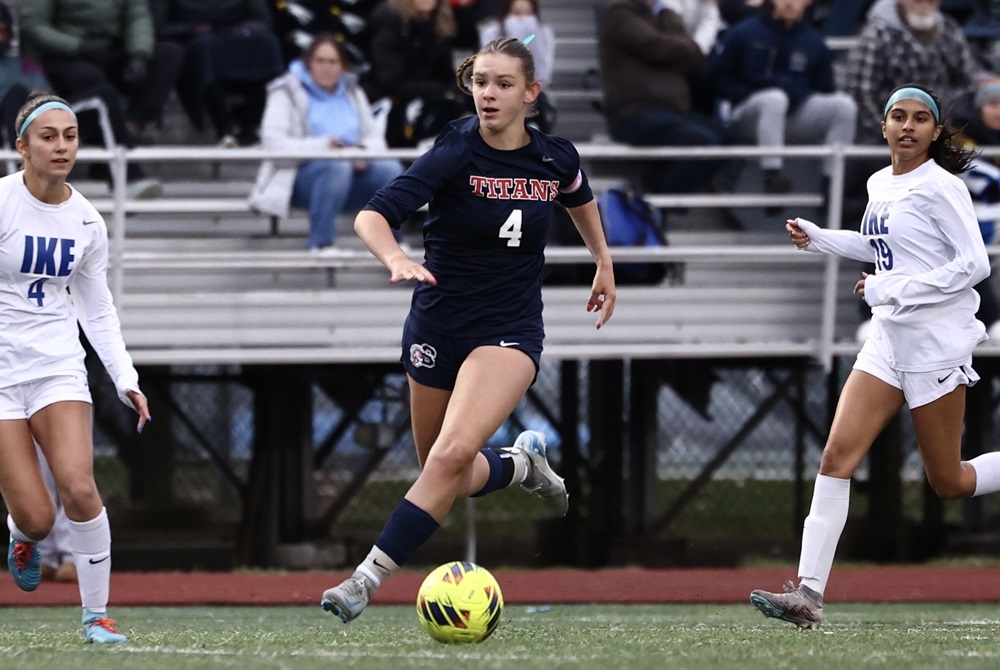
Performance of the Week: Sterling Heights Stevenson's Presley Jones
April 16, 2025
 Presley Jones ♦ Sterling Heights Stevenson
Senior ♦ Soccer
Jones netted both goals in her team’s 2-0 win over Grosse Pointe South on April 9 to become her school’s career scoring leader. She entered the match with 48 career goals, having tied the record set in 2006, and finished the win with 50 over her four varsity seasons.
The senior forward broke through with 15 goals as a sophomore and then set Stevenson’s single-season scoring record with 28 more goals last spring. She made the Division 1 all-state first team last year and has committed to continue her academic and soccer careers at Lawrence Tech. Stevenson is 4-2-1 this season after Wednesday night’s win over Grosse Pointe North.
@mhsaasports ⚽️POW: Presley Jones #SHStevenson #soccer #goal #recordbreaker #alltime #leadingscorer #part1 #highschoolsports #tiktalk #interview #performanceoftheweek #mistudentaid #fyp #MHSAA ♬ original sound - MHSAA
@mhsaasports ⚽️POW: Presley Jones #boymeetsworld #alyssathompson #hamilton #drpepper #squishmallow #greysanatomy #emoji #part2 #performanceoftheweek #mistudentaid #fyp #MHSAA ♬ Monkeys Spinning Monkeys - Kevin MacLeod & Kevin The Monkey
Follow the MHSAA on TikTok.
MHSAA.com's "Performance of the Week" features are powered by MI Student Aid, a division within the Department of Lifelong Education, Advancement, and Potential (MiLEAP). MI Student Aid encourages students to pursue postsecondary education by providing access to student financial resources and information. MI Student Aid administers the state’s 529 college savings programs (MET/MESP), as well as scholarship and grant programs that help make college Accessible, Affordable and Attainable for you. Connect with MI Student Aid at www.michigan.gov/mistudentaid and find more information on Facebook and Twitter @mistudentaid.
Previous 2024-25 honorees
April 11: Olivia Jasniewicz, Troy soccer - Report
March 27: Katie Spicer, Fowler basketball - Report
March 21: Moses & Markus Blackwell; Warren Lincoln basketball - Report
March 13: Keyshawn Summerville, Lansing Sexton basketball - Report
March 6: Maggie Buurma, Fowlerville wrestling - Report
Feb. 28: Maren Studt, Pontiac Notre Dame Prep skiing - Report
Feb. 21: Olive Krueger, Marquette swimming - Report
Feb. 14: Hunter Lemmon, Fraser swimming - Report
Feb. 7: Aubrey Hillard, Rochester competitive cheer - Report
Jan. 31: Wyatt Spalo, Reed City wrestling - Report
Jan. 24: Olivia Flynn, Harbor Springs basketball - Report
Jan. 17: Levi Rozema, Holland Christian swimming - Report
Jan. 10: McRecco McFadden, Burton Bentley basketball - Report
Dec. 18: Nash Leonard, Bay City Western hockey - Report
Dec. 11: Blake Cosby, Dundee wrestling - Report
Dec. 4: Keaton Hendricks, Zeeland West football - Report
Nov. 29: Kate Simon, East Grand Rapids swimming - Report
Nov. 22: Ella Kokaly, Essexville Garber volleyball - Report
Nov. 15: Caroline Bryan, Grosse Pointe South swimming - Report
Nov. 8: Kaylie Livingston, Whitmore Lake cross country - Report
Oct. 25: Oliver Caldwell, Grand Rapids West Catholic tennis - Report
Oct. 18: Alex Graham, Detroit Cass Tech football - Report
Oct. 11: Victoria Garces, Midland Dow cross country - Report
Oct. 4: Asher Clark, Bay City John Glenn soccer - Report
Sept. 26: Campbell Flynn, Farmington Hills Mercy volleyball - Report
Sept. 19: TJ Hansen, Freeland cross country - Report
Sept. 12: Jordan Peters, Grayling soccer - Report
Sept. 6: Gabe Litzner, Sault Ste. Marie cross country - Report
Aug. 30: Grace Slocum, Traverse City St. Francis golf - Report
(Photos courtesy of Cindi Jones/Jones Photography.)