


AD Inducted to National Hall of Fame
May 7, 2014
By Geoff Kimmerly
Second Half editor
Winter gets hectic so quickly that we’re forced to save some intriguing items that come our way for a sunnier day – and that day is today.
Following are news, notes and a few key links collected over the last few months, including the national Hall of Fame induction of a longtime Michigan athletic director, local recognition for another and statewide acclaim for a group of students putting their video production equipment to good use benefiting all.
Ann Arbor AD Honored Nationally
Former Ann Arbor Huron athletic director Jane Bennett was among five inducted into the National Interscholastic Athletic Administrators Association Hall of Fame in December.
Bennett served 26 years as a teacher, coach, athletic director and assistant principal in Michigan before spending the last decade as a principal at two schools in Montana. She served as athletic director at Huron for 15 years through 2002-03. The NIAAA reported that during her final decade in that position, participation in athletics doubled.
Bennett, who received her bachelor’s and master’s degrees from the University of Michigan, began her career at Huron in 1977 as varsity softball coach and became a math teacher and the co-director of athletics a year later. She coached the softball team 14 seasons before moving into the full-time athletic director position. Bennett was co-founder of the Michigan High School Softball Coaches Association and served as MHSSCA president from 1982-87.
Among other achievements at Huron, Bennett was a leader in a successful campaign to gain voter approval of a $60 million bond package, which included $20 million to improve and expand athletic facilities. She also developed curriculum for an annual varsity captains/head coaches leadership training program and composed handbooks/guidebooks for coaches, athletes and parents.
Bennett also was a valuable contributor to the Michigan Interscholastic Athletic Administrators Association and the NIAAA. She was president of the MIAAA in 1993-94 and a state conference speaker on several occasions. Bennett also served in various NIAAA leadership positions including on the committee that developed the Leadership Training Institute in 1996.
Bennett was named MIAAA Athletic Director of the Year in 1998 and received its State Award of Merit in 1997. She received the MHSAA’s Women in Sports Leadership Award in 1995 and was inducted into the MHSSCA Hall of Fame in 1995. Prior to her selection to the NIAAA Hall of Fame, Bennett was honored with the NIAAA Distinguished Service Award in 1998 and the NIAAA Thomas E. Frederick Award of Excellence in 2000. In 2005, she was inducted into the National Council of Secondary School Athletic Directors Hall of Fame, having served as its president in 2003 and been selected as its Athletic Director of the Year in 1998.
PSL's Ward: 'Pillar' of Detroit Athletics
Alvin Ward, the executive director of athletics for the Detroit Public School League and a member of the MHSAA Representative Council, received a 2014 Pillar in the Community Award in April from the Coast II Coast All-Stars, a Detroit-based pro basketball team that plays in the American Basketball Association.
Ward has served as a teacher, assistant principal and principal as well for Detroit Public Schools, and directs programs with a combined 500 coaches and 4,500 athletes.
Linked up
- This winter, the MHSAA Representative Council adopted a number of football practice rules changes aimed at improving player acclimatization at the start of fall and reducing head trauma and injuries. The Adrian Daily Telegram’s Doug Donnelly got responses from a number of coaches from that area of the state; click to find out why they feel these changes are important.
- Port Huron Times Herald writer Paul Costanzo let people know about our Student Advisory Council through the experience of Marlette’s Connor Thomas, one of our juniors and a great contributor this school year.
Power of Awareness
The Kimberly Anne Gillary Foundation works to educate Michigan schools on sudden cardiac arrest and train personnel in CPR and the use of an AED (automated external defibrillator). The video below teaches us again about the importance of awareness.
Saginaw Heritage was awarded $5,000 in April as the winner of the Gillary Foundation’s High School AED Contest. Students were asked to create a 3-minute video emphasizing the importance of Michigan high schools being adequately prepared to respond to a sudden cardiac arrest or related event on school property.
Randy and Sue Gillary created the foundation after their 15-year-old daughter Kimberly – an athlete at Troy Athens – died after suffering sudden cardiac arrest in 2000. The contest judges were Kimberly’s sisters Emily Kucinich, Jennifer Gregroy and Katie Gillary.
As of April 1, the Gillary Foundation had raised $1.2 million and donated 650 AEDs to schools – with three lives having been saved with donated AEDs. For more, click www.kimberlysgift.org.

Musgrave's Iron Deficiency Work to Help Athletes 'Know If You're Low'
By
Tom Spencer
Special for MHSAA.com
November 5, 2021
Maya Musgrave wants every female high school cross country runner to know her story. And she wants to help everyone with a similar one.
 Boys, too, should take notice of what the Benzie Central senior has gone through. Her brothers already have. And, they got help.
Both the boys and girls Benzie runners have qualified for this weekend’s MHSAA Lower Peninsula Finals. The girls would not have made it without her leadership and contribution to the team. Perhaps the boys wouldn’t have either.
When she graduates in the spring, it won’t necessarily be Musgrave’s running performances people will remember. She’s in the process of starting a non-profit agency to create awareness for anemia and make iron blood testing free for future Benzie runners.
Now to her story. Musgrave started running cross country as a freshman. Her brothers Michael and Quinten also run for the Huskies.
Maya, who will be named to the academic all-state cross country team this weekend, got back into running her junior year, after recovery from an earlier surgery. She ran her best time of the season in the school’s first race.
But, Musgrave’s times dropped every race after. She and her coaches knew it wasn’t her training or effort. She and her family struggled with low energy and breathing difficulties.
 Upon receiving Musgrave’s blood test results, her personal physician actually asked Musgrave how she had been avoiding passing out. Her coaches wondered how it was possible she was staying awake during the day, let alone run.
Musgrave’s lab revealed she had iron levels just 10 percent of what they should be. She went through two iron infusions to get her levels to normal. Infusions are usually prescribed by doctors to treat iron deficiency anemia, or when needed to increase iron levels fast to avoid medical complications or a blood transfusion. They also are prescribed for iron deficiency anemia when dietary changes and iron supplements are not enough.
Her story has already led to iron testing of the entire Benzie girls team and some of the boys. Low iron levels are very common among female athletes, and to a lesser extent found among male runners. The testing revealed her brothers had low levels, as did half the girls team.
The cost of the testing was covered by Musgrave personally, with help from her family. The next step was to start the education process. She arranged to bring in Abigail Ellsworth, a local neuropathic doctor and acupuncturist, to speak to the team. Ellsworth also had volunteered her time to draw blood for the team testing.
Today, Musgrave is working with an attorney to set up her nonprofit called Know If You're Low. Once it is set up, the nonprofit will provide free iron testing and education for female runners at Benzie on an annual basis.
So others don’t have to, is Musgrave’s motivation.
“I just figured it had been a problem for girls in the past, it was obviously going to be with girls in the future as well, so I might as we’ll tell my friends about it and tell my teammates about it so they can get it checked and not have to worry about it like I did,” she said. “I didn’t want them to have to go through that.”
Her coaches, Asa and Traci Kelly, were among the first to suggest iron could be at the crux of her struggles. They’ve seen a lot of runners struggle with iron counts during their coaching and competitive personal running careers.
“She was at the point where we were consoling her after races and saying, ‘Hey, we’re sure this is what is going on,’” Asa Kelly said. “‘You just got to get tested.’”
Other than the extreme low levels, Musgrave’s story fits a pattern the Kellys have seen too often – watching times get slower without a known cause, thinking perhaps the athlete is not working hard enough and having kids quit the sport because of it.
 “A lot of coaches, a lot of athletes, a lot of parents just don’t understand how critical (iron levels are),” said Asa Kelly. “I think the biggest thing is back 30 or 40 year ago, you would just keep beating the horse.
“Low and behold many of these kids had underlying issues.”
The Kellys coach boys and girls cross country at Benzie. Their daughter Mylie broke the school record at the Regional last week and hopes to qualify for the all-state team again this year as a sophomore.
They’ve seen a couple of runners every year test low for iron when it was considered a possible culprit for decreasing performance. They can’t help but wonder what results would have shown if they had tested all the boys and girls every year. Musgrave may make that possible going forward.
“If coaches could be proactive with this kind of thing, imagine the difference in some of the lives of these kids you could make,” Asa Kelly said. “All of a sudden, ‘I just thought I was an OK runner on the team and I was just tired all of the time’ to maybe this kid has this untapped ability they are never going to discover just because of something that’s out of their control.”
Musgrave, who still takes iron supplements, has launched a website, KnowIfYoureLow.com.
“We figured that if people want to know more about this, there probably should be a website for them to go look at it,” Musgrave said. “It’s just a place that A, people can read information about this program, and B, donate if they want to. The money will go for paying for the actual blood test.”
Musgrave is undecided about college plans right how. Her coach believes she could land at one of the nation’s finest academic schools.
“She’s a spark plug,” Kelly said. “She’s a girl that is going to go places in this world for sure.
“She brings that poise, that confidence.”
 Tom Spencer is a longtime MHSAA-registered basketball and soccer official, and former softball and baseball official, and he also has coached in the northern Lower Peninsula area. He previously has written for the Saginaw News, Bay County Sports Page and Midland Daily News. He can be reached at [email protected] with story ideas for Manistee, Wexford, Missaukee, Roscommon, Ogemaw, Iosco, Alcona, Oscoda, Crawford, Kalkaska, Grand Traverse, Benzie, Leelanau, Antrim, Otsego, Montmorency, Alpena, Presque Isle, Cheboygan, Charlevoix and Emmet counties.
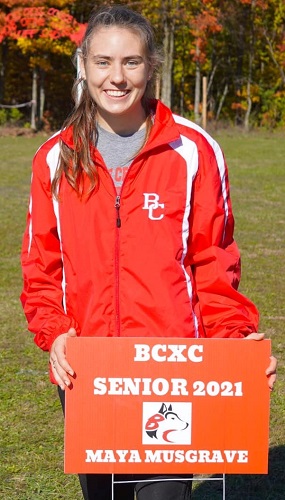
PHOTOS (Top) Benzie Central’s Maya Musgrave runs during a cross country race this fall. (Middle) Musgrave is a senior this season and forming a nonprofit to pay for iron deficiency testing for athletes. (Below) Musgrave, far left, with teammates Elise Johnson, Nora Grossnickle, Mylie Kelly, Ava Iverson, Hayley Vanwagoner and Ella Gaylord. (Photos courtesy of Benzie Central cross country program.)