

Add, Subtract, Divide, Multiply: MHSAA Not Alone
July 25, 2017
By Rob Kaminski
MHSAA benchmarks editor
This is the third part in a series on MHSAA tournament classification, past and present, that will be published over the next two weeks. This series originally ran in this spring's edition of MHSAA benchmarks.
As the MHSAA faces its most recent classification task with 8-Player Football, and opinions continue to swirl about as to the method, timeframe, location and other procedures, a look around the country provides plenty of company among state association brethren factoring variables into their own equations.
In the Pacific Northwest, the Oregon School Activities Association Football Playoffs are under public scrutiny as leadership ponders a five or six classification format beginning with the 2018-19 school year.
The OSAA has crowned six champions on the gridiron since 2006-07. Many of the state’s smaller schools would like to keep it that way, while larger schools lean toward a five-classification system, citing larger leagues, ease of travel and credibility to state championships as the advantages.
Still others would prefer more than six classes, pointing to safety issues and the opportunity to increase participation numbers as positives.
Moving southeast of Oregon, the Nevada Interscholastic Activities Association recently voted to hold serve on a classification proposal that was volleyed to the membership.
However, changes still could be forthcoming by as early as the 2018-19 season which would add a fifth classification in more populated southern Nevada while allowing northern schools to participate in four classifications. Such divisions could mean no state championship for the fifth class in southern Nevada.
Because of that, the NIAA wants equal numbers of schools in each classification on both ends of the state. Complicating the issue is the fact that the 24 largest schools in the state, by enrollment, are all in Clark County in Southern Nevada.
Across Nevada’s border into Arizona, charter schools are asking the Arizona Interscholastic Association to reconsider classification that was voted upon and approved in September 2015. That agreement called for the largest 33 percent of charter schools by enrollment to be placed in the state’s largest school classification, 3A, the middle 33 percent into 2A, and the smallest 33 percent into 1A.
Less than two years later the charter schools have had a change of heart and have asked to be considered the same as other Arizona public schools and be placed appropriately by enrollment beginning with the 2018-19 school year.
The situation in Arizona further illustrates how the public/private debate that all state associations have faced throughout existence now has the added dynamic of rapidly growing charter schools in today’s educational system, along with virtual school enrollment.
In the nation’s heartland, Nebraska has retooled its football classifications by using enrollment of boys students only in its schools rather than total enrollment. The Nebraska School Activities Association football-playing schools will kick off the 2018 season using this alignment.
Nebraska has three classes of 11-player football, with the smallest class divided in two, Class C-1 and C-2. The state also will have 8-player football for boys enrollments under 47, and the NSAA will sponsor a new 6-player tournament in 2018 for schools with 27 or fewer boys.
“This is a good proposal because some schools have a sizable imbalance between the number of boys and girls, and there’s a large gap (in enrollment) between the largest and smallest schools in Classes A and B,” NSAA executive director Jim Tenopir said. “I think this addresses both of those concerns.”
Swimmers in Georgia, meanwhile, will feel like they are moving with the current, rather than upstream in 2017-18, as the Georgia High School Association recently doubled the number of team championship events from two to four.
Swim enthusiasts can also count on longer days at the finals, as the top 30 finishers from the prelims will advance to the finals instead of 20, and all championship events will have three heats versus two.
Sister Pairs Help Bath Soccer Make Strides with 1st League, District Championships
By
Christine McCallister
Special for MHSAA.com
July 27, 2026
Although it still happens here and there, there once was a time – especially in small towns – when it wasn’t unusual to see multiple siblings on the same high school team.
 Part of that was practical. Families were often larger. Opportunities looked different.
But part of it was something deeper: community, continuity, and kids growing up together, not just in school, but in sports.
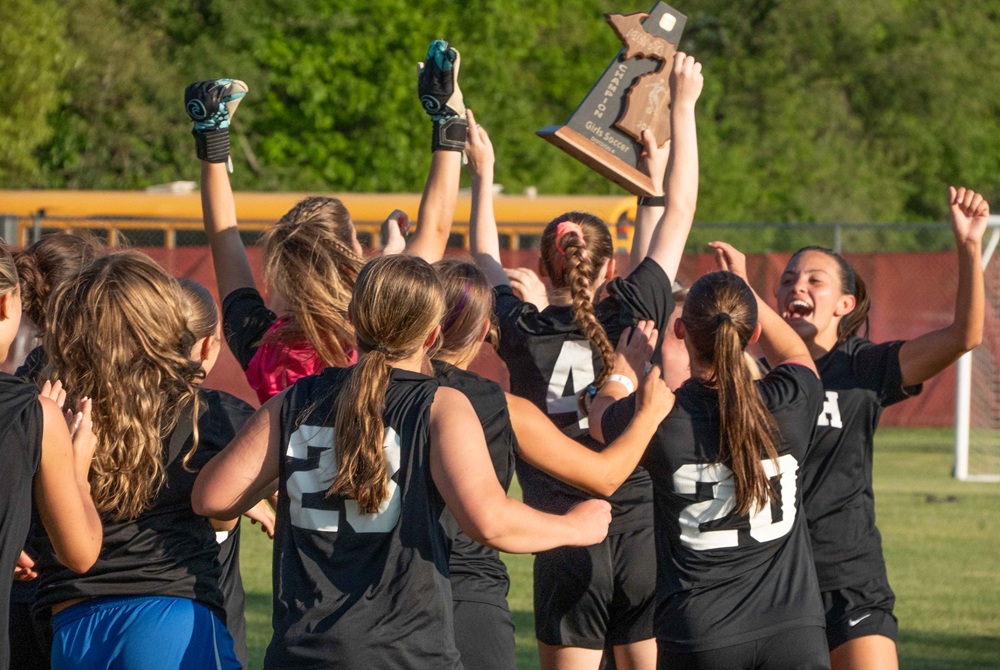
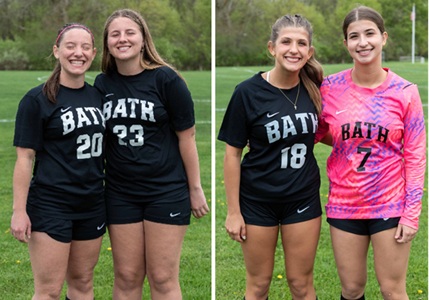
This spring, the Bath girls soccer team saw it come full circle. The Bees – who finished 15-2 and won Central Michigan Athletic Conference and Division 4 District championships under coach Sarah Murdoch – did so with five sets of siblings on their roster.
From freshmen to seniors, the five sets of sisters weren’t just on the same team – they were actively playing, contributing, and sharing the field together every single game.
“It has been something really amazing,” Bath assistant coach Megan Cook shared along the way. “I think it is really fun to watch how they push and support their siblings in their own unique way.”
The league and District titles were both program firsts for the Bees. Among those taking the field during the historic run were the following:
- The Kotch sisters – senior Angelynn and junior Electra.
- The Hamilton sisters – sophomore Sophia and freshman Ashlyn.
- The Barber sisters – senior Braelynn and freshman Jaydin.
- The Schneider sisters – junior Emily and freshman Isabella.
- The Montri sisters – senior Lydia and freshman Allie.
Together, they helped create a team dynamic that included younger sisters stepping into spaces they’d watched for years, and older sisters leading by example on an off the field. The families had spent seasons together in a way that went by too fast, as part of a program that has created room for connection and not just competition.
 There’s something powerful about sharing the same jersey, the same sidelines, the same wins and losses, with someone who knows you beyond the game.
What does it actually look like when five sets of siblings share the same field?
From warm-ups to drills to scrimmages, there’s a rhythm that’s a little different, and a little special. There’s built-in communication, quick understanding, and a level of trust that doesn’t need to be taught.
There’s a balance between familiarity and competition. Cook explained that each sibling set brought different personalities and energy to the field, which helped the athletes grow individually while still sharing that family connection.
“I believe the success of the girls soccer program can be directly attributed to the family atmosphere cultivated at the youth level. We’re very fortunate to have people like Steve Torok who work tirelessly to promote soccer at the youth level,” Bath athletic director Eric Harrelson said. “Younger sisters can see what a positive impact soccer has on their siblings and want to be a part of the program. Many of the younger sisters have watched their older sisters from the sidelines as ball shaggers and aspire to have the same success.
“Having five sets of sisters on the same team has been quite a unique phenomenon. The sense of pride that their parents have while watching their daughters play is obvious and infectious.”
Setting examples starts early
Torok, who directs the community’s youth program, described Bath soccer as something kids grow up around long before they officially join a team.
“A lot of these kids grow up on the sidelines watching older brothers and sisters play, helping at events, kicking balls around after games, and eventually they want to be part of it too,” he explained.
 “That kind of thing only happens when the environment is positive, welcoming, and fun for families year after year. To me, it really shows that Bath soccer has become more than just a sports program; it’s a community families want to stay involved with and keep coming back to.”
He also laughed about how younger sisters often end up following the same paths as their older siblings without anyone formally planning it.
“Younger sisters spend years around the fields watching games, hanging around practices, eating concession stand snacks, and tagging along to everything, so eventually they decide they want in too,” he noted.
Carolyn Hoard, who with Torok and others serves on the Bath Soccer Club board, shared that the excitement surrounding girls soccer often starts long before varsity.
She described the culture as “electric and contagious,” explaining that younger players grow up watching older girls compete, celebrate, work hard, and build friendships they hope to one day experience themselves.
“Growing up, my oldest daughter always talked about how she couldn’t wait to play on the varsity team,” Hoard shared. “Little did she know, in the background were her three little sisters watching her grow as a player and talk about her love of the game, which in return fueled their love and desire to play for BSC.”
Sisters tell their stories
When asked what it was like having a sister on the same team, the answers ranged from sweet to honest, with plenty of sisterly love mixed in.
Braelynn Barber shared that it was a good experience, even if her sister Jaydin could be a little annoying at times.
Emily Schneider described it as very eventful, while Lydia Montri said it was definitely entertaining.
Ashlyn Hamilton said it was fun, but as she passed the microphone to her goalie sister, Sophia, she admitted it could also be annoying sometimes. Sophia quickly added that it was frustrating being with your sister all day, every day.
Jaydin Barber summed it up simply as, “okay.” Meanwhile, Allie Montri said it was pretty cool.
As for their favorite memories, the answers were exactly what you might expect from a group of sisters – some funny, some sarcastic, and some simply different perspectives on the very same moment.
 Jaydin Barber shared that one of her favorite memories was scoring a goal and celebrating with a hug from her sister afterward. Braelynn Barber remembered that play a little differently, laughing that she passed the ball to Jaydin, who then kicked it right to the goalie – meaning no goal and no assist.
Allie Montri’s favorite memory came with a smile as she recalled being on the verge of scoring when sister Lydia swooped in and stole the goal. Coincidentally, that was Lydia’s favorite memory too (although Lydia remembers it as a great moment and was thankful for Allie’s assist).
Ashlyn Hamilton shared that scoring a goal and celebrating with a “scuba” was one of her favorite moments of the season. Sophia Hamilton quickly pointed out that it was her favorite memory too, joking that her little sister had stolen it.
For Isabella Schneider, a favorite memory was simply seeing one another on the field and sharing sister hugs afterward. Emily Schneider agreed, saying those moments stand out for her as well, while also looking ahead and noting that there are still more memories to be made.
And when asked whether she mostly sees sisters or simply one connected team when she looks out at the field as their coach, Cook’s answer was immediate:
“One team for sure,” she said.
“This team feels like they all are sisters together. I think that dynamic has helped lead us to so much success this year.”
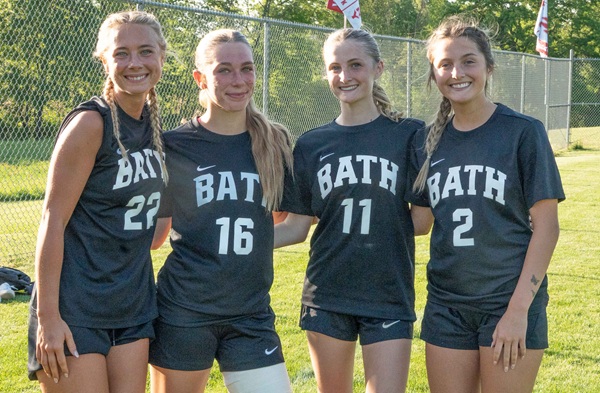
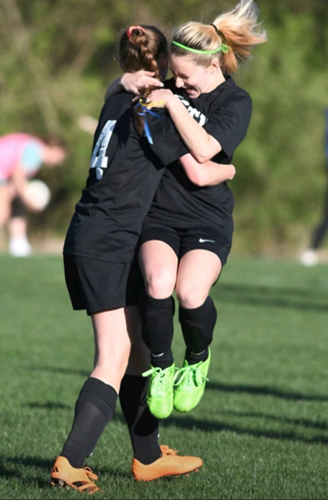
PHOTOS (Top) Bath players, including the Schneider sisters Emily (20) and Isabella (23), celebrate their District championship win May 31. (2) From left: Lydia Montri, Allie Montri, Jaydin Barber and Braelynn Barber. (3) Angelynn Kotch, right, jumps into sister Electra’s arms. (4) From left: Emily Schneider, Isabella Schneider, Ashlyn Hamilton and Sophia Hamilton. (Photos by Click by Christine McCallister.)