

Add, Subtract, Divide, Multiply: MHSAA Not Alone
July 25, 2017
By Rob Kaminski
MHSAA benchmarks editor
This is the third part in a series on MHSAA tournament classification, past and present, that will be published over the next two weeks. This series originally ran in this spring's edition of MHSAA benchmarks.
As the MHSAA faces its most recent classification task with 8-Player Football, and opinions continue to swirl about as to the method, timeframe, location and other procedures, a look around the country provides plenty of company among state association brethren factoring variables into their own equations.
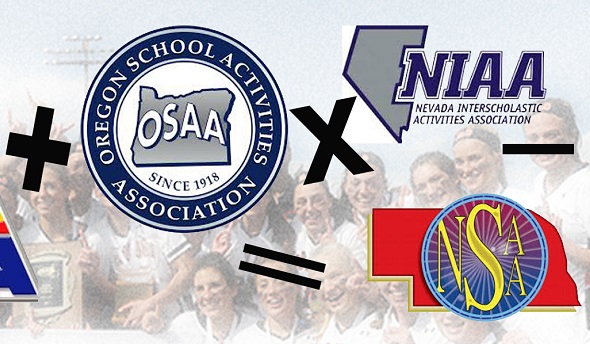
In the Pacific Northwest, the Oregon School Activities Association Football Playoffs are under public scrutiny as leadership ponders a five or six classification format beginning with the 2018-19 school year.
The OSAA has crowned six champions on the gridiron since 2006-07. Many of the state’s smaller schools would like to keep it that way, while larger schools lean toward a five-classification system, citing larger leagues, ease of travel and credibility to state championships as the advantages.
Still others would prefer more than six classes, pointing to safety issues and the opportunity to increase participation numbers as positives.
Moving southeast of Oregon, the Nevada Interscholastic Activities Association recently voted to hold serve on a classification proposal that was volleyed to the membership.
However, changes still could be forthcoming by as early as the 2018-19 season which would add a fifth classification in more populated southern Nevada while allowing northern schools to participate in four classifications. Such divisions could mean no state championship for the fifth class in southern Nevada.
Because of that, the NIAA wants equal numbers of schools in each classification on both ends of the state. Complicating the issue is the fact that the 24 largest schools in the state, by enrollment, are all in Clark County in Southern Nevada.
Across Nevada’s border into Arizona, charter schools are asking the Arizona Interscholastic Association to reconsider classification that was voted upon and approved in September 2015. That agreement called for the largest 33 percent of charter schools by enrollment to be placed in the state’s largest school classification, 3A, the middle 33 percent into 2A, and the smallest 33 percent into 1A.
Less than two years later the charter schools have had a change of heart and have asked to be considered the same as other Arizona public schools and be placed appropriately by enrollment beginning with the 2018-19 school year.
The situation in Arizona further illustrates how the public/private debate that all state associations have faced throughout existence now has the added dynamic of rapidly growing charter schools in today’s educational system, along with virtual school enrollment.
In the nation’s heartland, Nebraska has retooled its football classifications by using enrollment of boys students only in its schools rather than total enrollment. The Nebraska School Activities Association football-playing schools will kick off the 2018 season using this alignment.
Nebraska has three classes of 11-player football, with the smallest class divided in two, Class C-1 and C-2. The state also will have 8-player football for boys enrollments under 47, and the NSAA will sponsor a new 6-player tournament in 2018 for schools with 27 or fewer boys.
“This is a good proposal because some schools have a sizable imbalance between the number of boys and girls, and there’s a large gap (in enrollment) between the largest and smallest schools in Classes A and B,” NSAA executive director Jim Tenopir said. “I think this addresses both of those concerns.”
Swimmers in Georgia, meanwhile, will feel like they are moving with the current, rather than upstream in 2017-18, as the Georgia High School Association recently doubled the number of team championship events from two to four.
Swim enthusiasts can also count on longer days at the finals, as the top 30 finishers from the prelims will advance to the finals instead of 20, and all championship events will have three heats versus two.
Gordon to Receive MHSAA Hampton Award for Championing Unified Sports
By
Geoff Kimmerly
MHSAA.com senior editor
February 11, 2026
As athletic director at Novi High School a decade ago, Brian Gordon helped Michigan become a national leader in growing Special Olympics Unified Sports for students with intellectual disabilities. Nearly three years after retiring from school administration, he remains an impassioned advocate helping schools all over the state add these inclusive programs to their athletic offerings.
To recognize his pioneering and now continuing work in expanding these opportunities across the state, Gordon has been selected as the recipient of this year’s Nate Hampton Champion of Progress in Athletics Award by the Michigan High School Athletic Association.
The Hampton Award was created by the MHSAA’s Representative Council to honor Nate Hampton, who retired in 2021 after serving in education and educational athletics for 50 years, including the last 32 as an MHSAA assistant director. Honorees have championed the promotion and advancement of opportunities for women, minorities and other underrepresented groups within interscholastic athletics, while serving as an administrator, coach, official, educator or school sports leader in Michigan.
Gordon will receive the Hampton Award during the Michigan Interscholastic Athletic Administrators Association (MIAAA) annual conference, March 13-16 in Traverse City.
“To me, (Unified Sports) is absolutely the purest form of sport – what you’re supposed to get out of participating in athletics. Kids that participate in this program get every bit of that – teamwork, camaraderie, adversity, how to win, how to lose, being part of something bigger than yourself. It was, to me, just so impactful,” Gordon said. “The whole idea of more kids being involved in their athletic program, where they have the opportunity to play in front of their parents, being members of an athletic department at their school, to me was just incredible. … And the life lessons that kids learn, families learn, you can’t even measure them.
“It’s just a great, positive experience – for everyone.”
Gordon began his professional career in educational athletics in 1990 as a physical education and health teacher for Royal Oak Schools, and moved into his first athletic director/assistant principal role at Royal Oak in 2010. He left to become the director of athletic and physical education at Novi High School in 2012, retired from Novi at the end of the 2020-21 school year but then returned to Royal Oak as athletic director the following fall for two more years.
Unified Sports pair students with and without intellectual disabilities as teammates for training and competition. While at Novi, Gordon and Brighton athletic director John Thompson were inspired to bring Unified Sports not only to their schools, but to the Kensington Lakes Activities Association as a whole – and during the 2015-16 school year their schools were joined by Northville, Howell and Hartland in offering Unified teams, with the total soon growing to 13 KLAA schools. The KLAA, at Novi, hosted the first league tournament in the nation for Unified Sports teams – playing 21 basketball games during the inaugural event.
Also following his Novi retirement in 2021, Gordon became a liaison for Special Olympics of Michigan and Unified Sports. He meets with school administrators to promote Unified Sports and help districts build programs, and estimates there are more than 600 elementary, middle and high school Unified Sports teams across the state – with more than 100 high schools playing as part of leagues.
Current Unified offerings in Michigan include basketball, soccer and bocce, with track & field to be introduced this spring. Unified athletes have opportunities to play not just as part of leagues, but during special events like school-day assembly games and at venues like Little Caesars Arena in Detroit.
“Brian Gordon has spent more than 35 years promoting school sports and the athletes they serve, and who better to advocate for Unified Sports than someone who has dedicated his career to championing kids and creating opportunities for them to excel,” MHSAA Executive Director Mark Uyl said. “The MHSAA and the state’s school sports community have long benefitted from Brian’s positive approach and tremendous energy, and he’s poured all of himself into building bridges for Unified Sports in communities all over Michigan.”
In addition to his Special Olympics efforts, Gordon has served as a mentor for the MHSAA’s AD Connection Program since its creation at the start of the 2023-24 school year, working with first-year athletic directors as they transition to that role.
He’s also taught at the elementary and middle school levels, and supervised physical education and served as a health advisory chairperson at the district level. Including a season while still a college student, he has coached baseball, football, basketball and track & field from the junior high to varsity levels, including a stint as Royal Oak Kimball and Royal Oak High varsity baseball coach from 1995-2010. He was inducted into the Michigan High School Baseball Coaches Association Hall of Fame in 2011 and the Michigan High School Coaches Association Hall of Fame in 2021.
Gordon was selected for the MIAAA’s Jack Johnson Distinguished Service Award in 2021 and received an MHSAA Allen W. Bush Award in 2019 for his essential but often “behind-the-scenes” contributions to school sports. Previously, Gordon also was named Oakland County Athletic Director of the Year for 2018-19 by the Oakland County Athletic Directors Association, served as the OCADA president in 2014-15 and on its board from 2010-16, and also served as vice president of the Kensington Lakes Activities Association and president of the Kensington Conference. He has been a member of the MIAAA since 2008 and National Interscholastic Athletic Administrators Association (NIAAA) since 2010, and was named a Regional Athletic Director of the Year by the MIAAA in 2018.
“Being a recipient of the Nate Hampton Award – Nate has made such a difference in educational athletics in our state for so long, that it’s truly an honor to represent him in this award,” Gordon said. “I’m really proud of the fact that we’ve been able to make a difference in the state, just like he did, with Unified Sports.”
Gordon graduated from Clawson High School in 1985 and earned his bachelor’s degree at Central Michigan University – where he also played baseball – and master’s in sports administration and school leadership from Wayne State University. He earned his certified athletic administrator (CAA) designation from the NIAAA.
Prioritizing education and students has been a family focus for the Gordons; Brian’s wife Jill Gordon also is a retired teacher. They have two children – daughter McKenzie Ribbing and son Zachary Gordon, and retirement has allowed for more time with both as well as son-in-law Mike Ribbing and granddaughter Isabel.
The first Nate Hampton Champion of Progress in Athletics Award was presented in 2024.
Past recipients
2024 – Nicole Carter, Novi
2025 – Arnetta Thompson, Wyoming
(Photos courtesy of Brian Gordon.)