

Add, Subtract, Divide, Multiply: MHSAA Not Alone
July 25, 2017
By Rob Kaminski
MHSAA benchmarks editor
This is the third part in a series on MHSAA tournament classification, past and present, that will be published over the next two weeks. This series originally ran in this spring's edition of MHSAA benchmarks.
As the MHSAA faces its most recent classification task with 8-Player Football, and opinions continue to swirl about as to the method, timeframe, location and other procedures, a look around the country provides plenty of company among state association brethren factoring variables into their own equations.
In the Pacific Northwest, the Oregon School Activities Association Football Playoffs are under public scrutiny as leadership ponders a five or six classification format beginning with the 2018-19 school year.
The OSAA has crowned six champions on the gridiron since 2006-07. Many of the state’s smaller schools would like to keep it that way, while larger schools lean toward a five-classification system, citing larger leagues, ease of travel and credibility to state championships as the advantages.
Still others would prefer more than six classes, pointing to safety issues and the opportunity to increase participation numbers as positives.
Moving southeast of Oregon, the Nevada Interscholastic Activities Association recently voted to hold serve on a classification proposal that was volleyed to the membership.
However, changes still could be forthcoming by as early as the 2018-19 season which would add a fifth classification in more populated southern Nevada while allowing northern schools to participate in four classifications. Such divisions could mean no state championship for the fifth class in southern Nevada.
Because of that, the NIAA wants equal numbers of schools in each classification on both ends of the state. Complicating the issue is the fact that the 24 largest schools in the state, by enrollment, are all in Clark County in Southern Nevada.
Across Nevada’s border into Arizona, charter schools are asking the Arizona Interscholastic Association to reconsider classification that was voted upon and approved in September 2015. That agreement called for the largest 33 percent of charter schools by enrollment to be placed in the state’s largest school classification, 3A, the middle 33 percent into 2A, and the smallest 33 percent into 1A.
Less than two years later the charter schools have had a change of heart and have asked to be considered the same as other Arizona public schools and be placed appropriately by enrollment beginning with the 2018-19 school year.
The situation in Arizona further illustrates how the public/private debate that all state associations have faced throughout existence now has the added dynamic of rapidly growing charter schools in today’s educational system, along with virtual school enrollment.
In the nation’s heartland, Nebraska has retooled its football classifications by using enrollment of boys students only in its schools rather than total enrollment. The Nebraska School Activities Association football-playing schools will kick off the 2018 season using this alignment.
Nebraska has three classes of 11-player football, with the smallest class divided in two, Class C-1 and C-2. The state also will have 8-player football for boys enrollments under 47, and the NSAA will sponsor a new 6-player tournament in 2018 for schools with 27 or fewer boys.
“This is a good proposal because some schools have a sizable imbalance between the number of boys and girls, and there’s a large gap (in enrollment) between the largest and smallest schools in Classes A and B,” NSAA executive director Jim Tenopir said. “I think this addresses both of those concerns.”
Swimmers in Georgia, meanwhile, will feel like they are moving with the current, rather than upstream in 2017-18, as the Georgia High School Association recently doubled the number of team championship events from two to four.
Swim enthusiasts can also count on longer days at the finals, as the top 30 finishers from the prelims will advance to the finals instead of 20, and all championship events will have three heats versus two.
Cadillac Girls Take Back Title, Petoskey's Spence Completes Legendary Career
By
Jordan Puente
Special for MHSAA.com
February 27, 2024
HARBOR SPRINGS — The Cadillac girls ski team knew it couldn’t sneak up on anyone at Monday’s Division 2 Final, and rose to the challenge.
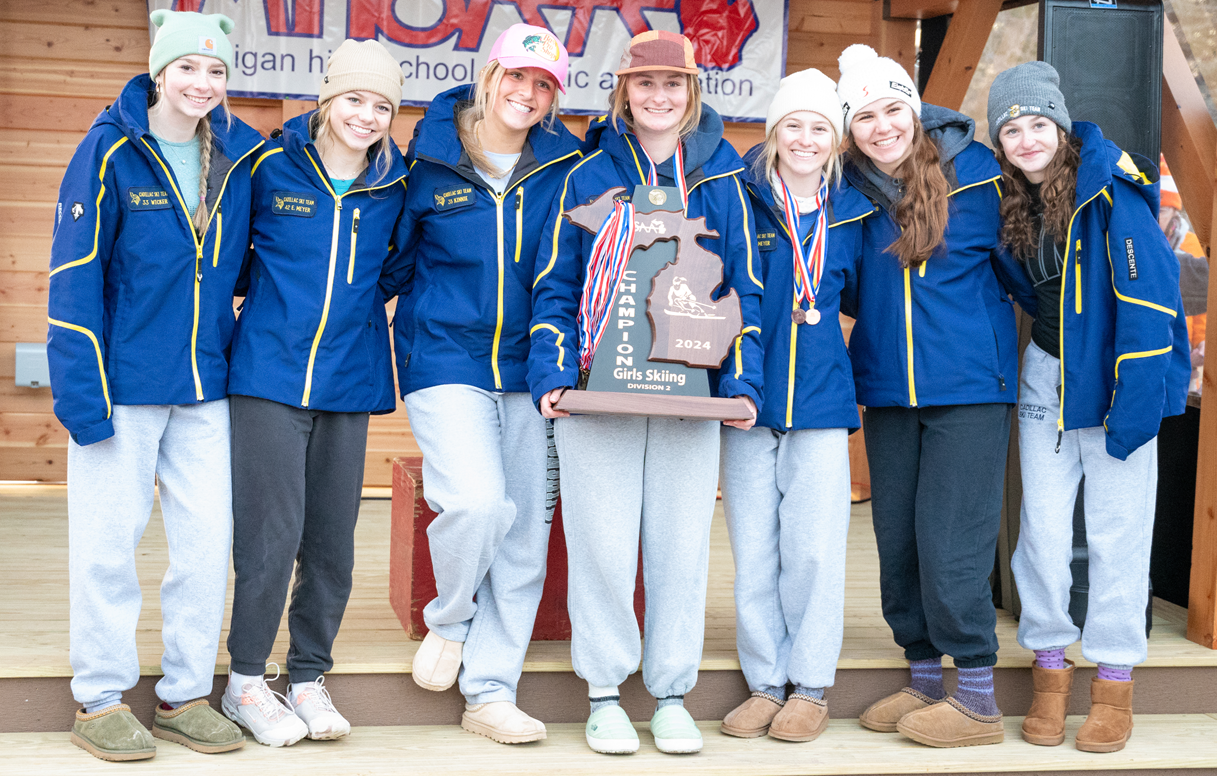
Cadillac walked away from Nub's Nob Ski Area and Resort in Harbor Springs with its second championship in three years and fourth-straight top-three finish. The Vikings finished with a combined team score of 72. Harbor Springs finished runner-up with a combined team score of 91.
Mattawan and Paw Paw placed third (107), Bloomfield Hills Marian finished fourth (168) and Norway finished fifth (171).
"A couple of years ago, we snuck up and got a ski title, but this year, we had more of a target on our backs knowing we had a pretty good team to do something special," Cadillac head coach James Netzley said. "It was a little nervous feeling today because of the start."
Netzley said his skiers made it a goal to repeat what they did in 2022 after finishing third last year.
"We said last night that it was going to take a complete team effort if we wanted to do something special today," Netzley said. "That came true, and we relied on every kid on the team."
 The Vikings started shaky at the slalom with a couple of falls, but in the end, several skiers pulled through. Senior Onalee Wallis led the Vikings with second-place finishes in the slalom and giant slalom. Wallis finished the slalom with a combined time of 1:12.63 and the giant slalom with a combined time of 51.67.
Wallis's teammate, senior Avery Meyer, finished third in the slalom with a combined time of 1:16.76. Great North Alpine's Grace Rowe finished fourth with a combined time of 1:17.46.
Rochester Adams' Katie Fodale finished third in the giant slalom (52.43), Meyer placed fourth (53.39), and Emma Borgula placed fifth in the giant slalom with a combined time of 53.97.
"They are pretty special kids," Netzley said about Meyer and Wallis. "Both have been first-team all-state for four years in a row, and gotten a top-10 finish since their freshmen year. Not many kids can do that by the time they come in as freshmen and cap off their senior year with outstanding performances."
Petoskey didn't have the outing it had hoped for, but senior Marley Spence stamped herself as one of the best high school athletes in the state after walking away with her fifth-straight D2 individual Finals medal after placing first in both the slalom and giant slalom. Spence finished the slalom with a combined time of 1:12.19 and giant slalom with a combined time of 51.17.
Northmen boys coach Ben Crockett, who leads the program alongside his sister and girls coach Jennifer Crockett, found no disagreement in naming Spence as one of the best individual athletes to come out of Petoskey, let alone the state.
"We've been trying to dig into the history books in Michigan, and she is definitely at the top of her group historically of anybody who has competed in a sport," Ben Crockett said. "She is the best in Michigan, and there is no question about it."
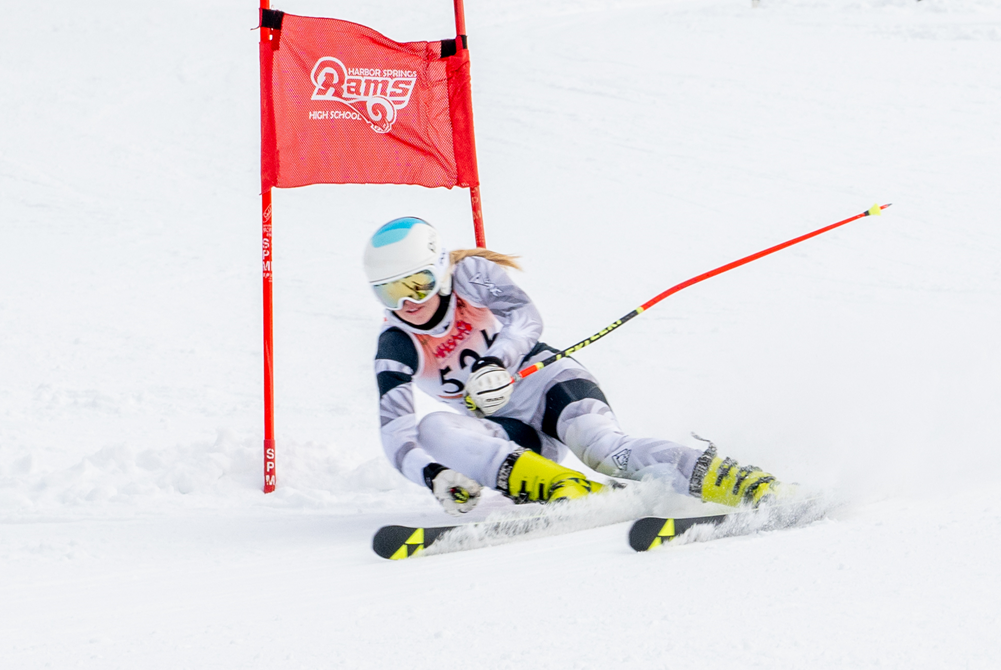
PHOTOS (Top) Petoskey’s Marley Spence races past a gate during the Division 2 giant slalom Monday. (Middle) Cadillac celebrates its second Finals team championship over the last three seasons. (Photos by Sarah Shepherd. Click for all photos.)