

Add, Subtract, Divide, Multiply: MHSAA Not Alone
July 25, 2017
By Rob Kaminski
MHSAA benchmarks editor
This is the third part in a series on MHSAA tournament classification, past and present, that will be published over the next two weeks. This series originally ran in this spring's edition of MHSAA benchmarks.
As the MHSAA faces its most recent classification task with 8-Player Football, and opinions continue to swirl about as to the method, timeframe, location and other procedures, a look around the country provides plenty of company among state association brethren factoring variables into their own equations.
In the Pacific Northwest, the Oregon School Activities Association Football Playoffs are under public scrutiny as leadership ponders a five or six classification format beginning with the 2018-19 school year.
The OSAA has crowned six champions on the gridiron since 2006-07. Many of the state’s smaller schools would like to keep it that way, while larger schools lean toward a five-classification system, citing larger leagues, ease of travel and credibility to state championships as the advantages.
Still others would prefer more than six classes, pointing to safety issues and the opportunity to increase participation numbers as positives.
Moving southeast of Oregon, the Nevada Interscholastic Activities Association recently voted to hold serve on a classification proposal that was volleyed to the membership.
However, changes still could be forthcoming by as early as the 2018-19 season which would add a fifth classification in more populated southern Nevada while allowing northern schools to participate in four classifications. Such divisions could mean no state championship for the fifth class in southern Nevada.
Because of that, the NIAA wants equal numbers of schools in each classification on both ends of the state. Complicating the issue is the fact that the 24 largest schools in the state, by enrollment, are all in Clark County in Southern Nevada.
Across Nevada’s border into Arizona, charter schools are asking the Arizona Interscholastic Association to reconsider classification that was voted upon and approved in September 2015. That agreement called for the largest 33 percent of charter schools by enrollment to be placed in the state’s largest school classification, 3A, the middle 33 percent into 2A, and the smallest 33 percent into 1A.
Less than two years later the charter schools have had a change of heart and have asked to be considered the same as other Arizona public schools and be placed appropriately by enrollment beginning with the 2018-19 school year.
The situation in Arizona further illustrates how the public/private debate that all state associations have faced throughout existence now has the added dynamic of rapidly growing charter schools in today’s educational system, along with virtual school enrollment.
In the nation’s heartland, Nebraska has retooled its football classifications by using enrollment of boys students only in its schools rather than total enrollment. The Nebraska School Activities Association football-playing schools will kick off the 2018 season using this alignment.
Nebraska has three classes of 11-player football, with the smallest class divided in two, Class C-1 and C-2. The state also will have 8-player football for boys enrollments under 47, and the NSAA will sponsor a new 6-player tournament in 2018 for schools with 27 or fewer boys.
“This is a good proposal because some schools have a sizable imbalance between the number of boys and girls, and there’s a large gap (in enrollment) between the largest and smallest schools in Classes A and B,” NSAA executive director Jim Tenopir said. “I think this addresses both of those concerns.”
Swimmers in Georgia, meanwhile, will feel like they are moving with the current, rather than upstream in 2017-18, as the Georgia High School Association recently doubled the number of team championship events from two to four.
Swim enthusiasts can also count on longer days at the finals, as the top 30 finishers from the prelims will advance to the finals instead of 20, and all championship events will have three heats versus two.
Rivalry Swings Back to Westwood as Patriots Earn 1st Finals Title Since 2021
By
Jason Juno
Special for MHSAA.com
October 1, 2026
NEGAUNEE — Ishpeming Westwood and Negaunee are 10 minutes apart, so they play plenty of tennis against each other whether it’s routine dual meets or the bigger ones with conference and Upper Peninsula championships on the line.
The Miners have been the one winning those meaningful meets lately with the last four U.P. Division 1 titles to their name.
This, however, was Westwood’s year.
The Patriots won the U.P. Finals on Tuesday for the first time since 2021, the last championship before Negaunee’s streak started, with wins in five of the day’s eight flights.
Their mentality was the key to their success this year, coach Sarah Zindler said, and it showed in the way they went up against the Miners.
“They weren’t scared to play Negaunee; they were excited to play Negaunee,” she said. “They were up for the challenge, they wanted to compete. When they were down in a match, they had that mentality of, ‘I can still win this,’ not the defeated (attitude) after you lose a point. That can sometimes be hard, especially for seniors on a U.P. Finals day where they know it’s their last matches.”
Eliisa Doney is one of those seniors. She talked about seeing Negaunee lifting up trophies in front of them in recent years. So, yeah, this one felt pretty good.
But regardless of the rivalry, she won at No. 2 singles after playing doubles the majority of her career. Her last memories of high school tennis at Westwood are pretty good.
“I’ve never been (a U.P. champion) individually or as a team before, so it’s an incredible feeling that I’ve never felt before,” she said.
Doney played doubles as an underclassmen, missed her junior year with an injury and then filled a spot as Westwood battled other injuries this season. She beat Negaunee’s Addie Chapman 6-2, 7-5 in their flight final Wednesday.
“She just took on the challenge and her first couple matches were a little rocky, but she had that competitive attitude of, ‘I’m gonna figure it out,’” Zindler said. “And now she’s a U.P. champ.”
So are many of her teammates.
Westwood’s Emmi Carlson won No. 3 singles and finished the season with just one loss. Despite that, she trailed Negaunee’s Lucy Rogers 5-2 in the first set of the final.
“And she told us, ‘I got this, I’m gonna win this set 7-5,’” Zindler said. “And she won the set 7-5. And that’s how she’s been all season. If she loses three or four games, she’s like, ‘It’s fine, no big deal, I got this.’”
Carlson won 7-5, 6-2.
Westwood’s Isabel Belpedio beat Negaunee’s Katie Carlson in their final to become the No. 4 singles champion. Belpedio went undefeated in her first year on varsity.
“I played a calm, consistent game,” she said. “I just played my best, and I gave what I had. It feels pretty great … like all the hard work I put in definitely (paid) off.”
“She has also just been steady and confident and knows how to play her game, doesn’t try to do too much and doesn’t let the other girls get in her head,” Zindler added.
The No. 3 doubles team of Emerson Williams and Samiah LaFreniere came out on top over Negaunee’s Bree Helppi and Audrey Hahn in their final despite entering as the third seed. They had lost to Negaunee just last week.
Williams was a part of the winning No. 4 doubles team last year. Since then, she suffered an injury and had to play this entire season left-handed, which is her non-dominant hand.
“They played a great semifinal match, and then in finals just looked like they were confident. They played the net well, they played smart from the back,” Zindler said. “They weren’t the unexpected victory but the wild card that we really needed today for our team.”
The winning No. 4 doubles team was Westwood’s freshmen Jenna Marana and Brie Mahaffey, who just picked up a racket during the summer.
“From the start of the season until now, they have just continually grown and improved,” Zindler said. “I just kept saying, ‘You guys are going to be there, you just got to keep working on it.’ And today, they're the best four doubles team.”
Kingsford junior Aubrie Moore repeated as a U.P. champion with a dominating 6-0, 6-0 win over Escanaba’s Anna Martin at No. 1 singles.
“I’m feeling good, I’m really happy and I’m glad,” Moore said. “It’s my second year, so I’m just really proud of myself. I think I really improved on my serving, and my forehand has gotten a lot better.”
Moore and the entire team played with “We play for her,” shirts with the initials GM in honor of her mom Ginger, who died after battling cancer earlier this year.
“Obviously my mom was by my side the whole time and helped me get through this and win,” Moore said.
Negaunee’s No. 1 doubles team of Paige O’Donnell and Olivia Richards won as juniors.
O’Donnell said Marquette has been tough for them and she was focused on doing well in their match to help out their entire team.
“We played Marquette a couple times, it’s always been super competitive, always super back and forth, usually going to some tiebreakers,” Richards said. “We were kind of expecting that going into it, but we saw their weaknesses in the first set and we knew we had to capitalize on those while also working together.”
Negaunee’s Maia Brunette and Aubrey Harper defeated Escanaba’s Isabella Noblet and Lily Benetti for the No. 2 doubles title.
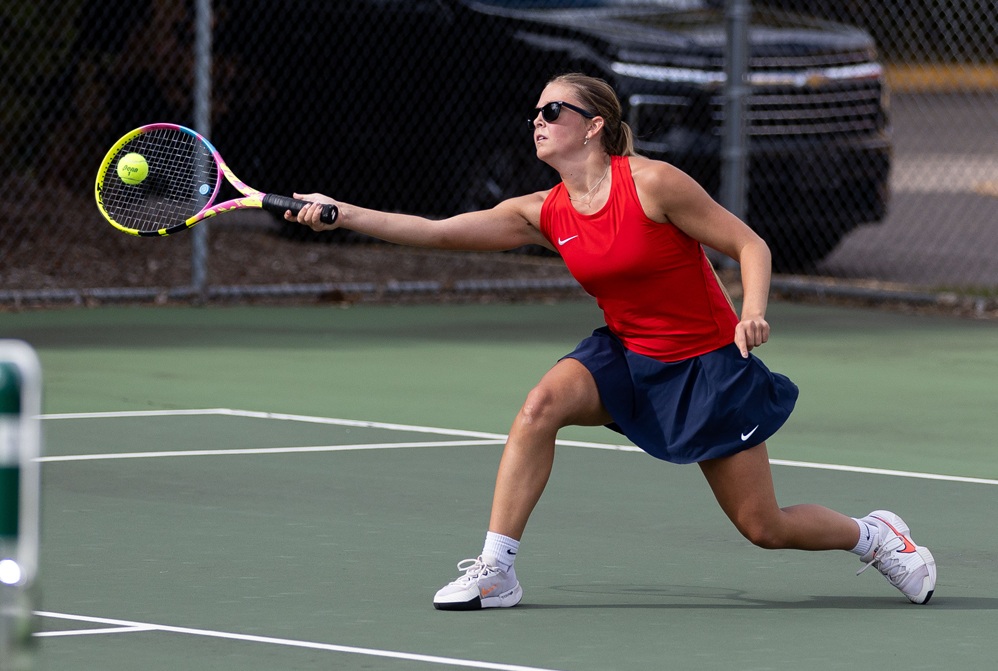
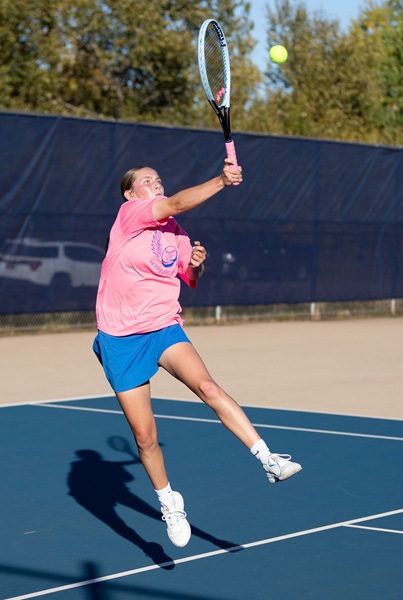
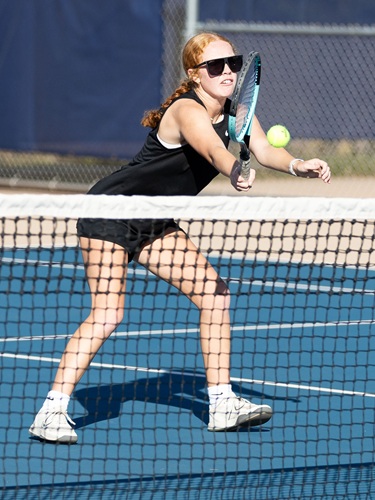
PHOTOS (Top) Ishpeming Westwood’s Eliisa Doney sends a forehand during a match Wednesday at No. 2 singles. (Middle) Kingsford’s Aubrie Moore returns a volley at No. 1 singles. (Below) Marquette’s Charlotte Thomsen reaches out to return a shot. (Photos by Jason Juno.)