

Add, Subtract, Divide, Multiply: MHSAA Not Alone
July 25, 2017
By Rob Kaminski
MHSAA benchmarks editor
This is the third part in a series on MHSAA tournament classification, past and present, that will be published over the next two weeks. This series originally ran in this spring's edition of MHSAA benchmarks.
As the MHSAA faces its most recent classification task with 8-Player Football, and opinions continue to swirl about as to the method, timeframe, location and other procedures, a look around the country provides plenty of company among state association brethren factoring variables into their own equations.
In the Pacific Northwest, the Oregon School Activities Association Football Playoffs are under public scrutiny as leadership ponders a five or six classification format beginning with the 2018-19 school year.
The OSAA has crowned six champions on the gridiron since 2006-07. Many of the state’s smaller schools would like to keep it that way, while larger schools lean toward a five-classification system, citing larger leagues, ease of travel and credibility to state championships as the advantages.
Still others would prefer more than six classes, pointing to safety issues and the opportunity to increase participation numbers as positives.
Moving southeast of Oregon, the Nevada Interscholastic Activities Association recently voted to hold serve on a classification proposal that was volleyed to the membership.
However, changes still could be forthcoming by as early as the 2018-19 season which would add a fifth classification in more populated southern Nevada while allowing northern schools to participate in four classifications. Such divisions could mean no state championship for the fifth class in southern Nevada.
Because of that, the NIAA wants equal numbers of schools in each classification on both ends of the state. Complicating the issue is the fact that the 24 largest schools in the state, by enrollment, are all in Clark County in Southern Nevada.
Across Nevada’s border into Arizona, charter schools are asking the Arizona Interscholastic Association to reconsider classification that was voted upon and approved in September 2015. That agreement called for the largest 33 percent of charter schools by enrollment to be placed in the state’s largest school classification, 3A, the middle 33 percent into 2A, and the smallest 33 percent into 1A.
Less than two years later the charter schools have had a change of heart and have asked to be considered the same as other Arizona public schools and be placed appropriately by enrollment beginning with the 2018-19 school year.
The situation in Arizona further illustrates how the public/private debate that all state associations have faced throughout existence now has the added dynamic of rapidly growing charter schools in today’s educational system, along with virtual school enrollment.
In the nation’s heartland, Nebraska has retooled its football classifications by using enrollment of boys students only in its schools rather than total enrollment. The Nebraska School Activities Association football-playing schools will kick off the 2018 season using this alignment.
Nebraska has three classes of 11-player football, with the smallest class divided in two, Class C-1 and C-2. The state also will have 8-player football for boys enrollments under 47, and the NSAA will sponsor a new 6-player tournament in 2018 for schools with 27 or fewer boys.
“This is a good proposal because some schools have a sizable imbalance between the number of boys and girls, and there’s a large gap (in enrollment) between the largest and smallest schools in Classes A and B,” NSAA executive director Jim Tenopir said. “I think this addresses both of those concerns.”
Swimmers in Georgia, meanwhile, will feel like they are moving with the current, rather than upstream in 2017-18, as the Georgia High School Association recently doubled the number of team championship events from two to four.
Swim enthusiasts can also count on longer days at the finals, as the top 30 finishers from the prelims will advance to the finals instead of 20, and all championship events will have three heats versus two.
Gull Lake Players Find Opportunities to Play, New Friendships as Part of 'Parchment Pride'
By
Pam Shebest
Special for MHSAA.com
September 22, 2026
PARCHMENT — When he took the field for his senior football season, Lucas Hutchinson did not expect to be wearing maroon and white.

The navy blue and white of Gull Lake High School was more his style.
But before the season started, an unusual series of events found Hutchinson and his 18 Gull Lake teammates without any team at all.
That’s when Parchment athletic director Brennan Davis stepped in, contacting Gull Lake AD Karyn Furlong and offering a solution: a cooperative team.
All of a sudden, those 19 players found a new football home.
“Obviously I’d rather be wearing navy blue and white but I’m happy to play in whatever color I can,” Hutchinson said. “Now that I’m playing for Parchment, I gotta have that Parchment Pride so I wear it with honor, and even though it’s not the color I wanted to wear, I’m excited to wear it.”
Gull Lake canceled its football season Aug. 12 after a preseason camp incident that resulted in school and law enforcement investigations.
Davis said his team’s numbers were down this year and adding the Gull Lake players would be the boost his team needed.
“I had heard about Gull Lake canceling their season due to safety concerns, and the schedule they’re playing is tough – to go into the game with 20 kids against some perennial powers,” Davis said. “So I reached out to Karyn (Furlong) on a Wednesday morning (about combining the teams). I heard back from her a few hours later.”
From there, a co-op team was born with the assurance that none of the players involved in the incident would be on the team.
The two groups held their first combined practice a week before the Aug. 27 season opener with just one snag.
“One issue we had was helmets,” Davis said. “We had a specific number of maroon helmets that would have outfitted our varsity and JV players, but then (Gull Lake) came over, they had white helmets.
"We asked the Gull Lake players to give up their white helmets for maroon helmets and gave the white to the JV players.”
First-day jitters
Several Gull Lake players, including Hutchinson, were a bit nervous that first practice.
“I didn’t know how we were going to work together and get along,” Hutchinson said. “I knew no one, but I do now,” he laughed. “When I first went into the locker room it was with a bunch of random faces I didn’t know. I was definitely eager to know everybody.”
He said he was worried about the way he and his teammates would be treated.
“Past two years, I was starting on varsity both ways, so even though I was getting to play football, I was worried how things were going to change, for not just me but all the guys from Gull Lake being treated equally and getting playing time. It transitioned smoothly, definitely no favoring with the coaches.”
Parchment quarterback Jordan Bagley said before the rosters combined the Panthers were preparing for a tough season with just 20 players.
“We knew we were going to have a lot of two-way players so that means we weren’t going to drag butt at practice,” the junior said. “We had to show up and bring it every day.
“It was definitely going to be a tough season mentally and physically. That’s a lot of wear and tear on your body.”
He added that Gull Lake players give the Panthers extra depth.
“It lets everybody come out fresh,” he said. “It reduces the risk of injuries, too. They don’t have to worry about coming out of the game if they’re gassed or need a breather, so it’s a big help.”
A bonus for Parchment was Hutchinson and junior quarterback Zac Pfenning, both past all-Southwest Michigan Athletic Conference first-teamers.
“We have a lot more skill positions so that’s always good for receivers and defensive backs to rotate in,” Bagley said. “They bring some leadership, too. Kessler (Johnson) is a good leader who’s helped X (Xavier Garcia). Depth and more players and a lot of new friendships.
"This has been one of better experiences for football in my career. I’ve actually enjoyed it a lot. It’s been a very positive thing for both sides, I believe. Everybody gets to play some football.”
Todd Nunn, Parchment’s second-year head coach, said he was excited to have his team’s numbers doubled.
“I don’t think we could have asked for a better practice that first day,” he said. “The group seemed to gel well; the Parchment kids were explaining to the Gull Lake kids our offensive plays, helped them understand the defense that was being called. It was like they’d been there the whole time.”
Nunn is no stranger to co-op teams.
He coached at Burr Oak, which combined with Colon for the four years he was there.
“I knew what it felt like being the team coming over to the main school,” he said. “I understood some of the reservations the Gull Lake kids might have coming over here.
“We sat the kids down, explained what was happening and how it would benefit them, not having to play both sides of the ball, getting more time to come to the sidelines to get a break. I think they were very receptive to that.”
Parchment and Gull Lake cheerleaders also have combined for several games.
“The co-op was just for football, but our cheerleaders and Gull Lake’s cheer team and coaches are good friends,” Davis said. “They have practiced together previously over the summer.
“We decided on a specific schedule where their cheerleaders would cheer with ours, four or five games.”
In addition, the football team will play a home game for Senior Night at Gull Lake, against Lawton on Oct. 16. The Blue Devils have 14 seniors and five juniors on the team.
Parchment has six seniors, 11 juniors and three sophomores.
Quick transition, perfect fit
The ease with which the process came together surprised Davis.
“Everything fell into place, which was strange because things usually take forever,” he said.
Over the course of one week:
- Davis and Furlong talked on a Wednesday.
- Parchment already had a staff development day scheduled that day and talked about the cooperative possibility.
- A Southwestern Athletic Conference meeting had been previously postponed from Tuesday to Thursday, and all 18 teams approved the co-op.
- “We did not involve the kids until prior to the (Parchment) board meet on Monday at 5.” Davis said. “I met with four of our team leaders at 4:50, board meeting at 5, meet the team night at 6:30, Gull Lake board meeting at 7, so that whole night was a lot.”
- The MHSAA then approved it.
With the season under way, the Panthers take a 2-2 record into Friday’s game against Kalamazoo United, another co-op team made up of Kalamazoo Christian and Hackett Catholic Prep players.
“(Gull Lake) kids follow our strength and conditioning requirements,” Davis said. “Whenever we have an away game, the kids drive here, ride our buses to our events.
“If there are disciplinary issues, they are a Parchment student-athlete, they function as Parchment students. Luckily nothing (bad) has happened.”
Bagley said the combined team has resulted in friendships that will last beyond this season.
“I got to meet a lot of new people, made a bunch of new friendships, which I’m really thankful for,” he said.
Hutchinson said he and his teammates have adjusted well.
“The first week it was weird seeing everyone wearing a different color (than he wore at Gull Lake), running out to a different field and having it be our home field. But now I’ve embraced it. Now I’m a Parchment Panther … for football,” he added, laughing.
 Pam Shebest served as a sportswriter at the Kalamazoo Gazette from 1985-2009 after 11 years part-time with the Gazette while teaching French and English at White Pigeon High School. She can be reached at [email protected] with story ideas for Calhoun, Kalamazoo and Van Buren counties.
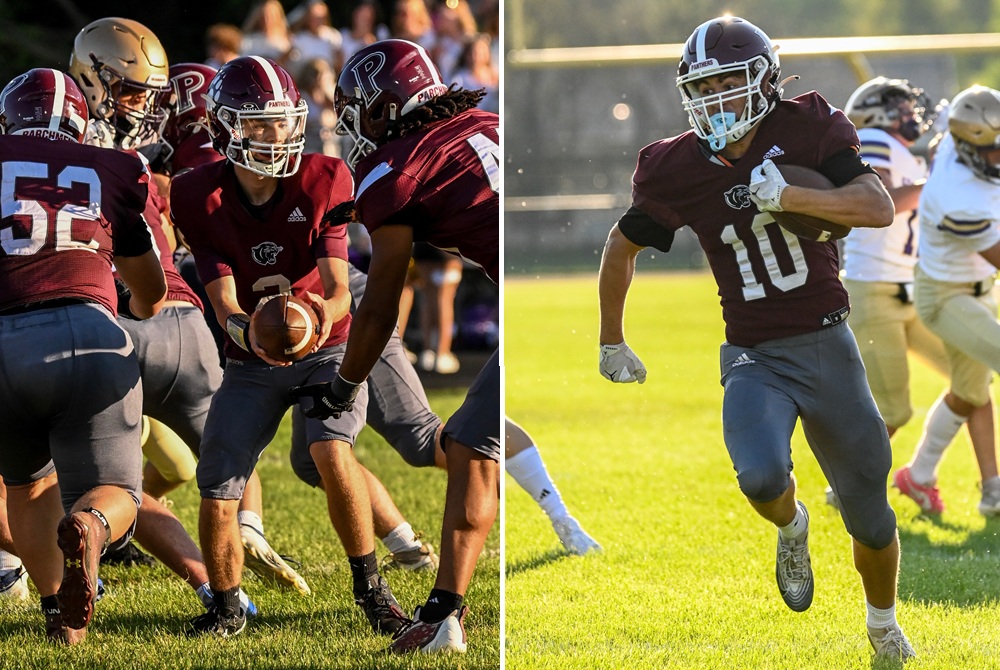
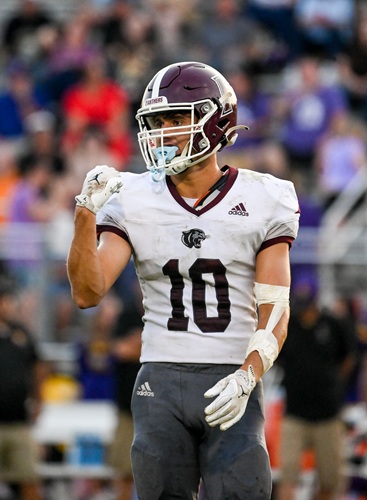
PHOTOS (Top) At left, Parchment quarterback Jordan Bagley (2) hands off during a game this season, and at right, Lucas Hutchinson (10) carries the ball downfield. (Middle) Clockwise from top left: Parchment athletic director Brennan Davis, varsity football coach Todd Nunn, senior Lucas Hutchinson and junior Jordan Bagley. (Below) Hutchinson wears the maroon and white of the Panthers. (Action photos by Kelci Henton. Headshots by Pam Shebest.)