


Add, Subtract, Divide, Multiply: MHSAA Not Alone
July 25, 2017
By Rob Kaminski
MHSAA benchmarks editor
This is the third part in a series on MHSAA tournament classification, past and present, that will be published over the next two weeks. This series originally ran in this spring's edition of MHSAA benchmarks.
As the MHSAA faces its most recent classification task with 8-Player Football, and opinions continue to swirl about as to the method, timeframe, location and other procedures, a look around the country provides plenty of company among state association brethren factoring variables into their own equations.
In the Pacific Northwest, the Oregon School Activities Association Football Playoffs are under public scrutiny as leadership ponders a five or six classification format beginning with the 2018-19 school year.
The OSAA has crowned six champions on the gridiron since 2006-07. Many of the state’s smaller schools would like to keep it that way, while larger schools lean toward a five-classification system, citing larger leagues, ease of travel and credibility to state championships as the advantages.
Still others would prefer more than six classes, pointing to safety issues and the opportunity to increase participation numbers as positives.
Moving southeast of Oregon, the Nevada Interscholastic Activities Association recently voted to hold serve on a classification proposal that was volleyed to the membership.
However, changes still could be forthcoming by as early as the 2018-19 season which would add a fifth classification in more populated southern Nevada while allowing northern schools to participate in four classifications. Such divisions could mean no state championship for the fifth class in southern Nevada.
Because of that, the NIAA wants equal numbers of schools in each classification on both ends of the state. Complicating the issue is the fact that the 24 largest schools in the state, by enrollment, are all in Clark County in Southern Nevada.
Across Nevada’s border into Arizona, charter schools are asking the Arizona Interscholastic Association to reconsider classification that was voted upon and approved in September 2015. That agreement called for the largest 33 percent of charter schools by enrollment to be placed in the state’s largest school classification, 3A, the middle 33 percent into 2A, and the smallest 33 percent into 1A.
Less than two years later the charter schools have had a change of heart and have asked to be considered the same as other Arizona public schools and be placed appropriately by enrollment beginning with the 2018-19 school year.
The situation in Arizona further illustrates how the public/private debate that all state associations have faced throughout existence now has the added dynamic of rapidly growing charter schools in today’s educational system, along with virtual school enrollment.
In the nation’s heartland, Nebraska has retooled its football classifications by using enrollment of boys students only in its schools rather than total enrollment. The Nebraska School Activities Association football-playing schools will kick off the 2018 season using this alignment.
Nebraska has three classes of 11-player football, with the smallest class divided in two, Class C-1 and C-2. The state also will have 8-player football for boys enrollments under 47, and the NSAA will sponsor a new 6-player tournament in 2018 for schools with 27 or fewer boys.
“This is a good proposal because some schools have a sizable imbalance between the number of boys and girls, and there’s a large gap (in enrollment) between the largest and smallest schools in Classes A and B,” NSAA executive director Jim Tenopir said. “I think this addresses both of those concerns.”
Swimmers in Georgia, meanwhile, will feel like they are moving with the current, rather than upstream in 2017-18, as the Georgia High School Association recently doubled the number of team championship events from two to four.
Swim enthusiasts can also count on longer days at the finals, as the top 30 finishers from the prelims will advance to the finals instead of 20, and all championship events will have three heats versus two.
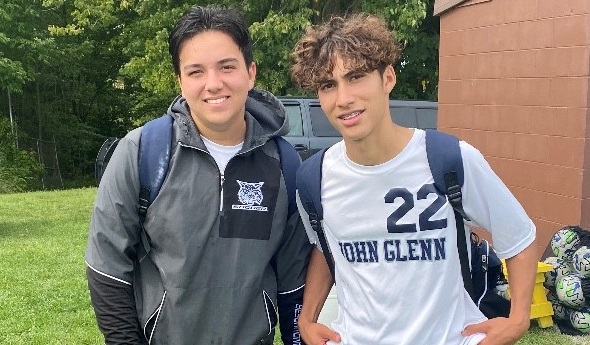
Brotherly Bond Sparks John Glenn Goals
By
Paul Costanzo
Special for MHSAA.com
September 15, 2020
It didn’t take even a half for the Beson-Montoya brothers to show off the potential of their connection this season.
 Freshman forward Lawsen Beson-Montoya scored two goals during the first 40 minutes of his debut for the Bay City John Glenn boys soccer team on Sept. 8, and each of those goals was assisted by his brother Lance, a senior.
It was as though they had been playing together for years – except it was the first time they’d been on the field together for a game.
“Honestly, I feel like it wasn’t surprising to them,” John Glenn coach Justin Page said. “I think they almost expected to have some sort of chemistry. The more you play together, the more chemistry you’re going to have with each other. They haven’t been playing with each other, but both of them have watched the other play enough that they know what type of player they are.”
Lance and Lawsen have been playing soccer since they can remember, but with a three-year age gap, they had never suited up for the same team. They’ve even been part of different non-school programs for the past two years, with Lance playing in the Bay Area Soccer Association and Lawsen with the Midland Fusion.
Their mother, Lance said, was most excited about the chance to have both brothers on the same field. But it’s an opportunity that they also are relishing.
“Especially for high school sports, I think the best part about it is playing with your friends and the social aspect,” Lawsen said. “So, it’s great to get to play with him, my buddies and his buddies, too.”
Playing varsity as a freshman was a goal for Lawsen, and something Lance had expected his brother to achieve. While they weren’t playing together, they would often work on their games together, sometimes joined by their youngest brother Landen, who is in sixth grade. During these training sessions, big brother isn’t giving any freebies.
“He doesn’t really cut me any slack when we’re playing around,” Lawsen said. “He’s the older brother; he kind of roughs me up. He doesn’t really go easy on me, because he wants me to be at the level he’s at.”
 For Page, though, the freshman being a viable varsity contributor was mostly just hearsay until he was able to see the speedster in action.
“Last year, I heard about him,” Page said. “’Oh, Lance’s brother is coming next year and he’s pretty good.’ You don’t know how good he’s going to be until the first kickoff of the first game. You could do all of these soccer drills extremely well, but when games start, it’s completely different.”
The early production only heightened the excitement and showed what the brothers are capable of in the John Glenn attack with Lance playing center midfield and Lawsen playing forward.
“It was awesome,” Lance said. “I kind of knew what my main goal was, and that was send the ball up to him because he’s got great speed. The first one, I just booted it up the field, and he was there. The second was a cross from a corner kick and he headed it in.”
While their natural chemistry is helping them connect on the field, their differing styles of play are too, as both brothers said they complement each other.
“Me and my brother are completely different players on the field – the physical aspect of it,” Lawsen said. “I was the one that was always the little dude on the field; he was more like a brick house. He might not have the speed I do, but he has foot skills like nobody compared to him. I was watching him thinking, ‘I have to get better on my foot skills.’ We’re like Batman and Robin, in a way.”
John Glenn is off to a 1-3 start, but the Bobcats are optimistic about the way they’ve played to this point against what Page said is tough competition.
“I think we’re going to pick it up here coming up in this next stretch,” he said. “I think the starting point we’ve had this year is fairly good, even if the record doesn’t show it. We’re going to start putting together a win streak coming up here, hopefully, and ideally we can put ourselves in a position to win the first-ever boys soccer District championship at John Glenn.”
A strong core of players who return from last year’s Bay County Tournament champions – including Lance – lead the way, and the contributions of youngsters like Lawsen can help make it possible.
Either way, it’s going to be a memorable year for the Beson-Montoya family.
“I knew this year was going to be fun because I knew what my brother could do,” Lance said. “I knew I could trust him and what his strong suits were.”
 Paul Costanzo served as a sportswriter at The Port Huron Times Herald from 2006-15, including three years as lead sportswriter, and prior to that as sports editor at the Hillsdale Daily News from 2005-06. He can be reached at [email protected] with story ideas for Genesee, Lapeer, St. Clair, Sanilac, Huron, Tuscola, Saginaw, Bay, Arenac, Midland and Gladwin counties.
PHOTOS: (Top) Lance, left, and Lawsen Beson-Montoya are providing an exciting connection for the Bay City John Glenn boys soccer team this fall. (Middle) Lawsen (22) and Lance (23) listen in during a break. (Photos courtesy of the Bay City John Glenn boys soccer program.)