


Add, Subtract, Divide, Multiply: MHSAA Not Alone
July 25, 2017
By Rob Kaminski
MHSAA benchmarks editor
This is the third part in a series on MHSAA tournament classification, past and present, that will be published over the next two weeks. This series originally ran in this spring's edition of MHSAA benchmarks.
As the MHSAA faces its most recent classification task with 8-Player Football, and opinions continue to swirl about as to the method, timeframe, location and other procedures, a look around the country provides plenty of company among state association brethren factoring variables into their own equations.
In the Pacific Northwest, the Oregon School Activities Association Football Playoffs are under public scrutiny as leadership ponders a five or six classification format beginning with the 2018-19 school year.
The OSAA has crowned six champions on the gridiron since 2006-07. Many of the state’s smaller schools would like to keep it that way, while larger schools lean toward a five-classification system, citing larger leagues, ease of travel and credibility to state championships as the advantages.
Still others would prefer more than six classes, pointing to safety issues and the opportunity to increase participation numbers as positives.
Moving southeast of Oregon, the Nevada Interscholastic Activities Association recently voted to hold serve on a classification proposal that was volleyed to the membership.
However, changes still could be forthcoming by as early as the 2018-19 season which would add a fifth classification in more populated southern Nevada while allowing northern schools to participate in four classifications. Such divisions could mean no state championship for the fifth class in southern Nevada.
Because of that, the NIAA wants equal numbers of schools in each classification on both ends of the state. Complicating the issue is the fact that the 24 largest schools in the state, by enrollment, are all in Clark County in Southern Nevada.
Across Nevada’s border into Arizona, charter schools are asking the Arizona Interscholastic Association to reconsider classification that was voted upon and approved in September 2015. That agreement called for the largest 33 percent of charter schools by enrollment to be placed in the state’s largest school classification, 3A, the middle 33 percent into 2A, and the smallest 33 percent into 1A.
Less than two years later the charter schools have had a change of heart and have asked to be considered the same as other Arizona public schools and be placed appropriately by enrollment beginning with the 2018-19 school year.
The situation in Arizona further illustrates how the public/private debate that all state associations have faced throughout existence now has the added dynamic of rapidly growing charter schools in today’s educational system, along with virtual school enrollment.
In the nation’s heartland, Nebraska has retooled its football classifications by using enrollment of boys students only in its schools rather than total enrollment. The Nebraska School Activities Association football-playing schools will kick off the 2018 season using this alignment.
Nebraska has three classes of 11-player football, with the smallest class divided in two, Class C-1 and C-2. The state also will have 8-player football for boys enrollments under 47, and the NSAA will sponsor a new 6-player tournament in 2018 for schools with 27 or fewer boys.
“This is a good proposal because some schools have a sizable imbalance between the number of boys and girls, and there’s a large gap (in enrollment) between the largest and smallest schools in Classes A and B,” NSAA executive director Jim Tenopir said. “I think this addresses both of those concerns.”
Swimmers in Georgia, meanwhile, will feel like they are moving with the current, rather than upstream in 2017-18, as the Georgia High School Association recently doubled the number of team championship events from two to four.
Swim enthusiasts can also count on longer days at the finals, as the top 30 finishers from the prelims will advance to the finals instead of 20, and all championship events will have three heats versus two.
FHN's Henkel Off to Headline-Making Start
September 11, 2020
By Dean Holzwarth
Special for Second Half
GRAND RAPIDS – Lilia Henkel admitted to struggling a bit with her golf game during the months leading up to this high school girls golf season.
 You wouldn’t have guessed it after the Forest Hills Northern senior sent a buzz through the statewide golf community with a record-setting performance in her season debut.
Henkel fired an eye-popping 12-under-par 60 last month in the Mona Shores Invitational at Stonegate Golf Club.
“It was a mediocre summer, and the past few tournaments before then I didn’t play that well,” Henkel said. “I played some of my worst golf, and I just wasn’t hitting the ball where I needed to. I was frustrated and confused about what was happening.”
Henkel overcame the issues she was encountering in the first event of a fall season that was in jeopardy due to the current Covid-19 pandemic.
Golf, tennis and cross country were the first sports cleared to play after five months, and the three-time all-state selection took advantage of the opportunity.
“It was obviously the first event for any high school sport and everything just set up perfectly,” said Henkel, who made the all-state Super Team last season. “The weather was beautiful, the course was awesome and it was good to be back with the team. With everything that has been going on, we all just wanted to go out and have fun and make it as memorable as possible.”
Henkel has enjoyed her share of high school golf highlights; she individually tied for second at the 2019 Lower Peninsula Division 2 Final, tied for third in 2018 and was seventh as a freshman.
But her round at Stonegate certainly made for another memorable moment.
She set a course record, besting the previous low round of 66, set by former Miss Golf and two-time MHSAA Finals champion Laura Kueny.
“The pro at Stonegate couldn’t believe it, and he gave her a certificate,” Forest Hills Northern coach Kent Graves said. “That’s a difficult course. We’ve been going out there to play for a number of years and it’s not an easy course by any means, but she was just all over it that day.”
Henkel’s first nine holes included three birdies and three eagles, as she shot a stunning 8-under-par 28 entering the back nine.
She rolled in a 25-foot eagle putt on No. 5, and then followed with a 20-foot chip-in from just off the green on No. 6. She chipped in for an unexpected eagle yet again on No. 9.
“That was one of my favorite holes,” Henkel said. “It was a short par 4 and I drove it to the side of a greenside bunker. I didn’t realize how fast and downhill that green was, and I duffed my chip. I hit ground first, and it landed just five feet on the green. I thought it was going to be short, but it kept going and went in.”
Henkel made four more birdies on the back nine for a 32. Her final score bested her previous low round by seven strokes; however, she wasn’t completely satisfied after the round.
“It sounds bad, but I didn’t feel like I played great golf, I just played good golf,” Henkel said. “I know I’m capable of shooting that score. Sixty is real low, but I know I’m capable of shooting an under-par round.
“If I didn’t leave anything out there I would’ve been like, ‘Wow, I just shot a really good score,’ but I honestly felt like at the very least I left three (shots) out there, if not four or five, because I had two three-putts and then I remember a 6-foot birdie putt that I missed.”
Graves, who has guided the Huskies to three straight wins at the MHSAA Division 2 Finals, also believed Henkel could’ve gone even lower.
“I hate to say this, but I looked at her card and saw 60 and I was disappointed,” Graves said. “She had 28 (on the front nine) so I was hoping for sub-60. That is the silliest thing in the world to say in retrospect, but what a great round. It was just one of those days when everything came together.”
Henkel admitted to having aspirations of bettering her score as well.
“On the 11th tee box I said to myself and to the girls I was playing with that I was going to shoot 59,” she said. “That was my goal. There wasn’t a sliver of doubt in my mind that I couldn’t go and do it. I was having fun, it was an awesome day, so I thought, ‘Let’s go do this.’”
Led by Henkel and senior Anna Fay, a two-time all-stater, the Huskies have since won two more tournaments – the Kent County Classic and Forest Hills Central Invitational. Henkel shot under par at both.
Henkel likes this year’s veteran group as she and her teammate pursue a rare fourth Finals win in a row. The Mona Shores teams from 2009-12, with four straight titles, are the only Lower Peninsula girls golf teams to win more than three straight Finals championships.
“If we could get the four-peat it would be a cherry on the top, mic drop, I’m out,” Henkel said. “I’m really looking forward to the rest of the season, and the other girls have been shooting great scores so far. I see the potential in this team, and we’ve been working hard in practice. It’s been really nice.”
Graves believes this year’s team can contend for another Division 2 title.
“You certainly give yourself a chance anytime you have players like Lilia and Anna on the team,” he said. “Everyone has a great one and two, but it’s that three, four and five (player) that really wins championships. And I think we’re really solid in those positions this year.”
 Dean Holzwarth has covered primarily high school sports for Grand Rapids-based WOOD-TV for four years after serving at the Grand Rapids Press and MLive for 16 years along with shorter stints at the Ionia Sentinel and WZZM. Contact him at [email protected] with story ideas for Allegan, Kent and Ottawa counties.
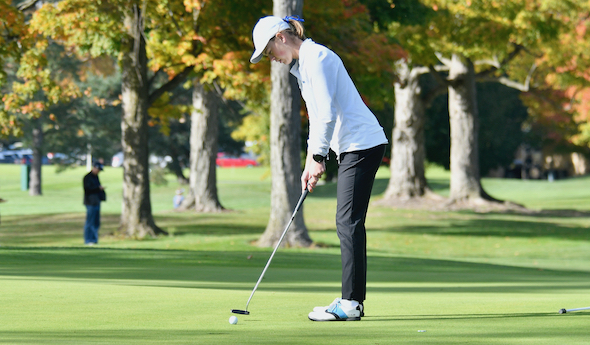
PHOTO: Grand Rapids Forest Hills Northern's Lilia Henkel putts during last season's Lower Peninsula Division 2 Final at Forest Akers East. (Click to see more from HighSchoolSportsScene.com.)