


Add, Subtract, Divide, Multiply: MHSAA Not Alone
July 25, 2017
By Rob Kaminski
MHSAA benchmarks editor
This is the third part in a series on MHSAA tournament classification, past and present, that will be published over the next two weeks. This series originally ran in this spring's edition of MHSAA benchmarks.
As the MHSAA faces its most recent classification task with 8-Player Football, and opinions continue to swirl about as to the method, timeframe, location and other procedures, a look around the country provides plenty of company among state association brethren factoring variables into their own equations.
In the Pacific Northwest, the Oregon School Activities Association Football Playoffs are under public scrutiny as leadership ponders a five or six classification format beginning with the 2018-19 school year.
The OSAA has crowned six champions on the gridiron since 2006-07. Many of the state’s smaller schools would like to keep it that way, while larger schools lean toward a five-classification system, citing larger leagues, ease of travel and credibility to state championships as the advantages.
Still others would prefer more than six classes, pointing to safety issues and the opportunity to increase participation numbers as positives.
Moving southeast of Oregon, the Nevada Interscholastic Activities Association recently voted to hold serve on a classification proposal that was volleyed to the membership.
However, changes still could be forthcoming by as early as the 2018-19 season which would add a fifth classification in more populated southern Nevada while allowing northern schools to participate in four classifications. Such divisions could mean no state championship for the fifth class in southern Nevada.
Because of that, the NIAA wants equal numbers of schools in each classification on both ends of the state. Complicating the issue is the fact that the 24 largest schools in the state, by enrollment, are all in Clark County in Southern Nevada.
Across Nevada’s border into Arizona, charter schools are asking the Arizona Interscholastic Association to reconsider classification that was voted upon and approved in September 2015. That agreement called for the largest 33 percent of charter schools by enrollment to be placed in the state’s largest school classification, 3A, the middle 33 percent into 2A, and the smallest 33 percent into 1A.
Less than two years later the charter schools have had a change of heart and have asked to be considered the same as other Arizona public schools and be placed appropriately by enrollment beginning with the 2018-19 school year.
The situation in Arizona further illustrates how the public/private debate that all state associations have faced throughout existence now has the added dynamic of rapidly growing charter schools in today’s educational system, along with virtual school enrollment.
In the nation’s heartland, Nebraska has retooled its football classifications by using enrollment of boys students only in its schools rather than total enrollment. The Nebraska School Activities Association football-playing schools will kick off the 2018 season using this alignment.
Nebraska has three classes of 11-player football, with the smallest class divided in two, Class C-1 and C-2. The state also will have 8-player football for boys enrollments under 47, and the NSAA will sponsor a new 6-player tournament in 2018 for schools with 27 or fewer boys.
“This is a good proposal because some schools have a sizable imbalance between the number of boys and girls, and there’s a large gap (in enrollment) between the largest and smallest schools in Classes A and B,” NSAA executive director Jim Tenopir said. “I think this addresses both of those concerns.”
Swimmers in Georgia, meanwhile, will feel like they are moving with the current, rather than upstream in 2017-18, as the Georgia High School Association recently doubled the number of team championship events from two to four.
Swim enthusiasts can also count on longer days at the finals, as the top 30 finishers from the prelims will advance to the finals instead of 20, and all championship events will have three heats versus two.
USA Discovering New Winning Pack
By
Paul Costanzo
Special for MHSAA.com
September 1, 2020
Mike Peter knew his Unionville-Sebewaing boys cross country team would have to make adjustments for the 2020 season, and deal with a different set of circumstances.
 And that was before COVID-19 gripped the nation.
“We lost some team dynamic – a team isn’t all about time and place all the time,” the USA coach said. “Two of our senior boys that left the team, they really brought a lot just as teammates to our boys side. We’re trying to find that again. It takes time to rebuild that again when the team dynamic changes. We’ll have to fight a little harder this year and try to find our new normal.”
The Patriots are coming off a runner-up finish at the 2019 Lower Peninsula Division 4 Finals, the best finish in program history. That followed a fifth-place finish the year before which had been the program best.
While they’re off to a slower start this season, they feel the pieces are there to continue that statewide success.
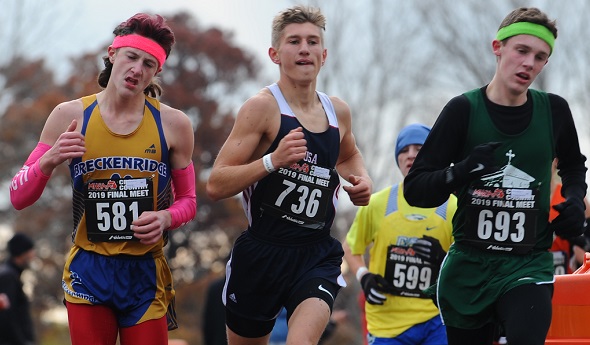
“I think we have a very good chance of coming back to state,” senior Bryce Langmaid said. “I think we have a chance to come back and be top-three again, or win a state championship.”
Three of the five runners who scored at the 2019 Finals are back, led by Langmaid who had an all-state finish at 22nd. Juniors Ty Pavlichek (38th) and Jacob VanHove (53rd) are back as well. The Patriots are without all-state finisher Bentley Alderson, who placed 16th as a junior but has decided to play soccer his senior year.
But the strength of USA’s 2019 team was its pack – all five scoring runners a year ago finished among the top 40 team scorers at the Final. That pack is something the Patriots are currently trying to establish.
“Since Day 1, we’ve been really close, really tight, and Coach has preached pack running,” Langmaid said. “That would be one of the biggest successes of how we run, and that carried over to how tight we are.”
While that pack is still looking to come together on the course this season, it was a big benefit through the spring and summer. With track season canceled because of the pandemic, and in a world of social distancing, Peter said his team did a good job of getting together to run in small groups.
 “The nice thing is that there’s a brother and sisterhood with our group,” Peter said. “They are fantastic about texting each other, communicating with one another and getting out for a run. Once we knew track wasn’t going to happen, it was just about packing on miles, and I think for the mental health of a young person who is a person who competes, that was important. Our team is really good about reaching out to each other, and luckily, we didn’t have to meet to do it.”
Staying focused on running helped, but it wasn’t always easy.
“At times I wasn’t,” Pavlichek admitted. “I slowed down and didn’t run as much. When it came closer to the season I started to run more, and I was just hoping we could have a season.”
What helped them get through it, though, was each other.
“I know this put a lot of stress on families, friends and athletes in USA and Michigan,” Langmaid said. “I tried to stay close with everyone and talk with everyone to see how they’re doing. If someone wanted to meet up, I would do that to run with them and talk with them and let them get things off their mind.”
The Patriots have competed twice this season, at their own quad and the Ithaca Early Invitational. They were second in the quad (losing via tiebreaker to Mayville), and fifth at Ithaca.
“It’s hard to come out of a season where you’re second in the state and not feel that pressure again,” Peter said. “Sometimes, I think after having a year where we got first place at almost every meet, it’s hard to come back and uphold that. There’s an unspoken pressure that kids put on themselves, and they have to be OK with a second or third some of the time, and not always running your best time.”
While the results haven’t been there yet for the Patriots, just being back in competition and wearing the school colors felt like a victory.
“From my perspective, it was just wonderful to see a uniform of any of the schools,” Peter said. “It was nice to see kids from other communities at least roughly near each other, and competing. It was nice to see the joy they had to do something they loved.”
 Paul Costanzo served as a sportswriter at The Port Huron Times Herald from 2006-15, including three years as lead sportswriter, and prior to that as sports editor at the Hillsdale Daily News from 2005-06. He can be reached at [email protected] with story ideas for Genesee, Lapeer, St. Clair, Sanilac, Huron, Tuscola, Saginaw, Bay, Arenac, Midland and Gladwin counties.
PHOTOS: (Top) USA's Bryce Langmaid (736) races to an all-state finish at last season's LPD4 Final at Michigan International Speedway. (Middle) Ty Pavlichek is another of three USA scorers back from the 2019 runner-up team. (Click to see more from RunMichigan.com.)