

2022 WISL Honoree Hyman Lauded for Lifetime of Leadership
By
Geoff Kimmerly
MHSAA.com senior editor
February 25, 2022
Lori Hyman was a sports standout in high school, then at Michigan State University. She then coached college basketball for 17 years, starting when she was only 23 years old, and surely could’ve continued down that path.
While always a leader, she decided to change gears in 1995 and provide guidance another way – coaching up coaches as a high school athletic director. Over the next 27 years, she became one of the most respected ADs in Michigan – and contributed in that role at her alma mater Livonia Stevenson over the last 22.
To celebrate her many contributions to school sports, at home but also statewide, Hyman has been named the 35th recipient of the MHSAA Women In Sports Leadership Award. She will receive the award during the Division 1 Girls Basketball Final on March 19 at Michigan State’s Breslin Center.
Hyman served her first five years as an athletic director at Dexter, making the move there after four college basketball coaching stops. After a memorable hoops career at MSU, she served as a women’s basketball graduate assistant at Ferris State University and then head coach at Northwood Institute (now University) from 1981-82 – when she was only 23 years old – through 1985-86.
She then served as an assistant at University of Illinois before returning as head coach at Ferris State from 1989-90 through 1994-95. In Fall 1995, she began at Dexter.
“Every part of my career I’ve been happy with, and honored, and just thoroughly enjoyed it,” Hyman said. “It’s been a passion of mine, every aspect.
“(Playing at Michigan State) was one of the best times, if not the best time, of my life as a youngster. And then being an athletic director has probably been the most rewarding as an adult. And being at Stevenson, coming back home, has been quite an honor and just a very rich experience for me.”
Each year, the Representative Council considers the achievements of women coaches, officials and athletic administrators affiliated with the MHSAA who show exemplary leadership capabilities and positive contributions to athletics.
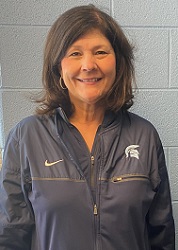 Hyman is a 1975 graduate of Stevenson, where she also played softball and competed in track & field. She was named MSU’s Outstanding Athlete of the Year for women’s basketball in 1979, after serving as co-captain of the team that season but missing the majority of it with an injury.
As an athlete at MSU, she joined her teammates in filing a 1978 discrimination complaint that requested the women’s basketball team receive travel allowances equal to those received by the Spartans men’s team. “It is very meaningful that Michigan State is where they are now, not just in women’s basketball but the women’s sport program,” Hyman said. “I feel like we were part of that growing and moving forward in a positive way, and I thank Michigan State for recognizing that and moving it forward.”
She graduated with a bachelor’s degree in physical education and health in 1980 and has a master’s in athletic administration from Wayne State University. She received her certified master athletic administrator designation from the National Interscholastic Athletic Administrators Association (NIAAA) in 2006.
Back at Stevenson, Hyman has directed the athletic program for a high school with nearly 1,700 students, which by enrollment ranks 50th out of 750 MHSAA member schools.
She has hosted a multitude of MHSAA Tournament events while at both Dexter and Stevenson and has served on the MHSAA’s girls tennis, girls basketball and boys basketball committees. She also has served as the girls and boys tennis commissioner of the Kensington Lakes Activities Association, of which Stevenson is a member.
“Lori has been a leader and pioneer in the world of athletics, and in particular as an advocate for females and girls sports,” MHSAA Executive Director Mark Uyl said. “When she left coaching basketball to work as an AD, it was an incredible victory for kids in our state. She’s been dependable, loyal and just a model of consistency in running a first-class program.”
Hyman was named her region’s Athletic Director of the Year by the Michigan Interscholastic Athletic Administrators Association (MIAAA) in 2014 and received its Jack Johnson Distinguished Service Award in 2015.
As an instructor for the MIAAA, Hyman has provided training particularly to beginning athletic directors. She has served as a Leadership Training Institute instructor as well for the MIAAA and as a presider and speaker at the MIAAA’s annual conference. She also has spoken at the MHSAA’s Women In Sports Leadership Conference.
“I’ve always been an advocate for women in sports and equal opportunity,” Hyman added. “I treat all of the sports here equally, male and female. But if I feel that there needs to be a little bit more advocacy for women in sports, whether it’s coaching and getting more girls involved, or officiating, administration, any kind of leadership, I’m really big on that.”
“I’m a big advocate for women in athletics, but (also) just athletics in general.”
In addition to her vast school sports responsibilities and contributions, Hyman has volunteered with Special Olympics, Livonia’s Newburg United Methodist Church and Rotary Club.
The first Women In Sports Leadership Award was presented in 1990.
Past recipients
1990 – Carol Seavoy, L’Anse
1991 – Diane Laffey, Harper Woods
1992 – Patricia Ashby, Scotts
1993 – Jo Lake, Grosse Pointe
1994 – Brenda Gatlin, Detroit
1995 – Jane Bennett, Ann Arbor
1996 – Cheryl Amos-Helmicki, Huntington Woods
1997 – Delores L. Elswick, Detroit
1998 – Karen S. Leinaar, Delton
1999 – Kathy McGee, Flint
2000 – Pat Richardson, Grass Lake
2001 – Suzanne Martin, East Lansing
2002 – Susan Barthold, Kentwood
2003 – Nancy Clark, Flint
2004 – Kathy Vruggink Westdorp, Grand Rapids
2005 – Barbara Redding, Capac
2006 – Melanie Miller, Lansing
2007 – Jan Sander, Warren Woods
2008 – Jane Bos, Grand Rapids
2009 – Gail Ganakas, Flint; Deb VanKuiken, Holly
2010 – Gina Mazzolini, Lansing
2011 – Ellen Pugh, West Branch; Patti Tibaldi, Traverse City
2012 – Janet Gillette, Comstock Park
2013 – Barbara Beckett, Traverse City
2014 – Teri Reyburn, DeWitt
2015 – Jean LaClair, Bronson
2016 – Betty Wroubel, Pontiac
2017 – Dottie Davis, Ann Arbor
2018 – Meg Seng, Ann Arbor
2019 – Kris Isom, Adrian
2020 – Nikki Norris, East Lansing
2021 – Dorene Ingalls, St. Ignace
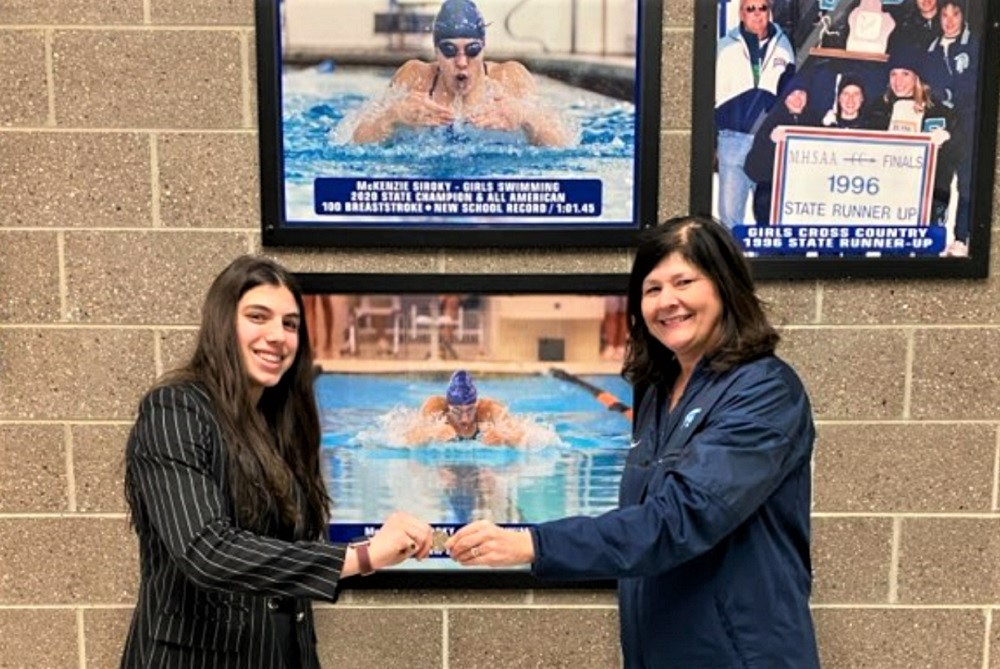
PHOTO Livonia Stevenson athletic director Lori Hyman (right) and Finals swimming champion McKenzie Siroky hold up a championship medal alongside photos honoring Siroky's achievements. (Photo courtesy of the Stevenson athletic department.)

MHSAA Teams with Sparrow Health
February 16, 2015
By Geoff Kimmerly
Second Half editor
Providing information and best practices to players, parents, coaches and administrators on how best to minimize health risks is a key component of keeping student-athletes safe. The Michigan High School Athletic Association has teamed with Sparrow Health System of Lansing to better inform its member schools on such health and safety matters.
Sparrow, a member of the prestigious Mayo Clinic Care Network, is mid-Michigan’s premier healthcare organization with more than 10,000 caregivers. Sparrow’s Sports Medicine division offers programs for athletes at all levels and includes primary care physicians, orthopedic surgeons, physical therapists and athletic and performance trainers.
Sparrow will lend its expertise through the MHSAA Website and on-site at various MHSAA tournament events. Resources from Sparrow staff, including information on current health and safety topics and trends, will be accessible online through the Health & Safety page of the MHSAA Website.
Sparrow’s contributions also will be promoted through the MHSAA’s multiple social media platforms. “This partnership is one of the biggest steps we’ve ever taken to build the MHSAA’s capacity to address the almost daily questions we receive about student-athlete health and wellness, and to sort out and solve the biggest issues of school sports safety,” said John E. “Jack” Roberts, executive director of the MHSAA.
A key component to Sparrow’s addition to the MHSAA Website is an “Ask the Experts” feature that connects users directly to Sparrow’s Sports Medicine staff. Sparrow also will set up booths at various MHSAA tournaments where staff will be available to answer similar questions and discuss sports medicine-related issues.
“Sparrow is thrilled to partner with the MHSAA,” said Stella Cash, Sparrow vice president for development and strategic partnerships. “We have the region’s pre-eminent primary care physicians trained in sports medicine who specialize in the prevention and treatment of sports-related injuries.
Parents and coaches can turn to us for all health-related issues and trust we are focused on transforming care to keep their high school athletes fit, healthy and in the game.”
Sparrow Health System includes hospitals in Lansing, St. Johns, Ionia and Carson City as well as Physicians Health Plan, Sparrow Physicians Health Network, the Sparrow Medical Group and the Michigan Athletic Club. Sparrow also is affiliated with Michigan State University’s three human health colleges.
The MHSAA is a private, not-for-profit corporation of voluntary membership by more than 1,400 public and private senior high schools and junior high/middle schools which exists to develop common rules for athletic eligibility and competition. No government funds or tax dollars support the MHSAA, which was the first such association nationally to not accept membership dues or tournament entry fees from schools. Member schools which enforce these rules are permitted to participate in MHSAA tournaments, which attract more than 1.4 million spectators each year.