


4 Thrusts: In Motion, On Track in 2013-14
December 20, 2013
By Jack Roberts
MHSAA Executive Director
During the fall of 2012 at Update meetings across Michigan, we described “Four Thrusts for Four Years” – four health and safety emphases that would help us keep student-athletes healthier and also get a seat for Michigan’s policies and procedures for school sports on the train of best practices – an express train that is moving faster than we've ever seen it toward more cautious practice and play policies and more educational requirements for coaches.
At this December’s meeting, the MHSAA Representative Council examined a first quarter report card – what’s been accomplished during the first year.
It has been a remarkably strong start, but it’s only a start.
The first thrust, improving management of heat and humidity, received a boost last March when the Representative Council adopted a “Model Policy for Managing Heat and Humidity.” It has been promoted in print, online and at face-to-face meetings; and the response of schools has been nothing short of outstanding.
This rapid acceptance by school administrators and coaches reflects their appreciation for a clear policy that identifies the precise conditions that call for adjustments in activities, and lists specific actions to be taken when temperature and humidity combine to reach un-safe levels. Gut and guesswork are gone.
The second thrust, raising expectations for coaches’ preparedness, is being advanced in three ways.
In May, the Representative Council adopted the requirement that by the 2014-15 school year, schools must attest that, prior to established deadlines, all assistant and subvarsity coaches at the high school level have completed annually the same MHSAA rules meeting required by all varsity head coaches or, in the alternative, one of the free online sports safety courses posted on or linked to MHSAA.com and designated to fulfill this requirement. This popular change is only the first component of this critically important second thrust.
The second component is this. The Representative Council voted in December to require by 2015-16 that MHSAA member high schools certify that all of their varsity head coaches of high school teams have a valid (current) CPR certification, with AED training as a recommended component.
As this requirement was discussed at constituent meetings, the question was frequently raised: “Why just head coaches?”
“Why indeed,” is our response. If a school has the will and resources, it most certainly should make CPR a requirement of all its coaches, as some school districts have required for many years.
CPR training is conveniently available near almost every MHSAA member school in Michigan. Still, the MHSAA will begin offering CPR certification (with AED training) on an optional basis as an extension of Level 1 of the Coaches Advancement Program (CAP) during 2014-15.
The third component of this thrust is scheduled to go before the Representative Council in March. The proposal is that all individuals hired for the first time as a varsity head coach of a high school team, to begin those coaching duties after July 31, 2016, must have completed the Coaches Advancement Program (CAP) Level 1 or 2.
The MHSAA will track compliance and prohibit varsity head coaches from attending their teams’ MHSAA tournament contests if they fail to complete this requirement, beginning in the 2016-17 school year.
In cases of very late hiring, schools may substitute two online courses of the National Federation of State High School Associations – “Fundamentals of Coaching” and “First Aid, Health and Safety.” However, that coach must complete CAP Level 1 or 2 within six months of the hiring date.
These feel like big steps to some people in MHSAA member schools – “too expensive” or “another obstacle to finding qualified coaches,” some say; but these are baby steps.
This barely keeps pace with national trends. Michigan’s tradition of local control and its distaste for unfunded mandates has kept Michigan schools in neutral while schools in most other states have made multiple levels of coaching education, and even licensing or certification, standard operating procedure.
The three initiatives to upgrade coaches education in this critical area of health and safety over the next three years only nudges Michigan to a passing grade for what most parents and the public expect of our programs. We will still trail most other states, which continue to advance the grading curve.
And for a state association that is among the national leaders by almost every other measure, it is unacceptable to be below average in what is arguably the most important of all: promoting athlete health and safety by improving the preparation of coaches.
The third health and safety thrust is a focus on practice policies to improve acclimatization and to reduce head trauma; and the fourth thrust is a focus on game rules to reduce head trauma and to identify each sport’s most injurious situations and reduce their frequency.
Because of the critical attention to football on all levels, peewee to pros, our first focus has been to football with the appointment of a football task force which has effectively combined promotion of the sport’s safety record at the school level and its value to students, schools and communities with probing for ways to make the sport still safer.
The task force proposals for practice policies are receiving most attention and will receive Council action in March (and will be published on Second Half over the next few weeks). But the task force also has assisted MHSAA staff in developing promotional materials that are already in use, and the task force pointed MHSAA staff to playing rules that need emphasis or revision to keep school-based football as safe as possible.
During 2013-14, all MHSAA sport committees will be giving unprecedented time to the topics of the third and fourth thrusts and, when necessary, a task force will be appointed to supplement those sport committee efforts.
Frequently Asked Questions About CPR Certification
Q. Who is authorized to provide CPR certification?
A. The MHSAA does not dictate which organization must provide the CPR education and certification. However, the Michigan Department of Human Services lists the following organizations that are approved to provide CPR training:
- American CPR Training: www.americancpr.com
- American Heart Association: www.americanheart.org
- American Red Cross: www.redcross.org
- American Safety and Health Institute: www.hsi.com/ashi/about
- American Trauma Event Management: www.atem.us
- Cardio Pulmonary Resource Center: 517-543-9180
- Emergency Care and Safety Institute: www.ecsinstitute.org
- EMS Safety Services: www.emssafety.com
- Medic First Aid: www.medicfirstaid.com
- National Safety Council: www.nsc.org
- Pro CPR: www.procpr.org
Q.
A. $0 to $75.
Q. How long does certification take?
A. Two to five hours.
Q. How long does the certification last?
A. Generally, two years.
Q. Does the MHSAA specify the age level for the CPR training?
A. No. Generally, the course for adults alerts candidates of the necessary modifications for children and infants, and vice versa.
Family Coaching Tree Grows to 3 Generations
By
Tom Markowski
Special for Second Half
September 13, 2018
Like father like son, like grandson.
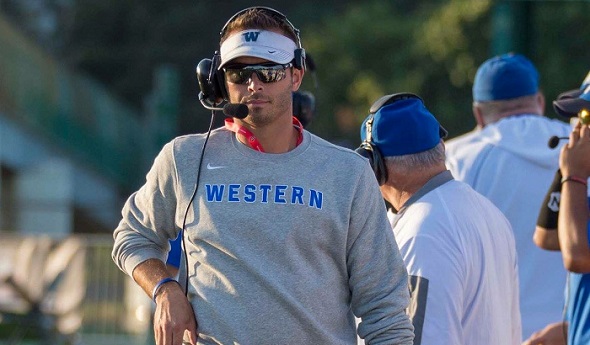
 The Grignon football family continued its progression in the coaching ranks this season when Alex Grignon got his shot at being a head coach. Grignon was hired in June as head coach at Walled Lake Western to replace Mike Zdebski, who resigned to take a coaching position in Arizona.
Alex Grignon, 31, represents the third generation from a family of past and present high school head football coaches. And one can’t talk football in Wayne County communities like Dearborn and Lincoln Park without mentioning the Grignon family.
Ted Grignon was the athletic director and head football coach at Lincoln Park in the 1980s. His two sons, Ted and Jamie, played football at Dearborn Edsel Ford and then in college – Ted, a quarterback at Western Michigan University and Jamie, a safety at Grand Valley State. Jamie Grignon is in his third stint as Lincoln Park’s head coach. He was hired in 1994 and stepped aside after the 1999 season, but never left the sport as he went to Dearborn High as an assistant under Dave Mifsud in 2000. Grignon went back to Lincoln Park in 2013 as the head coach and, after taking another brief hiatus, came back last season and remains in that position.
His two sons, Andrew and Alex, played for Mifsud at Dearborn; and in 2004, Alex’s senior season, Dearborn reached a Division 2 Semifinal before losing to Orchard Lake St. Mary’s, 6-0. It marked the first time the program advanced that far in the MHSAA Playoffs.
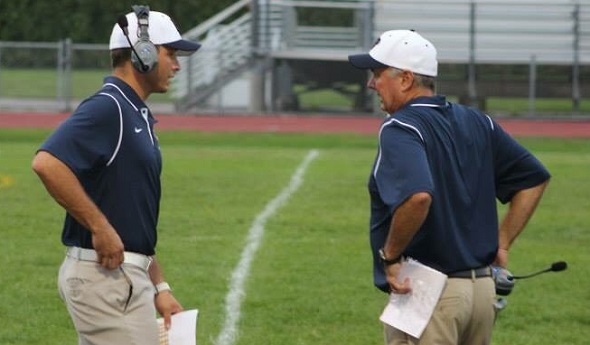 Andrew switched sports and played lacrosse in college (at Grand Valley), but his younger brother stuck with football. After playing four years at Northern Michigan, Alex was a graduate assistant there working with the offense before joining his father’s staff at Lincoln Park.
The Railsplitters have had their struggles of late, starting this season 0-3 and last making the playoffs in 2015. But in 2013, with Jamie as the head coach and Alex as the defensive coordinator, Lincoln Park ended a 66-game losing streak by defeating Taylor Kennedy, 34-20.
After five seasons at Lincoln Park, Alex went to South Lyon last season as the offensive coordinator, and this season he made the big jump. Walled Lake Western is one of the top programs in the Detroit area and a member of the Lakes Valley Conference, and Grignon has the Warriors off to a 2-1 start.
“He was proud that he was the third generation (of head coaches),” Jamie Grignon said. “When he coached with me, it was a growing process for him. There isn’t anyone who works harder than Alex. Whether it’s watching film, working with the kids after practice or what. He’s full-go.”
Like father like son. Jamie is not one to toot his own horn, but when he was the defensive coordinator at Dearborn people in the Downriver area, and in other football strongholds in the county, knew Mifsud had one of the best coaches calling his defense.
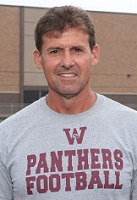
Mifsud is in his sixth season as the head coach at Parma Western after serving 16 in the same position at Dearborn. He was an assistant coach at Dearborn for four seasons before being named head coach in 1997.
 Remember those dates. Before Mifsud was able to hire Grignon, the two met as adversaries on the field. Lincoln Park defeated Dearborn, 14-0, during Dearborn’s homecoming, no less, in 1999. That was Grignon’s last season during his first stint at Lincoln Park.
Mifsud didn’t have to twist Grignon’s arm to join his staff at Dearborn. Grignon’s oldest son, Andrew, was set to play for Mifsud in 2000. Alex is two years younger, so Mifsud was secure knowing the Grignons had his back.
“I was in my fourth year when Andrew came through, I hired Jamie and Keith Christnagel, who’s the coach at Woodhaven now,” Mifsud said. “We grew up together, the three of us, as coaches. We racked our brains learning the ropes. I always coached the offense. Keith had the offensive and defensive lines and Jamie the defense. The working relationship with Jamie was excellent. We split up the special teams, though he probably did more there.
“People know of Jamie, and he worked his tail off. On Sundays I’d stop by, you know, just to drop some film off or just to touch base, and his entire dining room would be spread all around with notes on breaking down the other team’s offense and such. Jamie’s a high-energy guy. He’s always thinking.
“Looking at Alex, yeah, I think they are similar. They can’t sit still. They’re always looking for something better. What a great hire (for Walled Lake Western). Alex is so great with the kids. He’s young (31). He’s got great football intelligence. Jamie was like that. He would tweak things in practice. He’d never be satisfied. Alex has that. He’s Jamie but at a different level.”
Mifsud and Jamie Grignon both said that what makes Alex a cut above is his leadership. As good as Alex was athletically as a player, his father said it was his leadership qualities that set him apart.
 Mifsud recalled a story, a 2-3 week period, actually, during the 2004 season. The staff had yet to elect captains, and as preseason practices wore on Mifsud and his staff were taken aback by the actions of three seniors, Alex among them.
The coaches didn’t have to blow a whistle to start practice. Those three would have the players ready.
“I looked at my coaches,” Mifsud said. “And said those are our captains.”
Alex said he never thought about being a leader. It just came naturally. He grew up watching football from the sidelines, and later as a water boy, and then at home watching his father gather notes and dissect film footage.
“I was on the sidelines my entire life,” he said. “The leadership, you see it. You watch the players. You know what it takes to be a leader. I tell my players at Western, people want to be led.
“As a youth you don’t realize what level dad is coaching at, but you remember going to coffee shops exchanging film. I’d have my ninja toys with me, and the next minute I’d be holding dummies. Dad didn’t push us. He wanted us to do what we wanted to do. Heck, I was a big-time soccer player. I didn’t start playing football until middle school. For two years I did both.”
By his freshman year, Alex was all in for football. His was one of best classes the school has had for the sport, and Alex recalls that 40-50 of his classmates showed their dedication by increasing their work in the weight room.
Playing with his brother for two years and with his father for all four only made Alex more determined.
“I can’t talk football and family without getting emotional about it,” he said. “Watching your dad work 18 hours on the weekend, turning the pages of his legal pad, he was always doing something. I remember eating eggs for breakfast every day and peanut butter sandwiches for lunch to try and get as much protein in our bodies. I’d get up as a child, and he’d be on his third cup of coffee. He never stopped. He saw us wanting to be around the game, and he helped in any way he could to make us better.
“Everything I know, I’ve seen him do.”
 Tom Markowski is a columnist and directs website coverage for the State Champs! Sports Network. He previously covered primarily high school sports for the The Detroit News from 1984-2014, focusing on the Detroit area and contributing to statewide coverage of football and basketball. Contact him at [email protected] with story ideas for Oakland, Macomb and Wayne counties.
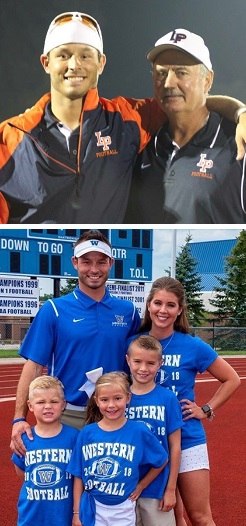
PHOTOS: (Top) Walled Lake Western coach Alex Grignon is in his first season as head coach at Walled Lake Western. (Top middle) Alex, left, and father Jamie Grignon when Alex was assisting Jamie at Lincoln Park. (Middle) Current Parma Western and former longtime Dearborn coach Dave Mifsud. (Below) Alex and Jamie Grignon, when both were coaching Lincoln Park, and Alex with his family now as coach at Walled Lake Western. (Photos courtesy of Grignon family; Walled Lake Western photos by Teresa Presty Photography.)