

4 Thrusts: In Motion, On Track in 2013-14
December 20, 2013
By Jack Roberts
MHSAA Executive Director
During the fall of 2012 at Update meetings across Michigan, we described “Four Thrusts for Four Years” – four health and safety emphases that would help us keep student-athletes healthier and also get a seat for Michigan’s policies and procedures for school sports on the train of best practices – an express train that is moving faster than we've ever seen it toward more cautious practice and play policies and more educational requirements for coaches.
At this December’s meeting, the MHSAA Representative Council examined a first quarter report card – what’s been accomplished during the first year.
It has been a remarkably strong start, but it’s only a start.
The first thrust, improving management of heat and humidity, received a boost last March when the Representative Council adopted a “Model Policy for Managing Heat and Humidity.” It has been promoted in print, online and at face-to-face meetings; and the response of schools has been nothing short of outstanding.
This rapid acceptance by school administrators and coaches reflects their appreciation for a clear policy that identifies the precise conditions that call for adjustments in activities, and lists specific actions to be taken when temperature and humidity combine to reach un-safe levels. Gut and guesswork are gone.
The second thrust, raising expectations for coaches’ preparedness, is being advanced in three ways.
In May, the Representative Council adopted the requirement that by the 2014-15 school year, schools must attest that, prior to established deadlines, all assistant and subvarsity coaches at the high school level have completed annually the same MHSAA rules meeting required by all varsity head coaches or, in the alternative, one of the free online sports safety courses posted on or linked to MHSAA.com and designated to fulfill this requirement. This popular change is only the first component of this critically important second thrust.
The second component is this. The Representative Council voted in December to require by 2015-16 that MHSAA member high schools certify that all of their varsity head coaches of high school teams have a valid (current) CPR certification, with AED training as a recommended component.
As this requirement was discussed at constituent meetings, the question was frequently raised: “Why just head coaches?”
“Why indeed,” is our response. If a school has the will and resources, it most certainly should make CPR a requirement of all its coaches, as some school districts have required for many years.
CPR training is conveniently available near almost every MHSAA member school in Michigan. Still, the MHSAA will begin offering CPR certification (with AED training) on an optional basis as an extension of Level 1 of the Coaches Advancement Program (CAP) during 2014-15.
The third component of this thrust is scheduled to go before the Representative Council in March. The proposal is that all individuals hired for the first time as a varsity head coach of a high school team, to begin those coaching duties after July 31, 2016, must have completed the Coaches Advancement Program (CAP) Level 1 or 2.
The MHSAA will track compliance and prohibit varsity head coaches from attending their teams’ MHSAA tournament contests if they fail to complete this requirement, beginning in the 2016-17 school year.
In cases of very late hiring, schools may substitute two online courses of the National Federation of State High School Associations – “Fundamentals of Coaching” and “First Aid, Health and Safety.” However, that coach must complete CAP Level 1 or 2 within six months of the hiring date.
These feel like big steps to some people in MHSAA member schools – “too expensive” or “another obstacle to finding qualified coaches,” some say; but these are baby steps.
This barely keeps pace with national trends. Michigan’s tradition of local control and its distaste for unfunded mandates has kept Michigan schools in neutral while schools in most other states have made multiple levels of coaching education, and even licensing or certification, standard operating procedure.
The three initiatives to upgrade coaches education in this critical area of health and safety over the next three years only nudges Michigan to a passing grade for what most parents and the public expect of our programs. We will still trail most other states, which continue to advance the grading curve.
And for a state association that is among the national leaders by almost every other measure, it is unacceptable to be below average in what is arguably the most important of all: promoting athlete health and safety by improving the preparation of coaches.
The third health and safety thrust is a focus on practice policies to improve acclimatization and to reduce head trauma; and the fourth thrust is a focus on game rules to reduce head trauma and to identify each sport’s most injurious situations and reduce their frequency.
Because of the critical attention to football on all levels, peewee to pros, our first focus has been to football with the appointment of a football task force which has effectively combined promotion of the sport’s safety record at the school level and its value to students, schools and communities with probing for ways to make the sport still safer.
The task force proposals for practice policies are receiving most attention and will receive Council action in March (and will be published on Second Half over the next few weeks). But the task force also has assisted MHSAA staff in developing promotional materials that are already in use, and the task force pointed MHSAA staff to playing rules that need emphasis or revision to keep school-based football as safe as possible.
During 2013-14, all MHSAA sport committees will be giving unprecedented time to the topics of the third and fourth thrusts and, when necessary, a task force will be appointed to supplement those sport committee efforts.
Frequently Asked Questions About CPR Certification
Q. Who is authorized to provide CPR certification?
A. The MHSAA does not dictate which organization must provide the CPR education and certification. However, the Michigan Department of Human Services lists the following organizations that are approved to provide CPR training:
- American CPR Training: www.americancpr.com
- American Heart Association: www.americanheart.org
- American Red Cross: www.redcross.org
- American Safety and Health Institute: www.hsi.com/ashi/about
- American Trauma Event Management: www.atem.us
- Cardio Pulmonary Resource Center: 517-543-9180
- Emergency Care and Safety Institute: www.ecsinstitute.org
- EMS Safety Services: www.emssafety.com
- Medic First Aid: www.medicfirstaid.com
- National Safety Council: www.nsc.org
- Pro CPR: www.procpr.org
Q.
A. $0 to $75.
Q. How long does certification take?
A. Two to five hours.
Q. How long does the certification last?
A. Generally, two years.
Q. Does the MHSAA specify the age level for the CPR training?
A. No. Generally, the course for adults alerts candidates of the necessary modifications for children and infants, and vice versa.
AD Hardy Hands Off After Memorable Run
April 11, 2017
By Dennis Chase
Special for Second Half
TRAVERSE CITY – It all came into focus last Monday morning for Sophia Hardy.
 With school about to resume after spring break, the fifth-grader looked at her father and asked, “You’re done with all the night events, right?”
Tom Hardy had a ready response.
“Yep,” he said. “I’m ready for softball in the front yard, or whatever you want to do.”
Life is changing for the 46-year-old Hardy, who stepped down as athletic director/director of transportation at Traverse City St. Francis after the winter sports season.
Hardy, a St. Francis graduate, led one of the state’s most successful athletic programs for 17 years.
“It was a tough decision because of the relationships you build, the sense of family you have here,” he said. “It took a lot of thought, a lot of prayer. Ultimately, it boiled down to me putting my family first.”
Hardy and his wife, Betsy, have five children – Olivia, a junior at Michigan State; Julia, a freshman at Hope College; Thomas, a sophomore at St. Francis; Andrew, a sixth-grader; and Sophia.
“It was time for a change, time for something different that would allow me the flexibility to make sure I’m available for all my kids,” he said.
Hardy is now an information technology job recruiter for Genoa. He has an office near downtown Traverse City, but one of the perks of the job is that he’s able to work almost anywhere – as long as there’s wireless internet and phone service.
So in March, he was able to watch Julia, a softball player at Hope, and her teammates compete in Florida without taking time off and without the worry of preparing for spring sports.
Typically this week, Hardy would be in full throttle trying to cover all his bases for eight varsity teams plus more at lower levels.
“How many games do we have? Are the fields ready? Are they too wet? Do they need to be mowed? Can we even practice outside? If not, what about gym times? Do we have the concessions set up? Do we have ticket takers? It would be all the stress of walking back in and getting the season ready,” he said. “It’s definitely a different day today.”
Hardy was recognized for his efforts at a basketball game near the end of the season.
“The athletic director’s job is a very busy and often thankless one,” Superintendent Mike Buell told the crowd. “Nights and weekends are the norm. Changes are constant. Details are endless.
“For 17 years, Tom juggled a lot of things, big and small, on our behalf – game schedules, practice times, physicals, securing game day officials, transportation and logistics, concessions, athletes’ eligibility, special events, milestone celebrations, awards banquets. It’s a huge job at any school, and during Tom’s tenure, it became even bigger because since 2000 the variety of sports at our school has grown from 13 to 20 to include things like soccer, hockey, equestrian and sailing.
“He was the champion behind new sports even though a lot of people thought that was going to dilute the talent pool,” Buell added.
St. Francis, which has an enrollment of 341, just added lacrosse as a varsity sport this spring.
Despite the expansion, St. Francis continues to excel in nearly all sports. During Hardy’s tenure, the Gladiators won 17 MHSAA team championships and were runners-up 14 times. The success was across the board. The 2015-16 season was one for the ages. St. Francis won MHSAA Finals titles in girls cross country and girls skiing (a co-op); finished second in girls basketball, girls tennis and boys skiing (a co-op); third in boys tennis and girls track; and reached the Semifinals in football and volleyball.
“All the stars aligned – great kids, great parents, great coaches,” Hardy said. “It was awesome to be a part of it.”
The key to the success starts with the participation numbers.
“We’re at a plus 90 percent,” Buell said.
And most play more than one sport.
“I know one of the concerns of the MHSAA is that more and more kids are specializing today,” Hardy said. “I think that’s one of our successes – we’re pushing our kids to be multi-sport athletes. With specialization comes burnout, (an increased) injury rate. To me, it doesn’t make the well-rounded athlete college coaches want.
 “Take (senior) Juliana Phillips. She’s going (to St. Louis University) on a volleyball scholarship, but she could easily be going on a basketball scholarship. She’s a great athlete. More importantly, though, she’s a great kid. Her basketball team loses in the District and the next day she’s leading the student section for the boys game.
“Those kind of stories are there – parents and kids who understand what it means to be part of a team instead of (playing as) individuals, and coaches knowing that the athletes are going to be shared. Our coaches revel in the success the kids have in other sports because they know it’s going to help their teams.”
In addition to strong participation numbers, St. Francis has had its share of talented athletes come through the system, too, including Phillips.
One family, the Bulloughs, had four family members that starred for the Gladiators. Hardy said their success was no accident.
“I remember driving by Thirlby Field three years ago (during the summer) and I see a bunch of people on the field,” he said. “I turned around so I could find out why they were there. I go in and at the 50-yard line there’s Shane Bullough blowing a whistle while Holly, Byron, Riley, Max and Lee Ann (Shane’s wife) are all running 50-yard sprints. Max is in a full sweat suit trying to get ready for the Texas heat (as a member of the NFL Houston Texans). That’s an example of the work ethic and dedication they had to succeed, not only at the high school level but beyond. They have one in the NFL, one hoping to be drafted (later this month), one on the Michigan State football team, and one running cross country and track at Michigan State and doing very well. People don’t see those kind of things, what it takes to be a great athlete. And they were not just one-sport kids. They played other sports, too.”
When Hardy reflects back on the “oh, my!” moments during his tenure, one immediately comes to mind. It was Gabe Callery’s half-court shot at the buzzer that toppled previously-unbeaten East Jordan last January, a shot that made ESPN’s plays of the day segment.
“It was awesome to watch,” Hardy said. “The backstory is that (coach) Keith Haske ends every basketball practice with a game-winner half-court shot. That’s a practiced moment because you know it’s going to happen at some point. And when they make it, they celebrate. So to know that backstory and then to see Gabe nail that shot in a huge moment, in a packed gym, and then for it to make ESPN, that’s every player’s dream, right?”
On a more personal note, there was the day Hardy was able to hand daughters Olivia and Julia Regional medals in softball. It’s a day he will not forget.
“That’s a memory you can’t replace,” he said.
Then there’s Molly Maxbauer.
“She was trying out for the girls basketball team back when the season was in the fall,” Hardy recalled. “She was a junior and wasn’t sure where she fit. The basketball team went out to run a mile for conditioning and I happened to be standing in front of the gym when they were coming back. She was three blocks in front of all the other players. I said, ‘Have you ever thought about running cross country?’ Well, she made that transition. This was a girl who loved to play basketball, grew up playing basketball. She went on to run in college.”
Hardy took a tremendous amount of pride in that type of success, watching kids thrive.
“One of Tom’s strengths has been his enthusiasm for all sports and the lessons that they could teach beyond the classroom,” Buell said. “His sports teams were like his kids. He loved them all and experienced their joys and sorrows right along with them.
 “Tom also had a knack for diffusing contentious situations with humor and helping people find common ground in their disagreements.”
Football coach Josh Sellers agreed.
“First and foremost, as an AD you have to have a thick skin,” he said. “It’s a job where you don’t hear a lot of the good; you hear a lot of the bad. Tom had the right temperament for that gig.”
In football, Sellers was always appreciative that Hardy stressed safety.
“When it came to reconditioning helmets or buying safety equipment, he was like, ‘Josh, do what you need to do to keep our kids safe,’” Sellers said. “That’s all any parent or coach wants to hear. Player safety is a big part of his legacy.”
Buell said Hardy also did things behind the scenes to help people.
“Asked to describe Tom Hardy in one word, people say things like efficient, joyful, loyal, tireless, encouraging and crazy,” he said. “But I would add one word, and that is compassionate. When there was a tragedy in the athletics community – the Grayling golf team’s car accident is one example – Tom always found ways for us, as a school system, to provide meaningful support. On a personal level, he often went above and beyond to help our students, volunteers, coaches and teams.”
Hardy leaves in good company. The senior class that will be departing soon will be remembered for a long time, too.
The 84-member class includes four National Merit scholars, two students who posted perfect ACT scores and two who are bound for military academies (Air Force and Navy).
“And all those kids play sports,” Buell said. “That class got it done everywhere. They’re good role models for the classes behind them.”
Aaron Biggar, an elementary school principal and assistant football coach, has succeeded Hardy.
“I graduated with Aaron,” Sellers said. “We played on the offensive line next to one another in high school. The bad news is I lose a position coach. The good news is that he’ll be able to impact more people beyond the football program now. We’re in good hands.”
Biggar will take over an athletic program that’s a major player on the state level, thanks in part to Hardy.
As for the former athletic director, Hardy was looking to fill 10 IT job openings across the country Monday.
“It’s a fun thing,” he said, “to call people each day and say, ‘Hey, are you open to new opportunities?”
It was that type of call that Hardy received a few months ago.
“While we’re sad to see Tom leave,” Buell said, “we wish him the very best because we know he will always be a Gladiator at heart.”
 Dennis Chase worked 32 years as a sportswriter at the Traverse City Record-Eagle, including as sports editor from 2000-14. He can be reached at [email protected] with story ideas for Manistee, Wexford, Missaukee, Roscommon, Ogemaw, Iosco, Alcona, Oscoda, Crawford, Kalkaska, Grand Traverse, Benzie, Leelanau, Antrim, Otsego, Montmorency, Alpena, Presque Isle, Cheboygan, Charlevoix and Emmet counties.
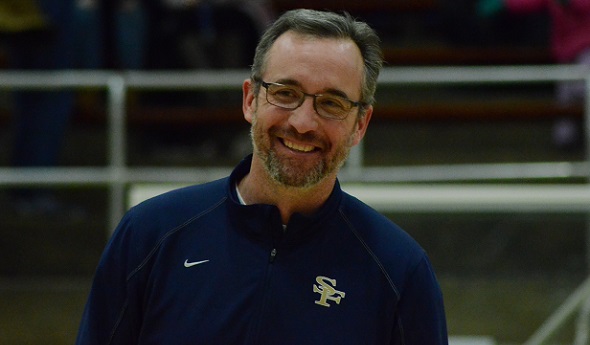
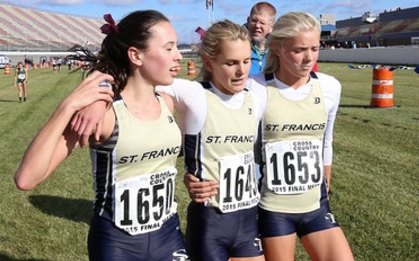
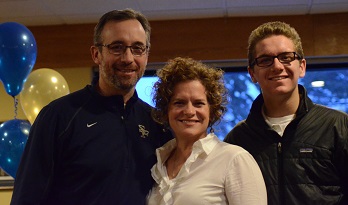
PHOTOS: (Top) Outgoing St. Francis athletic director Tom Hardy is honored during a halftime ceremony at a boys basketball game this season. (Middle) Gladiators Katelyn Duffing (1650), Holly Bullough (1649) and Emmalyne Tarsa leave the Michigan International Speedway chute together after leading their team to the 2015 Lower Peninsula Division 3 cross country title. (Below) Hardy, left, with wife Betsy and son Thomas. (Top and below photos by Julie English, middle photo by RunMichigan.com.)