


'Anyone Can Save a Life' Aims to Prepare
July 28, 2015
By Rob Kaminski
MHSAA benchmarks editor
It was 2008 when Jody Redman and staff at the Minnesota State High School League developed an emergency action plan to provide guidance and procedure in the event of sudden cardiac arrest during scholastic athletic competition.
The desired response from schools upon receipt of the plan was, well, less than enthusiastic.
“Only about 40 percent of our schools used the information and implemented the program,” said Redman, associate director for the MSHSL. “Our focus was completely on sudden cardiac arrest, that being the worst-case scenario regarding athletic-related health issues.”
The MSHSL asked the University of Minnesota to survey its member schools, and results showed that the majority of schools not on board simply felt a sudden cardiac arrest “would never happen at their school.” Naive or not on the schools’ parts, that was the reality – so Redman went back to revise the playbook.
“We expanded the plan to deal with all emergencies, rather than specific incidents,” Redman said. “Now it’s evolved so that we are prepared to deal with a variety of situations which put participants at risk. We shifted gears and got more schools to participate.”
Did they ever. And not just in Minnesota.
This summer, the “Anyone Can Save a Life” program, authored by the MSHSL and the Medtronic Foundation, is being disseminated to high schools nationwide with the financial support of the NFHS Foundation. The program will reach schools in time for the 2015-16 school year.
Once received, schools will find that there are two options for implementation, via in-person training or online.
“The in-person method is facilitated by the athletic administrator with the assistance of a training DVD” Redman said. “The important element is the follow through, ensuring coaches return their completed Emergency Action Plan (EAP). With the e-learning module on anyonecansavealife.org, individuals will complete an e-learning module that will walk them through the details of their specific plan, and as they answer questions, the information will automatically generate a PDF of the Emergency Action Plan (EAP) which they can edit at a later date as information changes.”
Schools will find five major components of the program to be received this summer: the first is an implementation checklist for the AD, explaining their role. Next are sections for in-person training, online training and event staff training. The last item contains a variety of resources that will ensure the successful implementation of a comprehensive emergency response to all emergencies.
Generally speaking, the program prompts schools to assemble preparedness teams, broken into four categories: a 911 team, a CPR team, an AED team and a HEAT STROKE team. The groups are made up of coaches and their students who will be in close proximity to all after-school activities.
“The reality about school sports is, at 3:30 every day the office closes and any type of medical support ceases to exist,” Redman said. “We then send thousands of students out to gyms, courts, fields and rinks to participate without systemic support for emergencies. This program puts into place that systemic support.”
Another stark reality is that the majority of schools in any state do not have full-time athletic trainers. Even for those fortunate enough to employ such personnel, it’s most likely the training “staff” consists of one person. That one body can only be in one place at one time, and on widespread school campuses the time it takes to get from one venue to another could be the difference between life and death.
“Athletic trainers can champion the program, but someone needs to oversee that every coach has a completed EAP in place,” Redman said. “For every minute that goes by when a cardiac arrest occurs, chance for survival decreases by 10 percent.”
Thus, it’s imperative to train and grant responsibility to as many people as possible, including student-athletes. In fact, students are a vital component to having a successful EAP. Students will be put in position to call 911, to meet the ambulance at a pre-determined access point, to locate the nearest AED, to make sure emersion tubs are filled for hot-weather practices, and for those who are trained, to assist with CPR. Coaches will identify students at the beginning of the season and prior to an emergency taking place. They will provide them with the details of the job they are assigned so they will be ready to assist in the event of an emergency.
“We have game plans for every sport, and for every opponent on our schedule,” Redman said. “But we don’t have a plan to save the life of a member of our team or someone attending a game at our school.
“This is about developing a quick and coordinated response to every emergency so we give someone in trouble a chance at survival, and then practicing it once or twice a season. We have ‘drop the dummy’ drills where we drop a dummy and evaluate how it went, and how everyone performed. In one scenario, it’s the coach that goes down, and then you have a group of 15- or 16-year-olds standing there. That’s why students have to take ownership of this, too.”
The key to an effective emergency action plan is to utilize and empower students in every sport and at every level to be a part of the response team. Following are brief descriptions of the teams.
The 911 Team
- Two students will call 911 from a pre-determined phone and provide the dispatcher with the location and details of the emergency.
- Two students will meet the ambulance at a pre-determined access point and take them to the victim.
- Two students will call the athletic trainer, if one is available, and the athletic administrator and alert them to the emergency.
The CPR Team
- The coach is the lead responder on this team and is responsible for attending to the victim and administering CPR, if necessary, until trained medical personnel arrive.
- One person is capable of providing effective CPR for approximately two minutes before the quality begins to diminish. Having several students trained and ready to administer CPR will save lives.
The AED Team
- Two students will retrieve the AED and take it to the victim.
- Two students will physically locate the athletic trainer, if one is available, and take him or her to the victim.
The Heat Stroke Team
- Two students identify locations of emersion tub, water source, ice source and ice towels.
- Two students prepare tub daily for practices and events.
For more information, visit anyonecansavealife.org or contact the MSHSL.
Martin Brings LA Marathon Championship Experience Home as Jackson High Coach
By
Doug Donnelly
Special for MHSAA.com
April 23, 2026
Nathan Martin has the best possible example a coach can give when it comes to the old phrase, “It’s never over, until it’s over.”
 Last month, the Jackson cross country head coach and track assistant captured national attention when he miraculously came from behind to win the Los Angeles Marathon.
The winning margin was one hundredth (0.01) of a second.
“I didn’t really know if I won,” said Martin. “I tried not to get too emotional or celebrate too much. Then people around me started confirming it.”
Martin, 36, was running his race when, with about five miles to go, he had a surge and passed the pack he was with to get comfortably into second place.
“There was only one guy to catch at that point; he was so far ahead,” Martin said. “I couldn’t even see him. At that point, it was like, ‘Okay, let’s push, let’s finish, be strong, and all that kind of stuff.”
Slowly, the leader came into focus.
“Within the last mile, I’d say, he came into view,” Martin said. “By 800 meters to go I thought I had a serious shot to try and win.
“I made one final surge. That last 800 was super painful. I was thinking to myself maybe I’ll catch him, maybe I won’t, but I definitely wanted to make sure I crossed that finish line with no regrets, knowing I left everything out there.”
As he and the leader, Michael Kimani Kamau of Kenya, approached the finish, the crowed braced for the finish.
“It was the last 50 to 80 meters where the true opportunity to win presented itself and I took full advantage of it,” Martin said. “When I crossed the line, it was so close. I was trying to hold back the excitement and emotions and all of that kind of stuff. People started confirming it, and it was surreal. I just started absorbing the moment and everything going on.”
He credits his own coach, James McCurdy, with preparing him with everything from the right nutrition to handling the Los Angeles heat to the running strategy.”
“It was painful, but I still had something left in the tank,” he said. “If the race would have been a couple miles longer, I would have been okay (to finish).”
Martin finished with a personal best time of 2 hours, 11 minutes, 16.5 seconds. It was the closest finish in LA Marathon history.
 “It was pretty special,” Martin said.
Martin was born in Chicago Heights, Ill., and moved with his family to Three Rivers before he started school. He began running in middle school and competed throughout high school. He ran the mile in high school and the 5K in college.
“I had a lot of success in my running journey,” he said. “Eventually, my coach thought I had what it takes to run a marathon.”
It wanted until late in his college career at Spring Arbor University that Martin ran his first marathon. He was 23.
“I won the 10K, then 36 hours later I won the marathon,” he said. “My coach was like, ‘Okay, you need to do this.’”
Martin is now a professional runner and has sponsors. He was at the Boston Marathon on Monday making appearances and connecting with people in the running community.
After college he began substitute teaching while trying to advance his running career. That’s when he launched his coaching career.
“There was a year where I was substitute teaching and going to races to try and place well,” he said. “By year two or three, I was coaching and I’ve continued that on.”
Martin said coaching is rewarding, “Especially seeing a kid overcome some kind of challenge.
“It’s being able to use my experiences to give back,” he added. “I want to help kids along their running journey. Even if they don’t become a big-time runner, I hope the types of lessons they learn, they can apply in life.
“Just see them be able to fight through something makes me feel like I am making a positive impact in the world.”
Martin has run fewer than 20 marathons in his life. “If you are training at an insanely high level, you usually look at doing one, maybe two or three a year,” he said.
He has taken some time away from marathon training recently as he’s made several national appearances.
And an assistant at Jackson this year, he said he’s noticed a buzz around the distance runners.
“There’s way more interest in distance running,” he said. “Normally they give me my two minutes of fame, then they are back to being high school students. This has been different. They’ve made me feel like definitely I’ve done something.”
He will begin ramping up his training and plans on competing in a half marathon soon, then has set his sights on either the New York or Chicago Marathon.
“It’s been pretty cool,” he said of the running community in Jackson. “They’ve been showing me a lot of love, and they are super proud. If I did Chicago, I imagine I would get a chunk of people down to watch. I’ve had so many people supporting me. It’s a really good feeling.”
 Doug Donnelly has served as a news and sports reporter at the Adrian Daily Telegram and the Monroe News for 30 years, including 10 years as city editor in Monroe. He's written a book on high school basketball in Monroe County and compiles record books for various schools in southeast Michigan. He is now publisher and editor of The Blissfield Advance, a weekly newspaper. E-mail him at [email protected] with story ideas for Jackson, Washtenaw, Hillsdale, Lenawee and Monroe counties.
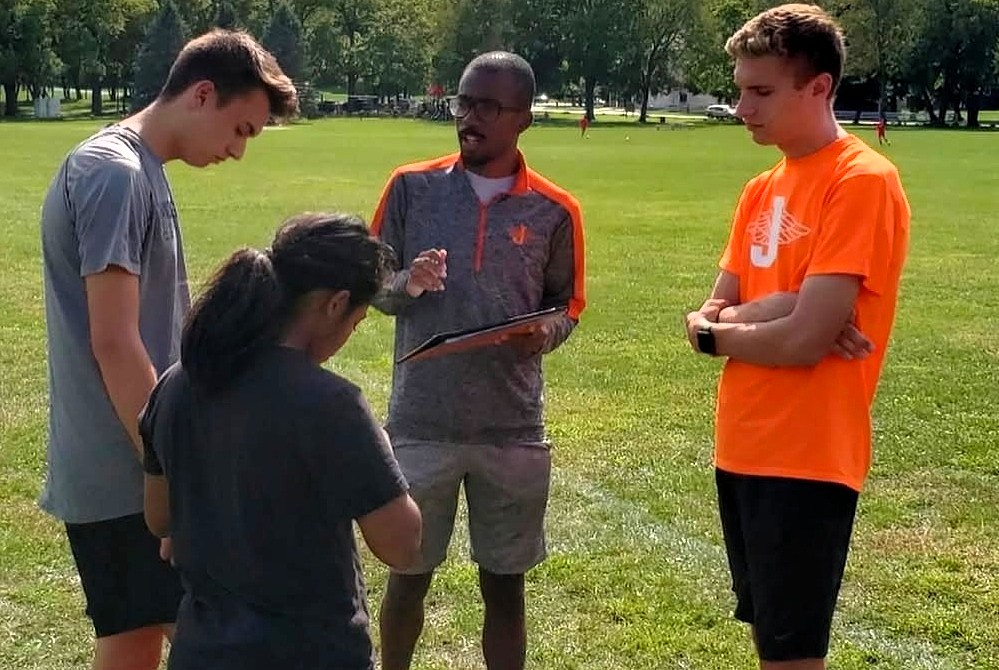
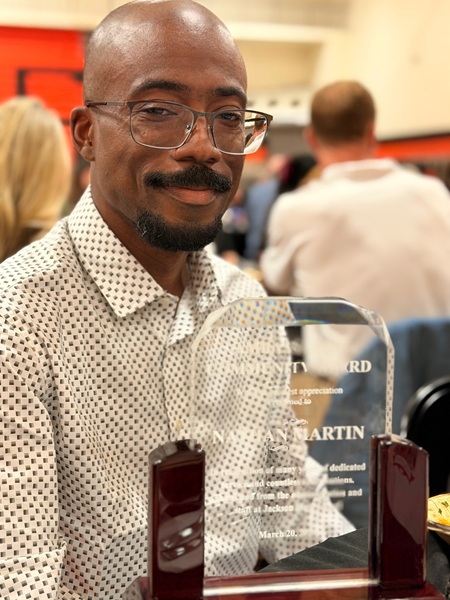
PHOTOS (Top) Nathan Martin, middle with clipboard, coaches his Jackson distance runners. (Middle) Martin poses for a photo with a community award he received from the school. (Photos courtesy of Nathan Martin.)