

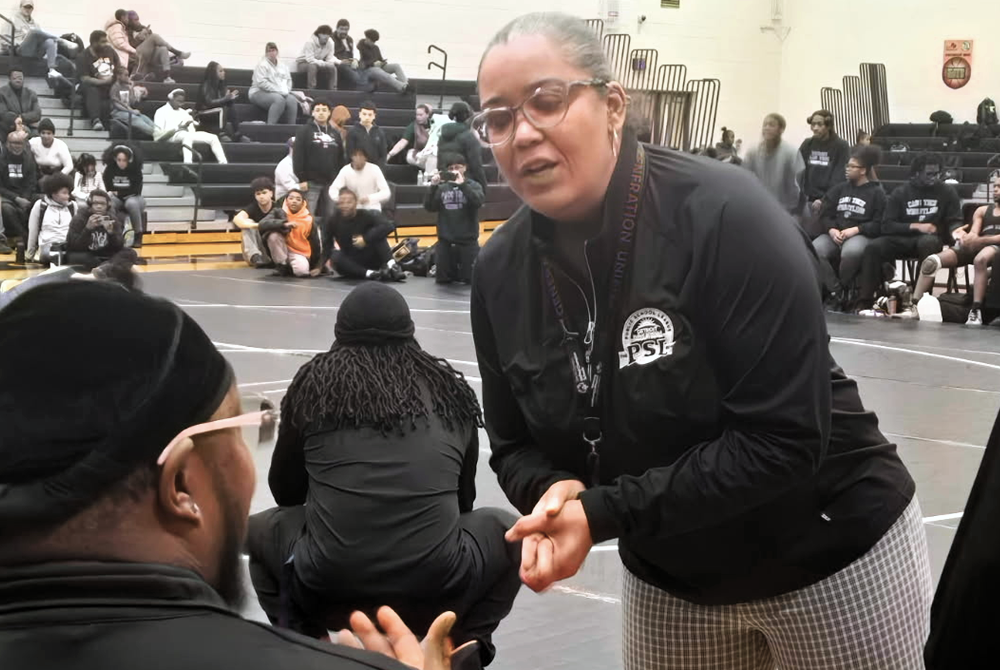
Detroit Public Schools' McEvans Selected for MHSAA Women In Sports Leadership Award
By
Geoff Kimmerly
MHSAA.com senior editor
January 22, 2026
Over nearly three decades as a coach, school and league administrator, Anika McEvans has worked to provide the athletic opportunities for all children that she enjoyed as an athlete herself and later as a mother of three including two who have gone on to play at the collegiate level.
Her work in several roles, serving multiple school districts over nearly 28 years, has benefited thousands of students. In recognition of those contributions, McEvans has been named the 40th recipient of the MHSAA’s Women In Sports Leadership Award.
Each year, the Representative Council considers the achievements of women coaches, officials and athletic administrators affiliated with the MHSAA who show exemplary leadership capabilities and positive contributions to athletics. McEvans will receive her award during the WISL Conference Banquet, Feb. 1 at the Crowne Plaza Lansing.
 Currently midway through her seventh school year serving in the Office of Athletics for the Detroit Public Schools Community District, she is responsible for planning and implementation of the Detroit Public School League’s sports offerings for 72 elementary and middle schools in addition to her several responsibilities supporting the league’s 20 high schools. McEvans came to the PSL from Southfield Public Schools, where as district director she supervised more than 100 coaches, staff and volunteers.
Before that she was a building athletic director, and prior to becoming an administrator she coached multiple sports across tenures at three schools.
“Obviously as an athlete myself, and also the mother of female athletes, my children and I both were very fortunate to have amazing coaches and administrators who elevated our sports,” McEvans said. “I made it a goal of mine everywhere I go to advocate in the same way. I want any child to have what I’d want for my children.”
A basketball, volleyball and softball player while a student at Detroit Renaissance, McEvans returned to high school athletics after college first as a coach, serving as head girls varsity basketball coach at Detroit Academy of Arts & Sciences, assistant boys basketball and softball coach at Renaissance, and assistant girls basketball coach at Southfield.
She served as athletic director from 2012-15 at the former Southfield High School, and as district athletic director through 2017-18 she assisted in the merger of Southfield High and Southfield-Lathrup into Southfield Arts & Technology High School for the start of the 2016-17 school year.
Also during her time at Southfield, McEvans added competitive cheer to the school’s athletic offerings, and then brought the sport to the PSL after moving to the Detroit district office. Cass Tech, Martin Luther King and Renaissance high schools have added competitive cheer teams, and McEvans is hopeful two more schools will do the same over the coming year.
“Anika McEvans continues to create and expand opportunities so as many students as possible can enjoy all of the good that comes with participation in school sports,” MHSAA Executive Director Mark Uyl said. “This award celebrates Anika’s leadership in this way, but also the example she sets in showing what’s possible when someone is driven to make a difference.”
McEvans received an MHSAA Allen W. Bush Award in 2024, celebrating her work often “behind the scenes” in school sports. She was selected for a Skillman Foundation Visionary Award this past year for her work “updating and upgrading the education system in Detroit and beyond.”
She has contributed her expertise to statewide athletics in many ways as well, serving on several MHSAA committees including athletic equity, junior high/middle school, scholar-athlete and as part of multiple officials and site selection committees. She also provided a key voice as part of the MHSAA Multi-Sport Task Force during the last half of the last decade and has played a leading role in providing coaches education throughout Detroit Public Schools through the MHSAA Coaches Advancement Program.
McEvans graduated from Renaissance in 1994 and went on to earn a bachelor's degree in sports management and communications from University of Michigan and a master’s in business administration from the University of Detroit Mercy. She also previously served as director of business operations and then general manager for the Detroit Demolition/Detroit Danger women’s professional football franchise from 2002-06 and as assistant general manager for the Motor City Mechanics minor league hockey team from 2004-06.
Her daughter Cheyenne McEvans is currently a graduate student playing her final season of college basketball at University of Nevada. Son Cameron McEvans played basketball at Lawrence Technological University and most recently professionally in Uruguay. Youngest daughter Cierra McEvans participated on West Bloomfield’s competitive cheer team and is now a sophomore at Grand Valley State University.
“I know how for young men and women that participate in sports, that it rounds out their development, gives them leadership skills and confidence to move through the world,” Anika McEvans said. “I was telling someone the other day that because of their successes and failures on the court, I knew my children would move through the world fearlessly.
“I (also) know in my particular role (at DPSCD) and also to a certain degree at Southfield, there are still gaps in how minority students and programs are supported … (and helping fill that gap) is just my mission.”
More than 700 participants – mostly female high school student-athletes from across the state – have registered to attend this year’s sold-out WISL Conference, the 27th in the series that remains the first, largest and longest-running program of its type in the country.
The opening address Feb. 1 will be presented by Kristen Kelsay, a two-time team captain during her playing career for the Michigan State University women’s volleyball team who recently completed her first season as the Spartans’ head coach and led the team to its highest win total since 2017. MSU women’s basketball coach Robyn Fralick – in her third season and leading a Spartans team that is 17-2 and ranked No. 13 by The Associated Press – will speak during the general session at the start of the Feb. 2 conference schedule.
Several workshops will be offered over the two days, with topics including coaching, teaching and learning leadership; sports nutrition and performance, and empowerment and goal-setting. Presenters are accomplished in their fields and represent a wide range of backgrounds in sport. A complete itinerary is available on the Women In Sports Leadership page.
The first Women In Sports Leadership Award was presented in 1990.
Past recipients
1990 – Carol Seavoy, L’Anse
1991 – Diane Laffey, Harper Woods
1992 – Patricia Ashby, Scotts
1993 – Jo Lake, Grosse Pointe
1994 – Brenda Gatlin, Detroit
1995 – Jane Bennett, Ann Arbor
1996 – Cheryl Amos-Helmicki, Huntington Woods
1997 – Delores L. Elswick, Detroit
1998 – Karen S. Leinaar, Delton
1999 – Kathy McGee, Flint
2000 – Pat Richardson, Grass Lake
2001 – Suzanne Martin, East Lansing
2002 – Susan Barthold, Kentwood
2003 – Nancy Clark, Flint
2004 – Kathy Vruggink Westdorp, Grand Rapids
2005 – Barbara Redding, Capac
2006 – Melanie Miller, Lansing
2007 – Jan Sander, Warren Woods
2008 – Jane Bos, Grand Rapids
2009 – Gail Ganakas, Flint; Deb VanKuiken, Holly
2010 – Gina Mazzolini, Lansing
2011 – Ellen Pugh, West Branch; Patti Tibaldi, Traverse City
2012 – Janet Gillette, Comstock Park
2013 – Barbara Beckett, Traverse City
2014 – Teri Reyburn, DeWitt
2015 – Jean LaClair, Bronson
2016 – Betty Wroubel, Pontiac
2017 – Dottie Davis, Ann Arbor
2018 – Meg Seng, Ann Arbor
2019 – Kris Isom, Adrian
2020 – Nikki Norris, East Lansing
2021 – Dorene Ingalls, St. Ignace
2022 – Lori Hyman, Livonia
2023 – Laurie Glass, Leland
2024 – Mary Cicerone, Bloomfield Hills; Eve Claar, Ann Arbor
2025 – Jennifer Thunberg, Freeland
Forsythe Honorees Led with Statewide View
By
Geoff Kimmerly
MHSAA.com senior editor
March 6, 2019
Jim Derocher always tried to listen to everyone before making a decision while serving on the MHSAA's Representative Council. He wanted to best serve not just the stars but all student-athletes, and not just those down the road but all over Michigan.
Longtime Council member Fred Smith always thought back to something Lake Michigan Catholic coach Terry Rose once told him: when making decisions, do what's best for kids first. Smith did so while trying to consider the needs not just of the student-athletes in his community, but in the many communities all over the state.
Both Derocher and Smith served thousands of students locally over decades of service and provided statewide contributions that continue to guide educational athletics in Michigan today. In recognition of their dedication, Derocher and Smith have been named the 2019 recipients of the Michigan High School Athletic Association’s Charles E. Forsythe Award.
The annual award is in its 42nd year and named after former MHSAA Executive Director Charles E. Forsythe, the Association's first full-time and longest-serving chief executive. Forsythe Award recipients are selected each year by the MHSAA Representative Council, based on an individual's outstanding contributions to the interscholastic athletics community. Derocher and Smith will receive their honors during the break after the first quarter of the MHSAA Division 1 Boys Basketball Final on March 16 at the Breslin Student Events Center in East Lansing.
After beginning his career as a teacher and coach at L’Anse, Derocher went on to serve as athletic director and assistant principal at Ishpeming Westwood from 1989-94, then as superintendent at Brimley from 1994-98 and finally Negaunee from 1998-2014. He also represented the Upper Peninsula’s Class C & D schools on the MHSAA Representative Council from 2003-14 and served as its president from 2008-14.
Smith taught, coached and served as athletic director at St. Joseph Lake Michigan Catholic from 1981-91, then served as athletic director at Comstock from 1991-2007, Buchanan from 2007-2015 and Benton Harbor from 2015-17. He represented the Lower Peninsula’s Southwestern Class A & B schools on the MHSAA Representative Council from 2008-17, including serving as vice president his final four years.
“Jim Derocher was an outstanding Council president, always approaching things first as a superintendent and looking at the big picture,” MHSAA Executive Director Mark Uyl said. “He provided a statewide perspective through an Upper Peninsula prism, always considering how decisions would impact schools from Monroe to Menominee.
“Fred Smith is simply one of the best athletic directors I’ve gotten to work with during my career in athletics,” Uyl added. “I met him while he was at Comstock; from Comstock to Buchanan to Benton Harbor he was presented with and led his programs through different challenges. And he always served as a champion for those schools in that part of the state while keeping a statewide perspective when helping shape the Council’s work.”
 Derocher finished his time at L’Anse earning the Copper Country Conference Coach of the Year award for boys basketball in 1989, and he also served as an MHSAA-registered official in football, boys and girls basketball from 1970-90. While on the Representative Council, Derocher served concurrently on the Upper Peninsula Athletic Committee.
He was a member of the Michigan Association of School Administrators from 1994-2014 and selected as its Region 1 Superintendent of the Year in 2013. He also received MASA’s 20-year Distinguished Administrator Award.
“I believe the experiences our student-athletes get in school athletics molds their future, whether they are the stars of the team or the supporting cast that make a team. This experience is no different for students in Brimley, Negaunee or Detroit," Derocher said. "I was always trying to work with other members of the Representative Council to recognize that these student-athletes are the same all over the state. I wanted to provide the best possible experience while also giving equality to all.”
Smith’s impact continues to be far-reaching. He remains active as part of the Michigan Interscholastic Athletic Administrators Association (MIAAA) and National Interscholastic Athletic Administrators Association (NIAAA), having served on the Board of Directors for both and recently named to the Strategic Planning Committee for the latter. He also continues to teach courses for the MHSAA’s Coaches Advancement Program (CAP) and taught the NIAAA’s Leadership Training Course at the national conference and via the internet in 13 states. He has presented at a number of MHSAA New Athletic Administrator In-Service programs and served as the co-chairperson of the MIAAA’s Professional Development Committee.
 Smith has been a registered cross country and track & field official for more than 30 years, and while an athletic director at his various schools hosted a multitude of MHSAA Tournament events in cross country, volleyball, boys and girls tennis, boys and girls basketball, track & field, wrestling, baseball, boys and girls soccer and softball. He received the MHSAA’s Allen W. Bush Award in 2014 for his many contributions behind the scenes, was named the MIAAA’s Athletic Director of the Year in 2000 and George Lovich State Award of Merit winner in 2007, and received the Art Jevert/Bruce Jacobs Distinguished Service Award from the Association of Track Officials of Michigan (ATOM) in 2013. He was named Midwest Athletic Director of the Year in 2000 as well by the National Council of Secondary School Athletic Directors (NCSSAD), and recognized by the NIAAA with a special commendation in 1999, its Distinguished Service Award in 2000, its Thomas Frederick Award of Excellence in 2004 and its Frank Kovaleski Professional Development Award in 2012. Smith also is a member of the Battle Creek St. Philip and Comstock halls of fame.
“Looking back on the service, it goes back to something my mom taught me when I was young and tried to impress on my brothers and sisters – it’s better to serve than to be served,” Smith said. “I’ve always tried to serve. I was very blessed with good high school coaches, and I enjoyed my high school experience at St. Philip. I was wanting to give back and fell into that niche, and I really enjoyed it.”
Derocher graduated from L’Anse High School in 1970 and earned his bachelor’s in secondary education, mathematics and physics in 1975 and master’s in education in 1988, both from Northern Michigan University. He also earned education specialist certification in 2003. He was a member of the Lake Superior Community Partnership from 2003-14 and remains a member of the Negaunee Lions Club. He resides in Ishpeming and works as an account executive for SET SEG, which coordinates benefits for Michigan public schools and their employees.
Smith graduated from Battle Creek St. Philip in 1973 and Western Michigan University with his bachelor’s degree in 1979. He received the Certified Master Athletic Administrator designation from the NIAAA in 2004. He remains active through his church, Our Lady Queen of Peace Catholic Church in Bridgman, and resides in Stevensville.
Past recipients of the Charles E. Forsythe Award
1978 - Brick Fowler, Port Huron; Paul Smarks, Warren
1979 - Earl Messner, Reed City; Howard Beatty, Saginaw
1980 - Max Carey, Freesoil
1981 - Steven Sluka, Grand Haven; Samuel Madden, Detroit
1982 - Ernest Buckholz, Mt. Clemens; T. Arthur Treloar, Petoskey
1983 - Leroy Dues, Detroit; Richard Maher, Sturgis
1984 - William Hart, Marquette; Donald Stamats, Caro
1985 - John Cotton, Farmington; Robert James, Warren
1986 - William Robinson, Detroit; Irving Soderland, Norway
1987 - Jack Streidl, Plainwell; Wayne Hellenga, Decatur
1988 - Jack Johnson, Dearborn; Alan Williams, North Adams
1989 - Walter Bazylewicz, Berkley; Dennis Kiley, Jackson
1990 - Webster Morrison, Pickford; Herbert Quade, Benton Harbor
1991 - Clifford Buckmaster, Petoskey; Donald Domke, Northville
1992 - William Maskill, Kalamazoo; Thomas G. McShannock, Muskegon
1993 - Roy A. Allen Jr., Detroit; John Duncan, Cedarville
1994 - Kermit Ambrose, Royal Oak
1995 - Bob Perry, Lowell
1996 - Charles H. Jones, Royal Oak
1997 - Michael A. Foster, Richland; Robert G. Grimes, Battle Creek
1998 - Lofton C. Greene, River Rouge; Joseph J. Todey, Essexville
1999 - Bernie Larson, Battle Creek
2000 - Blake Hagman, Kalamazoo; Jerry Cvengros, Escanaba
2001 - Norm Johnson, Bangor; George Lovich, Canton
2002 - John Fundukian, Novi
2003 - Ken Semelsberger, Port Huron
2004 - Marco Marcet, Frankenmuth
2005 - Jim Feldkamp, Troy
2006 - Dan McShannock, Midland; Dail Prucka, Monroe
2007 - Keith Eldred, Williamston; Tom Hickman, Spring Lake
2008 - Jamie Gent, Haslett; William Newkirk, Sanford-Meridian
2009 - Paul Ellinger, Cheboygan
2010 - Rudy Godefroidt, Hemlock; Mike Boyd, Waterford
2011 - Eric C. Federico, Trenton
2012 - Bill Mick, Midland
2013 - Jim Gilmore, Tecumseh; Dave Hutton, Grandville
2014 - Dan Flynn, Escanaba
2015 - Hugh Matson, Saginaw
2016 - Gary Hice, Petoskey; Gina Mazzolini, Lansing
2017 - Chuck Nurek, Rochester Hills
2018 - Gary Ellis, Allegan
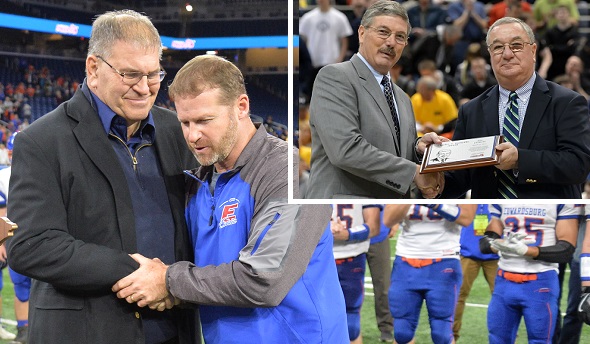
PHOTOS: (Top left) Fred Smith, left, congratulates Edwardsburg football coach Kevin Bartz after the 2017 Division 4 Final at Ford Field. (Top right) Jim Derocher, left, presents Tecumseh's Jim Gilmore with the Forsythe Award in 2013 at the Breslin Center.