

Gordon to Receive MHSAA Hampton Award for Championing Unified Sports
By
Geoff Kimmerly
MHSAA.com senior editor
February 11, 2026
As athletic director at Novi High School a decade ago, Brian Gordon helped Michigan become a national leader in growing Special Olympics Unified Sports for students with intellectual disabilities. Nearly three years after retiring from school administration, he remains an impassioned advocate helping schools all over the state add these inclusive programs to their athletic offerings.
To recognize his pioneering and now continuing work in expanding these opportunities across the state, Gordon has been selected as the recipient of this year’s Nate Hampton Champion of Progress in Athletics Award by the Michigan High School Athletic Association.
The Hampton Award was created by the MHSAA’s Representative Council to honor Nate Hampton, who retired in 2021 after serving in education and educational athletics for 50 years, including the last 32 as an MHSAA assistant director. Honorees have championed the promotion and advancement of opportunities for women, minorities and other underrepresented groups within interscholastic athletics, while serving as an administrator, coach, official, educator or school sports leader in Michigan.
 Gordon will receive the Hampton Award during the Michigan Interscholastic Athletic Administrators Association (MIAAA) annual conference, March 13-16 in Traverse City.
“To me, (Unified Sports) is absolutely the purest form of sport – what you’re supposed to get out of participating in athletics. Kids that participate in this program get every bit of that – teamwork, camaraderie, adversity, how to win, how to lose, being part of something bigger than yourself. It was, to me, just so impactful,” Gordon said. “The whole idea of more kids being involved in their athletic program, where they have the opportunity to play in front of their parents, being members of an athletic department at their school, to me was just incredible. … And the life lessons that kids learn, families learn, you can’t even measure them.
“It’s just a great, positive experience – for everyone.”
Gordon began his professional career in educational athletics in 1990 as a physical education and health teacher for Royal Oak Schools, and moved into his first athletic director/assistant principal role at Royal Oak in 2010. He left to become the director of athletic and physical education at Novi High School in 2012, retired from Novi at the end of the 2020-21 school year but then returned to Royal Oak as athletic director the following fall for two more years.
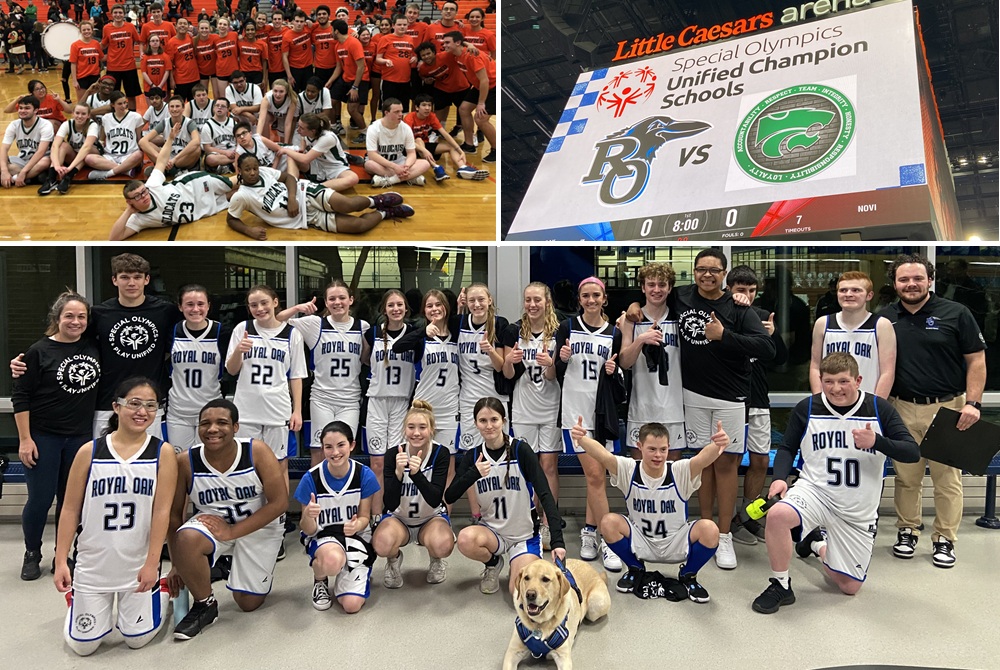
Unified Sports pair students with and without intellectual disabilities as teammates for training and competition. While at Novi, Gordon and Brighton athletic director John Thompson were inspired to bring Unified Sports not only to their schools, but to the Kensington Lakes Activities Association as a whole – and during the 2015-16 school year their schools were joined by Northville, Howell and Hartland in offering Unified teams, with the total soon growing to 13 KLAA schools. The KLAA, at Novi, hosted the first league tournament in the nation for Unified Sports teams – playing 21 basketball games during the inaugural event.
Also following his Novi retirement in 2021, Gordon became a liaison for Special Olympics of Michigan and Unified Sports. He meets with school administrators to promote Unified Sports and help districts build programs, and estimates there are more than 600 elementary, middle and high school Unified Sports teams across the state – with more than 100 high schools playing as part of leagues.
Current Unified offerings in Michigan include basketball, soccer and bocce, with track & field to be introduced this spring. Unified athletes have opportunities to play not just as part of leagues, but during special events like school-day assembly games and at venues like Little Caesars Arena in Detroit.
“Brian Gordon has spent more than 35 years promoting school sports and the athletes they serve, and who better to advocate for Unified Sports than someone who has dedicated his career to championing kids and creating opportunities for them to excel,” MHSAA Executive Director Mark Uyl said. “The MHSAA and the state’s school sports community have long benefitted from Brian’s positive approach and tremendous energy, and he’s poured all of himself into building bridges for Unified Sports in communities all over Michigan.”
In addition to his Special Olympics efforts, Gordon has served as a mentor for the MHSAA’s AD Connection Program since its creation at the start of the 2023-24 school year, working with first-year athletic directors as they transition to that role.
He’s also taught at the elementary and middle school levels, and supervised physical education and served as a health advisory chairperson at the district level. Including a season while still a college student, he has coached baseball, football, basketball and track & field from the junior high to varsity levels, including a stint as Royal Oak Kimball and Royal Oak High varsity baseball coach from 1995-2010. He was inducted into the Michigan High School Baseball Coaches Association Hall of Fame in 2011 and the Michigan High School Coaches Association Hall of Fame in 2021.
Gordon was selected for the MIAAA’s Jack Johnson Distinguished Service Award in 2021 and received an MHSAA Allen W. Bush Award in 2019 for his essential but often “behind-the-scenes” contributions to school sports. Previously, Gordon also was named Oakland County Athletic Director of the Year for 2018-19 by the Oakland County Athletic Directors Association, served as the OCADA president in 2014-15 and on its board from 2010-16, and also served as vice president of the Kensington Lakes Activities Association and president of the Kensington Conference. He has been a member of the MIAAA since 2008 and National Interscholastic Athletic Administrators Association (NIAAA) since 2010, and was named a Regional Athletic Director of the Year by the MIAAA in 2018.
“Being a recipient of the Nate Hampton Award – Nate has made such a difference in educational athletics in our state for so long, that it’s truly an honor to represent him in this award,” Gordon said. “I’m really proud of the fact that we’ve been able to make a difference in the state, just like he did, with Unified Sports.”
Gordon graduated from Clawson High School in 1985 and earned his bachelor’s degree at Central Michigan University – where he also played baseball – and master’s in sports administration and school leadership from Wayne State University. He earned his certified athletic administrator (CAA) designation from the NIAAA.
Prioritizing education and students has been a family focus for the Gordons; Brian’s wife Jill Gordon also is a retired teacher. They have two children – daughter McKenzie Ribbing and son Zachary Gordon, and retirement has allowed for more time with both as well as son-in-law Mike Ribbing and granddaughter Isabel.
The first Nate Hampton Champion of Progress in Athletics Award was presented in 2024.
Past recipients
2024 – Nicole Carter, Novi
2025 – Arnetta Thompson, Wyoming
(Photos courtesy of Brian Gordon.)
Finalists Announced for 2023-24 MHSAA/Farm Bureau Insurance Scholar-Athlete Awards
By
Geoff Kimmerly
MHSAA.com senior editor
January 19, 2024
The 120 finalists for the Michigan High School Athletic Association's Scholar-Athlete Awards for the 2023-24 school year, presented by Farm Bureau Insurance, have been announced.
 The program, in its 35th year, has recognized student-athletes since the 1989-90 school year and again this winter will honor 32 individuals from MHSAA member schools who participate in at least one sport in which the Association sponsors a postseason tournament.
Farm Bureau Insurance underwrites the Scholar-Athlete Awards and will present a $2,000 scholarship to each recipient. Since the beginning of the program, 928 scholarships have been awarded.
Scholarships will be presented proportionately by school classification, with 12 scholarships to be awarded to Class A student-athletes, six female and six male; eight scholarships will be awarded to Class B student-athletes, four female and four male; six scholarships will be awarded to Class C student-athletes, three female and three male; and four scholarships will be awarded to Class D student-athletes, two female and two male. In addition, two scholarships will be awarded at-large to minority recipients, regardless of school size.
Every MHSAA member high school could submit as many applications as there are scholarships available in its classification and could have more than one finalist. Ann Arbor Greenhills, Birmingham Seaholm, East Grand Rapids, Manistee and Midland Dow have three finalists this year. Seven schools have two finalists: Beal City, Britton Deerfield, Dearborn, Mason, Northville, Oxford, and Traverse City West.
Multiple-sport participation remains the norm among applicants. The average sport participation rate of the finalists is 2.88. There are 77 three-plus sport participants in the finalists field, and all but two of the 28 sports in which the MHSAA sponsors postseason tournaments are represented.
Of 445 schools which submitted applicants, 28 submitted the maximum allowed. This year, 1,607 applications were received. All applicants will be presented with certificates commemorating their achievement. Additional Scholar-Athlete Award information, including a complete list of scholarship nominees, can be found on the Scholar-Athlete page.
The applications were judged by a 65-member committee of school coaches, counselors, faculty members, administrators and board members from MHSAA member schools. Selection of the 32 scholarship recipients will take place in early February. Class C and D scholarship recipients will be announced Feb. 6, Class B scholarship recipients will be announced Feb. 13 and Class A scholarship recipients will be announced Feb. 20. All announcements will be made on the MHSAA Website.
To be eligible for the award, students must have a cumulative grade-point average of 3.50 (on a 4.0 scale) and previously have won a varsity letter in at least one sport in which the MHSAA sponsors a postseason tournament. Students also were asked to respond to a series of short essay questions, and submit two letters of recommendation and a 500-word essay on the importance of sportsmanship in educational athletics.
Farm Bureau Insurance of Michigan was founded in 1949 by Michigan farmers who wanted an insurance company that worked as hard as they did. Those values still guide the company today and are a big reason why it is known as Michigan’s Insurance Company, dedicated to protecting the farms, families, and businesses of this great state. Farm Bureau Insurance agents across Michigan provide a full range of insurance services—life, home, auto, farm, business, retirement, Lake Estate®, and more—protecting nearly 500,000 Michigan policyholders.
The MHSAA is a private, not-for-profit corporation of voluntary membership by more than 1,500 public and private senior high schools and junior high/middle schools which exists to develop common rules for athletic eligibility and competition. No government funds or tax dollars support the MHSAA, which was the first such association nationally to not accept membership dues or tournament entry fees from schools. Member schools which enforce these rules are permitted to participate in MHSAA tournaments, which attract more than 1.3 million spectators each year.
2023-24 Scholar-Athlete Award Finalists
GIRLS CLASS A
Yan Yee Adler, Ann Arbor Pioneer
Bella Adams, Battle Creek Lakeview
Katherine Slazinski, Birmingham Seaholm
Aya Moughni, Dearborn
Sam M. Peot, East Grand Rapids
Julia Holt, Farmington Hills Mercy
Tori Briggs, Fowlerville
Arianna Pate, Gibraltar Carlson
Cameron Herman, Hartland
Brooke Pedersen, Holland West Ottawa
Ella Chatfield, Jenison
Meghan Ford, Mason
Lauren VanSumeren, Midland Dow
Addison Raffle, Northville
Ella Boyd, Oxford
Abigail DeGraw, Rochester Hills Stoney Creek
Anna Lassan, South Lyon East
Lily Sackrider, St. Johns
Cecilia Ruchti, St. Joseph
Addison Booher, Traverse City Central
Ava King, Traverse City West
London Williams, Trenton
Sarah Fromm, Utica
Ryah Dewey, Walled Lake Western
BOYS CLASS A
Viraj Nautiyal, Birmingham Seaholm
Dylan Shoresh, Birmingham Seaholm
Charles Howell, Cadillac
Erik Giedeman, Dearborn
Joseph Stachelek, Detroit U-D Jesuit
Charlie Lentz, East Grand Rapids
Charlie Seufert, East Grand Rapids
Chris Piwowarczyk, Fenton
TJ Silvernale, Grand Rapids Forest Hills Northern
Jack Ryan, Grosse Pointe South
Jaden Reji, Livonia Churchill
Connor Curtis, Livonia Stevenson
Austin Martel, Mason
Jonathan Song, Midland Dow
Logan Yu, Midland Dow
Jaxson Whitaker, Muskegon Reeths-Puffer
Kyle Brown, Northville
Sean Wilson, Oxford
Anirudh Krishnan, Plymouth
Abrar Hossen, Portage Central
Andrew Miller, Saline
Jack Carlisle, Stevensville Lakeshore
Willem Howard Anthony DeGood, Traverse City West
Vansh Jvalit Baxi, Troy Athens
GIRLS CLASS B
Elaine Gordon, Adrian
Navya Ashok, Ann Arbor Greenhills
Anika Bery, Ann Arbor Greenhills
Hannah Herman, Buchanan
Gwenyth L. Geiger, Caro
Reese Herioux, Gladstone
Julie Ashbaugh, Grant
Grace deWaalMalefyt, Hudsonville Unity Christian
Megan Marta, Ishpeming Westwood
Addison Rutter, Kingsford
Libby McCarthy, Manistee
Cecilia Postma, Manistee
Malena Johnson, Marshall
Katelyn Baney, Paw Paw
Malia Thelen, Portland
Isabella DeWildt, Sault Ste. Marie
BOYS CLASS B
Angelo Ciarelli, Ann Arbor Father Gabriel Richard
Lucas Nor, Ann Arbor Greenhills
Austin Hinkley, Big Rapids
Logan Cripps, Brooklyn Columbia Central
Jackson Dell, Chelsea
William E. Ribby, Eaton Rapids
Logan Lipka, Frankenmuth
Charles Lindemann, Grand Rapids Catholic Central
Ben Sytsma, Grand Rapids Christian
Stephen Petersen, Hillsdale
Michael Stout, Howard City Tri County
Anthony Mariotti Goatley, Madison Heights Lamphere
Braydon Sorenson, Manistee
Ethan Chambliss, Niles
Aiden Roulo, St. Clair
Oliver Brown, Williamston
GIRLS CLASS C
Mikaela Ann Boyle, Bad Axe
Kylie Ott, Bridgman
Allison Bowles, Clinton
Jaida Schulte, Elk Rapids
Lauren Borsenik, Hemlock
Mariah Thompson, Houghton Lake
Lola Korpi, Ishpeming
Alexis Ewing, Jonesville
Adilyn Anne Ruggles, Marlette
Sara Dammann, New Lothrop
Brooke Spitzley, Pewamo-Westphalia
Claire Neumann, Saginaw Valley Lutheran
BOYS CLASS C
Carter Upper, Alcona
Payton Butkovich, Beal City
Jamisen Latham, Beal City
Tristan B. Harbaugh, Gobles
Niko Burgoon, Iron Mountain
Kannon Duffing, Manchester
Brad H. McNeill, Montrose
Jack Lantz, New Buffalo
Ryin Ruddy, Ottawa Lake Whiteford
Benjamin March, St. Louis
Julian Ahluwalia, Traverse City St. Francis
Landen Muska, Vassar
GIRLS CLASS D
Makenzee Grimm, Battle Creek St. Philip
Alivia Salenbien, Britton Deerfield
Alayna Salenbien, Britton Deerfield
Caroline Beggs, Clarkston Everest Collegiate
Rachel Case, Kimball New Life Christian
Mallory Lowe, Leland
Bonnie Kiger, Marion
Hazel Hysell, St. Joseph Our Lady of the Lake Catholic
BOYS CLASS D
Samuel Wallace Lutz, Adrian Lenawee Christian
Jürgen Griswold, Ellsworth
Christian Besonen, Ewen-Trout Creek
Trenton Taratuta, Hillman
Ridley Fast, Hillsdale Academy
Ben McCaw, Lawrence
Nathan Mihills, Marcellus
Clayton Shoup, Mason County Eastern
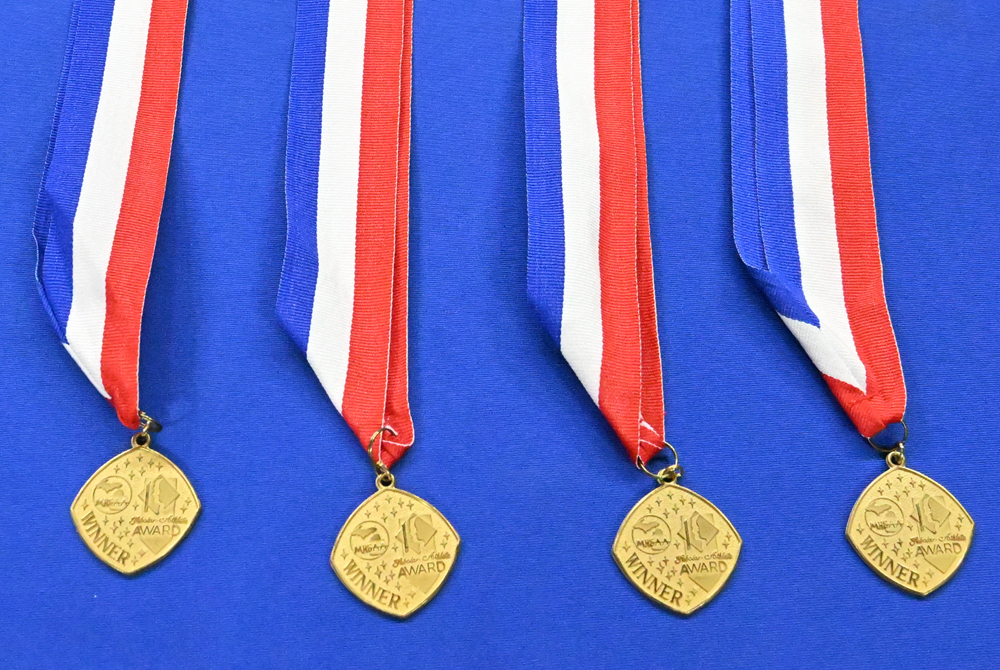
PHOTO Scholar-Athlete Award medals are ready for presentation during the 2023 ceremony at Breslin Center.