

Health & Safety: A Look Back, Gallop Ahead
By
John E. (Jack) Roberts
MHSAA Executive Director, 1986-2018
August 7, 2015
We are just completing year six of eight during which we have been addressing the four important health and safety issues that, for ease of conversation, we call the “Four Hs.”
During the 2009-10 and 2010-11 school years, our focus was on Health Histories. We made enhancements in the pre-participation physical examination form, stressing the student’s health history, which we believe was and is the essential first step to participant health and safety.
During the 2011-12 and 2012-13 school years, our focus was on Heads. We were an early adopter of removal-from-play and return-to-play protocols, and our preseason rules/risk management meetings for coaches included information on concussion prevention, recognition and aftercare.
Without leaving that behind, during the 2013-14 and 2014-15 school years, our focus was on Heat – acclimatization. We adopted a policy to manage heat and humidity – it is recommended for regular season and it’s a requirement for MHSAA tournaments. The rules/risk management meetings for coaches during these years focused on heat and humidity management.
At the mid-point of this two-year period, the MHSAA adopted policies to enhance acclimatization at early season practices and to reduce head contact at football practices all season long.
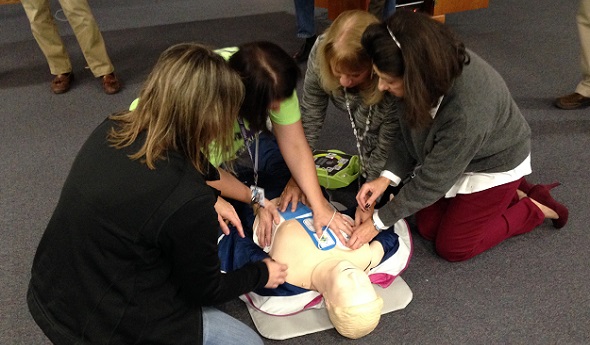
Without leaving any of the three previous health and safety “H’s” behind, during the 2015-16 and 2016-17 school years, our focus will be on Hearts – sudden cardiac arrest and sudden cardiac death.
Coinciding with this emphasis is the requirement that all high school level, varsity level head coaches be CPR certified starting this fall. Our emphasis will be on AEDs and emergency action plans – having them and rehearsing them.
On Feb. 10, bills were introduced into both the U.S. Senate and House of Representatives, together called the “Safe Play Act (see below),” which addressed three of the four health and safety “H’s” just described: Heat, Hearts and Heads.
For each of these topics, the federal legislation would mandate that the director of the Centers for Disease Control develop educational material and that each state disseminate that material.
For the heat and humidity management topic, the legislation states that schools will be required to adopt policies very much like the “MHSAA Model Policy to Manage Heat and Humidity” which the MHSAA adopted in March of 2013.
For both the heart and heat topics, schools will be required to have and to practice emergency action plans like we have been promoting in the past and distributed to schools this summer.
For the head section, the legislation would amend Title IX of the 1972 Education Amendments and eliminate federal funding to states and schools which fail to educate their constituents or fail to support students who are recovering from concussions. This support would require multi-disciplinary concussion management teams that would include medical personnel, parents and others to provide academic accommodations for students recovering from concussions that are similar to the accommodations that are already required of schools for students with disabilities or handicaps.
This legislation would require return-to-play protocols similar to what we have in Michigan, and the legislation would also require reporting and recordkeeping that is beyond what occurs in most places.
This proposed federal legislation demonstrates two things. First, that we have been on target in Michigan with our four Hs – it’s like they read our playbook of priorities before drafting this federal legislation.
This proposed federal legislation also demonstrates that we still have some work to do.
And what will the following two years – 2017-18 and 2018-19 – bring? Here are some aspirations – some predictions, but not quite promises – of where we will be.
First, we will have circled back to the first “H” – Health Histories – and be well on our way to universal use of paperless pre-participation physical examination forms and records.
Second, we will have made the immediate reporting and permanent recordkeeping of all head injury events routine business in Michigan school sports, for both practices and contests, in all sports and at all levels.
Third, we will have added objectivity and backbone to removal from play decisions for suspected concussions at both practices and events where medical personnel are not present; and we could be a part of pioneering “telemedicine” technology to make trained medical personnel available at every venue for every sport where it is missing today.
Fourth, we will have provided a safety net for families who are unable to afford no-deductible, no exclusion concussion care insurance that insists upon and pays for complete recovery from head injury symptoms before return to activity is permitted.
We should be able to do this, and more, without judicial threat or legislative mandate. We won’t wait for others to set the standards or appropriate the funds, but be there to welcome the requirements and resources when they finally arrive.
Safe Play Act — H.R.829
114th Congress (2015-2016) Introduced in House (02/10/2015)
Supporting Athletes, Families and Educators to Protect the Lives of Athletic Youth Act or the SAFE PLAY Act
Amends the Public Health Service Act to require the Centers for Disease Control and Prevention (CDC) to develop public education and awareness materials and resources concerning cardiac health, including:
- information to increase education and awareness of high risk cardiac conditions and genetic heart rhythm abnormalities that may cause sudden cardiac arrest in children, adolescents, and young adults;
- sudden cardiac arrest and cardiomyopathy risk assessment worksheets to increase awareness of warning signs of, and increase the likelihood of early detection and treatment of, life-threatening cardiac conditions;
- training materials for emergency interventions and use of life-saving emergency equipment; and
- recommendations for how schools, childcare centers, and local youth athletic organizations can develop and implement cardiac emergency response plans.
Requires the CDC to: (1) provide for dissemination of such information to school personnel, coaches, and families; and (2) develop data collection methods to determine the degree to which such persons have an understanding of cardiac issues.
Directs the Department of Health and Human Services to award grants to enable eligible local educational agencies (LEAs) and schools served by such LEAs to purchase AEDs and implement nationally recognized CPR and AED training courses.
Amends the Elementary and Secondary Education Act of 1965 to require a state, as a condition of receiving funds under such Act, to certify that it requires: (1) LEAs to implement a standard plan for concussion safety and management for public schools; (2) public schools to post information on the symptoms of, the risks posed by, and the actions a student should take in response to, a concussion; (3) public school personnel who suspect a student has sustained a concussion in a school-sponsored activity to notify the parents and prohibit the student from participating in such activity until they receive a written release from a health care professional; and (4) a public school's concussion management team to ensure that a student who has sustained a concussion is receiving appropriate academic supports.
Directs the National Oceanic and Atmospheric Administration to develop public education and awareness materials and resources to be disseminated to schools regarding risks from exposure to excessive heat and humidity and recommendations for how to avoid heat-related illness. Requires public schools to develop excessive heat action plans for school-sponsored athletic activities.
Requires the CDC to develop guidelines for the development of emergency action plans for youth athletics.
Authorizes the Food and Drug Administration to develop information about the ingredients used in energy drinks and their potential side effects, and recommend guidelines for the safe use of such drinks by youth, for dissemination to public schools.
Requires the CDC to: (1) expand, intensify, and coordinate its activities regarding cardiac conditions, concussions, and heat-related illnesses among youth athletes; and (2) report on fatalities and catastrophic injuries among youths participating in athletic activities.
Jack Roberts, on Tom Rashid: One More Call
By
John E. (Jack) Roberts
MHSAA Executive Director, 1986-2018
December 9, 2021
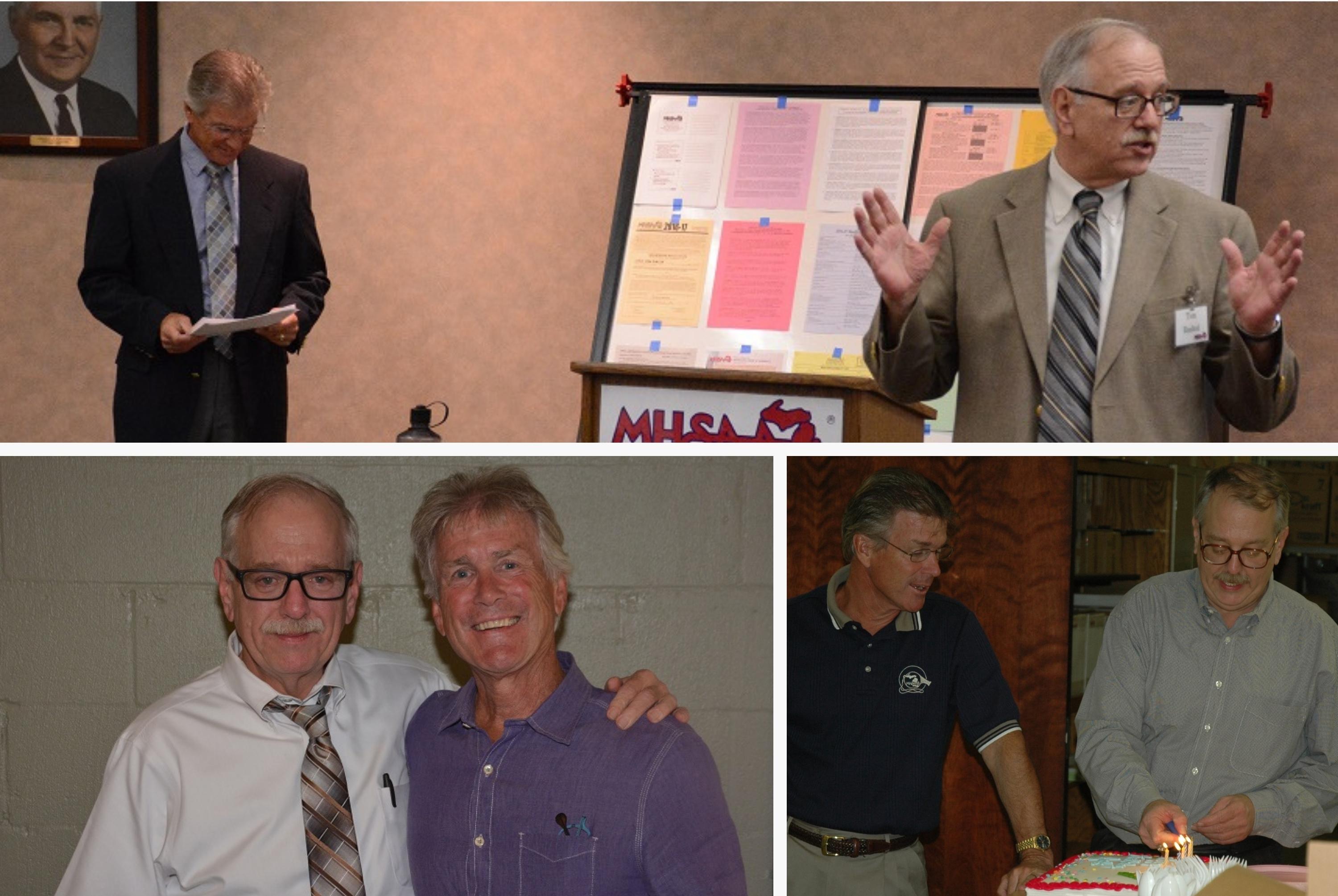
More than a decade ago, with his knowledge, I placed in my “Will & Instructions Upon Death” that Tom Rashid was to be the one and only person to speak at my funeral or memorial service. A short number of years later, Tom told me that I was to do the same for him. Obviously, we knew that we could not both keep our promise to the other. But I must say, if Tom does not actually show up for my funeral, that will be the first time he has not kept a promise to me.
I understand there will be a time in the future, when the weather warms and COVID wanes, when school administrators across Michigan can gather in force to show their respects to Tom, and when I will provide the eulogy that Tom asked of me. But Tom’s recent death reminds us how uncertain life can be and suggests that I say some things now, before it’s too late.
Tom was the unparalleled master of award presentations; and for more than a dozen years he wrote and delivered polished praise on award recipients at the annual conference of the Michigan Interscholastic Athletic Administrators Association. My tribute now isn’t an awards presentation or hall-of-fame induction, so I won’t recount the particulars of Tom’s career; but what you will see here is the importance of Tom’s life … the themes that distinguish him from any other person I’ve known.
Tom comes from a large, complicated and compassionate family of parents, aunts, uncles, brothers, sisters, nephews and nieces who mourn his loss at levels few of us can fathom. Over the years, and for many years, he was the caretaker for several family members; and he was generous with all of them. My hope for each family member now – and for many days, weeks and months to come – is that you are at peace. Tom’s pain is over; and his place in eternity is secure. Tom purchased a reserved seat.
Tom often joked that his only good habit was prayer. That’s not really true, of course. But for as long as I’ve known Tom, he talked to God many times a day; and I’ve always had the feeling that he talked to God the same way he talked to us: bluntly, forcefully, passionately, honestly, loudly, making very plain what he had on his mind.
Tom was a rigorous practitioner of his devout Catholic faith; and, the God whom Tom believed in is a big God … the president, general manager and head coach of a huge, diverse team whose game plan is a large, loving Gospel of limitless parameters and possibilities. I have no doubt that, both in times of need and not, members of the Roberts family – including both my parents, my sister, my wife and our children and grandchildren – have been specific in his petitions to God. I have no doubt that Tom’s daily prayers included many of you, and your loved ones as well.
In addition to Tom’s immediate family is the even larger and even more complicated family Tom developed through a long, illustrious career in Michigan school sports administration: a full 25 years with the Archdiocese of Detroit, until 2003, when I invited him to join me at the MHSAA office in East Lansing.
During my 32 years as the executive director of the MHSAA, I never saw another like Tom … never, anywhere. He talked to anybody, anytime of the day or night, about any question or problem they might have. Usually, Tom didn’t need to give me notes reviewing his telephone conversations. From my adjacent office, and given his forceful voice, I could hear Tom’s every word, very clearly.
Tom had the ability to anticipate what I might need and take care of it without my asking. It is no exaggeration to say that Tom would do anything for me. For example, Tom’s reluctance to travel and his fear of flying are well known to many of you. I believe the one and only time that Tom flew in an airplane was in 2003, when I ordered him to fly to Texas so that he might receive the highest award of the National High School Coaches Association. He had never flown before; he has never flown since.
Most remarkable was not merely Tom’s unselfish, unlimited, legendary availability to athletic administrators at any hour of the day or night, nor his experienced, learned grasp of the subject matter in answering their calls. What was more remarkable was his effort to help school administrators through their hard times. On many occasions these callers had made an error of commission or omission. They had made a mistake or an oversight; and Tom was supremely compassionate in guiding them through the local fallout from disappointed athletes and disgruntled adults. Secure in himself and our mission to be servant-leaders, Tom very often shared or completely shouldered unjustified blame so others would not. He gave cover to countless local school administrators every year of his MHSAA career so that those administrators might survive and even thrive in their careers.
Among my remarkably loyal MHSAA staff, Tom still stands out. And he earned the enduring loyalty of those with whom he worked. I think especially of his successor at the Archdiocese of Detroit, Vic Michaels: I doubt that more than two days ever passed between their almost daily telephone conversations … usually in the morning … for the full 15 years that my office was next to Tom’s at the MHSAA. I have never, ever been witness to anything like that; and I know there is no one in our good work who misses our dear colleague more than Vic.
But most remarkable of all was Tom’s ability to turn an adversary into an ally. He could have a knock-down, drag-out argument with a person one day, and by the next day, and for years to come, that person was Tom’s greatest advocate and admirer.
Well … maybe second-greatest advocate and admirer. Because no one in athletic administration – no one – loved Tom more than I. And no one in our work told him this more than I did.
I have written often about my admiration and affection for Tom. I have spoken both publicly and privately of it, on many occasions. But let me say it one more time, here, as we celebrate his life, and mourn our loss …
Tom and I provide proof that opposites attract, and we tag-teamed MHSAA’s leadership. One of us was very outgoing and vocal, the other more reserved and reticent. One of us was loud, the other more subdued. One of us was more comfortable on the phone, the other with the pen. One of us had no idea what to do with apostrophes, while the other would put them in the correct places. One of us was more spontaneous and extemporaneous, the other a more detailed planner and measurer of consequences. One of us hated to travel, the other sent messages to him from distant oceans and continents every year on Christmas or New Year’s Day to thank him for his life and service. But in our hearts, where one’s core values are harbored, we were almost identical twins.
I doubt that any two people who were side-by-side in the workplace for 15 years expressed their gratitude for each other more than we did, nor any two co-workers who said “I love you” to one another as often as we did. We each felt in deep debt to the other for myriad gifts and gestures that improved our careers and our lives.
Over the years, Tom and I developed the strategy of making one more telephone call before we made a final decision in a difficult matter … making one more call that sometimes made a difference in the controversial decision we had to make or in how that decision was accepted by those it affected. Tom loved to be the one to make those calls. And, sometimes, that “one more call” made all the difference.
Throughout my adult life, whenever I’ve attended a funeral or memorial service, I’ve found myself asking what it is I should learn and try to emulate from the life of the deceased. If you should find your mind and heart doing anything like that now, may I suggest these two answers.
First, Tom’s life and death remind us that we should not delay a single day in telling those with whom we work that we appreciate them and are grateful for what they do. And, if it is true and you are able, say you love them. Tom did this more often than anyone I’ve known.
And the second message is this. Tom’s life stands for faithfulness … faithfulness to his God, faithfulness to his family, faithfulness to his colleagues and friends, and faithfulness to his work and the mission of not just amateur athletics, but particularly school-operated, educational athletics. His was a steadfast faithfulness, never-a-day-off faithfulness, you-come-first faithfulness.
So Tom, my dear friend, once again I say, “I love you.”
And, “Rest in peace, Tom. God knows, you rarely rested in life.”
I would give anything for just one more call.