

Health & Safety: A Look Back, Gallop Ahead
By
John E. (Jack) Roberts
MHSAA Executive Director, 1986-2018
August 7, 2015
We are just completing year six of eight during which we have been addressing the four important health and safety issues that, for ease of conversation, we call the “Four Hs.”
During the 2009-10 and 2010-11 school years, our focus was on Health Histories. We made enhancements in the pre-participation physical examination form, stressing the student’s health history, which we believe was and is the essential first step to participant health and safety.
During the 2011-12 and 2012-13 school years, our focus was on Heads. We were an early adopter of removal-from-play and return-to-play protocols, and our preseason rules/risk management meetings for coaches included information on concussion prevention, recognition and aftercare.
Without leaving that behind, during the 2013-14 and 2014-15 school years, our focus was on Heat – acclimatization. We adopted a policy to manage heat and humidity – it is recommended for regular season and it’s a requirement for MHSAA tournaments. The rules/risk management meetings for coaches during these years focused on heat and humidity management.
At the mid-point of this two-year period, the MHSAA adopted policies to enhance acclimatization at early season practices and to reduce head contact at football practices all season long.
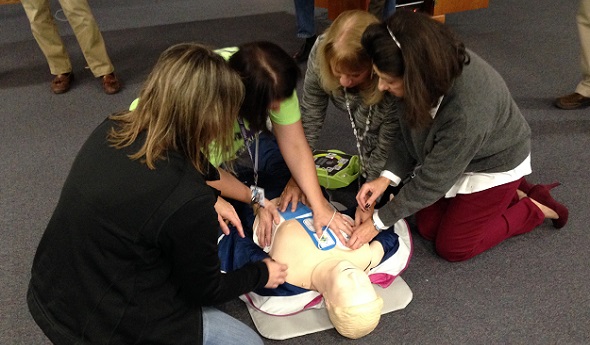
Without leaving any of the three previous health and safety “H’s” behind, during the 2015-16 and 2016-17 school years, our focus will be on Hearts – sudden cardiac arrest and sudden cardiac death.
Coinciding with this emphasis is the requirement that all high school level, varsity level head coaches be CPR certified starting this fall. Our emphasis will be on AEDs and emergency action plans – having them and rehearsing them.
On Feb. 10, bills were introduced into both the U.S. Senate and House of Representatives, together called the “Safe Play Act (see below),” which addressed three of the four health and safety “H’s” just described: Heat, Hearts and Heads.
For each of these topics, the federal legislation would mandate that the director of the Centers for Disease Control develop educational material and that each state disseminate that material.
For the heat and humidity management topic, the legislation states that schools will be required to adopt policies very much like the “MHSAA Model Policy to Manage Heat and Humidity” which the MHSAA adopted in March of 2013.
For both the heart and heat topics, schools will be required to have and to practice emergency action plans like we have been promoting in the past and distributed to schools this summer.
For the head section, the legislation would amend Title IX of the 1972 Education Amendments and eliminate federal funding to states and schools which fail to educate their constituents or fail to support students who are recovering from concussions. This support would require multi-disciplinary concussion management teams that would include medical personnel, parents and others to provide academic accommodations for students recovering from concussions that are similar to the accommodations that are already required of schools for students with disabilities or handicaps.
This legislation would require return-to-play protocols similar to what we have in Michigan, and the legislation would also require reporting and recordkeeping that is beyond what occurs in most places.
This proposed federal legislation demonstrates two things. First, that we have been on target in Michigan with our four Hs – it’s like they read our playbook of priorities before drafting this federal legislation.
This proposed federal legislation also demonstrates that we still have some work to do.
And what will the following two years – 2017-18 and 2018-19 – bring? Here are some aspirations – some predictions, but not quite promises – of where we will be.
First, we will have circled back to the first “H” – Health Histories – and be well on our way to universal use of paperless pre-participation physical examination forms and records.
Second, we will have made the immediate reporting and permanent recordkeeping of all head injury events routine business in Michigan school sports, for both practices and contests, in all sports and at all levels.
Third, we will have added objectivity and backbone to removal from play decisions for suspected concussions at both practices and events where medical personnel are not present; and we could be a part of pioneering “telemedicine” technology to make trained medical personnel available at every venue for every sport where it is missing today.
Fourth, we will have provided a safety net for families who are unable to afford no-deductible, no exclusion concussion care insurance that insists upon and pays for complete recovery from head injury symptoms before return to activity is permitted.
We should be able to do this, and more, without judicial threat or legislative mandate. We won’t wait for others to set the standards or appropriate the funds, but be there to welcome the requirements and resources when they finally arrive.
Safe Play Act — H.R.829
114th Congress (2015-2016) Introduced in House (02/10/2015)
Supporting Athletes, Families and Educators to Protect the Lives of Athletic Youth Act or the SAFE PLAY Act
Amends the Public Health Service Act to require the Centers for Disease Control and Prevention (CDC) to develop public education and awareness materials and resources concerning cardiac health, including:
- information to increase education and awareness of high risk cardiac conditions and genetic heart rhythm abnormalities that may cause sudden cardiac arrest in children, adolescents, and young adults;
- sudden cardiac arrest and cardiomyopathy risk assessment worksheets to increase awareness of warning signs of, and increase the likelihood of early detection and treatment of, life-threatening cardiac conditions;
- training materials for emergency interventions and use of life-saving emergency equipment; and
- recommendations for how schools, childcare centers, and local youth athletic organizations can develop and implement cardiac emergency response plans.
Requires the CDC to: (1) provide for dissemination of such information to school personnel, coaches, and families; and (2) develop data collection methods to determine the degree to which such persons have an understanding of cardiac issues.
Directs the Department of Health and Human Services to award grants to enable eligible local educational agencies (LEAs) and schools served by such LEAs to purchase AEDs and implement nationally recognized CPR and AED training courses.
Amends the Elementary and Secondary Education Act of 1965 to require a state, as a condition of receiving funds under such Act, to certify that it requires: (1) LEAs to implement a standard plan for concussion safety and management for public schools; (2) public schools to post information on the symptoms of, the risks posed by, and the actions a student should take in response to, a concussion; (3) public school personnel who suspect a student has sustained a concussion in a school-sponsored activity to notify the parents and prohibit the student from participating in such activity until they receive a written release from a health care professional; and (4) a public school's concussion management team to ensure that a student who has sustained a concussion is receiving appropriate academic supports.
Directs the National Oceanic and Atmospheric Administration to develop public education and awareness materials and resources to be disseminated to schools regarding risks from exposure to excessive heat and humidity and recommendations for how to avoid heat-related illness. Requires public schools to develop excessive heat action plans for school-sponsored athletic activities.
Requires the CDC to develop guidelines for the development of emergency action plans for youth athletics.
Authorizes the Food and Drug Administration to develop information about the ingredients used in energy drinks and their potential side effects, and recommend guidelines for the safe use of such drinks by youth, for dissemination to public schools.
Requires the CDC to: (1) expand, intensify, and coordinate its activities regarding cardiac conditions, concussions, and heat-related illnesses among youth athletes; and (2) report on fatalities and catastrophic injuries among youths participating in athletic activities.
Valued Leaders Talk Sportsmanship
April 12, 2013
By Rob Kaminski
MHSAA benchmarks editor
Anyone who has attended an MHSAA sporting event has undoubtedly heard the public address announcements touting sportsmanship.
Sportsmanship is one of many lessons taught through school sports. But are today’s student-athletes the willing pupils in the subject? Or are too many kids opting for elective courses in showmanship offered via YouTube and cable networks?
While many involved in high school athletics have noticed a decline in sportsmanship, it’s not too late to inject this valuable ingredient back into our games. But efforts need to begin at the local level, and the scholastic environment needs to supplant community venues where poor sportsmanship often flourishes.
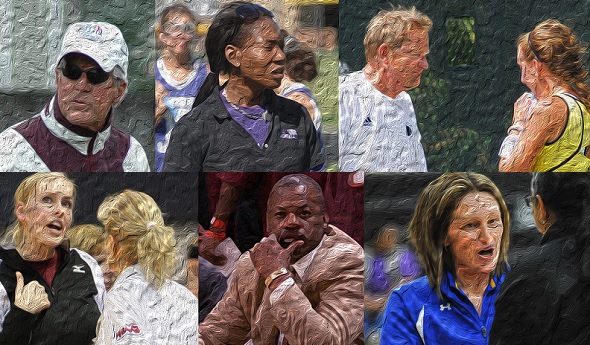
Seventeen coaches from all over the state chipped in to a benchmarks town hall discussion on sportsmanship.
East Kentwood’s Dave Emeott: “I think it is easy to see that sportsmanship is at least diminished. I think sportsmanship starts in the home, but we cannot always depend on the household to teach these lessons. As we sit in the stands, we realize that if this is where they learn it, then we need to get to work. I think we need to teach parents what a good sport looks like, as well as students. It is apparent that students will be the kind of sports they are permitted to be. Most coaches want good sportsmanship, but struggle with the balance of teaching character and winning or losing.”
Middleville Thornapple-Kellogg’s Tamara Benjamin: “Sportsmanship could be endangered. If a parent is allowed to sit in the stands and berate coaches, officials, and other athletes, it’s difficult for our students to see that this behavior is wrong because it is being tolerated. My expectations for our girls’ behavior are made clear the first day of practice. I hold them accountable for themselves, and we go forward each day.”
Holland’s Don Kimble: “I believe that it starts at home; always looking for a reason for failure opens the door to unsportsmanlike behavior. On our team, sportsmanship is stressed within the team first; if you cannot be a sportsman to your teammates, then you cannot be to others.”
Grand Haven’s Kimberly Vincent: “We’re all about sportsmanship and work with students and parents to set expectations. There are too many people pointing fingers at other people about this subject, and I think coaches have to set the example.”
Battle Creek Pennfield’s Mike Roach: “Youth sports programs need to concentrate on sportsmanship and the fact that there are winners and losers in sports. By not keeping score, the kids do not learn how to win, nor do they learn how to handle losing. Keep score. Teach kids that it is not the end of the world to lose, but be gracious in winning and losing.”
***
It could be true that much of the focus on poor sportsmanship is a result of just that: the spotlight on poor sportsmanship, rather than the good.
Thornapple-Kellogg’s Abby Kanitz: “I think that too much focus is put on the unsportsmanlike situations. There is much more good out there than bad; it just doesn't make for great stories. It does not take much more than one bad situation to ruin a game, competition or meet. I think sportsmanship comes from the coach. If your athletes know you have high expectations in this area, then their parents will know, too.”
Allegan’s Gary Ellis: “Sportsmanship is alive and well, though it is under attack. Students are exposed to so many examples of poor to horrendous sportsmanship on TV, that it seems to be the norm.”
Bloomfield Hills Andover’s David Zulkiewski: “I see positive sportsmanship every day with my athletes, and that’s because we focus on it and make it part of our daily practice and competition. Our team is much more than swimming or diving; it’s about excelling at life. So many of our kids will not compete in athletics after high school, so we try to give them skills they can use in the real world. Being a good sport is one of those skills.”
Grand Haven’s James Richardson: “Kids want and need structure, and will uphold the guidelines as long as they are clearly defined and enforced consistently. As coaches we need to build relationships with the kids and teach them proper behavior, and serve as models for them.”
Holt’s Mike Van Antwerp: “Sportsmanship is still around. If kids respect their opponents as individuals, they are good sports. Most of them would get along well if they were on the same team, so it’s important they realize that. The kids they play against are no different from them. If they respect the game, respecting their opponent follows.”
***
To be sure, no coach worth his or her clipboard sets out to allow poor sportsmanship. But emphasizing proper conduct early and often should be as essential as conducting tryouts.
Munising’s Cathy Mutter: “Sportsmanship is an important part of high school sports and life in general. I always tell my athletes, ‘You do not deserve; you earn. You have to work hard, be positive and be fair.’ I teach them to strive to be the best they can be on the team, in the classroom, at the jobs they have, and at home in their family life. Many programs struggle due to the fact they do not work together as a unit. You are only as strong as your weakest link.”
Rockford’s Ed Van Portfliet: “The O-K Conference and the member schools have done a great job of promoting sportsmanship, and I think it’s alive and well in our area. We teach our players it’s important to play hard, but they also have to respect their opponent and the game. We don’t tolerate actions or play from our players that would be considered disrespectful or detrimental to the game.”
Warren Regina’s Diane Laffey: “We always talk sportsmanship at our team meetings, our parent meetings and our coaches meetings. I guess it is an endangered species in some areas – but I do not feel it has gotten anywhere near that point at our school. I make every effort to make sure that our athletes, teams, coaches and parents keep sportsmanship at the top of our list.”
Allegan’s Ellis: “Leagues have a responsibility to educate their students about proper behavior at high school athletic events and how to treat their opponents. Schools need to develop leaders – on teams and in the stands – who set the tone at contests. The biggest trophy given out at our year-end awards night is the sportsmanship trophy.”
Marshall’s Sue Hutchings: “Sportsmanship starts with the coaching staff respecting the players and hammering the philosophy home. If one of our players exhibits bad sportsmanship, they are taken out of the competition and made to apologize. And trust me, it has happened. Our conference coaches are all pretty tight and have worked together for a number of years. We all share the same philosophy and have very, very little trouble with bad sportsmanship.”
***
Sometimes, proper sportsmanship is simply woven into the fabric of a given sport.
Grand Rapids Forest Hills Northern/Forest Hills Eastern’s Brian Telzerow: “Sportsmanship in golf is the leader in integrity. There is no other sport that is as self-policing as is golf. The young men and women must play with honor and integrity, calling penalties on themselves with no referees present. There is no entitlement here. After we play, players shake hands with all other competitors in their groups. We also make it a practice to say thanks to the host team and to the host course personnel. This is intentional to instill gratitude for the privilege of playing this sport.”
Portland’s Jim Niebling: “Sportsmanship may very well be endangered, but not in high school tennis and certainly not on our teams in Portland. Just this season my No. 1 singles player was playing his arch rival in the league championship match. They had gone back and forth for years and both knew the implication of winning the match for the upcoming Regional and Final tournaments where they were surely going to have to play again. The loser would be seeded lower and would have decidedly more difficult draws. But when the other player, up a set, began to cramp in the second set, looking like he may not be able to finish the match, my player walked to his cooler, pulled out a Gatorade and handed it to his opponent.
“My player ended up losing that match, and he knew that was a possibility when he handed his opponent that Gatorade. If that’s not sportsmanship, I don’t know what is.”
Grand Haven’s Richardson: “Sportsmanship is promoted on our team because in wrestling we are only in charge of ourselves and our actions. It’s a sport that holds individuals accountable. It is difficult in our sport to place blame on others.”
Grand Rapids Kenowa Hills/Grandville’s Brenda McDonald: “I always have my girls practice good sportsmanship. They always thank the home team or say, ‘Good job,’ to the opposing team. Many of the girls know the girls on other teams from previous gymnastics classes, so they enjoy seeing them again.”
High School Coaches Survey Identifies Parental Concerns
More than 3,000 high school coaches and athletic directors responded to a nationwide survey conducted by Growing Great Relationships (GGR) in cooperation with the National High School Coaches Association (NHSCA). The purpose of the survey was to understand what coaches and athletic directors see as their greatest needs concerning coach-parent and coach-athlete communication and relationships. GGR and NHSCA will use the results to design training and programs that address the identified needs.
The first section of the survey addressed issues surrounding parents of athletes. The first question asked coaches about their greatest concerns dealing with parents. More than 50 percent indicated over-involved parents as their No. 1 concern.
The second question asked coaches what they think parents are most concerned about. Overwhelmingly, nearly 80 percent reported the child’s amount of playing time as their perception of a parent’s biggest issue.
The next question asked coaches who are the most difficult parents. Athlete “wanna bes” were identified by 55 percent of the respondents.
Coaches then were asked what parents should do to support them. More than 70 percent indicated keeping them informed of personal difficulties their child was having at home. This was followed by 63 percent asking parents not to use social media regarding the team, or to gossip about the team or the coach’s expertise. Athletic directors’ responses were similar but with different percentages. Nearly 73 percent ranked not using social media or gossip about the team as the most important.
The second section of the survey asked coaches about their greatest concerns regarding relationships with their athletes. The first question asked coaches about the challenges they face communicating with student-athletes. Nearly 58 percent indicated an athlete receiving contradictory advice from parents and other coaches/advisers. This was followed closely with 55 percent stating an athlete’s inflated belief about his or her ability. Athletic director responses were similar but with somewhat different percentages. The greatest response, 70 percent, was the athlete receiving contradictory advice.
The second question asked the coaches for other factors interfering with their relationships with their student-athletes. The factor indicated by 58 percent of coaches was an athlete over-burdened with competing school demands (clubs, academics). For this particular question, the response from the athletic directors closely matched the coaches.
Athletic directors were asked that in their role what are their greatest concerns dealing with parents and athletes. The most frequent answer by 76 percent of athletic directors was parents bypassing coaches to complain directly to them.
In addition, nearly 500 coaches and athletic directors wrote in additional concerns that they have in their ability to communicate and work with athletes and their parents.
– Richard & Jane: Relationship Coaching