

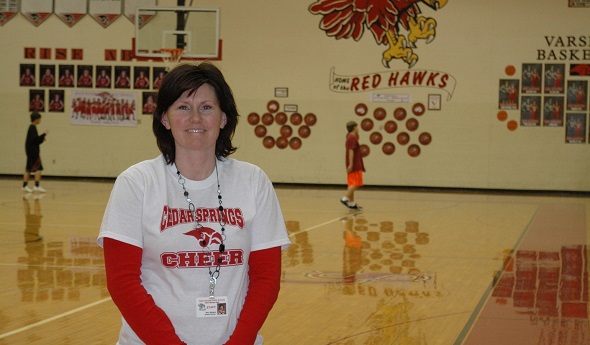
No Place Like Home for Cedar Springs' AD
July 16, 2013
By Rob Kaminski
MHSAA benchmarks editor
As half of the Superdome in New Orleans went dark early in the third quarter of Super Bowl XLVII on Feb. 3, Autumn Mattson had this thought go through her mind: things can happen even during events of that magnitude.
“I thought, ‘I guess some burnt popcorn setting off the smoke alarm at a basketball game isn’t the worst thing that can happen,’” said the seventh-year athletic director at Cedar Springs High School.
On this day in early February, it’s the OK Conference Competitive Cheer Meet scheduled for that evening which occupies much of her focus, another event in the winter sports season that can make the Red Hawks’ gym feel like her home.
Coordinating events like this one – and attempting to prepare for the unexpected – is one component of her job she previously had not given much thought.
“There were bound to be some oddities of being an athletic director that I never thought about,” said Mattson. “But the amount of work that goes into the actual setup for events is something I didn’t fully realize. From who’s taking tickets, to the cash box, concessions, locker rooms; it’s a lot to prepare for.”
In a position that calls for organizational skills and a high-energy personality, accessibility also helped her become a successful administrator in a short time.
“I’ve learned to become a very good listener. Heading into this job, I didn’t realize how essential it is to listen to people,” Mattson said. “I’ve gained a lot of perspective on the different passions people have and why they do things. And many times it just helps to know their voice will be heard.”
Mattson also can talk, particularly when it comes to her favorite subject: Red Hawks athletics, and the town of Cedar Springs in general. She belongs to the sixth generation of family in Cedar Springs, and says the city and its schools have always had a close-knit relationship.
That much is evident driving through the neighborhood near the high school, where street signs are painted Cedar Springs red. How many other towns across the state have residential street signs painted in school colors (the school long ago adopted the color of its “Red Flannel” heritage)?
“We’ve always been a close-knit community with so many good people looking out for each other, and so many groups pulling for each other here,” Mattson said. “I always dreamed of coming back here; it just happened sooner than I thought. When I got the job, I had to pinch myself.”
A 1997 Cedar Springs grad, Mattson just missed playing in the Red Hawks’ current facilities, as she was part of the last graduating class in the old building, Her prep career led to a basketball scholarship at Lake Superior State University, where she played from 1997-2001. When she returned, she had a new role in a new building, but made herself right at home.
In her initial position as athletic department secretary, Mattson had the good fortune of working for Pete Bush, now principal at Coopersville HS.
“He was a fabulous mentor who showed me the passion and desire it took to be an athletic director,” Mattson said. “He didn’t label me as a secretary, and sought my feedback and advice. Looking back, that was so instrumental; I probably wouldn’t have this job if he hadn’t told the administration to give me a chance.”
Mattson also served as the Red Hawks’ girls basketball coach until four years ago. That role also helped her prepare for administration.
“I sometimes struggled to understand why kids might not have the same passion that I did. I learned that some played for the competition, and some did it just to be part of a team.”
She now gets her fix of student interaction through the school’s Athletic Leadership Council, a group Mattson started in 2010 to unite students, staff and community members. It’s a unique representation of the entire athletic student body, which represents roughly half of the 950 students enrolled when multiple-sport athletes are counted. In many respects, Mattson feels like a coach – or mentor – to all of them.
“These kids all become part of the Red Hawk athletic family, and it’s overwhelming the amount of joy this job brings. I get goose bumps when I see kids have that ‘Aha’ moment when they get that payoff, and I know how much hard work they’ve put in,” she said.
A big factor in the success of any athletic director is having the support of one’s own family. Team Mattson – husband Scott, a former college tennis player and coach, along with sons Drew (9) and Evan (6) – is behind her 100 percent.
“We eat dinner in the office a lot,” said Mattson. “I am truly blessed to have a flexible family. We also try to keep a balance with the boys; we don’t force athletics down their throats. We take them to band concerts, plays and all of the different sports. They’ve grown up around a lot of awesome young adults. The kids are true Red Hawk fans.”
A seventh generation of Mattson’s family appears set for the land of red street signs.
PHOTO: Cedar Springs athletic director Autumn Mattson stands in his school's gymnasium. She returned to her alma mater after a college basketball career at Lake Superior State.
This is the fifth installment of a series, "Career Paths," focusing on the unsung contributions of athletic directors. See below for earlier installments.
Southwest Schools Begin League Shuffle
By
Wes Morgan
Special for MHSAA.com
December 6, 2016
Just when it seemed that the waters had calmed concerning conference realignment in Southwest Michigan, two area leagues are expected to lose a chunk of their respective memberships with the berth of a new alliance.
 It was announced in June that Bronson would be leaving the Berrien-Cass-St. Joseph League at the end of the 2016-17 school year to join the Big 8 Conference. The BCS began in 2014.
Now, all three St. Joseph County schools — Centreville, Mendon and White Pigeon — along with Cass County seat Cassopolis, are expected to exit the BCS this year as well. Those schools are joining Southwestern Athletic Conference defectors Bangor, Bloomingdale, Eau Claire, Hartford, Decatur and Marcellus to form the Southwest 10 Conference.
Seven of the 10 school districts have already voted in favor of the new league, with the last three unnamed schools expected to vote the same way later this month.
Once again, football was a driving force, though several other factors sparked the initial discussions back in August. It was important for Centreville, Mendon and White Pigeon to stick together after a long run dating back to the St. Joseph Valley League.
Competitive fairness and logistics were two other key concerns.
“(The SAC schools) came into this meeting stating the No. 1 goal is to not have a mega conference,” Mendon co-athletic director Glen Samson said. “They tried to get us to strike while the iron is hot. At the same time they are discussing this with us, the superintendents of the SAC and the BCS wanted us to all get together and form an even larger league, like 35 schools.
“We’ve just not had a whole lot of luck with this large conglomerate. It’s not really a league. You can see people voting on party lines, so to speak.”
A big obstacle in the BCS was football scheduling. The BCS did not make it mandatory that teams play cross-divisional games, which left some schools in the lurch when it came to filling out a nine-game schedule.
For instance, Mendon had to drive to the Upper Peninsula in Week 9 to play Manistique after finding no takers from similar-sized schools and with no desire of its own to compete against the likes of Class B programs up to three times a year.
Current BCS schools like Berrien Springs, Buchanan, Comstock and Parchment — all with about 450 students or more — are twice the size of schools like Mendon (203) and Cassopolis (278).
 “This idea came across our table, so we took a look at it,” Samson said. “The schools involved want to keep it to 10 teams. The more we got into it, the more it made sense.
“When Bronson left, it left us with four teams in our division in football. All that guaranteed Mendon, Centreville and Cass were three games. We’re sitting here with three games, and we have to find six and we have to now play two or three Class B schools to fill out a schedule in a league of 18 teams. This is not right.”
A 10-team league solves that issue and makes for easier organization of all other sports. More often than not, Samson and Cassopolis athletic director Matt Brawley agreed, coaches didn’t even know what division their school was in as the groupings changed by sport.
“Scheduling and getting the bylaws in order,” are at the top of the priority list for Brawley. “Right now, things seem to be running pretty smoothly. We have a great group of athletic directors and superintendents working diligently.”
If all goes according to plan, schedules will take care of themselves in the Southwest 10 since most schools offer the same sports. There are five schools that offer soccer with a sixth considering adding it for next season. A positive byproduct would be less travel time.
“For Cass, logistically, our furthest drive (would be) 37 miles,” Brawley said. “Marcellus and Decatur are our next-door neighbors. It doesn’t make much sense not to play them (as is the case now).
“I’m very excited,” Brawley said of a new league without divisions. “What I’m most excited about is being in a league where you’ve got to (likely) win nine games to win the conference championship or go 17-1 or 16-2 in basketball. It holds a lot more weight. The BCS is a great bunch of people, but this opportunity makes the most sense for us.”
 Wes Morgan has reported for the Kalamazoo Gazette, ESPN and ESPNChicago.com, 247Sports and Blue & Gold Illustrated over the last 12 years and is the publisher of JoeInsider.com. He can be reached at [email protected] with story ideas for Berrien, Cass, St. Joseph and Branch counties.
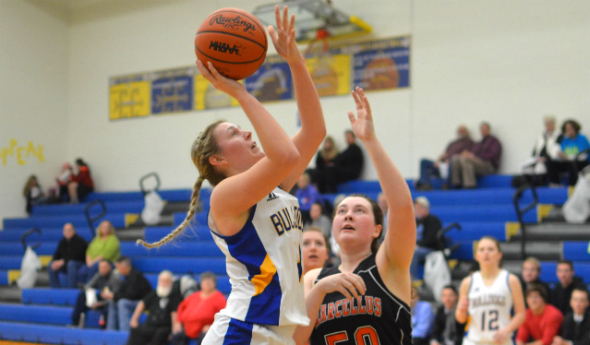
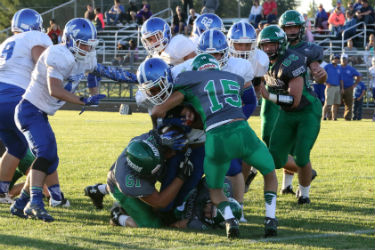
PHOTOS: (Top) Centreville and Marcellus face off in a girls basketball nonleague matchup. (Middle) Mendon and Casspolis will bring their football rivalry to the new Southwest 10 Conference. (Photos courtesy of Wes Morgan.)