

No Place Like Home for Cedar Springs' AD
July 16, 2013
By Rob Kaminski
MHSAA benchmarks editor
As half of the Superdome in New Orleans went dark early in the third quarter of Super Bowl XLVII on Feb. 3, Autumn Mattson had this thought go through her mind: things can happen even during events of that magnitude.
“I thought, ‘I guess some burnt popcorn setting off the smoke alarm at a basketball game isn’t the worst thing that can happen,’” said the seventh-year athletic director at Cedar Springs High School.
On this day in early February, it’s the OK Conference Competitive Cheer Meet scheduled for that evening which occupies much of her focus, another event in the winter sports season that can make the Red Hawks’ gym feel like her home.
Coordinating events like this one – and attempting to prepare for the unexpected – is one component of her job she previously had not given much thought.
“There were bound to be some oddities of being an athletic director that I never thought about,” said Mattson. “But the amount of work that goes into the actual setup for events is something I didn’t fully realize. From who’s taking tickets, to the cash box, concessions, locker rooms; it’s a lot to prepare for.”
In a position that calls for organizational skills and a high-energy personality, accessibility also helped her become a successful administrator in a short time.
“I’ve learned to become a very good listener. Heading into this job, I didn’t realize how essential it is to listen to people,” Mattson said. “I’ve gained a lot of perspective on the different passions people have and why they do things. And many times it just helps to know their voice will be heard.”
Mattson also can talk, particularly when it comes to her favorite subject: Red Hawks athletics, and the town of Cedar Springs in general. She belongs to the sixth generation of family in Cedar Springs, and says the city and its schools have always had a close-knit relationship.
That much is evident driving through the neighborhood near the high school, where street signs are painted Cedar Springs red. How many other towns across the state have residential street signs painted in school colors (the school long ago adopted the color of its “Red Flannel” heritage)?
“We’ve always been a close-knit community with so many good people looking out for each other, and so many groups pulling for each other here,” Mattson said. “I always dreamed of coming back here; it just happened sooner than I thought. When I got the job, I had to pinch myself.”
A 1997 Cedar Springs grad, Mattson just missed playing in the Red Hawks’ current facilities, as she was part of the last graduating class in the old building, Her prep career led to a basketball scholarship at Lake Superior State University, where she played from 1997-2001. When she returned, she had a new role in a new building, but made herself right at home.
In her initial position as athletic department secretary, Mattson had the good fortune of working for Pete Bush, now principal at Coopersville HS.
“He was a fabulous mentor who showed me the passion and desire it took to be an athletic director,” Mattson said. “He didn’t label me as a secretary, and sought my feedback and advice. Looking back, that was so instrumental; I probably wouldn’t have this job if he hadn’t told the administration to give me a chance.”
Mattson also served as the Red Hawks’ girls basketball coach until four years ago. That role also helped her prepare for administration.
“I sometimes struggled to understand why kids might not have the same passion that I did. I learned that some played for the competition, and some did it just to be part of a team.”
She now gets her fix of student interaction through the school’s Athletic Leadership Council, a group Mattson started in 2010 to unite students, staff and community members. It’s a unique representation of the entire athletic student body, which represents roughly half of the 950 students enrolled when multiple-sport athletes are counted. In many respects, Mattson feels like a coach – or mentor – to all of them.
“These kids all become part of the Red Hawk athletic family, and it’s overwhelming the amount of joy this job brings. I get goose bumps when I see kids have that ‘Aha’ moment when they get that payoff, and I know how much hard work they’ve put in,” she said.
A big factor in the success of any athletic director is having the support of one’s own family. Team Mattson – husband Scott, a former college tennis player and coach, along with sons Drew (9) and Evan (6) – is behind her 100 percent.
“We eat dinner in the office a lot,” said Mattson. “I am truly blessed to have a flexible family. We also try to keep a balance with the boys; we don’t force athletics down their throats. We take them to band concerts, plays and all of the different sports. They’ve grown up around a lot of awesome young adults. The kids are true Red Hawk fans.”
A seventh generation of Mattson’s family appears set for the land of red street signs.
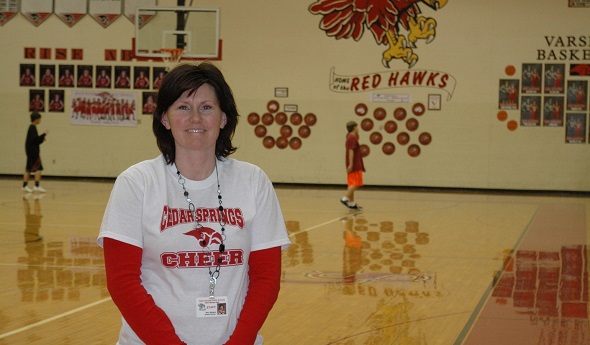
PHOTO: Cedar Springs athletic director Autumn Mattson stands in his school's gymnasium. She returned to her alma mater after a college basketball career at Lake Superior State.
This is the fifth installment of a series, "Career Paths," focusing on the unsung contributions of athletic directors. See below for earlier installments.
Health & Safety: A Look Back, Gallop Ahead
By
John E. (Jack) Roberts
MHSAA Executive Director, 1986-2018
August 7, 2015
We are just completing year six of eight during which we have been addressing the four important health and safety issues that, for ease of conversation, we call the “Four Hs.”
During the 2009-10 and 2010-11 school years, our focus was on Health Histories. We made enhancements in the pre-participation physical examination form, stressing the student’s health history, which we believe was and is the essential first step to participant health and safety.
During the 2011-12 and 2012-13 school years, our focus was on Heads. We were an early adopter of removal-from-play and return-to-play protocols, and our preseason rules/risk management meetings for coaches included information on concussion prevention, recognition and aftercare.
Without leaving that behind, during the 2013-14 and 2014-15 school years, our focus was on Heat – acclimatization. We adopted a policy to manage heat and humidity – it is recommended for regular season and it’s a requirement for MHSAA tournaments. The rules/risk management meetings for coaches during these years focused on heat and humidity management.
At the mid-point of this two-year period, the MHSAA adopted policies to enhance acclimatization at early season practices and to reduce head contact at football practices all season long.
Without leaving any of the three previous health and safety “H’s” behind, during the 2015-16 and 2016-17 school years, our focus will be on Hearts – sudden cardiac arrest and sudden cardiac death.
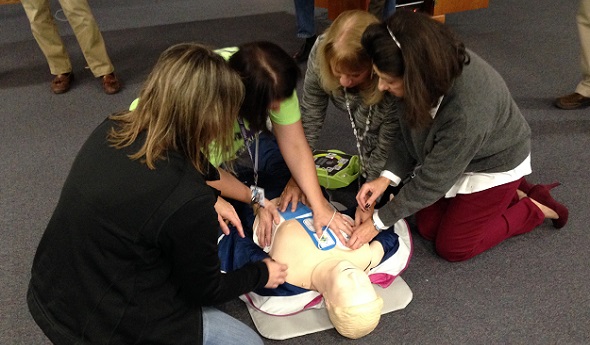
Coinciding with this emphasis is the requirement that all high school level, varsity level head coaches be CPR certified starting this fall. Our emphasis will be on AEDs and emergency action plans – having them and rehearsing them.
On Feb. 10, bills were introduced into both the U.S. Senate and House of Representatives, together called the “Safe Play Act (see below),” which addressed three of the four health and safety “H’s” just described: Heat, Hearts and Heads.
For each of these topics, the federal legislation would mandate that the director of the Centers for Disease Control develop educational material and that each state disseminate that material.
For the heat and humidity management topic, the legislation states that schools will be required to adopt policies very much like the “MHSAA Model Policy to Manage Heat and Humidity” which the MHSAA adopted in March of 2013.
For both the heart and heat topics, schools will be required to have and to practice emergency action plans like we have been promoting in the past and distributed to schools this summer.
For the head section, the legislation would amend Title IX of the 1972 Education Amendments and eliminate federal funding to states and schools which fail to educate their constituents or fail to support students who are recovering from concussions. This support would require multi-disciplinary concussion management teams that would include medical personnel, parents and others to provide academic accommodations for students recovering from concussions that are similar to the accommodations that are already required of schools for students with disabilities or handicaps.
This legislation would require return-to-play protocols similar to what we have in Michigan, and the legislation would also require reporting and recordkeeping that is beyond what occurs in most places.
This proposed federal legislation demonstrates two things. First, that we have been on target in Michigan with our four Hs – it’s like they read our playbook of priorities before drafting this federal legislation.
This proposed federal legislation also demonstrates that we still have some work to do.
And what will the following two years – 2017-18 and 2018-19 – bring? Here are some aspirations – some predictions, but not quite promises – of where we will be.
First, we will have circled back to the first “H” – Health Histories – and be well on our way to universal use of paperless pre-participation physical examination forms and records.
Second, we will have made the immediate reporting and permanent recordkeeping of all head injury events routine business in Michigan school sports, for both practices and contests, in all sports and at all levels.
Third, we will have added objectivity and backbone to removal from play decisions for suspected concussions at both practices and events where medical personnel are not present; and we could be a part of pioneering “telemedicine” technology to make trained medical personnel available at every venue for every sport where it is missing today.
Fourth, we will have provided a safety net for families who are unable to afford no-deductible, no exclusion concussion care insurance that insists upon and pays for complete recovery from head injury symptoms before return to activity is permitted.
We should be able to do this, and more, without judicial threat or legislative mandate. We won’t wait for others to set the standards or appropriate the funds, but be there to welcome the requirements and resources when they finally arrive.
Safe Play Act — H.R.829
114th Congress (2015-2016) Introduced in House (02/10/2015)
Supporting Athletes, Families and Educators to Protect the Lives of Athletic Youth Act or the SAFE PLAY Act
Amends the Public Health Service Act to require the Centers for Disease Control and Prevention (CDC) to develop public education and awareness materials and resources concerning cardiac health, including:
- information to increase education and awareness of high risk cardiac conditions and genetic heart rhythm abnormalities that may cause sudden cardiac arrest in children, adolescents, and young adults;
- sudden cardiac arrest and cardiomyopathy risk assessment worksheets to increase awareness of warning signs of, and increase the likelihood of early detection and treatment of, life-threatening cardiac conditions;
- training materials for emergency interventions and use of life-saving emergency equipment; and
- recommendations for how schools, childcare centers, and local youth athletic organizations can develop and implement cardiac emergency response plans.
Requires the CDC to: (1) provide for dissemination of such information to school personnel, coaches, and families; and (2) develop data collection methods to determine the degree to which such persons have an understanding of cardiac issues.
Directs the Department of Health and Human Services to award grants to enable eligible local educational agencies (LEAs) and schools served by such LEAs to purchase AEDs and implement nationally recognized CPR and AED training courses.
Amends the Elementary and Secondary Education Act of 1965 to require a state, as a condition of receiving funds under such Act, to certify that it requires: (1) LEAs to implement a standard plan for concussion safety and management for public schools; (2) public schools to post information on the symptoms of, the risks posed by, and the actions a student should take in response to, a concussion; (3) public school personnel who suspect a student has sustained a concussion in a school-sponsored activity to notify the parents and prohibit the student from participating in such activity until they receive a written release from a health care professional; and (4) a public school's concussion management team to ensure that a student who has sustained a concussion is receiving appropriate academic supports.
Directs the National Oceanic and Atmospheric Administration to develop public education and awareness materials and resources to be disseminated to schools regarding risks from exposure to excessive heat and humidity and recommendations for how to avoid heat-related illness. Requires public schools to develop excessive heat action plans for school-sponsored athletic activities.
Requires the CDC to develop guidelines for the development of emergency action plans for youth athletics.
Authorizes the Food and Drug Administration to develop information about the ingredients used in energy drinks and their potential side effects, and recommend guidelines for the safe use of such drinks by youth, for dissemination to public schools.
Requires the CDC to: (1) expand, intensify, and coordinate its activities regarding cardiac conditions, concussions, and heat-related illnesses among youth athletes; and (2) report on fatalities and catastrophic injuries among youths participating in athletic activities.