

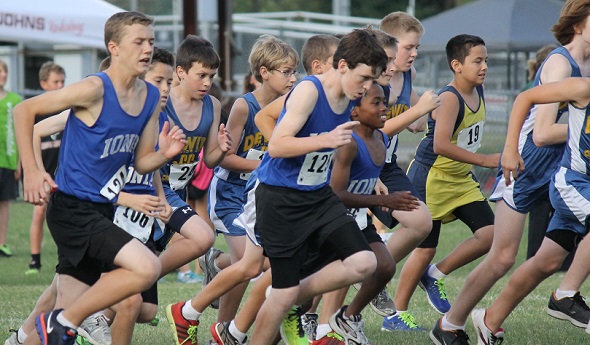
Nurturing Our Lower Level Programs
May 15, 2014
By John E. “Jack” Roberts
MHSAA Executive Director
When I’ve been faced with the most difficult choices as to different courses of action for the MHSAA, I’ve tried to face up to this reframing of the issue: “If we were creating the MHSAA for the first time today, would we do this, or would we do that?”
For example, would we or would we not limit coaches’ contact with athletes out of season? Would we have a 90-day period of ineligibility for transfer students or would it be 180 days?
There are other examples of such “either, or” questions I could provide, but none is as difficult or defining as this: Should school sports under the MHSAA’s auspices provide more opportunities for 7th- and 8th-graders and new opportunities for even younger students?
I won’t be coy about what I think our answer should be. I haven’t always felt this way, and I recognize it is a different opinion than some who are quoted in this publication; but today it’s my belief that if we were creating the MHSAA for the first time in 2014, the MHSAA would allow more contests and longer contests for 7th- and 8th-graders, and the MHSAA would have competition policies and programs for younger middle schoolers too.
I believe this is what parents want for their children and what students want for themselves; and I believe, within reason, that the better we serve these students in their junior high/middle school years, the stronger high school sports will be and the better these programs will support the educational missions of schools.
I believe we must begin to serve middle school students more comprehensively, and that our doing so today is the best hope we have for retaining comprehensive programs for high school students tomorrow. Not only does the lower profile and pressure of lower level programs nurture the highest ideals of educational athletics, they provide our highest hope for preserving those ideals at the high school level.
The Lasting Impact of First Impressions
The over-arching question before us is how to maintain policies that encourage multiple sport experiences for students at the junior high/middle school level while at the same time adjusting those policies in terms of grade level served and the numbers and lengths of contests allowed in order to be more attractive to junior high/middle school parents and to school districts which desire additional competition opportunities in the school setting for students prior to high school.
There is a good healthy discussion in our midst about the scope of junior high/middle school athletics – how much should occur and how young it should commence; and the result of these discussions may have long-lasting effect on students, schools and the MHSAA.
Here are two central issues:
1. Contest Limits
Many people over many years have contributed to developing the current season limitations for the number of contests permitted by MHSAA member junior high/middle schools. These good people have believed in a philosophy of sports at this level that encourages students to try multiple sports.
“Kids haven’t fully matured yet,” they say. “Kids haven’t been exposed to some sports yet. They don’t know what they might like or be good at. So let’s have policies and programs that encourage new opportunities and experiences at this level.”
The season limits that have been put in place allow some junior high/middle schools, or their entire leagues, to fit four distinct seasons in a nine-month school year, consistent with this over-arching philosophy to encourage these students to try new things and learn.
There is another educationally grounded and equally astute group of administrators and coaches who are concerned that the current limits are too severe in comparison to non-school youth sports programs. For example, community/club basketball or soccer programs may schedule 15 or 18 or more games per season versus the MHSAA limit of 12 at the junior high/middle school level.
These folks think these restrictive limitations create a disincentive for kids to play school sports, and that many of those who have no place in junior high/middle school sports have no interest later in high school sports.
2. 6th-Graders
Historically, the popular opinion among educators has held that 7th and 8th grade is early enough for schools to provide competitive athletics, early enough to put youth into the competitive sports arena, and early enough to pit one school against another in sports.
Today, however, many educators and parents point out that such protective philosophies and policies were adopted about the same time “play days” were considered to be the maximum exertion females should experience in school sports. Some administrators and coaches argue that both our severe limits on contest limits at the junior high/middle school level, and our refusal to serve 6th-graders, are as out of date and inappropriate as play days for females.
Today, in nearly four of five school districts with MHSAA member schools, 6th-graders go to school in the same building with 7th- and 8th-graders. But MHSAA rules don’t allow 6th-graders to participate with and against 7th- and 8th-graders. In fact, the MHSAA Constitution doesn’t even acknowledge that 6th-graders exist.
Today, in many places, 6th-graders have aged-out of non-school, community sports, but they are not permitted to play on MHSAA junior high/middle school teams.
Last school year, 50 different school districts requested this rule be waived for them, and the MHSAA Executive Committee approved 46 of 50 waivers, allowing 6th-graders to compete on 7th- and 8th-grade teams. During 2011-12, 37 of 40 requests for waiver were approved, in all cases for small junior high/middle schools. Many of these schools want, and some of them desperately need, these 6th-graders to fill out junior high/middle school teams.
Young people are starting sports much younger today than 100 years ago when the MHSAA was created. Younger than even 50 years ago when the MHSAA was incorporated. If the MHSAA were created today to serve any students before 9th grade, I’m certain it would not leave out 6th-graders who are walking the same halls with 7th- and 8th-graders, and who have been playing competitive sports almost since the first day they started walking at all.
Eyes on the future
The most important thing we can do to enhance high school sports is to grow junior high/middle school sports programs. The earlier we disconnect young people from non-school sports and engage them in school-sponsored sports, the better our chances are of keeping high school athletic programs healthy, and the better our prospects are of keeping both participation rates and conduct standards high.
School sports are in competition for hearts and minds of young people. Our competition includes movies, jobs, cars, video games, boyfriends and girlfriends and club sports ... especially club sports. School sports needs to market itself better, and part of better is to be available earlier – much sooner in the lives of youth. More contests at the junior high/middle school level and more opportunities for 6th-graders should be parts of our marketing strategies on behalf of educational athletics generally.
For at least 50 years there have been predictions by people outside of our member schools that the system of school-sponsored sports that is almost unique to the United States would someday give way to the system of most countries where youth sports is provided by non-school community groups and private athletic clubs. Some people challenge school-sponsored sports on a program basis – for example, that competitive athletics creates a distraction to the core educational mission of schools. Others may challenge school-sponsored sports on a financial basis – that interscholastic athletics compete for the limited resources communities have to support their schools.
Today there also exists among our member schools a small percentage of administrators who have come to their leadership roles without involvement in school sports and who either desire and believe that interscholastic sports will be moved from schools to communities or who do not want but predict that such will occur as resources for schools continue to shrink.
I believe this is more likely to happen, or to happen sooner, if we do not change our approach to junior high/middle school sports. If we continue to restrict 7th- and 8th-graders to so few contests of such limited length compared to what those students have in non-school sports, and if we continue to offer nothing for younger students, we essentially and effectively force these students to non-school sports.
It is an often cited statistic that between 80 and 90 percent of all young people who ever begin playing competitive athletics stop playing before they reach the age of 13, meaning the vast majority of young people never, ever are involved in school programs. Thus, it is no mystery why people question the future of school sports. We’re doing nothing to make programs available to them. They have no experience in them.
Our restrictive and possibly outdated policies and procedures regarding contest limits and lengths and the age at which we begin to serve junior high/middle school students may assure that the dire predictions about school sports’ future will be accurate. We are doing too little, too late. It is marketing at its worst.
In my mind there is little doubt that we are doing too little too late with junior high/middle school students. Now the challenge before us is to think beyond “we can’t afford it” and make some necessary changes, while still avoiding a system that allows or even encourages schools doing too much too soon.
Longtime Leader Brodie Still Giving Back
February 10, 2016
By Chip Mundy
Special for Second Half
Joe Brodie played basketball for legendary River Rouge coach Loften Greene in the 1940s, he coached Olympic Trials swimmer Ray Martin in the 1950s and coached University of Michigan quarterback Dennis Brown in the 1960s.
 Brodie was the third winner of the MHSAA’s prestigious Vern Norris Award in 1994 for his service as an official.
So it should come as no surprise that Brodie, 87, is enjoying his retirement in Flat Rock with his wife of 62 years, Margo, their son and daughter and eight grandchildren.
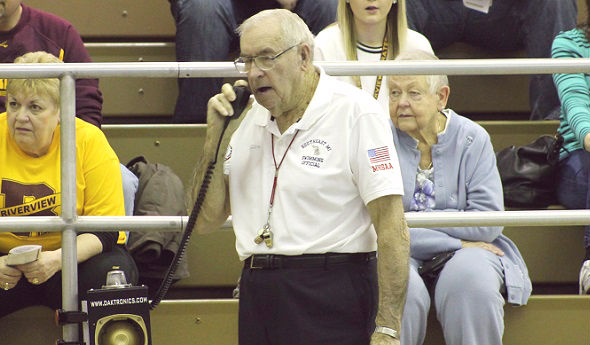
There is, however, an impressive twist: Brodie still has an active connection with high school sports as he occasionally serves as a referee for swimming meets in the Downriver area. Forever humble, Brodie has a simple reply to the question, “Why are you still doing that?”
“I just want to give back,” he said. “Maybe it’s in my genes, I don’t know. Maybe it’s my heredity. I think it’s like playing cards; you have to go with the cards you’re dealt with. I still work out about three days a week.”
Early days
Greene built one of the greatest dynasties in the history of Michigan high school basketball. He coached 41 seasons and won 12 MHSAA Finals championships, including five in a row from 1961-65 and four in a row from 1969-72. Brodie, who also played football and ran track in high school, played on Greene’s third team in 1945-46.
Maybe sensing his calling as a coach, Brodie also helped the program by starting a summer league for younger players.
“There was a park that had an asphalt court, and when he won his first state championship team, those were kids I started in seventh grade dribbling around in circles,” Brodie said, “and the eighth-grader on that team was Blanche Martin, who played football at Michigan State. DeWayne Smith was on the team, too, and he ended up succeeding Greene as the coach.”
After graduating from River Rouge, Brodie went into the service and ended up in Japan. When he returned, Brodie enrolled at Michigan State Normal College (now Eastern Michigan University), where he played football for three years and basketball for two.
It was while at Michigan State Normal that Brodie became certified in Red Cross life-saving, and that not only led to a job at Torch Lake near Traverse City but paved the way for his involvement with swimming.
Brodie’s first job came as head basketball, head baseball and assistant football coach at Sebewaing High School in 1952. He wore many hats at Sebewaing.
“I made $2,800 and taught seventh-grade geography and eighth-grade science, two ninth-grade biology classes, a study hall and a phys ed class,” he said. “I didn’t get anything extra for coaching, but I met my honey up there. I fell in love and married her and came back downstate. It was instant love.”
In 1953, Lincoln Park High School hired Brodie as a physical education teacher and assistant coach in football, basketball and baseball. Lincoln Park had no idea what it was getting. In 1955, the athletic director asked Brodie to coach the swimming team because of his background with life-saving.
Within a couple of years, Lincoln Park had its first conference championship in swimming, so the athletic director then asked Brodie to take over the struggling basketball program, which had never won a conference championship.
Brodie led Lincoln Park to back-to-back conference championships and an appearance in the MHSAA Quarterfinals in 1961. No Lincoln Park boys basketball team has made it back to the Quarterfinals since that year.
On to administration
After 13 years at Lincoln Park, Brodie accepted a job as athletic director at Southgate High School. Eventually, the position also included duties at Schafer High School, which is closed.
 “It was strictly an administrative job, and that got me out of coaching,” Brodie said. “That’s when I had the time to do a little bit of officiating.”
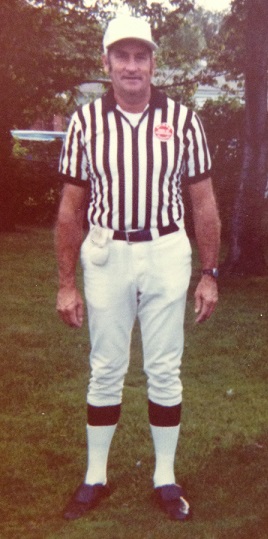
Brodie, who had first registered as an MHSAA official for 1955-56, joined a football officiating crew that went on to work an MHSAA championship game, served on the MHSAA Representative Council from 1978-80 and 1981-83, and officiated swimming meets. And he was never afraid to let his voice be heard.
“Our crew was headed to Jackson to do a playoff game, and the athletic director there was my good friend Dennis Kiley,” Brodie said. “The guys on the crew were getting up there in age, and the game was getting tougher to do. They were going to pay four of us, but I wanted to have an extra official so we could cover the deep passes and said we would still take the pay for four and just split it among the five of us.
“They told us no, but we did it anyway. I was the umpire that night, and I was the deepest umpire you ever saw in high school football. Nobody said anything about it.”
Kiley chuckled at the mention of Brodie.
“Joe was one heck of an athlete; football, basketball, you name it,” Kiley said. “He is a heck of a good guy and was a very good official. He was excellent. I would have hired him anytime.”
Not one to take time off, Brodie found odd jobs in the summer to pick up a little extra cash.
“I’ve worked every summer doing all sorts of things,” he said. “I’ve jumped off milk trucks, things like that.”
No job was too big or too small for Brodie, whose next move was to Davison Middle School in Southgate, where he was principal when he retired in 1986 – 30 years ago.
He didn’t slow down much in retirement.
Every winter for 25 years, Brodie and his wife would go to Arizona, and he could not resist getting involved with athletics. He worked track meets, doing high school and AAU meets. He once was named the official of the year in Arizona and also had a chance to work the Pac-10 conference meet at Arizona State University.
“Here’s a little kid from River Rouge, and I’m lining up guys from Washington, Washington State, USC and Arizona. I felt so humbled being a starter. Where else other than this country can this happen?”
Legacy lives on
Brodie concedes he is slowing down at 87, but slowing down at 87 is a good thing. He and his wife no longer go to Arizona for the winter, so that has opened the door to do a few boys swimming meets in addition to girls meets he often works in the fall.
“I’m not going out and campaigning to referee,” he said. “This year I took the Riverview boys schedule, about four or five meets, and took six to eight middle-school meets – you can’t get officials for middle-school meets – and I had a couple of girls meets that I did.
“I just fill in for people, that’s what I do. I’m not going out and hustling, but I think I’m still sharp enough to do the job.”
 Brodie’s legacy lives on, not only in the continued work he is doing but in his son and daughter. Brodie’s son, Bob, has been the head basketball coach at Salem for 26 years and is in the Michigan High School Coaches Association Hall of Fame. He also has been an MHSAA registered official for 39 years in five sports.
Brodie’s daughter, Jann Stahr, is an MHSAA official in competitive cheer and swimming.
“They are why we don’t go to Arizona anymore,” Brodie said. “Both kids live in Flat Rock. My daughter is about seven houses away, and my son lives about three blocks away.”
The Brodie legacy has more meat to it. In addition to the Norris Award, Brodie is in the Michigan High School Coaches Association Hall of Fame, the Eastern Michigan University Hall of Fame and the Lincoln Park Hall of Fame, which has his bust on display at the Sportsmen’s Den in Riverview.
“I hate saying, ‘I did this,’ or ‘I did that,’” he said. “It’s never been about me. All I ever wanted to do was give back.”
Mission accomplished.
 Chip Mundy served as sports editor at the Brooklyn Exponent and Albion Recorder from 1980-86, and then as a reporter and later copy editor at the Jackson Citizen-Patriot from 1986-2011. He also co-authored Michigan Sports Trivia. E-mail him at [email protected] with story ideas for Jackson, Washtenaw, Hillsdale, Lenawee and Monroe counties.
PHOTOS: (Top) Flat Rock's Joe Brodie officiates a swimming and diving meet Tuesday at Riverview. (Middle) Brodie, an official for 61 years, dresses for a football game during the 1970s. (Below) Brodie with the "Brodie Bunch," his family, which includes current officials, coaches, athletes and past coaches. (Photos courtesy of the Brodie/Stahr family.)