

Beginning Another Tourney Journey
August 8, 2016
Below is the introductory commentary to the MHSAA's spring issue of benchmarks. Histories of MHSAA tournaments published in that issue have been appearing on Second Half every Tuesday and Friday.
By Jack Roberts
MHSAA Executive Director
Concussions and cutbacks. Participation fees and part-time employment. Student safety and specialization. International students and interstate travel. Transfers and trials.
Through a myriad of issues which periodically cloud our mission, the foundation on which the MHSAA was built still shines brightest three times each year: Tournament Time!
It can be daunting and overwhelming to make a living at this business of interscholastic athletics these days, not to mention a tad confusing. Do we need legal degrees? Medical degrees? Business degrees? Marketing degrees? There seems to be no escape from threat of legislative mandates which continually change the landscape of our product and how it’s delivered. Demands pile up, resources dwindle.
Add the daily challenges of scheduling issues, inclement weather and pleasing teenagers and their parents on a daily basis, and it’s easy to lose focus of the primary missions for the MHSAA and its member schools.
And then, scenes like this happen:
• Holly Bullough, a senior cross country runner from Traverse City St. Francis takes her second straight Division 3 championship, winning by 36.4 seconds ... with a stress fracture in her left foot.
• Detroit Martin Luther King QB Armani Posey directs a game-winning drive to give his school the Division 2 football championship ... a drive which started on his own 3-yard line with 37 seconds left and ended with a 40-yard heave to receiver Donnie Corley on the final play of the game.
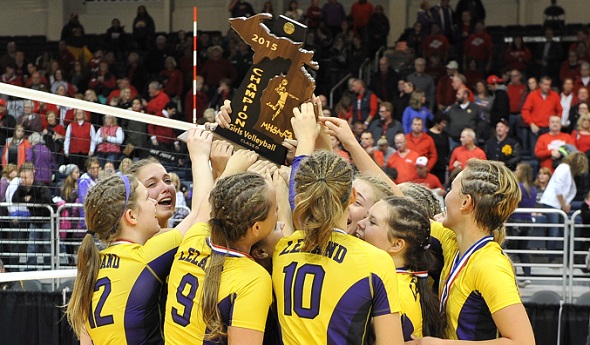
• Leland sweeps the Class D volleyball title match 3-0 over Battle Creek St. Philip ... ending a string of nine straight titles for St. Phil, the 10th longest national streak in history.
• Davison’s Taylor Davis becomes only the fourth person in MHSAA Girls Bowling history to roll a 300 game in the Singles portion of the tournament ... and the first ever in the championship match.
• The Upper Peninsula’s Hancock HS wins the Division 3 ice hockey title in its first trip to the Final since 2000 ... a trip funded in part from a “Go Fund Me” web page that raised $6,620 from 99 donors in two days.
• Junior Kierra Fletcher of Warren Cousino carries her team to the Class A girls basketball championship with 27 points in the Final ... after scoring 37 of her team’s 60 points in the Semifinals and totaling 198 during eight tournament games.
That’s just a sampling of the magic from last fall and winter.
These moments shine through the current challenges and the unseen future that awaits us as they always have. The uniforms and faces are different, but the tournaments have always yielded the fruits of our labors, and the memories for our mental scrapbooks.
PHOTO: Leland's volleyball team hoists its Class D championship trophy last fall at Kellogg Arena.
'Baker's Dozen' Continues Rapid Rise Earning Leland's 1st Trip to Girls Golf Final
By
Tom Spencer
Special for MHSAA.com
October 9, 2026
A lot has changed since Leland High School began offering girls golf just a decade ago.
 Starting as a club sport with tremendous support from the Leland Country Club, the Comets began participation in MHSAA competition in 2021. These days, they are among Northern Michigan’s best Division 4 programs – and Tuesday qualified for the Lower Peninsula Division 4 Final for the first time.
The Comets have done especially well considering more than 90 percent of their student-athletes had never picked up a club prior to entering high school.
Not many would have thought this rapid rise possible, but the team’s coaches – head coach Grace Keeble and assistant Kathy Wheeler, also a Leland teacher – are not among them.
“I don't think you can write a better script, really,” Keeble said. “I'm really excited for the girls. It is just so magical to be in the same sentence with Traverse City St. Francis and Elk Rapids.”
The Comets placed second to Elk Rapids at their Regional to qualify for next week’s Final. St. Francis also qualified for the LPD4 championship tournament, which will be played at The Meadows on the campus of Grand Valley State University.
“Leland has been very fortunate to have some incredible teams go to states,” Keeble acknowledged, referring to the Comets’ successes on the volleyball court and soccer pitch. “I am honored and excited that these girls get to be added to that list. We've been riding an incredible wave, and I just want to ride it out. I want these girls to just soak it up.”
Leland’s run to the Final started at last year’s Regional, where they fell just shy of advancing.
“We were fourth, and the girls looked at me – and there were three girls who were really close to making it as individuals – and they had a smile on their faces and a determined look, and they said, ‘Coach, we're going to states next year.’ And I looked at them and I said, ‘Let's keep up with the hard work and the determination.’”
With five seniors leading the way and a total of 13 golfers on the roster, the Comets started this fall destined to reach championship weekend. Four seniors – Ariah Amin, Maya Hamelin, Elise Vann and Lillian Conner – were a part of the Comets team that nearly made the Final last year. The fifth senior, Ella Hennessey, is playing her first year of golf. All five seniors took at least a half-dozen strokes off their averages this fall.
“I wholeheartedly believed they could do it,’ said Keeble, a retired teacher and avid golfer. “It’s been kind of a mantra since the end of the season last year. I have 13 magnificent girls, and for the first time ever in this program, a representation from every class, from freshman sophomore, junior and senior.”
Keeble likes to refer to the 13-player roster as her “baker’s dozen” pointing out it took all 13 to get the team where it is today.
“When I saw the magical number 13, I told them they were my baker's dozen, and they kind of just looked at me,” Keeble recalled. “Well, there's 13, and I don't like classifying if you're the number one player or you're my 13th player – you're a member of this team. There are six going to states with five playing and four scores counting, but it took all of them, and it was these seniors leading.”
The rest of the “baker’s dozen” consists of juniors Jaelyn DeFour and Sadie Hill, sophomores Lucy Baldwin, Ella Hamelin, Bryn Waskiewicz, Flora Wengreen and Ellie Yoffy; and Penelope Shank, a freshman.
All 13 golfers will be behind the fire truck as Leland hosts a parade Thursday to send the Comets to Allendale.
Conner, finishing fourth, and Hamelin, sixth, led the way at this week’s Regional, and Amin, 11th, and Vann, 15th, rounded out the scoring. DeFour was right behind the scorers in 17th, allowing the entire team to place among the overall top 20 individuals. That success was despite weather conditions hampering the Comets after they all shot personal bests during their previous most recent tournament in Cadillac, with the team’s top four scores there all under 100 for the first time in program history.
As the Comets prepare for the Final, Keeble has them focused on the upcoming experience, rather than the result. She expects her golfers to always focus on the next hole, even if the last wasn’t so good, and let the results fall where they may.
“I'm not a big believer of putting expectations of where you're going to place,” Keeble noted. “I'd rather have the girls enjoy the experience and come off a course and say, ‘Hey, coach, I just did the best I could.’”
 Tom Spencer is a longtime MHSAA-registered basketball and soccer official, and former softball and baseball official, and he also has coached in the northern Lower Peninsula area. He previously has written for the Saginaw News, Bay County Sports Page and Midland Daily News. He can be reached at [email protected] with story ideas for Manistee, Wexford, Missaukee, Roscommon, Ogemaw, Iosco, Alcona, Oscoda, Crawford, Kalkaska, Grand Traverse, Benzie, Leelanau, Antrim, Otsego, Montmorency, Alpena, Presque Isle, Cheboygan, Charlevoix and Emmet counties.
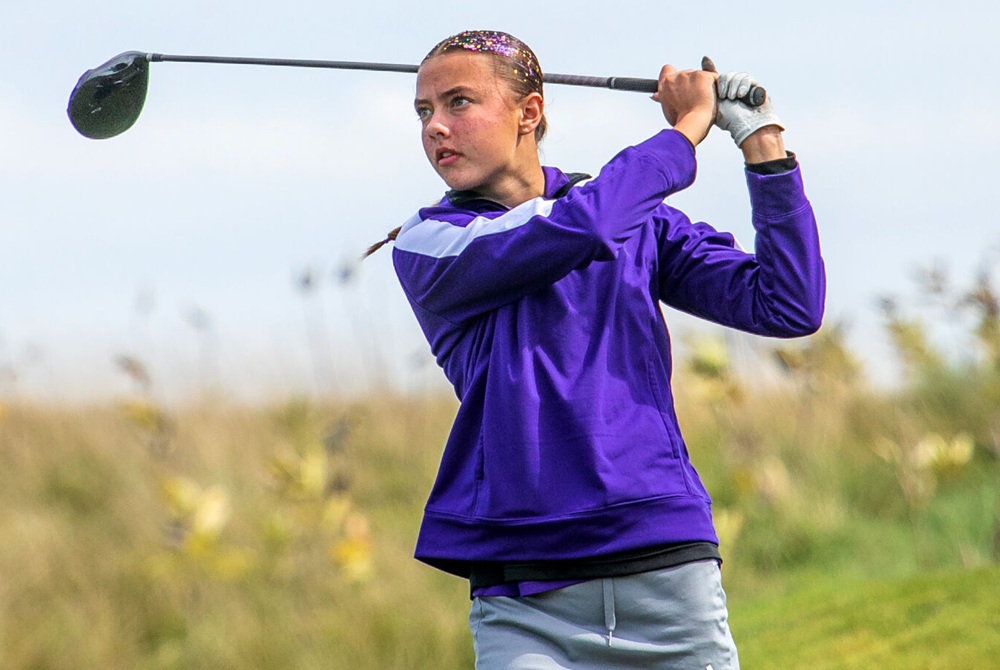
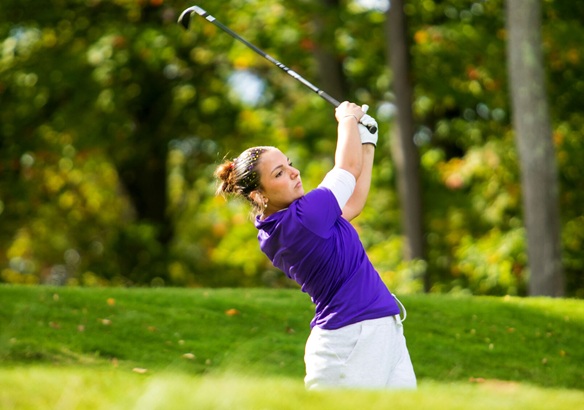
PHOTOS (Top) Leland’s Jaelyn Defour tees off on the Sundance Course during Tuesday’s Division 4 Regional at A-Ga-Ming Golf Resort in Kewadin. (Middle) Elise Vann tees off during her Regional round. (Photos by Jan-Michael Stump/Traverse City Record-Eagle.)