


Anytime, Anywhere
July 28, 2014
The MHSAA’s Coaches Advancement Program (CAP) is like no other high school level coaches education program in the US.
In an online world, including many other ways here at the MHSAA, CAP still trades purposefully in face-to-face learning; and the MHSAA Is committed to delivering sessions “anytime, anywhere” – any time a school, district, league or coaches association will sign up 20 coaches, the MHSAA will deliver one or more of the six CAP levels the group requests.
About 60 percent of those who complete CAP Levels 1 through 5 do so as a part of their course work at one of seven colleges or universities in Michigan (Central Michigan University, Kalamazoo Valley Community College, Lake Michigan Community College, Muskegon Community College, Northern Michigan University, Oakland County Community College and Western Michigan University).
The other 40 percent of those who complete CAP – and this will be a growing percentage – do so through sessions facilitated by a group of people who have committed many evenings and weekends to CAP’s “anytime, anywhere” approach to ongoing, adult education. During 2013-14, Jerry Haggerty, athletic director at Hamilton High School, led all presenters, teaching 25 sessions. Among other of the busiest presenters were Tony Moreno of Eastern Michigan University; retired athletic administrator Jim Feldkamp; Ken Mohney, athletic director at Mattawan; and Hally Yonko, athletic director at Ann Arbor-Gabriel Richard High School.
The leader of boundless energy and enthusiasm for CAP is MHSAA Assistant Director Kathy Vruggink Westdorp. In 2016-17, CAP Level 1 or 2 becomes a requirement for all persons hired for the first time at any MHSAA member school after July 31, 2016 as a high school varsity head coach. Kathy and a growing cadre of presenters are eagerly awaiting that challenge.
The team closed the 2013-14 school year by presenting eight levels of CAP at six different sites over six days, June 9-14, and then conducted CAP Levels 1, 2 and 3 on three consecutive days, June 19-21, at Clinton High School.
The More Things Change ...
December 20, 2013
By Rob Kaminski
MHSAA benchmarks editor
As we begin another calendar year, let's take a brief look at how the mission of school sports has (or hasn’t) changed since 1955, when former MHSAA Executive Director Charles E. Forsythe presented this practicum to the University of Michigan.
The following is an excerpt:
Presented by Charles E. Forsythe
Practicum in Physical Education
University of Michigan, Ann Arbor
Tuesday, June 21, 1955
WHY DO WE HAVE INTERSCHOLASTIC ATHLETICS IN OUR SCHOOLS?
 To meet the urge for competition which is a basic American tradition – let’s keep it.
- To provide a “whole school” interest and activity, bring in students other than athletes, enlist many student organizations.
- To teach students habits of health, sanitation, and safety.
- Athletics teach new skills and opportunities to improve those we have; this is basic educationally.
- To provide opportunities for lasting friendships both with teammates and opponents.
- To provide opportunity to exemplify and observe good sportsmanship which is good citizenship.
- Athletics give students a chance to enjoy one of America’s greatest heritages, the right to play and compete.
- One of the best ways to teach that a penalty follows the violation of a rule is through athletics.
- There must be an early understanding by students that participation in athletics is a privilege which carries responsibilities with it. Awarding school letter to a student is the second-highest recognition his school can give him – his diploma at graduation is the highest.
- To consider interscholastic athletic squad as “advanced” classes for the teaching of special skills – similar to bands, orchestras, school play casts, members of debating teams, etc. There is no reason why a reasonable amount of attention should not be given to such groups – as well as to those in the middle and lower quartiles in our schools. Both leaders and followers must be taught.
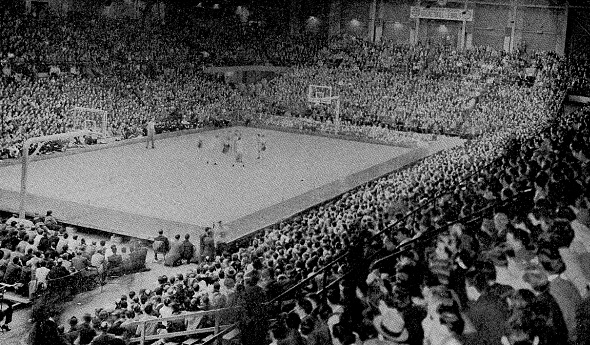
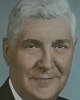
PHOTOS: (Top) Fans filled the arena for this MHSAA boys basketball tournament game. (Middle) Charles Forsythe served as the first executive director of the MHSAA.