


Risks & Rewards
May 7, 2012
When my terrific son was a college student, I suggested he get into sports officiating. You know, to earn some money, stay involved in sports, keep in shape. His response was “No. It’s not worth the hassle.” He didn’t want to subject himself to being criticized, heckled and second-guessed; and I couldn’t blame him.
Which told me then (and I’m reminded often) that sports officials are risk-takers. Men and women willing to step out and step up.
The best officials make the toughest calls at the tightest times in the competition. They’re risk-takers in ways mere spectators are not.
And in this so-called “modern world,” where people can sit comfortably at home and comment irritably on everything, and fans can text, tweet and transmit videos instantly, it has never taken more courage to be a sports official than it does today.
Tomorrow evening, for the 33rd consecutive year, the MHSAA hosts a banquet that honors our most veteran MHSAA registered officials. Officials who have reached the 20-, 30-, 40-, 45- and 50-year service milestones will be recognized; and Rockford’s Lyle Berry will receive the Vern L. Norris Award for a lifetime of grassroots contributions to high school sports officiating in Michigan.
It is one of the rare occasions when we ask officials, referees and judges to step out of the background and into the spotlight. Without any risk.
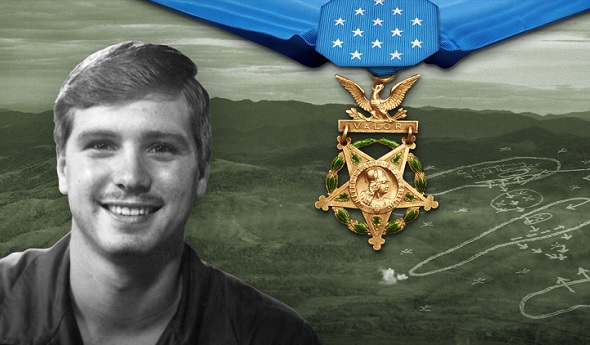
Longtime Official to Receive Medal of Honor
July 31, 2017
By Geoff Kimmerly
Second Half editor
South Haven's James C. McCloughan, a longtime MHSAA wrestling official and coach of multiple sports, will receive the Medal of Honor this afternoon for service in 1969 in Vietnam.
McCloughan, also a retired teacher from South Haven High School, previously received multiple Bronze Stars and Purple Hearts among a number of awards and decorations. During battle May 13-15, 1969, McCloughan risked his life to rescue and treat wounded personnel despite being wounded himself by shrapnel and small-arms fire. A combat medic with the U.S. Army, the 23-year-old McCloughan refused medical evacuation to remain with his comrades.
His rank at the time was private first class. He was discharged from the Army with the rank of specialist.
After his service, McCloughan became a dedicated educator. His bio as a 2008 inductee to the Michigan High School Football Coaches Association credits him with 36 years coaching football and coaching 131 teams total from the South Haven athletic program. He also is a member of the Michigan High School Coaches Association Hall of Fame and Michigan High School Baseball Coaches Association Hall of Fame. He has served as well 25 years as an MHSAA official and is registered to continue this upcoming wrestling season.
The U.S. Army website produced a tremendous multi-media feature on McCloughan in advance of today's ceremony. To see that feature in full, click here, and watch below the Army's video that details McCloughan's service in receiving this high honor. (The photo above also is taken from the linked feature.)