


Risks & Rewards
May 7, 2012
When my terrific son was a college student, I suggested he get into sports officiating. You know, to earn some money, stay involved in sports, keep in shape. His response was “No. It’s not worth the hassle.” He didn’t want to subject himself to being criticized, heckled and second-guessed; and I couldn’t blame him.
Which told me then (and I’m reminded often) that sports officials are risk-takers. Men and women willing to step out and step up.
The best officials make the toughest calls at the tightest times in the competition. They’re risk-takers in ways mere spectators are not.
And in this so-called “modern world,” where people can sit comfortably at home and comment irritably on everything, and fans can text, tweet and transmit videos instantly, it has never taken more courage to be a sports official than it does today.
Tomorrow evening, for the 33rd consecutive year, the MHSAA hosts a banquet that honors our most veteran MHSAA registered officials. Officials who have reached the 20-, 30-, 40-, 45- and 50-year service milestones will be recognized; and Rockford’s Lyle Berry will receive the Vern L. Norris Award for a lifetime of grassroots contributions to high school sports officiating in Michigan.
It is one of the rare occasions when we ask officials, referees and judges to step out of the background and into the spotlight. Without any risk.
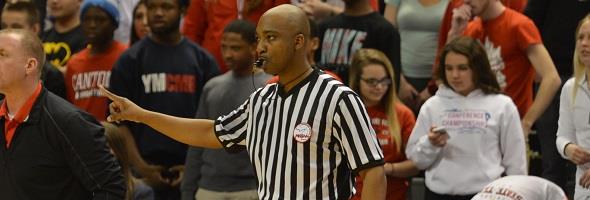
Be the Referee: Free Throw Change
January 12, 2017
This week, MHSAA assistant director Mark Uyl discusses one of the most significant rules changes of this winter season, regarding basketball free throws.
Be The Referee is a series of short messages designed to help educate people on the rules of different sports, to help them better understand the art of officiating, and to recruit officials.
Below is this week's segment – Free Throw Change - Listen
One of the big changes in basketball this year deals with the free throw and movement along the lane.
Players who are in the lane in marked spaces can enter the lane as soon as the free throw is released by the shooter. The big change for this year is that no player – defensive or offensive – can enter the semicircle where the shooter has shot the ball from until the ball either hits the rim or the free throw ends.
In recent years, we’ve seen players move into the semi-circle, making early contact with the shooter before the ball has hit the rim.
Past editions
Jan. 5: Ratings - Listen
Dec. 22: Video Review - Part 2 - Listen
Dec. 15: Video Review - Part 1 - Listen
Dec. 8: Registration - Part 2 - Listen
Dec. 1: Registration - Part 1 - Listen
Nov. 24: You Make the Call - Sleeper Play - Listen
Nov. 17: Automatic 1st Downs - Listen
Nov. 10: Uncatchable Pass - Listen
Nov. 3: The Goal Line - Listen
Oct. 27: Help Us Retain Officials - Listen
Oct. 20: Point After Touchdown - Listen
Oct. 13: Untimed Down - Listen
Oct. 6: Soccer Penalty Kick Change - Listen
Sept. 29: Preparation for Officials - Listen
Sept 22: You Make the Call: Returning Kickoffs - Listen
Sept. 15: Concussions - Listen
Sept 8: Equipment Covering the Knees - Listen
Sept. 1: Play Clock Experiment - Listen
Aug. 25: Clipping in the Free Blocking Zone - Listen