


Risks & Rewards
May 7, 2012
When my terrific son was a college student, I suggested he get into sports officiating. You know, to earn some money, stay involved in sports, keep in shape. His response was “No. It’s not worth the hassle.” He didn’t want to subject himself to being criticized, heckled and second-guessed; and I couldn’t blame him.
Which told me then (and I’m reminded often) that sports officials are risk-takers. Men and women willing to step out and step up.
The best officials make the toughest calls at the tightest times in the competition. They’re risk-takers in ways mere spectators are not.
And in this so-called “modern world,” where people can sit comfortably at home and comment irritably on everything, and fans can text, tweet and transmit videos instantly, it has never taken more courage to be a sports official than it does today.
Tomorrow evening, for the 33rd consecutive year, the MHSAA hosts a banquet that honors our most veteran MHSAA registered officials. Officials who have reached the 20-, 30-, 40-, 45- and 50-year service milestones will be recognized; and Rockford’s Lyle Berry will receive the Vern L. Norris Award for a lifetime of grassroots contributions to high school sports officiating in Michigan.
It is one of the rare occasions when we ask officials, referees and judges to step out of the background and into the spotlight. Without any risk.
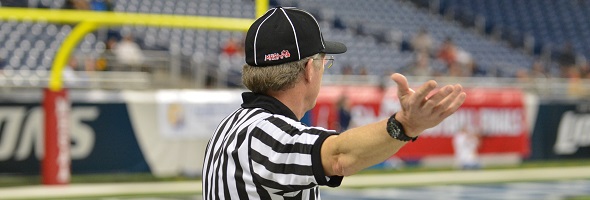
Be the Referee: Correcting a Down
September 10, 2015
This week, MHSAA assistant director Mark Uyl discusses how officials at the high school level have the authority to correct an error in what down is being played.
Be The Referee is a series of short messages designed to help educate people on the rules of different sports, to help them better understand the art of officiating, and to recruit officials.
Below is this week's segment - Correcting a Down - Listen
For anyone who has followed football for a long time, perhaps the most famous “5th down” game was back in 1990 between Colorado and Missouri.
In that game, the officials mistakenly gave Colorado an extra down while trailing by four points. On the “fifth down” play, Colorado scored a touchdown on the final play of the game to win 33-31.
Under high school rules, the officiating crew has the ability to correct an error of the wrong down as long as it is done before the next snap. For example, if the crew realizes a team has been given an extra down, that play would be nullified and the ball would correctly go over to the other team.
Past editions:
Sept 3: Spearing - Listen
Aug. 27: Missed Field Goal - Listen