

Calumet Invite Produces Northern Stars
September 18, 2013
By Geoff Kimmerly
Second Half editor
The Calumet Invitational dates back roughly 30 years as an annual staple of the cross country schedule for schools at the northernmost tip of Michigan's Upper Peninsula.
A creative move by the Copper Kings last year added some statewide prestige to the event.
 Last week, for the second season, Calumet ran the series of races at Keweenaw Mountain Lodge, a resort near Copper Harbor and the northern bank of the Keweenaw Peninsula.
Calumet is the northernmost high school in Michigan. And moving this race another 35 miles northeast more or less guaranteed it's the northernmost event run in the state.
"We figured it was pretty safe. We're the northernmost school in the state, and you can only go four more miles and you're in Lake Superior," Calumet athletic director Sean Jacques said. "Nobody else is going to do anything more north than that."
A total of 10 schools were represented this fall in the races for boys and girls varsity, junior varsity and middle schoolers.
Jacques said the event formerly was run at a golf course in Calumet. But a few years ago, Calumet graduate and former Copper Kings cross country runner Dan Harri moved home from Florida to become general manager at the Mountain Lodge (he's also a renowned chef and has owned restaurants in Miami with Hall of Fame Dolphins coach Don Shula).
Harri had asked a few times about bringing a cross country or golf event to the lodge. Jacques told him last year they'd give it a try, so Harri set up a course that includes golf course, a couple of bridges, trails and finishes with a climb on the No. 1 fairway. It also provides various points for fans to watch runners go by, not always available on other courses.
"We were looking for a little bit of a change, and it's a beautiful course," Jacques said. "We thought if people were willing to make the extra drive, it would be really nice."
Calumet won the boys race this season, just ahead of runner-up Houghton. Houghton's girls were victorious, followed by the host Copper Kings.
Click to read more about this year's event from the Houghton Mining Gazette.
Michigan's claim to an NFL evolution
As part of its NFL preview this month, Sports Illustrated reported on one of the most significant developments for offenses over the last few decades – the silent snap count, which is used regularly by visiting teams because offensive linemen can’t hear the quarterback calling for the ball over the clamor of the home crowd.
And the article explained that the silent snap count might’ve gotten its start at one of Michigan’s smallest high schools – Flint’s Michigan School for the Deaf.
Offensive linemen during the 1980s were feasted on by pass rushers like Lawrence Taylor and Bruce Smith, who built record sack totals by blasting past blockers who seemed a step slow. Turns out, that was true. Defensive players were getting an edge by attacking as soon as they saw the ball move. But blockers (especially offensive tackles), focused instead on the defensive ends and linebackers lined up across from them, and didn’t have the luxury of watching the ball – and since they also couldn’t hear the snap count, started each play a step behind.
Enter the silent count. The quarterback signals to the center that he is ready to receive the ball (with a pat on the back, by raising a foot, etc.). The center then raises his head, and after a predetermined count of at least one second snaps the ball without a sound. This means an offensive tackle doesn’t have to listen for a snap count – he just counts after seeing the center get set.
The SI report recognized longtime offensive line coach Howard Mudd as the guru of the silent snap count. But Mudd recalled a conversation he’d had while working for the Seattle Seahawks with another coach, the late Andy MacDonald, who also had coached early in his career at a school for the deaf in Michigan.
The article doesn’t mention Michigan School for the Deaf by name. But it seems to make sense that the Tartars were the first to use the now-revolutionary count. MacDonald – who played at Central Michigan University and went on to coach at Michigan State and four other colleges and also for the Buffalo Bills – grew up in Flint and attended Flint Northern before playing for the Chippewas from 1950-53. The historical web site Michigan-football.com has results for Flint’s Michigan School for the Deaf dating to 1950, making it a decent assumption that MacDonald might’ve gotten in a little early coaching experience at the school down the road from his home.
Click for the SI story and go to page 4 for the mention of Michigan’s school.
Michigan mourns trooper, running standout
The law enforcement community is mourning the death of Michigan State Police trooper Paul Butterfield, who was shot Sept. 9 during a traffic stop in Mason County. He also was a well-known distance runner during the 1980s and the MHSAA Class A cross country champion running for Bridgeport in 1987.
According to a Ludington Daily News report, Butterfield continued running after high school at the University of Tennessee, and also competed at the 1989 Pan American Junior Games in Argentina.
Butterfield was stationed in Hart after previously serving in Manistee, and lived in Mason County. He also had served in the U.S. Army. Click to read more from the Ludington Daily News.
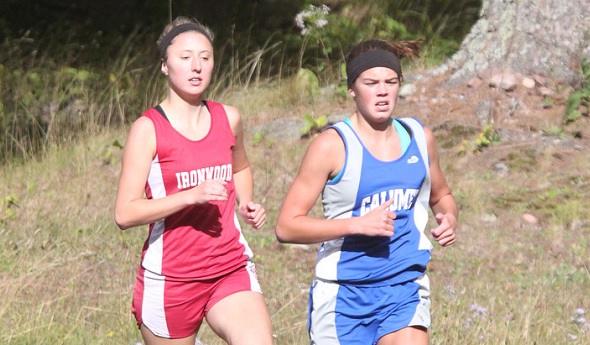
PHOTO: Calumet's Chelsea Jacques (right) won this season's Calumet Invitational with a time of 21:08.06, just ahead of Ironwood's Jessica Gering at 21:46.16. (Photo courtesy of Calumet athletic department.)
Finals Flashback: Remembering the '9s'
November 29, 2019
By Ron Pesch
Special for Second Half
This weekend’s MHSAA 11-Player Football Finals at Ford Field will conclude another decade for the most played and watched high school sport in Michigan.
We’ll roll into this year’s games remembering some decade-enders of the past from 1979, 1989, 1999 and 2009.
Redemption
The 1979 season marked the first playoff appearance for Norway, which had failed to qualify for the MHSAA postseason in 1975 and 1976 despite undefeated seasons.
However, the scoreless first half of the Knights’ Class D championship battle with Schoolcraft wasn’t proceeding as planned.
“We went into the locker room at halftime and made a few offensive changes,” said Norway coach Bob Giannunzio. “Our running game wasn’t working, so we decided we would pass more in the second half.”
The Norway defense forced six second-half turnovers that led to three touchdowns and a 21-6 win over Schoolcraft. Quarterback Chuck Soderlund connected on 6-of-14 passes for 110 yards including a 45-yard TD pass to Gregg Noordhoff to break the scoreless deadlock. Nordhoff added a second score from four yards out early in the in the fourth quarter for a 14-6 lead. Soderlund added a game-sealing TD on a QB sneak with 1:30 remaining.
It was the first of back-to-back titles for Giannunzio and the little Upper Peninsula school located near Iron Mountain. Since that season, Norway has advanced as far as the Semifinal round twice, in both 2002 and 2006
“We said if we ever got here we’d win it, said Giannunzio to the Detroit Free Press. “We wanted to start off right for the U.P. It’s a big burden playing for the whole Upper Peninsula.”
The Greatest
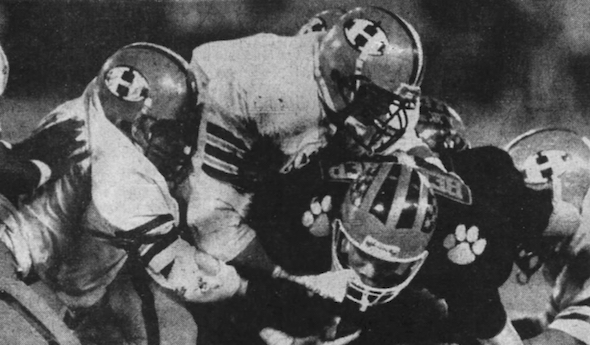
In Class B in 1989, Farmington Hills Harrison scored a 28-27 victory over DeWitt in what many still consider one of the greatest games of the MHSAA’s 45-year playoff history. The reigning Class B champion and top-ranked Hawks had their hands full. Tied 7-7 after one quarter, the Panthers grabbed a two-touchdown lead in the second quarter on 32-yard run by fullback John Tellford and a 35-yard pass play from Tellford to John Cowan. Harrison responded with a Matt Conley one-yard run to cut the margin to 21-14 at the half.
Hawks quarterback Mill Coleman knotted the score at 21-21 with a dazzling 16-yard run early in the fourth quarter, but DeWitt stormed back again driving 75 yards on 13 plays. The series was highlighted by tight end Dave Riker's 24-yard, one-handed catch to the Hawks’ 3-yard line. Two plays later, quarterback Chris Berkimer slipped over from the 1, and DeWitt again took the lead 27-21.
With 2:12 remaining and the ball at the Harrison 33, Coleman went to work. Three quick completions moved the ball to the DeWitt 16, and then Coleman let his legs do the rest. Following a Hawks timeout, Coleman dashed right for seven more yards to the Panthers’ 9. Facing a 2nd-and-3, Coleman dropped back to pass, escaped the rush at the DeWitt 17, then scampered up the middle and dove into the end zone for the tying points. Steve Hill added his fourth PAT of the game with 1:34 remaining for the final margin, then secured the victory with an interception on the next series.
Electrifying
Charles Rogers, perhaps the most electrifying high school receiver to ever touch the carpet at the Pontiac Silverdome, caught a single pass in the 1999 Division 2 title game, but he was the difference maker in Saginaw’s 14-7 win over Birmingham Brother Rice. The reception, defended by a single back, was a 60-yard touchdown reception from Brandon Cork on Saginaw’s first possession. Rogers broke a pair of tackles on the way to the end zone to open the scoring. The point-after attempt was blocked.
It was one of only six pass attempts by Saginaw on the day, and the only completion. But after that, as Mick McCabe of the Detroit Free Press wrote, “If Rogers would have gone up to the concourse for a hot dog, I’m sure a couple of Rice defensive backs would have been there to wipe the mustard off his chin.”
“He’s a big-time player, he should be in the NFL,” Rice coach Al Fracassa told McCabe. “He reminded me of Randy Moss. He’s always a threat just having him out there.”
A Saginaw fumble on the first play of the second half was recovered by Rice’s Tony Gioutsos at the Trojans’ 31. Eight plays later, Gioutsos scored from five yards out. Ross Ryan added the extra point for a 7-6 Rice lead.
Saginaw’s defense was aggressive, with constant pressure on Rice quarterback Mark Baker, sacking him twice while holding the Warriors to 78 yards rushing on 36 attempts.
Saginaw took advantage of the extra attention received by Rogers. Terry Jackson pounded out 106 yards on 18 carries, including 60 of Saginaw’s 84 yards on their game-winning drive in the fourth quarter. With Rogers drawing triple coverage, Jackson dashed opposite side for a 17-yard TD with 7:03 to play. Jackson also added the 2-point conversion for the game’s final margin.
A Wild Ride
Farmington Hills Harrison picked up its 10th state title with a 42-35 win over Grand Rapids Creston in a 1999 Division 3 championship game filled with wide-open play. Creston opened the title contest with a recovered onside kick and then drove 49 yards in five plays, ending with an Andrew Terry’s touchdown from a yard out. Harrison rebounded with a field goal, followed by a three-yard TD run by Kevin Woods off a pass interception for a 10-7 lead.
Creston responded with a four play, 79-yard touchdown drive that consumed a little over two minutes. Featuring a 41-yard pass play from QB Carlton Brewster to Lanard Latham near the end of the first quarter, the Polar Bears opened the second with a 25-yard run to the end zone by Terry. Odene Pringle’s extra point gave Creston a 14-10 lead.
Harrison then went 68 yards in six plays and under three minutes as Woods scored again from a yard out to regain the lead for his team 17-14.
The fireworks continued following another pass interception by the Hawks and another three-yard TD by Woods that upped the lead to 24-14. By halftime it was 27-21.
Harrison’s lead was short-lived as coach Charles “Sparky” McEwen’s Creston squad went 80 yards in 2:27 following the kickoff, capped by a Brewster to Latham 11-yard scoring strike. Pringle’s kick made it 28-27.
The Hawks responded on the next drive. It was 35-28 at the end for three quarters, then 42-28 when Woods scored again near the beginning of the fourth. In total, he would finish with 153 yards on 33 carries and four touchdowns, tying then-Final scoring marks for touchdowns and points.
Creston struck again with a 56-yard touchdown pass to Richard Gill from Brewster with 7:00 remaining to pull within a seven, 42-35. The Polar Bears regained the ball with 57 second remaining, but a final Hail Mary fell incomplete, ending one of the tournament’s most entertaining games.
Thriller
In 2007, the East Grand Rapids-Orchard Lake St. Mary’s championship battle was a 5 OT affair.
In 2009, it was again anybody’s guess who would emerge as the winner between the schools. The Pioneers entered undefeated, while Orchard Lake St. Mary’s carried four losses into the contest. They began the year with two defeats for the first time since 1991. The first was to this same East team, 21-7. Two others were to Division 1 Detroit Catholic Central, 27-0 and then 7-0.
The opening quarter of the Division 3 Final was scoreless. Orchard Lake opened the scoring early in the second. Quarterback Robert Bolden hit Gary Hunter for a 49-yard completion, and three plays later Bolden broke a pair of tackles to ramble across the goal line from 13 yards out. The Pioneers tied the game at 7-7 with 30 seconds remaining before the intermission, when 6-foot-7 Colin Voss caught a five-yard pass from Ryan Elble and snaked the last two yards into the end zone. St. Mary’s nearly answered in the time remaining as Hunter returned the kickoff 63 yards to the Pioneers’ 24. A false start penalty sent the ball back to the EGR 29, but then Bolden completed a pass to Allen Robinson for 28 yards to the Pioneers’ 1-yard line. Two rushing attempts by St. Mary’s were stopped at the goal line as time expired in the half, the last by Bolden that was ended by East’s Joshua Laarman.
Orchard Lake had opened a 21-17 lead with 9:12 remaining in the game following a three-yard TD by Cortez Riley and an extra point by Nathan Perry. With 4:01 left, that score still stood as the Pioneers took possession at their own 13 following an Eaglets punt. Kirk Spencer dashed for 38 yards to the Orchard Lake 49 on the first play. But with 2:49 remaining, East faced desperation at 4th-and-14. The ensuing pass, intended for Voss, slipped off his fingertips, but was caught by Spencer for a gain of 27 yards to the St. Mary’s 26. With 1:14 to play, Elble found Deon Jobe in the end zone from 15 yards out. Bobby Aardema’s kick gave East Grand Rapids a 24-21 lead.
“But it wasn’t quite over until we heard from Laarman and Spencer one more time,” wrote McCabe about play after the touchdown. “Bolden completed two passes to get to East’s 44 when he took off running. Earlier he scored on a breathtaking 83-yard keeper (giving St. Mary as 14-10 lead in the third quarter).
“The first thing Laarman thought of when he saw Bolden take off was: here we go again.”
Laarman caused a fumble on his attempted stop, and Spencer came up with the ball to seal victory. The win gave East Grand Rapids its fourth consecutive championship. East Grand Rapids would win five straight Division 3 titles between 2006 and 2010.
 Ron Pesch has taken an active role in researching the history of MHSAA events since 1985 and began writing for MHSAA Finals programs in 1986, adding additional features and "flashbacks" in 1992. He inherited the title of MHSAA historian from the late Dick Kishpaugh following the 1993-94 school year, and resides in Muskegon. Contact him at [email protected] with ideas for historical articles.
PHOTO: Farmington Hills Harrison scored late to edge DeWitt 28-27 in the 1989 Class B Final. (Photo courtesy of the Lansing State Journal.)