

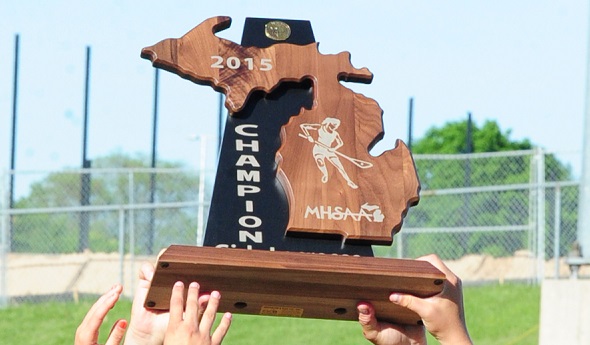
Casting Lines for Future Tournaments
August 12, 2016
By Jack Roberts
MHSAA Executive Director
The MHSAA is best known to the public for the tournaments it conducts to conclude the fall, winter and spring seasons each school year.
These tournaments, the first and largest program of the MHSAA, have survived the Vietnam War, the Korean conflict and two World Wars. They have survived the technology bubble, the housing collapse, the energy crisis and the Great Depression.
MHSAA tournaments existed at the dawn of aviation and at the time of our nation’s lunar landing. Popes, presidents and governors have changed and changed again and again, and MHSAA tournaments roll on year after year.
But the sense of tradition and permanence and inevitability of MHSAA tournaments doesn’t dissuade us from asking questions about our tournaments, even some of the most basic questions. Here are two.
Question #1
I have long been and will always be an advocate for a Ryder Cup format for the MHSAA Golf Finals, and a team tennis approach to the MHSAA Tennis Finals; but 90 years of tradition is hard to overcome. Might this be a more exciting format? Could it be co-ed? Could it reverse the decline in boys tennis participation, and increase girls golf participation? Wouldn’t it be fun to try?
Periodically, the International Olympic Committee requires each of the designated Olympic sports to defend its status, to state its case why the sport should remain a part of the Olympic program. Then, after a series or votes that retain one sport at a time, the IOC drops the sport that makes the weakest case. It does so to make room for one of the previously unlisted sports that makes the best case for inclusion.
This would appear to keep the existing Olympic sports on their toes, and to keep the Olympic movement fresh and reflective of modern trends in sports.
While I would not enjoy the controversy, I can see the potential for some positive results if the MHSAA were to invoke the same policy for determining the 14 tournaments it will provide for girls and the 14 for boys.
This might cause us to consider more deeply what a high school sport should look like, or at least what an MHSAA tournament sport should stand for.
On the one hand, we might be inclined to drop tournaments for those sports that involve mostly non-faculty coaches and non-school venues, or require cooperative programs to generate enough participants to support a team, or resort almost entirely to non-school funding, or cater to individuals more than teams.
Or perhaps this process would cause policymakers to forget traditional thinking and ask: “In this day and age, should we shake off traditional notions of sport and consider more where modern kids are coming from?” That might mean fewer team sports and more individual sports, more “extreme” sports like snowboarding and skateboarding, and more lifetime sports, meaning not just golf and tennis and running sports, but also fishing and even shooting sports.
Currently, MHSAA policy states that the MHSAA will consider sponsorship of a tournament series for any sport which 64 member schools conduct on an interscholastic basis as a result of action by the governing boards of those schools.
Should the only question be how many schools sponsor a sport, or must an activity also have certain qualities and/or avoid certain “defects?” What should an MHSAA tournament sport look like and stand for?
Question #2
Bristling from criticism that his association is a money-grabbing exploiter of children, my counterpart in another state said, “If we were running our programs just to make money, we would do very many things very differently.” I knew exactly what he meant.
Because we care about the health and welfare of students, because we mean what we say that the athletic program needs to maximize the ways it enhances the school experience while minimizing academic conflicts, and because we try to model our claim that no sport is a minor sport when it comes to its potential to teach young people life lessons, we operate our programs in ways that make promoters, marketers and business entrepreneurs laugh, cry or cringe.
If money were the only object, we would seed and select sites to assure the teams that attracted the most spectators had the best chance to advance in our tournaments, regardless of the travel for any team or its fan base. If money were the only object, we would never schedule two tournaments to overlap and compete for public attention, much less tolerate three or four overlapping events. If money were the only object, we would allow signage like NASCAR events and promotions like minor league baseball games.
Those approaches to event sponsorship may not be all wrong; they’re just not all right for us. And we will live with the consequences of our belief system.
During a typical school year, more than 20 percent of the MHSAA’s 2,097 District, Regional and Final tournaments lose money. Not a single site in golf, skiing or tennis makes a single penny. In no sport did every District, Regional and Final site have revenue in excess of direct expenses.
In fact, in only three sports – boys and girls basketball and football – is revenue so much greater than direct expenses overall that it helps to pay for all the other tournaments in which the MHSAA invests.
That’s right: invests. When we present our budget to our board, we talk about the MHSAA’s investment in providing tournament opportunities in all those sports and all those places that cannot sustain the cost of those events on their own. How much is this investment worth to students, schools and society?
These two are core questions that require our focus far in advance of talk about scheduling, site selection, seeding and the myriad matters that too often hijack our time and attention.
Bronson Football Raising Bar with Growth in Numbers, Growing String of Successes
By
Scott Hassinger
Special for MHSAA.com
October 6, 2026
BRONSON – Tony Myers remembers the excitement he felt 17 years ago when, as a player, his Bronson football team won a Division 6 District championship.
 Years later, Myers, now in his third year as the Vikings' head coach, has fans in this small community located in Branch County buzzing with enthusiasm as Bronson seeks a third-straight playoff berth and upper-tier finish in the Big 8 Conference.
Bronson, 4-2, has big games left on its schedule over the final three weeks of the regular season against league foes Quincy, Reading and East Jackson.
But its lone blemishes came to Division 8 ninth-ranked Springport 35-14 in the season opener and a 22-14 loss a couple weeks later to Union City. The Vikings own an impressive 14-0 win over Division 5 Buchanan in a nonleague battle.
Bronson hasn't won a District since Myers' playing days. The Vikings lost 20-12 to Hanover Horton in a Division 7 District Final last season and fell in a District Semifinal to Schoolcraft 28-14 in 2024.
For several years the program struggled before finally seeing an increase in numbers and players putting in the work during the offseason to make significant changes.
"Our coaching staff has instilled that belief that Bronson can be successful in football. I always talk to the kids about integrity, discipline, honor and those things that aren't mentioned too much outside of football. Men of integrity expect to be believed, and if they aren't then they prove people wrong over time," said Myers, whose wife Kate is a 2012 Bronson graduate; together they have a 7-year-old son Korbin and 5-year-old daughter Charlie June Myers.
He and his coaching staff brought a system and have been successful implementing it across the program. There are solid numbers at the junior varsity and middle school levels.
"It's really exciting to see the growth of this program. We have a new weight room and growth in numbers. Everything has just been really positive, and the community has been very supportive,” said Myers, who is serving as a substitute teacher in Bronson's school district while pursuing an education degree. “There is a huge crowd that follows us, which is great with the situation we're facing this season with no home games."
Due to stadium and field renovations, Bronson has been playing its home games this season at Sturgis, Coldwater and Union City high schools. Thanks to a successful millage vote, renovations to Bronson's stadium are now underway. A new track is being installed, and the field will be re-sodded, along with the addition of new lighting, new goal posts and future plans for upgrades of the press box and seating.
Bronson's defensive unit has forced 14 turnovers in six games. Going into last week's against Maple Valley, the Vikings' hadn't given up a single point during a second half.
Offensively, the Vikings have rolled up 2,428 yards of total offense, with 1,565 rushing yards and 863 passing. Bronson is averaging 30.8 points per game.
"We have a goal for our offense to achieve 5,000 total yards by the end of the season. We've been pretty balanced both passing and running the football," Myers said.
Bronson's backfield is led by the senior duo of Reid Stukey and Ben Stevens.
Stukey, a 5-foot-9, 165-pounder, leads his team in rushing with 97 carries for 809 yards and four touchdowns.
"Our mantra is exactly with Coach Myers preaches in practice, hard work and discipline. These guys all show up every day and ready to work. That's what makes you successful,” Stukey said. “The culture we've built calms my nerves. I'm not nervous about any roles I perform on the field. We want to win titles and play for one another.”
Stevens is the team's second-leading ground gainer with 55 carries for 562 yards and eight TDs. He's also caught 12 passes for 183 yards and two TDs.
"Ben is electric and knows how to read blocks. He's patient and waits until that pulling guard comes around, and after he leads into that linebacker he shoots out of the gap and is off to the races," Myers said.
Stevens, a slot back and tailback, also plays cornerback and safety.
"My leadership and explosiveness, I feel, are two of my biggest strengths. I try to get everyone pumped up after we make a big play and celebrate," Stevens said.
Starting quarterback Owen Losinski separated his shoulder two weeks ago, forcing Myers to move Stukey behind center. Stukey is 9-of-16 passing for 126 yards and two TDs since taking over as signal caller. Losinski is expected back on the field later this week.
"Reid has done a nice job stepping in at quarterback. He provides great leadership and picked things right up and has been able to run our offense effectively," Myers said.
Bronson's most imposing figure on the field is junior offensive tackle and defensive end Kyle Hyska (6-2, 290).
"We have a great deal of size up front with good chemistry within the entire team. Our guys are playing well as a unit and getting better each week,” Hyska said. “We just have to have trust that the guy next to us is doing his job at a high level. I like that with my positions that I get to run through people with controlled aggression.”
Hyska has received a Division I scholarship offer from Harvard.
"Kyle couldn't even squat 185 pounds as a freshman, but he's since grown into his body and increased his strength. He has dreams of playing at the college level and has the right body size, work ethic and mindset to do so," Myers said.
Leading Bronson defensively is senior middle linebacker Caleb Harvey (6-1, 185) with 45 tackles, including nine for loss of yardage and two QB sacks.
"Caleb is one of our toughest kids. He doesn't brag on himself, but he's an absolute animal at linebacker,” Myers said. “He is a great leader, makes quick reads and is always in the backfield making lots of tackles and just gets everyone focused.”
Harvey takes a lot of pride in the Vikings' defense.
"Most of the guys on the team have been playing together since our days in rocket football. At my position I really get to see the field and make big plays. I enjoy leading our defense. We just all need to be in unison to reach our goals," Harvey said.
Thirteen members of Bronson's team went to a summer football camp at Trine University.
"These kids are hungry, but they understand that nothing is given to you in life. We've really tried to ingrain to this group that if there's something you want, that you have to work hard and go after it,” Myers said. “People are going to have their opinions and be critical of you. No one builds statues of critics, so we tell the kids not to let the naysayers hold them down. I'm so thankful our senior group bought into what we're doing at such a young age because now all our underclassmen are seeing they can be successful as well.”
Ultimately, the Vikings want to add some hardware to the school trophy case once the postseason rolls around.
"These kids have talked about getting some trophies to put in their memory bank," Myers said.
 Scott Hassinger is a contributing sportswriter for Leader Publications and previously served as the sports editor for the Three Rivers Commercial-News from 1994-2022. He can be reached at [email protected] with story ideas for Berrien, Cass, St. Joseph and Branch counties.
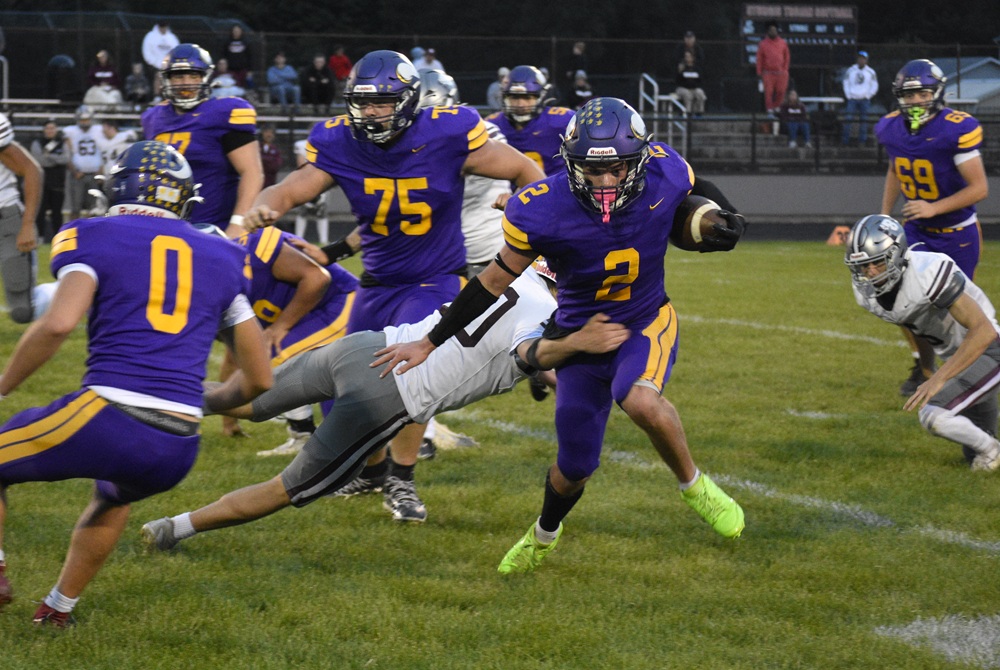
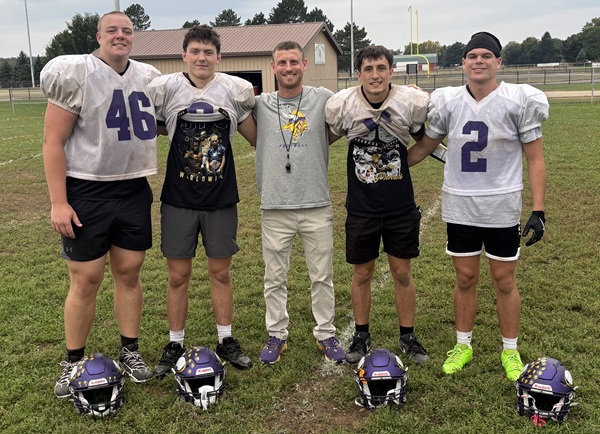
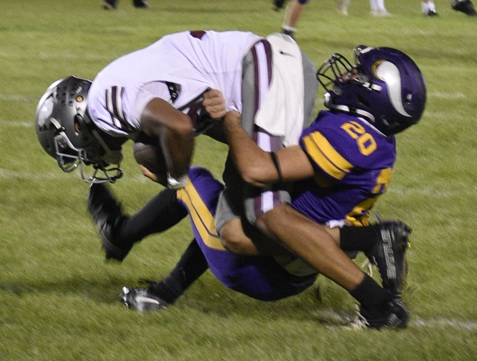
PHOTOS (Top) Bronson senior tailback Ben Stevens (2) works to break a tackle against Buchanan on Sept. 25. (Middle) Bronson players (from left) Kyle Hyska, Reid Stukey, Caleb Harvey and Ben Stevens pose for a photo with head coach Tony Myers after a practice. (Below) Reid Stukey (20) tackles a Buchanan receiver following a reception. (Photos by Scott Hassinger.)