

Casting Lines for Future Tournaments
August 12, 2016
By Jack Roberts
MHSAA Executive Director
The MHSAA is best known to the public for the tournaments it conducts to conclude the fall, winter and spring seasons each school year.
These tournaments, the first and largest program of the MHSAA, have survived the Vietnam War, the Korean conflict and two World Wars. They have survived the technology bubble, the housing collapse, the energy crisis and the Great Depression.
MHSAA tournaments existed at the dawn of aviation and at the time of our nation’s lunar landing. Popes, presidents and governors have changed and changed again and again, and MHSAA tournaments roll on year after year.
But the sense of tradition and permanence and inevitability of MHSAA tournaments doesn’t dissuade us from asking questions about our tournaments, even some of the most basic questions. Here are two.
Question #1
I have long been and will always be an advocate for a Ryder Cup format for the MHSAA Golf Finals, and a team tennis approach to the MHSAA Tennis Finals; but 90 years of tradition is hard to overcome. Might this be a more exciting format? Could it be co-ed? Could it reverse the decline in boys tennis participation, and increase girls golf participation? Wouldn’t it be fun to try?
Periodically, the International Olympic Committee requires each of the designated Olympic sports to defend its status, to state its case why the sport should remain a part of the Olympic program. Then, after a series or votes that retain one sport at a time, the IOC drops the sport that makes the weakest case. It does so to make room for one of the previously unlisted sports that makes the best case for inclusion.
This would appear to keep the existing Olympic sports on their toes, and to keep the Olympic movement fresh and reflective of modern trends in sports.
While I would not enjoy the controversy, I can see the potential for some positive results if the MHSAA were to invoke the same policy for determining the 14 tournaments it will provide for girls and the 14 for boys.
This might cause us to consider more deeply what a high school sport should look like, or at least what an MHSAA tournament sport should stand for.
On the one hand, we might be inclined to drop tournaments for those sports that involve mostly non-faculty coaches and non-school venues, or require cooperative programs to generate enough participants to support a team, or resort almost entirely to non-school funding, or cater to individuals more than teams.
Or perhaps this process would cause policymakers to forget traditional thinking and ask: “In this day and age, should we shake off traditional notions of sport and consider more where modern kids are coming from?” That might mean fewer team sports and more individual sports, more “extreme” sports like snowboarding and skateboarding, and more lifetime sports, meaning not just golf and tennis and running sports, but also fishing and even shooting sports.
Currently, MHSAA policy states that the MHSAA will consider sponsorship of a tournament series for any sport which 64 member schools conduct on an interscholastic basis as a result of action by the governing boards of those schools.
Should the only question be how many schools sponsor a sport, or must an activity also have certain qualities and/or avoid certain “defects?” What should an MHSAA tournament sport look like and stand for?
Question #2
Bristling from criticism that his association is a money-grabbing exploiter of children, my counterpart in another state said, “If we were running our programs just to make money, we would do very many things very differently.” I knew exactly what he meant.
Because we care about the health and welfare of students, because we mean what we say that the athletic program needs to maximize the ways it enhances the school experience while minimizing academic conflicts, and because we try to model our claim that no sport is a minor sport when it comes to its potential to teach young people life lessons, we operate our programs in ways that make promoters, marketers and business entrepreneurs laugh, cry or cringe.
If money were the only object, we would seed and select sites to assure the teams that attracted the most spectators had the best chance to advance in our tournaments, regardless of the travel for any team or its fan base. If money were the only object, we would never schedule two tournaments to overlap and compete for public attention, much less tolerate three or four overlapping events. If money were the only object, we would allow signage like NASCAR events and promotions like minor league baseball games.
Those approaches to event sponsorship may not be all wrong; they’re just not all right for us. And we will live with the consequences of our belief system.
During a typical school year, more than 20 percent of the MHSAA’s 2,097 District, Regional and Final tournaments lose money. Not a single site in golf, skiing or tennis makes a single penny. In no sport did every District, Regional and Final site have revenue in excess of direct expenses.
In fact, in only three sports – boys and girls basketball and football – is revenue so much greater than direct expenses overall that it helps to pay for all the other tournaments in which the MHSAA invests.
That’s right: invests. When we present our budget to our board, we talk about the MHSAA’s investment in providing tournament opportunities in all those sports and all those places that cannot sustain the cost of those events on their own. How much is this investment worth to students, schools and society?
These two are core questions that require our focus far in advance of talk about scheduling, site selection, seeding and the myriad matters that too often hijack our time and attention.
Mackey Leaving Court with 500+ College Hoops Wins, Many More Lessons Shared
By
Jason Juno
Special for MHSAA.com
July 24, 2026
IRONWOOD — Dennis Mackey made a big impact on generations of athletes at Gogebic Community College, so much so that college officials named the basketball court after him while he was still coaching.
 Mackey retired from coaching in April after 38 years at GCC, 19 with the women and 19 with the men. Even after all of those years, and more than 500 wins, the memories and lessons from his playing days at Ewen-Trout Creek still resonate with him.
He was always doing something athletically, football in the fall, baseball in the summer, track & field in the spring. His home being basketball-centered E-TC – the tiny Upper Peninsula school with nine combined boys and girls MHSAA Finals appearances – hoops was always mixed in.
“Basketball was the winter sport, but no matter the season we always found time to get to the gym and shoot hoops,” Mackey said. “Whether it was during the lunch hour, after school, on weekends, or after practices, we seemed to gravitate to the gym for some action.”
And if they didn’t go to the gym, there were outdoor courts in Ewen, Bruce Crossing and Trout Creek to get shots up.
“Basketball was the main sport in those communities and probably is still to this day,” Mackey said. “Looking back now, I must say the experiences growing up playing basketball at E-TC was awesome.”
Mackey, a 1981 graduate, played on the varsity team all four years of high school. The Panthers lost in the Regional Final at Northern Michigan University’s Hedgcock Fieldhouse both his junior and senior seasons.
“We had deep and talented teams but fell short of our goal of reaching the state finals both years,” Mackey said.
He won the Ed Helakoski Award as the most valuable senior in the Porcupine Mountain Conference. Even though he was a 1,000-point scorer, he took pride in other aspects of the game.
“I played the forward position, oftentimes guarding the opposing team’s best inside player,” Mackey said. “I prided myself on being a hardworking and unselfish player. I really enjoyed passing the ball to teammates for their scoring opportunities.”
Mackey went on to play basketball at Gogebic. After graduating from Northern Michigan University, he eventually got a call about an opening for a part-time business instructor and women’s basketball coach at Ironwood’s college.
He was excited to take over the team heading into the 1988-89 season. Six years into his tenure, he led a balanced Samsons team to the program’s first national tournament. They won another Region 13 title three years later.
Another E-TC graduate, Deke Routheaux, retired as men’s coach after the 2005-06 season. Mackey didn’t make the switch, instead opting to coach his daughter Caitlin in her first season at Gogebic. The job opened up again a year later, and he debuted as men’s coach in for 2007-08. They men won Region 13 championships in both 2011 and 2013, just missing trips to the national tournament both years.
He said the goal was to win more games and Region titles, but his teams usually left it all on the court.
 Mackey finished his tenure with the women with a record of 256-227 and a 277-263 record with the men. “It’s often said that teams tend to take on the identity of their coach,” Mackey said. “As I walk out the door, I’ll leave knowing my teams, like their coach, were known as fierce competitors.”
His signature saying is printed on the Lindquist Center court, “Coach Mackey Court,” — ”Once a Samson, Always a Samson.”
He wants the entire college to succeed, beyond just the basketball program. He took a lot of pride in giving local players a chance to play college basketball. He still supports them after they graduate.
Players came back yearly to play in their main fundraiser, the Spring Thaw Classic.
When GCC named the court after him, many of those he left an impact on filled the Lindquist Center gym on a random Tuesday game night in November.
Many appreciate the impact he had on their lives. He knows the importance of sports, whether it’s at the college level that he’s been at the last nearly 40 years, or at E-TC, where he got his start.
“Participation allows many to express themselves in ways that open doors to other life opportunities,” Mackey said. “High school athletics provide opportunities for youth to develop individual skills while learning life lessons at the same time. No matter the sport, learning to be a great teammate is challenging for most young people. Dedicating one’s time and efforts to improving oneself while also helping the team be better can be difficult. We all strive to be the best and win games, but are we willing to do the work to achieve the desired results? Everyone enjoys receiving the accolades, but many are unwilling to sacrifice the time and energy required to improve and develop individual skills, which enables this to happen.”
All three of wife Andrea (who was a big help to the GCC program as well) and his kids, Caitlin, Jesse and Adam, played high school basketball and then for Gogebic as well. Dennis said Adam was a similar player to him but a better scorer — he’s Ironwood’s all-time leader — who also wanted to get his teammates involved. They all teach at Ironwood now; Adam is the boys varsity basketball coach and Jesse the varsity girls coach.
The Mackeys continue to pass on many life lessons via high school sports.
“The thrill of victory and the agony of defeat not only applies to the games we play but to life in general,” Dennis said. “Success in high school is often measured with wins versus losses, but in the game of life the valuable lessons learned from the sports we play provide a platform for future growth. There are many folks employed in a variety of vocations who often credit their youthful days of playing sports as the impetus for their success later in life. The bonds created with teammates and opponents often last a lifetime. These bonds are immeasurable and help many advance in all facets of life.”
2026 Made In Michigan
July 16: Country Day Two-Time Champ Moore Building Perennial Winner at Harvard - Report
July 9: Multi-Sport Career at TC West Helps Gillis Thrive as Pro in Game She Once Left Behind - Report
July 2: Inspired by Home, Eager to Give Back, Spencer Hosts Hoop City Alumni Games - Report
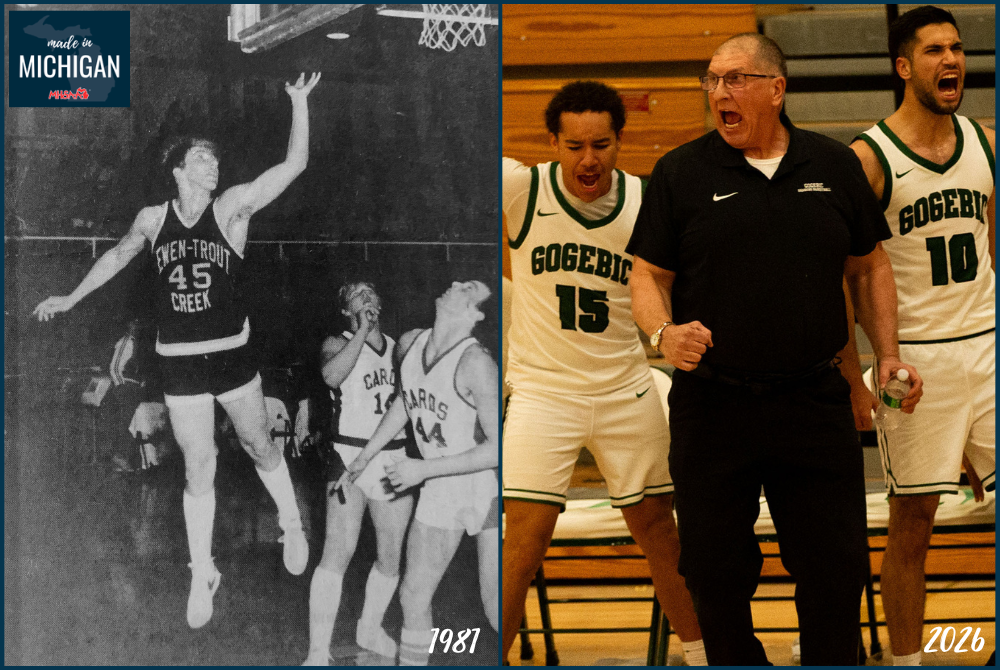
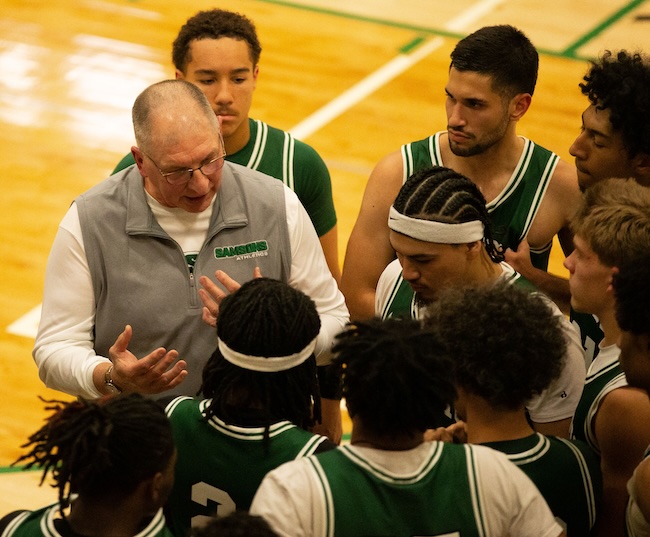
PHOTOS (Top) At left, Dennis Mackey (45) gets up a shot for Ewen-Trout Creek against Wakefield as a senior during the 1980-81 season. At right, Mackey coaches up his Gogebic Community College men’s basketball team this past summer. (Middle) Mackey huddles with his players during a break. (GCC photos by Jason Juno. Ewen-Trout Creek photo courtesy of the Ironwood Daily Globe.)