

Casting Lines for Future Tournaments
August 12, 2016
By Jack Roberts
MHSAA Executive Director
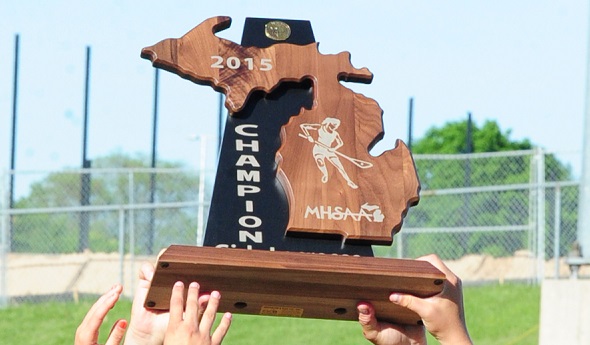
The MHSAA is best known to the public for the tournaments it conducts to conclude the fall, winter and spring seasons each school year.
These tournaments, the first and largest program of the MHSAA, have survived the Vietnam War, the Korean conflict and two World Wars. They have survived the technology bubble, the housing collapse, the energy crisis and the Great Depression.
MHSAA tournaments existed at the dawn of aviation and at the time of our nation’s lunar landing. Popes, presidents and governors have changed and changed again and again, and MHSAA tournaments roll on year after year.
But the sense of tradition and permanence and inevitability of MHSAA tournaments doesn’t dissuade us from asking questions about our tournaments, even some of the most basic questions. Here are two.
Question #1
I have long been and will always be an advocate for a Ryder Cup format for the MHSAA Golf Finals, and a team tennis approach to the MHSAA Tennis Finals; but 90 years of tradition is hard to overcome. Might this be a more exciting format? Could it be co-ed? Could it reverse the decline in boys tennis participation, and increase girls golf participation? Wouldn’t it be fun to try?
Periodically, the International Olympic Committee requires each of the designated Olympic sports to defend its status, to state its case why the sport should remain a part of the Olympic program. Then, after a series or votes that retain one sport at a time, the IOC drops the sport that makes the weakest case. It does so to make room for one of the previously unlisted sports that makes the best case for inclusion.
This would appear to keep the existing Olympic sports on their toes, and to keep the Olympic movement fresh and reflective of modern trends in sports.
While I would not enjoy the controversy, I can see the potential for some positive results if the MHSAA were to invoke the same policy for determining the 14 tournaments it will provide for girls and the 14 for boys.
This might cause us to consider more deeply what a high school sport should look like, or at least what an MHSAA tournament sport should stand for.
On the one hand, we might be inclined to drop tournaments for those sports that involve mostly non-faculty coaches and non-school venues, or require cooperative programs to generate enough participants to support a team, or resort almost entirely to non-school funding, or cater to individuals more than teams.
Or perhaps this process would cause policymakers to forget traditional thinking and ask: “In this day and age, should we shake off traditional notions of sport and consider more where modern kids are coming from?” That might mean fewer team sports and more individual sports, more “extreme” sports like snowboarding and skateboarding, and more lifetime sports, meaning not just golf and tennis and running sports, but also fishing and even shooting sports.
Currently, MHSAA policy states that the MHSAA will consider sponsorship of a tournament series for any sport which 64 member schools conduct on an interscholastic basis as a result of action by the governing boards of those schools.
Should the only question be how many schools sponsor a sport, or must an activity also have certain qualities and/or avoid certain “defects?” What should an MHSAA tournament sport look like and stand for?
Question #2
Bristling from criticism that his association is a money-grabbing exploiter of children, my counterpart in another state said, “If we were running our programs just to make money, we would do very many things very differently.” I knew exactly what he meant.
Because we care about the health and welfare of students, because we mean what we say that the athletic program needs to maximize the ways it enhances the school experience while minimizing academic conflicts, and because we try to model our claim that no sport is a minor sport when it comes to its potential to teach young people life lessons, we operate our programs in ways that make promoters, marketers and business entrepreneurs laugh, cry or cringe.
If money were the only object, we would seed and select sites to assure the teams that attracted the most spectators had the best chance to advance in our tournaments, regardless of the travel for any team or its fan base. If money were the only object, we would never schedule two tournaments to overlap and compete for public attention, much less tolerate three or four overlapping events. If money were the only object, we would allow signage like NASCAR events and promotions like minor league baseball games.
Those approaches to event sponsorship may not be all wrong; they’re just not all right for us. And we will live with the consequences of our belief system.
During a typical school year, more than 20 percent of the MHSAA’s 2,097 District, Regional and Final tournaments lose money. Not a single site in golf, skiing or tennis makes a single penny. In no sport did every District, Regional and Final site have revenue in excess of direct expenses.
In fact, in only three sports – boys and girls basketball and football – is revenue so much greater than direct expenses overall that it helps to pay for all the other tournaments in which the MHSAA invests.
That’s right: invests. When we present our budget to our board, we talk about the MHSAA’s investment in providing tournament opportunities in all those sports and all those places that cannot sustain the cost of those events on their own. How much is this investment worth to students, schools and society?
These two are core questions that require our focus far in advance of talk about scheduling, site selection, seeding and the myriad matters that too often hijack our time and attention.
TC Central's Zielinski Eying Finals Records, U-M Stardom, Olympic Aspirations
By
Tom Spencer
Special for MHSAA.com
May 29, 2026
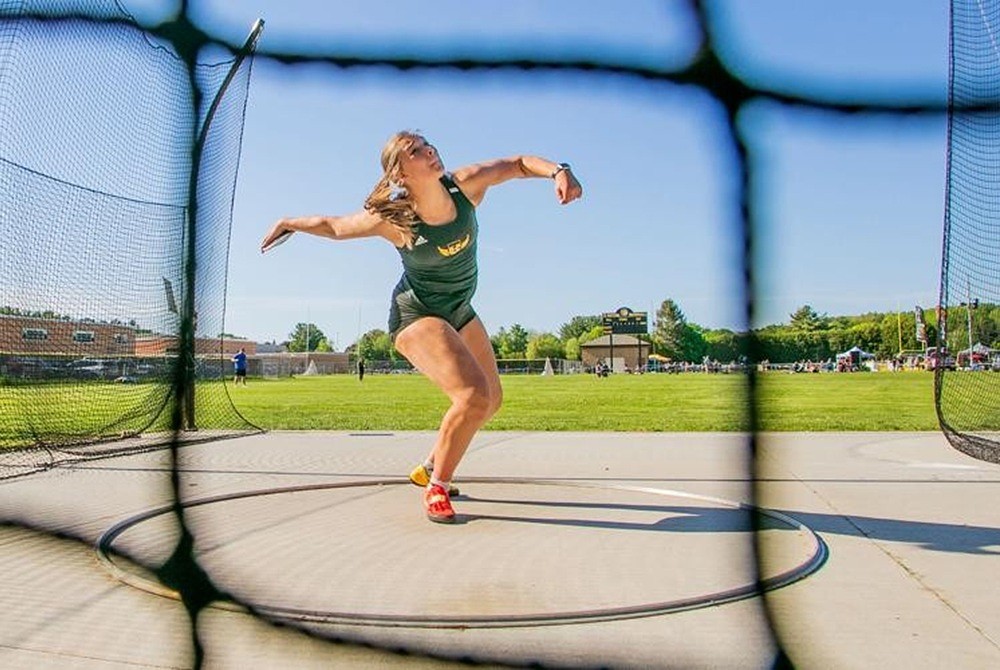
Lorelai Zielinski may be on the verge of winning her second-straight MHSAA Finals championships in both the discus and shot put as she prepares to compete at Saturday’s Lower Peninsula Division 1 Track & Field Finals in Rockford.
 And, while being named a champion again would be an honor for the Traverse City Central junior star, she’s quick to put it in perspective.
“One thing that I always tell myself, the point of track & field is not to win — it’s all that hard work that you have done to build up to that point, and winning is just part of it all,” the University of Michigan commit said. “It's just the effect of everything that you do, and it definitely is a great accomplishment because it’s ‘states’ and some people's biggest meet of the year. Having state champion next to your name, especially more than once, and more than one event, is amazing.”
Zielinski won last year’s titles as a sophomore with throws of 46 feet, 11¾ inches in the shot put and 155-1 in the discus. She has dominated the competition so much the last couple years that local media often report her success as a winning “by a long way again.”
Her personal records, both set this spring, are 52-6 in the shot put and 168-5 in the discus. Both would set MHSAA Finals records for all divisions if she replicates them Saturday.
To Paul Anderson, Central’s head coach, Zielinski is in a category all by herself. Anderson has been around high school track in New Mexico and Michigan for 30 years. He’s coached a couple of nationally recognized names over the years, but noted Zielinski really stands out.
At Central, Anderson also coached recent Stanford graduate Julia Flynn, who made national headlines when she became the first prep girl during the 2020 season to run a 5K faster than 17 minutes. In New Mexico at Los Alamos High School, Anderson coached Chase Jackson (then Chase Ealey), currently a dominant global force in track & field. Jackson made history as the first American woman to win a shot put world title, claiming outdoor gold in 2022 and 2023.
“Lorelai is a thrower, a strong woman, and is just a great person,” Anderson said. “She is probably one of the highest-rated high school athletes that I've ever coached. It’s not just her consistency, but dominance.”
During Zielinski’s early days in the sport she was coached by her mother, Amanda. Lorelai competed in shot put as a sixth grader for Traverse City East Middle School.
Zielinski, who remains the sixth, seventh and eighth-grade record-holder at East, started exploring throwing discus the summer after seventh grade.
“Lorelai started learning about and following the sport very early, but not obsessively,” Anderson said. “She loves it — but it's not owning her — it doesn't mean that’s who she is. It’s like, ‘This is what I do, and I'm not going to be like anybody else.’ Everybody talks about what a good person she is and then being an athlete — then being a thrower — gives a nice dimension.”
Zielinski has high hopes for success in college sports and quite possibly, and most likely, as onlookers say, for the national team someday.
She has her eyes on the throwing qualifying standards for the 2028 U.S. Olympic Trials, and she realizes 2032 might be a more obtainable goal. She’s planning to focus on shot put and discus while exploring the javelin, hammer and weight throws while competing for the Wolverines and pursuing studies in physical therapy or audiology.
 But for now, she is celebrating having an impact on young female athletes. She recalls her younger sports days looking up to basketball and track athletes, including current teammates.
“Obviously, track is about performing and all that, but I wanted to be able to be a role model for these younger girls,” said Zielinski, who also plays basketball for the Trojans. “I wanted to be able to inspire younger girls. It's definitely a great feeling that other people look to me for inspiration.”
Zielinski is a recognized figure around middle school and elementary track meets as she volunteers to help with events including shot put. She’s enjoyed watching anecdotal evidence of growth in the sport’s numbers and talent as well as in the presence of high school coaches helping out middle school throwers in particular.
As further evidence of Zielinski’s impact, earlier this week Traverse City kids swept the shot put podium at the MHSAA Middle School Regional in Cadillac. West’s Anna Hornacek, the school’s sixth, seventh and eighth-grade record-holder, took first with a 40-2 throw. East’s Delaney Neveau, a sixth grader, was second at 33-5, and West’s Eilley Dwyer, the second-leading sixth and seventh-grade thrower all-time, was third at 32-11.
Zielinski and Anderson are thrilled to have field events coach Chad Norton guiding her success. Zielinski especially appreciates Norton’s constant reminders that “practice doesn’t make perfection – practice makes progress.”
Norton’s been especially helpful with the mental aspects of throwing, something with which Zielinski admits she has often struggled.
“One thing Coach Doug always tells me is to breathe and have fun,” she said. “Getting in my head or setting my standards too high, I won't be having fun, and the point of it is to have fun.”
Anderson, now in his 10th year at the helm of the Trojans’ track program, is quick to point out the pride Norton has in Zielinski’s success. Anderson also points to the development of freshman thrower Nora Jensen, who already has found success under Zielinski’s mentorship.
“Doug avoids the spotlight and he’s very much honed into knowing what he had with Lorelai and his responsibility,” Anderson said. “I love Chad as a coach, because not only does he work with Lorelai, but then he takes as much time, or more, with the new shot putters. It's a great community that he has going there.”
Zielinski, who is hoping to have Norton train with her over the summer and next winter, has her freshman year MHSAA Finals in the back of her mind as she prepares for this year’s meet.
She finished second in both shot put and discus two years ago to then senior Abigail Russell of Allen Park. But she’s since exceeded Russell’s distances as she looks to become a teammate to Russell at Michigan.
Zielinski bettered Russell’s distances, in fact, at this year’s Regional Meet in Mount Pleasant. The Trojan stellar throw topped the 50-foot mark in the shot put and exceeded 161 feet in the discus.
Expect Zielinski to be wearing her trademark different-colored shoes again at the Finals. She’s worn two colors since entering high school, and this time she’ll be sporting a new pair of yellow and orange Nikes. She introduced them this week at the Traverse City Record-Eagle Honor Roll Meet.
Zielinski must replace the shoes during the season because she wears out the bottom of her right one.
“So I buy two pair of shoes for that reason, as well as my freshman year when I started doing it I felt a little bit superstitious. So I always have different-colored shoes as a tradition,” Zielinski said. “I also write different affirmations on each of my shoes such as ‘Have fun,’ ‘Breathe,’ ‘Control,’ and ‘Be the one thing in life you can control.’”
 Tom Spencer is a longtime MHSAA-registered basketball and soccer official, and former softball and baseball official, and he also has coached in the northern Lower Peninsula area. He previously has written for the Saginaw News, Bay County Sports Page and Midland Daily News. He can be reached at [email protected] with story ideas for Manistee, Wexford, Missaukee, Roscommon, Ogemaw, Iosco, Alcona, Oscoda, Crawford, Kalkaska, Grand Traverse, Benzie, Leelanau, Antrim, Otsego, Montmorency, Alpena, Presque Isle, Cheboygan, Charlevoix and Emmet counties.
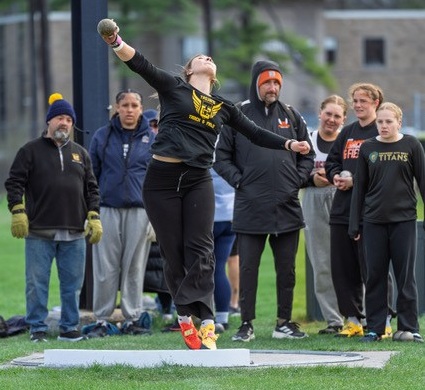
PHOTOS (Top) Traverse City Central’s Loralei Zielinski winds up during a discus throw. (Middle) Zielinski launches the shot while a gathered crowd watches. (Top photo by Jan Michael Stump/Traverse City Record-Eagle. Middle photo by TC Rick Sports Photography.)