

Casting Lines for Future Tournaments
August 12, 2016
By Jack Roberts
MHSAA Executive Director
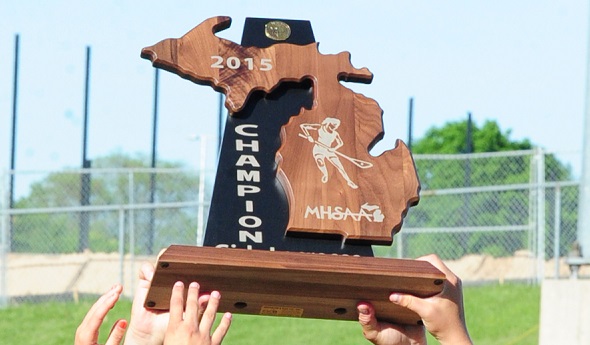
The MHSAA is best known to the public for the tournaments it conducts to conclude the fall, winter and spring seasons each school year.
These tournaments, the first and largest program of the MHSAA, have survived the Vietnam War, the Korean conflict and two World Wars. They have survived the technology bubble, the housing collapse, the energy crisis and the Great Depression.
MHSAA tournaments existed at the dawn of aviation and at the time of our nation’s lunar landing. Popes, presidents and governors have changed and changed again and again, and MHSAA tournaments roll on year after year.
But the sense of tradition and permanence and inevitability of MHSAA tournaments doesn’t dissuade us from asking questions about our tournaments, even some of the most basic questions. Here are two.
Question #1
I have long been and will always be an advocate for a Ryder Cup format for the MHSAA Golf Finals, and a team tennis approach to the MHSAA Tennis Finals; but 90 years of tradition is hard to overcome. Might this be a more exciting format? Could it be co-ed? Could it reverse the decline in boys tennis participation, and increase girls golf participation? Wouldn’t it be fun to try?
Periodically, the International Olympic Committee requires each of the designated Olympic sports to defend its status, to state its case why the sport should remain a part of the Olympic program. Then, after a series or votes that retain one sport at a time, the IOC drops the sport that makes the weakest case. It does so to make room for one of the previously unlisted sports that makes the best case for inclusion.
This would appear to keep the existing Olympic sports on their toes, and to keep the Olympic movement fresh and reflective of modern trends in sports.
While I would not enjoy the controversy, I can see the potential for some positive results if the MHSAA were to invoke the same policy for determining the 14 tournaments it will provide for girls and the 14 for boys.
This might cause us to consider more deeply what a high school sport should look like, or at least what an MHSAA tournament sport should stand for.
On the one hand, we might be inclined to drop tournaments for those sports that involve mostly non-faculty coaches and non-school venues, or require cooperative programs to generate enough participants to support a team, or resort almost entirely to non-school funding, or cater to individuals more than teams.
Or perhaps this process would cause policymakers to forget traditional thinking and ask: “In this day and age, should we shake off traditional notions of sport and consider more where modern kids are coming from?” That might mean fewer team sports and more individual sports, more “extreme” sports like snowboarding and skateboarding, and more lifetime sports, meaning not just golf and tennis and running sports, but also fishing and even shooting sports.
Currently, MHSAA policy states that the MHSAA will consider sponsorship of a tournament series for any sport which 64 member schools conduct on an interscholastic basis as a result of action by the governing boards of those schools.
Should the only question be how many schools sponsor a sport, or must an activity also have certain qualities and/or avoid certain “defects?” What should an MHSAA tournament sport look like and stand for?
Question #2
Bristling from criticism that his association is a money-grabbing exploiter of children, my counterpart in another state said, “If we were running our programs just to make money, we would do very many things very differently.” I knew exactly what he meant.
Because we care about the health and welfare of students, because we mean what we say that the athletic program needs to maximize the ways it enhances the school experience while minimizing academic conflicts, and because we try to model our claim that no sport is a minor sport when it comes to its potential to teach young people life lessons, we operate our programs in ways that make promoters, marketers and business entrepreneurs laugh, cry or cringe.
If money were the only object, we would seed and select sites to assure the teams that attracted the most spectators had the best chance to advance in our tournaments, regardless of the travel for any team or its fan base. If money were the only object, we would never schedule two tournaments to overlap and compete for public attention, much less tolerate three or four overlapping events. If money were the only object, we would allow signage like NASCAR events and promotions like minor league baseball games.
Those approaches to event sponsorship may not be all wrong; they’re just not all right for us. And we will live with the consequences of our belief system.
During a typical school year, more than 20 percent of the MHSAA’s 2,097 District, Regional and Final tournaments lose money. Not a single site in golf, skiing or tennis makes a single penny. In no sport did every District, Regional and Final site have revenue in excess of direct expenses.
In fact, in only three sports – boys and girls basketball and football – is revenue so much greater than direct expenses overall that it helps to pay for all the other tournaments in which the MHSAA invests.
That’s right: invests. When we present our budget to our board, we talk about the MHSAA’s investment in providing tournament opportunities in all those sports and all those places that cannot sustain the cost of those events on their own. How much is this investment worth to students, schools and society?
These two are core questions that require our focus far in advance of talk about scheduling, site selection, seeding and the myriad matters that too often hijack our time and attention.
Grant, Carrying Perfect Record Into Final Weeks, Quietly Making Statewide Name
By
Tom Kendra
Special for MHSAA.com
February 12, 2026
Don’t expect to see Dan George yelling and screaming and snapping clipboards.
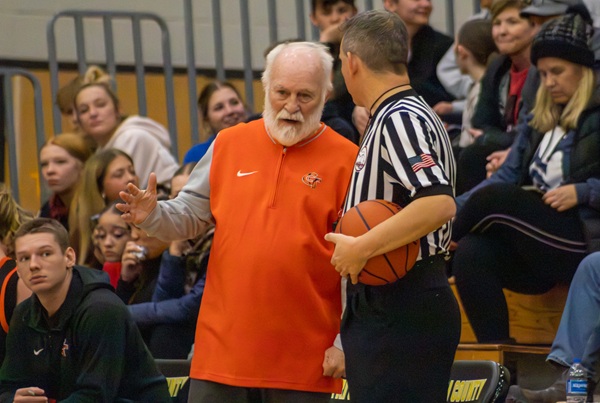
 In fact, he rarely raises his voice and doesn’t write down any Xs and Os during timeouts, instead calmly talking to his team, often with his hands in his pockets.
“You can’t teach during a timeout, there’s not enough time,” explained George, 73, a longtime college coach who came out of retirement and is now in his second year as the head coach at Grant.
“I just want to refocus everyone and reinforce what we’ve taught at practice.”
Those lessons from the old ball coach appear to be hitting home with the Tigers, who are one of the few remaining unbeaten teams in the state, with a spotless 19-0 record heading into Friday’s home game against Reed City.
Grant, which has already clinched its second-consecutive Central State Activities Association Red title, still has not cracked the Top 10 in the Division 2 Associated Press state rankings. The Tigers were among the “others receiving votes” in the latest poll.
Zaiden Phillips, a 6-foot-1 senior guard/forward, is the team’s ringleader, averaging 20 points, seven rebounds and four assists per game.
Phillips is one of three skilled long-range shooters for the Tigers, along with fellow senior Blake Rider (averaging 15 points, four rebounds and four assists) and junior Kohen Obenauf (eight points, six rebounds). On Wednesday at Big Rapids, the game began with each of those three hitting a 3-pointer as Grant took a quick 9-0 lead.
 When Big Rapids adjusted its defense, Phillips and others started cutting to the basket in the Tigers’ motion offense, where he is a great finisher. If those cuts result in drawing fouls, he’s also a strong free-throw shooter.
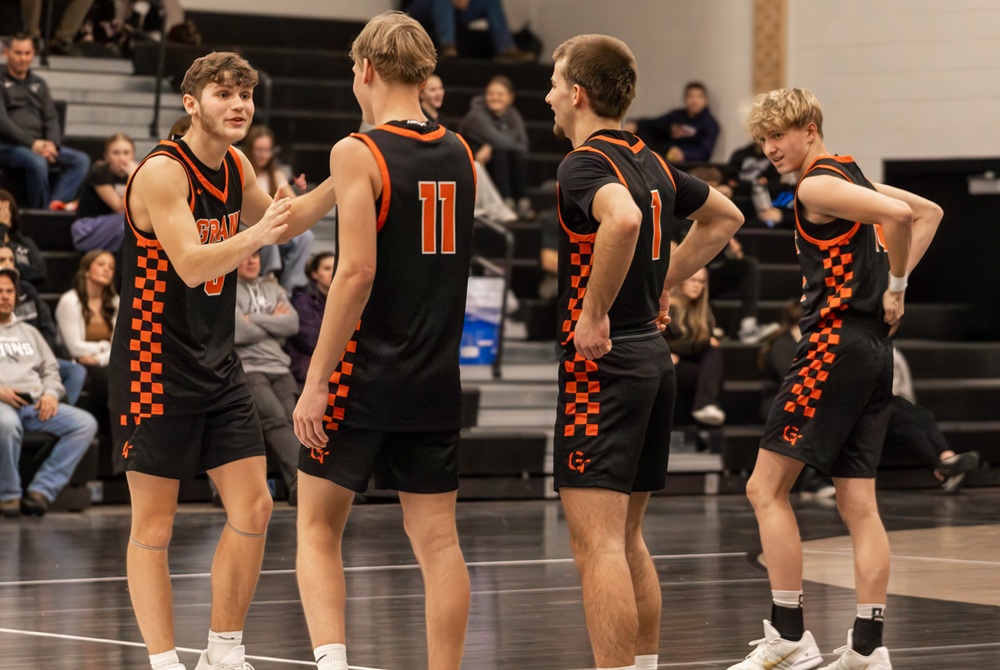
Phillips and Rider are Grant’s two senior starters (the other three are juniors) and best friends, and their many years of hanging out and playing basketball together is evident in their on-court chemistry.
Junior Austin Gragg is the team’s “big man” at 6-3, averaging eight points and six rebounds per game. The final member of the Tigers’ starting five is junior point guard Jack Swanson, who also excels at driving to the hoop and puts up nine points and five rebounds per game.
Grant goes seven deep, with senior Owen Chesebro and junior Jacob Gates the main reserves.
The Tigers had only nine varsity players as the season approached, before Phillips and Rider talked their buddy and fellow senior Rory Fish – a baseball standout – into playing hoops, which allows the team to scrimmage 5-on-5 at practice.
Those practices are where George’s old-school coaching techniques and the players’ developing skills come together.
“In practice, I make them throw six passes before they take a shot, and they also can’t dribble,” said George with a smile. “They learn in a hurry to be looking up and seeing the court.”
The defense is in the capable hands of assistant coach Kirk Rider (Blake’s father), who is also Grant’s athletic director. The Tigers play primarily man-to-man, but it often looks like a zone as they clog the lane to prevent penetration and force opponents to beat them from the perimeter.
The formula has been working to perfection, literally, this winter.
Phillips has garnered the most headlines, earning MVP honors at the inaugural Be Legendary Showcase at Grace Christian in early January, then scoring 22 points in a victory over Montague on Jan. 6 to top 1,000 career points.
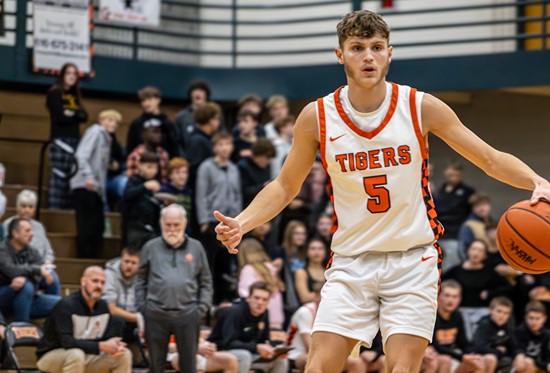 He has remained hot recently, scoring 27 against Remus Chippewa Hills and 31 at arch-rival Fremont in back-to-back games last weekend. His shot was slightly off on Wednesday at Big Rapids, and he finished with 14 points.
“When his scoring falls below his average, he will fill the stat sheet with assists, rebounds, and steals,” said George. “He understands the importance of doing the little things.”
Phillips said the key to his scoring, and the team’s consistency, is defense. Grant forces an average of 12 turnovers per game.
“We get after it on defense and cause a lot of turnovers, then we get easy buckets off of those,” said Phillips, who has received college basketball offers from Kuyper College and Grace Christian.
Grant, which has not won a District during Phillips and Rider’s high school careers, will be favored to win the Division 2 District tournament at Sparta, as it has beaten all four of the other teams in the bracket.
“It would mean a lot to get a District this year,” said Rider. “We’ve been close, but we just haven’t got it done. We know that we need to step up our defense and rebounding in the tournament.”
This year’s perfect season comes on the heels of last year’s 20-3 finish, giving Coach George a 39-3 record while wearing Grant’s orange colors, a gaudy 93-percent winning percentage.
Winning basketball games is nothing new for George, who made his mark as the head coach at Jordan College and later as an assistant coach at Grace Christian University, where he coached for 17 years and was part of six National Christian College Athletic Association championship teams.
But hang around George for even a few minutes and you’ll see that winning games is low on his list of priorities.
“I always tell my players that I want to accomplish three things,” said George, who noted he is having a blast because his team is so coachable.
“First is to have fun. Second is to help them become better people, better brothers and better husbands. And third is to see them in heaven someday.”
 Tom Kendra worked 23 years at The Muskegon Chronicle, including five as assistant sports editor and the final six as sports editor through 2011. E-mail him at [email protected] with story ideas for Muskegon, Oceana, Mason, Lake, Oceola, Mecosta and Newaygo counties.
PHOTOS (Top) Grant’s Zaiden Phillips, far left, interacts with his teammates before a recent game. (Middle) Veteran coach Dan George talks with a game official. (Below) Phillips considers his next move with George looking on from the sideline. (Photos courtesy of the Grant athletic department).