

Casting Lines for Future Tournaments
August 12, 2016
By Jack Roberts
MHSAA Executive Director
The MHSAA is best known to the public for the tournaments it conducts to conclude the fall, winter and spring seasons each school year.
These tournaments, the first and largest program of the MHSAA, have survived the Vietnam War, the Korean conflict and two World Wars. They have survived the technology bubble, the housing collapse, the energy crisis and the Great Depression.
MHSAA tournaments existed at the dawn of aviation and at the time of our nation’s lunar landing. Popes, presidents and governors have changed and changed again and again, and MHSAA tournaments roll on year after year.
But the sense of tradition and permanence and inevitability of MHSAA tournaments doesn’t dissuade us from asking questions about our tournaments, even some of the most basic questions. Here are two.
Question #1
I have long been and will always be an advocate for a Ryder Cup format for the MHSAA Golf Finals, and a team tennis approach to the MHSAA Tennis Finals; but 90 years of tradition is hard to overcome. Might this be a more exciting format? Could it be co-ed? Could it reverse the decline in boys tennis participation, and increase girls golf participation? Wouldn’t it be fun to try?
Periodically, the International Olympic Committee requires each of the designated Olympic sports to defend its status, to state its case why the sport should remain a part of the Olympic program. Then, after a series or votes that retain one sport at a time, the IOC drops the sport that makes the weakest case. It does so to make room for one of the previously unlisted sports that makes the best case for inclusion.
This would appear to keep the existing Olympic sports on their toes, and to keep the Olympic movement fresh and reflective of modern trends in sports.
While I would not enjoy the controversy, I can see the potential for some positive results if the MHSAA were to invoke the same policy for determining the 14 tournaments it will provide for girls and the 14 for boys.
This might cause us to consider more deeply what a high school sport should look like, or at least what an MHSAA tournament sport should stand for.
On the one hand, we might be inclined to drop tournaments for those sports that involve mostly non-faculty coaches and non-school venues, or require cooperative programs to generate enough participants to support a team, or resort almost entirely to non-school funding, or cater to individuals more than teams.
Or perhaps this process would cause policymakers to forget traditional thinking and ask: “In this day and age, should we shake off traditional notions of sport and consider more where modern kids are coming from?” That might mean fewer team sports and more individual sports, more “extreme” sports like snowboarding and skateboarding, and more lifetime sports, meaning not just golf and tennis and running sports, but also fishing and even shooting sports.
Currently, MHSAA policy states that the MHSAA will consider sponsorship of a tournament series for any sport which 64 member schools conduct on an interscholastic basis as a result of action by the governing boards of those schools.
Should the only question be how many schools sponsor a sport, or must an activity also have certain qualities and/or avoid certain “defects?” What should an MHSAA tournament sport look like and stand for?
Question #2
Bristling from criticism that his association is a money-grabbing exploiter of children, my counterpart in another state said, “If we were running our programs just to make money, we would do very many things very differently.” I knew exactly what he meant.
Because we care about the health and welfare of students, because we mean what we say that the athletic program needs to maximize the ways it enhances the school experience while minimizing academic conflicts, and because we try to model our claim that no sport is a minor sport when it comes to its potential to teach young people life lessons, we operate our programs in ways that make promoters, marketers and business entrepreneurs laugh, cry or cringe.
If money were the only object, we would seed and select sites to assure the teams that attracted the most spectators had the best chance to advance in our tournaments, regardless of the travel for any team or its fan base. If money were the only object, we would never schedule two tournaments to overlap and compete for public attention, much less tolerate three or four overlapping events. If money were the only object, we would allow signage like NASCAR events and promotions like minor league baseball games.
Those approaches to event sponsorship may not be all wrong; they’re just not all right for us. And we will live with the consequences of our belief system.
During a typical school year, more than 20 percent of the MHSAA’s 2,097 District, Regional and Final tournaments lose money. Not a single site in golf, skiing or tennis makes a single penny. In no sport did every District, Regional and Final site have revenue in excess of direct expenses.
In fact, in only three sports – boys and girls basketball and football – is revenue so much greater than direct expenses overall that it helps to pay for all the other tournaments in which the MHSAA invests.
That’s right: invests. When we present our budget to our board, we talk about the MHSAA’s investment in providing tournament opportunities in all those sports and all those places that cannot sustain the cost of those events on their own. How much is this investment worth to students, schools and society?
These two are core questions that require our focus far in advance of talk about scheduling, site selection, seeding and the myriad matters that too often hijack our time and attention.
Fracassa's Remarkable Records Still Rule
By
Tom Markowski
Special for Second Half
June 24, 2020
As a senior at Sterling Heights Stevenson during the 2009 season, Jason Fracassa lit up the high school football world with his aerial display.
 Fracassa shattered the MHSAA career totals for passing yards and touchdowns held by Mill Coleman of Farmington Hills Harrison. Fracassa also etched his name into the national record book in three career passing categories before the remarkable run ended with a 31-21 loss to Detroit Catholic Central in the Division 1 Final at Ford Field.
The numbers he posted at Stevenson indeed were staggering. And just more than a decade later, after securing two undergraduate degrees and a masters in finance from Walsh University in Ohio, Fracassa lives in Auburn Hills and continues to crunch numbers – now for a development company in Birmingham – while also planning for a Sept. 12 wedding to fiancé Kelsey Torzy.
Fracassa has always been a highly-motivated person, and that held true in the classroom and as a three-sport varsity athlete and continues now in the business world. But while driven by success, Fracassa doesn’t dwell on what he accomplished in the sports world – which also included Division II college careers in both football and baseball. What was important then remains so now, and those are the relationships he built through trust, hard work and having a little fun.
“I miss going to practice each day and hanging out with my friends,” he said. “Just walking around school and trying to set an example to the kids, that’s what was important. I’ll go to the golf course now and I’m with all of my friends. That’s what it’s all about. That was the best part. We had the best relationships, no matter if we won or lost. Playing for Coach (Rick) Bye and your friends, that’s the best memories I have.”
A four-year varsity starter for Bye, Fracassa led Stevenson to a combined 23-3 record over his last two seasons, culminated by that fourth trip in program history to an MHSAA Final.
During his junior season, Fracassa threw for 3,353 yards and 34 touchdowns over 12 games. He then took aim at Coleman’s career passing records for touchdowns (77) and yards (7,464), records that had stood for 20 years.
 Fracassa and his teammates put on a show that 2009 season as he threw for 4,433 yards and 44 touchdowns. His career (10,615) and single season (4,433) passing yards remain MHSAA records, the career total by nearly 2,000 yards. Fracassa also continues to own the records for career passing attempts (1,104) and completions (656), accrued over 44 games, and he briefly held the MHSAA record for career TD passes with 97 before it was broken in 2013. The career attempts and yards and senior-season yardage all rank in the National Federation record book as well.
Fracassa credits the coaching staff at Stevenson for the success he and his teammates enjoyed. He couldn’t have imagined playing for anyone but Bye and his staff. Fracassa said he’s spoken with many of Bye’s former players, and they all agree playing for Stevenson and Bye was a phenomenal experience.
Like Fracassa, Bye – who retired after 2009 with a record of 268-94 over 35 seasons – also keeps tabs of his cronies by playing golf once a week with former assistants like Ken Fiott, Jerry Lajeunesse, Larry Zimmerman, Joe Emanuele and D.J. Hill among others. Bye is quick to point out that many of his former players, including Fracassa, keep in touch on a regular basis.
“I saw (Fracassa) at a Stevenson playoff game,” Bye said. “He calls me at least once every two months or so to see how I’m doing. I appreciate that. He was always a highly-respected kid. He’s not a kid anymore.”
Bye recalls hearing about Fracassa when Fracassa was in the eighth grade at St. Lawrence in Utica. Fracassa enrolled at Davis Junior High, Stevenson’s feeder school, for his ninth grade and tried out for the football team not knowing whether he’d make the varsity or not.
“His dad wasn’t pushy one bit,” Bye said. “(Rick Fracassa) asked if Jason was going to be on the JV. A big reason he wanted his son to come (to Stevenson) was Joe Emanuele, who was our baseball coach, and Rick knew Joe had a good program. He wanted Jason to play baseball, too.
“Jason came out and won the (quarterback) job. He proved himself. And he had to win over our seniors.”
Jason Fracassa said that was the hard part – convincing a group of seniors that a freshman could come in, start at quarterback and lead the team can be daunting.
“I knew I could compete at that level,” Fracassa said. “It was more of my getting to associate myself with the older players. That was the most difficult part. The coaches were always there to back me.”
 Stevenson made the playoffs that 2006 season finishing 5-5. The next season was rough as the Titans lost a number of close games and finished 2-7. Stevenson improved substantially to 10-2 in 2008, losing to Lake Orion, 38-36, in a Regional Final.
That all built up to the memorable 2009 season, which included a tense Semifinal game against Clarkston won by Stevenson 37-35 on a Fracassa scoring pass on the final play.
Emotions also ran high the game before when Stevenson took on Detroit Public School League power Detroit Southeastern, led by Michigan State-bound and now-NFL defensive end William Gholston. Fracassa threw for a career-high 494 yards, and Stevenson defeated Southeastern, 38-32.
After a busy and accomplished prep career, Fracassa maintained a hectic athletic schedule in college first at Northwood University – where he started on the baseball team for three seasons and was a member of the football team for two.
After sitting out a term, Fracassa transferred to Walsh, located in North Canton, Ohio. There he revived his football career starting at quarterback his last two years. Walsh, then a recent addition to the Great Lakes Intercollegiate Athletic Conference, nearly upset conference power and undefeated Ferris State in Fracassa’s final game. Fracassa threw his second touchdown pass of the game to give Walsh a 42-32 lead with 9:38 left before Ferris State came back with two touchdowns, the second with 36 seconds left, to win 46-42.
Fracassa hasn’t completely abandoned football since his last game at Walsh. He and his father coached the Oakland University club team in 2018 and that team reached a championship game. Jason was the offensive coordinator, his father the head coach – branches from the coaching tree rooted with Jason’s grandfather Al Fracassa, the second-winningest high school football coach in MHSAA history and Bloomfield Hills Brother Rice legend.
Jason’s competitive juices continue to flow.
“We had a great run,” Fracassa said, “and any other year could have taken the championship trophy.”
Made in Michigan 2020
June 16: Muskegon Grad Casts "Magic" in HBO Series - Read
 Tom Markowski is a correspondent for the State Champs! Sports Network and previously directed its web coverage. He also covered primarily high school sports for the The Detroit News from 1984-2014, focusing on the Detroit area and contributing to statewide coverage of football and basketball. Contact him at [email protected] with story ideas for Oakland, Macomb and Wayne counties.
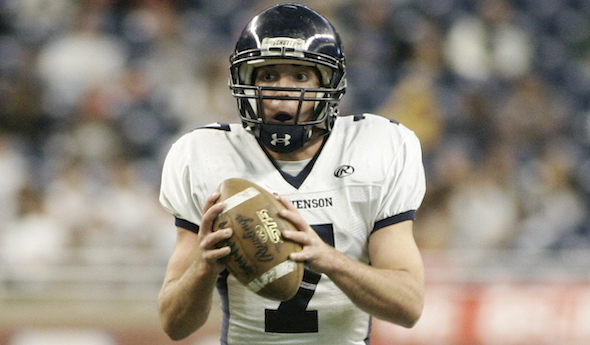
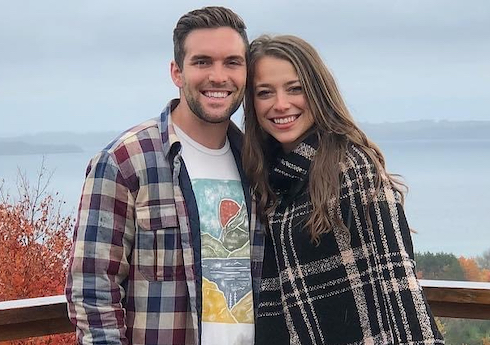
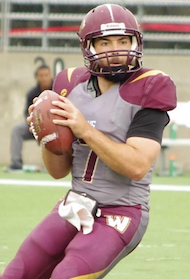
PHOTOS: (Top) Jason Fracassa rolls out during the 2009 Division I championship game at Ford Field. (Middle) Fracassa and fiancé Kelsey Torzy. (Below) Fracassa drops back to pass while playing for Walsh. (Middle and below photos courtesy of Jason Fracassa.)