


Classes Still Create Hoosier Hysteria
July 27, 2017
By Rob Kaminski
MHSAA benchmarks editor
This is the fourth part in a series on MHSAA tournament classification, past and present, that will be published over the next two weeks. This series originally ran in this spring's edition of MHSAA benchmarks.
Twenty years ago, Bloomington North High School won the Indiana High School Athletic Association boys basketball championship, defeating Delta 75-54 at the RCA Dome in Indianapolis.
The date, March 22, 1997, is at the same time revered and disdained by traditionalists in the state who saw it as the last schoolboy championship game the state would ever host.
That’s how devout the game of basketball, particularly interscholastic basketball, had become in the Hoosier state during the 87 years a state champion – one state champion, to be precise – was crowned.
Following that 1997 season, the IHSAA moved to a four-class system for its roundball tournaments, like so many of its state association counterparts had done years earlier.
It would be shocking to find more than a small percentage of current high school basketball players around the country unfamiliar with the iconic movie Hoosiers, even though the film is now more than 30 years old.
And, the storyline for that blockbuster unfolded more than 30 years prior to its release, when small-town, undermanned Milan High School defeated Muncie Central High School 32-30 in the 1954 IHSAA title game.
Perhaps it’s because of the David vs Goliath notion, or the fame of the movie that replaced Milan with the fictional Hickory and real-life star Bobby Plump with Hollywood hero Jimmy Chitwood, or the simple fact that Indiana had something other states didn’t.
Whatever the reason, plenty of opposition remains to this day to basketball classification in the state.
The fact is, the small rural schools were regularly being beaten handily by the much larger suburban and city schools as the tournament progressed each season.
Small schools also were closing at a rapid rate following the state’s School Reorganization Act in 1959, as students converged on larger, centralized county schools. From 1960 to 2000, the number of schools entering the tournament dropped from 694 to 381, and in 1997 a total of 382 schools and 4,584 athletes began competition at the Sectional level (the first level of the IHSAA Basketball Tournament).
It was at the entry level of the tournament where school administrators felt the pain of the new class system, but not necessarily for the same nostalgic reasons as the fans who either attended or boycotted the tournament.
At the Sectional round of the tournament, the IHSAA was culling just 2 percent of the revenue, with the participating schools splitting the balance. So, when Sectional attendance dropped by 14 percent in that first year of class basketball, many schools realized a financial loss. It was money they had grown to count on in prior years to help fund various aspects of the department.
Schools cumulatively received more than $900,000 from Sectional competition in 1998, but that total was down from more than $1 million in the last year of the single-class tournament.
Yet, the current format provides a great deal more opportunity and realistic chances at championship runs for schools of all enrollments.
To date, 60 additional teams have championship or runner-up trophies on display in school trophy cases around Indiana.
That was the mission in front of then-IHSAA commissioner Bob Gardner (now National Federation executive director) once the board made its decision: to give thousands more student-athletes the opportunity for once-in-a-lifetime experiences.
As any statistician knows, figures can be manipulated to tell any side of a story. Declining attendance in year one of class basketball is such a number.
The truth is tournament attendance had been on a steady downward spiral since its peak of just over 1.5 million in 1962. By the last single-class event in 1997, the total attendance was half that.
The challenge then and today, as it is for all state associations, is to find that delicate balance for those holding onto tradition, those holding onto trophies, and the number of trophies to hand out.
Editor’s Note: Stories from the Fort Wayne Journal Gazette in 1998 and from a 2007 issue of Indianapolis Monthly provided facts in this article.
Breslin Bound: 2024-25 Girls Semifinals Preview
By
Geoff Kimmerly
MHSAA.com senior editor
March 19, 2025
“To be the best, you have to beat the best” couldn’t ring truer than at this time of year.
 But playing the best along the way also appears to have made a difference for contenders headed to this weekend’s MHSAA Girls Basketball Semifinals.
All 16 taking the court at Breslin Center this weekend have something in common – an above-average degree of difficulty while preparing for this championship trip.
All but one contender ended the regular season with an opponents’ winning percentage above .500 – meaning the teams they played, combined, had a winning record – and the remaining field includes five teams whose schedules ranked among the toughest seven statewide by that metric. The lone outlier, Ewen-Trout Creek, played teams that still won a combined 48 percent of their regular-season games – and the Panthers still faced five of the top 25 teams in their division by Michigan Power Rating (MPR) on their way downstate.
Semifinals will be played Thursday and Friday, with all four championships games set for Saturday.
DIVISION 1 - Friday
Belleville (26-1) vs. West Bloomfield (19-8) - Noon
Wayne Memorial (21-6) vs. Rockford (26-1) - 2 p.m.
DIVISION 2 - Friday
Frankenmuth (23-4) vs. Tecumseh (25-1) - 5:30 p.m.
Grand Rapids West Catholic (23-3) vs. Detroit Edison (19-6) - 7:30 p.m.
DIVISION 3 - Thursday
Calumet (22-5) vs. Rochester Hills Lutheran Northwest (20-6) - Noon
Ypsilanti Arbor Prep (15-12) vs. Niles Brandywine (27-0) - 2 p.m.
DIVISION 4 - Thursday
Ewen-Tout Creek (26-1) vs. Concord (21-6) - 5:30 p.m.
Fowler (25-2) vs. Genesee Christian (24-2) - 7:30 p.m.
Finals – Saturday
Division 1 - 12:15 p.m.
Division 2 - 6:15 p.m.
Division 3 - 4 p.m.
Division 4 - 10 a.m.
Tickets for this weekend’s games are $12 for both Semifinals and Finals and available via the Breslin Center ticket office; for information and links visit the Girls Basketball page.
All Semifinals will be broadcast and viewable with subscription on MHSAA.tv, and all four Finals will air live on the FanDuel Sports Network primary channel. Audio broadcasts of all Semifinals and Finals will be available free of charge from the MHSAA Network.
The Girls Basketball Semifinals & Finals are sponsored by Michigan Achievement Scholarship/MI Student Aid.
Here’s a look at the 16 semifinalists (with rankings by MPR and statistics through Regional Finals):
Division 1
BELLEVILLE
Record/rank: 26-1, No. 3
League finish: Tied for first in Kensington Lakes Activities Association East
Coach: Jason Wilkins, fifth season (91-20)
Championship history: Has never played in an MHSAA Final.
Best wins: 59-54 over No. 18 DeWitt in Quarterfinal, 65-35 over No. 20 Hartland in Regional Final, 79-40 over No. 13 Dexter in Regional Semifinal, 70-48 over No. 19 Northville, 62-38 over No. 9 Wayne Memorial, 84-49 over No. 14 West Bloomfield, 54-40 over Division 2 No. 5 Detroit Edison, 72-56 over Division 2 No. 7 Parma Western, 46-45 over Division 2 No. 1 Ann Arbor Father Gabriel Richard.
Players to watch: Sydney Savoury, 6-0 soph. G (26.6 ppg, 53 3-pointers, 5.4 rpg, 3.8 apg, 5.2 spg); Se’Crette Carter, 5-8 jr. G (19.2 ppg, 41 3-pointers); Paisley Stephens, 5-8 fr. G (11.2 ppg, 5.3 apg, 3.5 spg).
Outlook: After making its first Semifinal trip last season, Belleville is making its second straight and with four starters back from last year’s run. Savoury remains arguably the best sophomore in the state and certainly among the top players overall, and guard Rylan Buschell (8.0 ppg, 4.7 apg, 3.9 spg) and 6-0 center Iyana Stephens are the team’s only seniors although both start. Belleville’s only loss was to Wayne, and the Tigers avenged it two weeks later.
WAYNE MEMORIAL
Record/rank: 21-6, No. 9
League finish: Tied for first in Kensington Lakes Activities Association East
Coach: Jarvis Mitchell, 11th season (192-69)
Championship history: Has never played in an MHSAA Final.
Best wins: 55-37 over No. 8 Temperance Bedford in Quarterfinal, 51-47 over No. 2 Detroit Renaissance in Regional Final, 55-43 over No. 6 Farmington Hills Mercy in Regional Semifinal, 63-51 over No. 22 Howell, 57-52 over No. 3 Belleville, 60-57 over Division 2 No. 21 Goodrich.
Players to watch: Mariah Cross, 5-3 jr. G (19.4 ppg); Morgan Smith, 5-5 jr. G (11.3 ppg); Colleena Bryant, 5-6 sr. PG (17.2 ppg).
Outlook: This will be Wayne’s first trip to the Semifinals since 2022 and fourth over the last seven seasons (not counting COVID-shortened 2020). The Zebras are the only team to defeat Belleville, and their three in-state losses (Belleville, Rockford, Detroit Edison) were to teams still playing this weekend. Bryant made the Division 1 all-state second team last season and was a Miss Basketball Award finalist this week; she’s committed to continue at Drexel.
WEST BLOOMFIELD
Record/rank: 19-8, No. 14
League finish: Second in Oakland Activities Association Red
Coach: Darrin McAllister, fourth season (91-12)
Championship history: Division 1 champions 2024 and 2022, Division 1 runner-up 2023, Class A runner-up 1989.
Best wins: 57-35 over No. 12 Utica Ford in Quarterfinal, 47-42 (Regional Final) and 44-43 over No. 15 Clarkston, 41-36 over No. 10 Orchard Lake St. Mary’s in District Final, 57-24 over No. 31 Detroit Cass Tech, 47-32 over No. 27 Detroit Mumford.
Players to watch: Sheridan Beal, 5-7 jr. G (16 ppg, 54 3-pointers); Breasia Gamble-Jones, 5-8 sr. G/F (9.0 ppg, 5.5 rpg); Ava Lord, 5-8 sr. G (8.4 ppg).
Outlook: West Bloomfield is making its fourth-straight trip to Finals weekend, and this one was perhaps the least expected and arguably most impressive. The Lakers returned one starter from last year’s championship team and graduated major contributors (including two 2024 all-staters) who contributed heavily to the last three Breslin runs, but have won 16 of their last 19 games and taken losses from five opponents that went on to win at least District titles. Junior 6-0 forward Londyn Hall adds another 8.6 points and 7.6 rebounds per game.
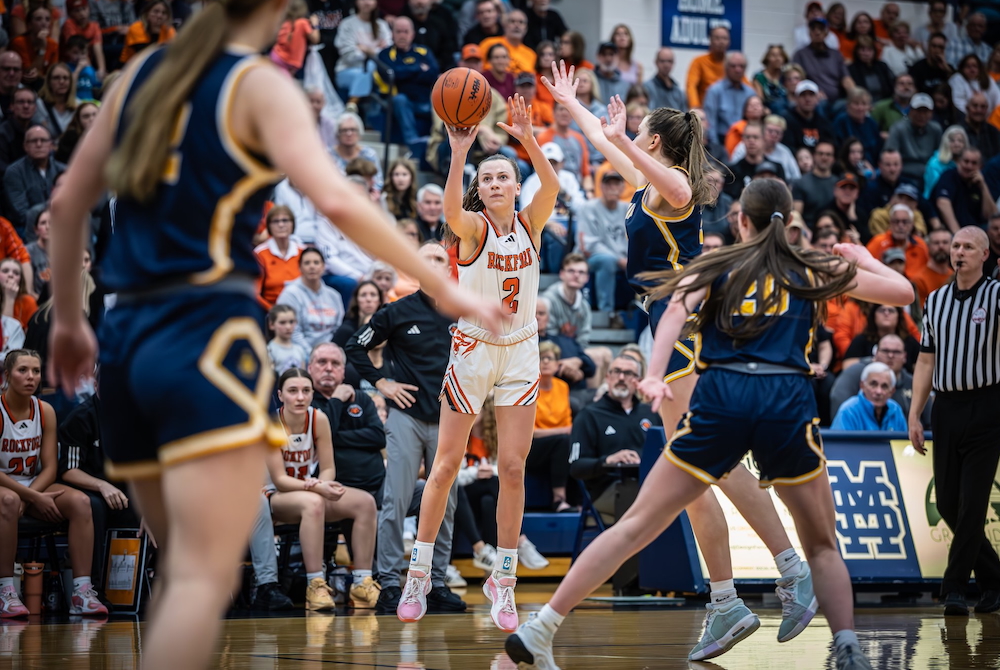
ROCKFORD
Record/rank: 26-1, No. 1
League finish: First in Ottawa-Kent Conference Red
Coach: Brad Wilson, 12th season (215-67)
Championship history: Division 1 champion 2023.
Best wins: 54-49 (Quarterfinal), 45-34 and 60-48 over No. 5 Grand Haven; 81-40 over No. 24 Traverse City Central in Regional Final, 54-31 over No. 4 Saginaw Heritage in Regional Semifinal, 52-35 over No. 22 Howell, 62-45 over No. 9 Wayne Memorial, 57-45 and 70-41 over No. 21 Hudsonville, 45-36 over Division 2 No. 4 Frankenmuth, 51-45 over Division 2 No. 2 Tecumseh, 71-36 over Division 2 No. 9 Haslett.
Players to watch: Anna Wypych, 6-0 sr. G (21.8 ppg, 85 3-pointers); Addison Wypych, 5-10 fr. G (9.2 ppg, 40 3-pointers, 3.5 apg); Kate Higgins, 6-0 jr. C (8.3 ppg, 5.5 rpg).
Outlook: This also will be the fourth-straight trip to Finals weekend for the Rams, who fell to West Bloomfield last season in overtime in their Semifinal but have three starters back from that game in Anna Wypych, Higgins and Jordan Mateer (5.8 ppg, 33 3-pointers). Wypych was named the Miss Basketball Award winner Monday and has signed with Butler. She made the all-state first team last season, and junior guard Sienna Wolfe (6.0 ppg) earned an honorable mention despite missing the end of last season with an injury. Rockford’s only loss this winter was to Ann Arbor Father Gabriel Richard (24-2) on Dec. 14.
Division 2
DETROIT EDISON
Record/rank: 19-6, No. 5
League finish: Does not play in a conference.
Coach: Monique Brown, 13th season (233-53)
Championship history: Five MHSAA titles (most recent 2024).
Best wins: 59-48 over No. 13 Detroit Country Day in Quarterfinal, 55-40 over No. 8 Chelsea, 52-40 over Division 1 No. 14 West Bloomfield, 61-42 over Division 1 No. 11 Utica Eisenhower, 54-46 over Division 1 No. 15 Clarkston, 48-46 (OT) over Division 1 No. 9 Wayne Memorial, 65-44 over Division 3 No. 10 Kalamazoo Christian.
Players to watch: Isis Johnson-Musah, 5-8 sr. G (17.3 ppg, 6.9 rpg, 3.9 apg, 3.7 spg); Nichole James, 6-2 soph. F (8.4 ppg); Rihanna Young, 5-7 soph. G (7.7 ppg).
Outlook: Edison has won two of the last three Division 2 championships, and Johnson-Musah and James started in last season’s championship game. Johnson-Musah was a Miss Basketball Award finalist and made the all-state first team last season, and has committed to continue at Cal-Berkeley. Senior forward Pria Johnson-Musah (5.2 ppg) has moved from key sub last year to starter, and junior 6-0 forward Marianna Jones (6.8 ppg, 5.0 rpg) also saw time in last season’s Final and is providing big minutes off the bench again.
FRANKENMUTH
Record/rank: 23-4, No. 4
League finish: Tied for first in Tri-Valley Conference Red
Coach: Joe Jacobs, fifth season (110-15)
Championship history: Two MHSAA titles (most recent 1996), five runner-up finishes.
Best wins: 56-36 over No. 16 Gladstone in Quarterfinal, 41-27 over No. 29 Portland in Regional Final, 53-44 (Regional Semifinal) and 60-33 and over No. 6 Freeland, 52-41 over No. 5 Detroit Edison, 45-39 over No. 21 Goodrich, 65-39 over No. 13 Detroit Country Day, 56-50 over No 26 Flint Powers Catholic, 39-31 over Division 1 No. 4 Saginaw Heritage, 47-40 over Division 1 No. 10 Orchard Lake St. Mary’s.
Players to watch: Clare Conzelmann, 5-11 sr. G (16.4 ppg, 70 3-pointers); Macy Donovan, 6-0 fr. G (10.7 ppg); Isabelle Bernthal, 5-7 sr. F (9.7 ppg, 6.8 rpg).
Outlook: Frankenmuth finished Division 2 runner-up two seasons ago with Conzelmann, Bernthal and senior guard/forward Rosemary Brenner starting as sophomores, and they’ve helped key this return run to Breslin that’s included avenging a season-opening one-point loss to Portland and defeating league rival Freeland for a second time after they shared the TVC Red title. The other two defeats came to Division 1 opponents Midland Dow and Rockford. Sophomore Lucy Conzelmann has joined her older sister as a perimeter standout with 31 3-pointers off the bench.
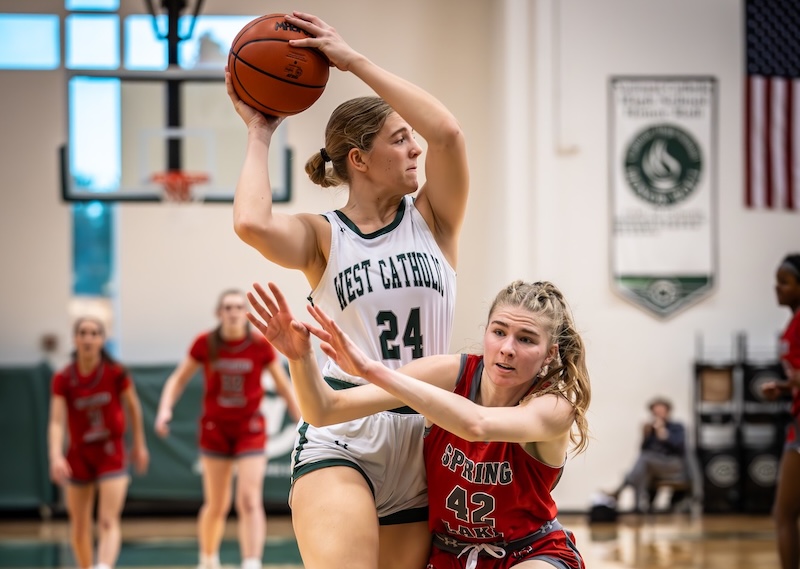
GRAND RAPIDS WEST CATHOLIC
Record/rank: 23-3, No. 10
League finish: Tied for first in O-K Gold
Coach: Derek Paiz, first season (23-3)
Championship history: Two MHSAA titles (most recent 1990), two runner-up finishes.
Best wins: 39-37 (Quarterfinal) and 62-49 over No. 14 Grand Rapids South Christian, 62-55 (Regional Final) and 59-35 over No. 30 Grand Rapids Catholic Central, 57-46 over Division 1 No. 21 Hudsonville.
Players to watch: Elisha Dykstra, 6-0 sr. G (10.6 ppg, 5.3 rpg, 4.2 apg); Anna Ignatoski, 5-7 sr. G (13.6 ppg, 45 3-pointers); Alexis Asekomeh, 5-11 soph. F (13.5 ppg, 8.2 rpg).
Outlook: Dykstra is a four-year starter and has helped West Catholic reach Finals weekend all four with a combined record of 100-8 over those seasons; she will continue at Toledo. Asekomeh also started in last season’s two-point Semifinal loss to Father Gabriel Richard, and senior guard Paige Seely-London (6.0 ppg) played more than half the game off the bench and has seen the floor at Breslin the last three years as well. Ignatoski was a top sub when West Catholic finished Division 2 runner-up in 2022. Freshman guard Kenley Slanger adds 8.7 points and 3.2 steals per game.
TECUMSEH
Record/rank: 25-1, No. 2
League finish: First in Southeastern Conference White
Coach: Kristy Zajac, eighth season (135-44)
Championship history: Class B champion 1974, Class B runner-up 1975.
Best wins: 61-53 over No. 21 Goodrich in Quarterfinal, 50-39 over No. 1 Ann Arbor Father Gabriel Richard in Regional Final, 74-29 (Regional Semifinal) and 76-44 over No. 27 Carleton Airport, 56-39 and 53-41 over No. 8 Chelsea, 70-65 (2OT) over No. 5 Detroit Edison, 72-40 over Division 1 No. 19 Northville, 58-32 over Division 1 No. 14 West Bloomfield, 52-39 over Division 1 No. 8 Temperance Bedford, 66-45 over Division 3 No. 18 Jackson Lumen Christi, 70-38 over Division 3 No. 13 Blissfield.
Players to watch: Alli Zajac, 6-2 sr. F (14.3 ppg, 6.1 rpg); Makayla Schlorf, 5-3 jr. G (12 ppg, 32 3-pointers, 3.1 apg); Addi Zajac, 6-0 soph. C (13.8 ppg, 8.8 rpg, 1.1 bpg).
Outlook: Tecumseh is returning to the Semifinals for the first time since that runner-up season of 1975, and with its only loss Jan. 11 against Rockford. The win over Father Gabriel Richard last week avenged a Quarterfinal defeat from a year ago. Alli Zajac made the all-state first team last season and Addi Zajac earned an honorable mention, and Alli also was a Miss Basketball Award finalist this season and has signed with Eastern Michigan – where her mother and coach Kristy remains one of the all-time leading scorers. Junior Chloe Bullinger (9.2 ppg, 3.7 apg) and senior Ashlyn Moorehead (9.0 ppg. 4.3 apg) combine with Schlorf for a playmaking backcourt.
Division 3
CALUMET
Record/rank: 22-5, No. 16
League finish: First in Westen Peninsula Athletic Conference West
Coach: Charlie Kemppainen, third season (49-21)
Championship history: Class C champion 2015.
Best wins: 48-33 over No. 15 Sanford Meridian in Quarterfinal, 64-39 over No. 21 Manton in Regional Final, 51-43 (District Final) and 53-32 over No. 20 Ishpeming, 54-45 and 48-41 over Division 2 No. 35 Houghton.
Players to watch: Jackie Kiilunen, 5-8 sr. G (14 ppg, 5.0 rpg); Kiirsi Johnson, 5-5 jr. G (10.7 ppg, 31 3-pointers); Baily Strom, 5-6 soph. G (8.7 ppg).
Outlook: Calumet was 11-12 just a year ago but has doubled that win total to return to the Semifinals for the second time in five seasons. The Copper Kings have won 13 straight games with three of their five losses to Division 2 Negaunee or Gladstone and the other two to strong Division 4 teams Baraga and L’Anse. Calumet’s defense has been stifling; opponents have scored only 38.6 points per game, and 37.6 during the playoffs. Five players are averaging at least one steal per game, with Kiilunen leading at nearly three per contest.
NILES BRANDYWINE
Record/rank: 27-0, No. 3
League finish: First in Lakeland Conference
Coach: Josh Hood, 16th season (347-36)
Championship history: Division 3 runner-up 2024.
Best wins: 45-32 over No. 10 Kalamazoo Christian in Regional Final, 60-32 (Regional Semifinal) and 69-37 over No. 22 Bronson, 66-21 (District Final) and 63-13 over No. 31 White Pigeon, 53-24 over No. 17 Lawton, 45-28 over Division 2 No. 15 Vicksburg.
Players to watch: Adeline Gill, 5-9 sr. F (12.5 ppg, 4.8 rpg); Adelyn Drotoz, 5-7 sr. G (8.5 ppg, 53 3-pointers); Miley Young, 5-6 sr. G (8.9 ppg, 4.3 apg, 3.1 spg).
Outlook: Brandywine is a combined 74-5 over the last three seasons as it seeks a first championship, and the three players noted above all started in last season’s Final as the Bobcats came up just short, 33-30, against Arbor Prep. Brandywine’s run this winter also has included a Quarterfinal victory over 20-win Grandville Calvin Christian and a combined four wins over Stevensville Lakeshore, Berrien Springs and Centreville – which all finished with 17 this season. Despite a tough schedule including several larger schools, Brandywine is giving up only 26 points per game – and 24.2 during the postseason.
ROCHESTER HILLS LUTHERAN NORTHWEST
Record/rank: 20-6, No. 26
League finish: First in Michigan Independent Athletic Conference Blue
Coach: Jimmy Mehlberg, 11th season (166-79)
Championship history: Has never played in an MHSAA Final.
Best wins: 35-19 over No. 14 Sandusky in Quarterfinal, 58-46 over No. 37 Detroit Pershing in Regional Final, 55-37 and 55-34 over No. 49 Plymouth Christian Academy, 49-19 and 60-17 over Division 4 No. 40 Auburn Hills Oakland Christian.
Players to watch: Addie Troska, jr. F (10.2 ppg); Morgan Griswold, sr. G (7.4 ppg, 5.3 rpg, 3.0 apg); Keaira Spiehs, soph. C (8.5 ppg, 8.8 rpg). (Heights not submitted.)
Outlook: After winning a Regional title and then advancing to the Semifinals last season for the first time, Lutheran Northwest has achieved those feats for a second straight. Spiehs, Griswold, Paige Macavage (6.4 ppg) and Charlotte Gramzow (6.0 ppg) all started in last season’s Semifinal, and Troska is one of five more returning players who came off the bench in that game. Another strong defensive team, Lutheran Northwest is allowing only 32.2 points per game this season and 28.6 during the playoffs – and will graduate only one starter and three players total this spring.
YPSILANTI ARBOR PREP
Record/rank: 15-12, No. 42
League finish: Does not play in a conference.
Coach: Scott Stine, eighth season (156-47)
Championship history: Three MHSAA titles (most recent 2024), two runner-up finishes.
Best wins: 31-28 over No. 18 Jackson Lumen Christi in Quarterfinal, 32-28 over No. 13 Blissfield in Regional Final, 42-24 over No. 44 Allen Park Cabrini in Regional Semifinal, 47-30 over Division 2 No. 52 Croswell-Lexington.
Players to watch: Angela Meggisson, 5-9 jr. G; Eliza Bush, 5-6 sr. G. (Statistics not submitted.)
Outlook: Arbor Prep certainly has defied expectations in returning to Breslin, even as the reigning champion. The Gators graduated multiple all-staters last spring, then lost anticipated top player Autumn Pernell to a season-ending injury before this one started, and also began 3-8 before finding their stride. Arbor Prep’s most impressive wins have been their most recent two, but the Gators also took losses from several top Division 1 and 2 teams and will be prepared for this weekend. Bush is a four-year varsity player, and Meggisson was a top sub last season and now is the leading scorer.
Division 4
CONCORD
Record/rank: 22-4, No. 4
League finish: Tied for first in Big 8 Conference
Coach: ArShawn Parker, second season (42-10)
Championship history: Has never played in an MHSAA Final.
Best wins: 35-34 over No. 16 Portland St. Patrick in Regional Final, 49-32 over No. 27 Adrian Lenawee Christian, 45-27 over No. 32 Hillsdale Academy, 49-46 over Division 3 No. 22 Bronson.
Players to watch: Cieara Barrett, 5-7 jr. G (10.8 ppg, 5.9 rpg, 3.2 apg, 3.5 spg); Bradie Lehman, 5-5 soph. G (13.7 ppg, 5.8 rpg, 4.2 apg, 4.5 spg); Grace Thorrez, 6-2 sr. F/C (14.1 ppg, 8.6 rpg, 2.9 bpg).
Outlook: Concord was coming off two straight sub-.500 finishes when Parker took over the program, and he’s led the Yellowjackets to more than 20 wins both seasons under his direction. This will be the program’s second trip to the Semifinals, and first since 2012. Lehman earned an all-state honorable mention last season and is among offensive leaders of a group that also includes senior guard Hannah Stimer (8.4 ppg, 42 3-pointers). The good times should continue as well as there are only three seniors, although Thorrez obviously provides an impact in the post.
EWEN-TROUT CREEK
Record/rank: 26-1, No. 10
League finish: First in Copper Mountain Conference
Coach: Jacky Besonen, 14th season (171-129)
Championship history: Class D champion 1973, Class D runner-up 1985 and 1974.
Best wins: 47-37 over No. 1 St. Ignace in Quarterfinal, 37-27 (Regional Semifinal) and 49-40 over No. 25 Hancock, 61-37 over No. 18 L’Anse, 61-34 over No. 24 Baraga, 56-41 over No. 23 Lake Linden-Hubbell, 40-26 over Division 2 No. 35 Houghton.
Players to watch: Bree Besonen, fr. G (16.9 ppg, 37 3-pointers, 4.5 apg); Emma Besonen, 5-1 jr. G (12.3 ppg, 60 3-pointers, 3.2 apg); Irelynd McGeshick, 5-10 jr. C (16.5 ppg, 10.2 rpg, 1.2 bpg).
Outlook: Ewen-Trout Creek had won eight league and five District titles under mid-1990s standout Jacky Besonen, but last week’s Regional title was the first since 2005 and this run to the Semifinals the first since 1986. And this team has no seniors and only three juniors, so anticipation should remain high. The Panthers’ only loss was to Division 2 Negaunee, on Dec. 27. Emma Besonen earned an all-state honorable mention last season. Freshman forward McKayla Basel is another top offensive contributor at 8.5 ppg.
FOWLER
Record/rank: 25-2, No. 3
League finish: Second in Central Michigan Athletic Conference
Coach: Nathan Goerge, 15th season (227-128)
Championship history: Three MHSAA titles (most recent 2022), two runner-up finishes.
Best wins: 64-21 over No. 13 Frankfort in Quarterfinal, 57-36 over No. 5 Mount Pleasant Sacred Heart in Regional Final, 62-21 over No. 29 Saginaw Michigan Lutheran Seminary in Regional Semifinal, 63-24 and 63-24 over No. 22 Lansing Christian, 45-33 and 43-35 over No. 16 Portland St. Patrick, 46-45 over Division 1 No. 34 Holt, 62-32 over Division 2 No. 23 Alma.
Players to watch: Katie Spicer, 5-7 sr. G (12.5 ppg, 44 3-pointers, 4.5 apg, 3.2 spg); Brooke Weber, 5-8 sr. F (9.8 ppg, 70 3-pointers); Elizabeth Hufnagel, 5-4 sr. G (9.9 ppg, 4.4 spg).
Outlook: The Eagles won Division 4 titles in 2021 and 2022 and have played in the Semifinals the last two seasons as well, with Spicer and Hufnagel seeing time in the 2023 Semifinal and Spicer, sophomore Isabella Halfmann (7.1 ppg, 5.2 rpg, 3.2 spg) and Weber starting during last year’s appearance while Hufnagel played more than half the game off the bench. Spicer made the all-state first team last season, but she’s the leading scorer among six players averaging at least seven points per game. Selena Stump (7.1) had made 52 3-pointers entering the week, and Paige Thelen (7.5 ppg, 5.2 rpg) is another returning contributor. Both losses came to Division 3 Pewamo-Westphalia (25-1).
GENESEE CHRISTIAN
Record/rank: 24-2, No. 8
League finish: Does not play in a conference.
Coach: DJ Boike, 19th season (257-158)
Championship history: Has never played in an MHSAA Final.
Best wins: 31-22 over No. 4 Morenci in Quarterfinal, 45-40 over No. 2 Kingston in Regional Final, 42-26 over No. 7 Clarkston Everest Collegiate in District Final, 46-16 over No. 40 Auburn Hills Oakland Christian, 59-34 over No. 29 Saginaw Michigan Lutheran Seminary, 43-29 over Division 3 No. 27 Ovid-Elsie, 27-21 over Division 3 No. 42 Ypsilanti Arbor Prep.
Players to watch: Haven Chapman, 5-11 sr. F (20.7 ppg, 8.9 rpg, 3.8 apg, 4.2 spg, 1.3 bpg); Bella Boike, 5-3 jr. G (9.7 ppg); Reagan Gardner, fr. G (7.5 ppg).
Outlook: After winning 12 District titles under DJ Boike, Genesee Christian broke through for a second Regional championship and first trip to the Semifinals – and made this run while facing one of the tougher paths of any team in any division. Chapman has become the program’s all-time leading scorer along the way and made the all-state second team last season. The Soldiers have won 13 straight games, with their losses to Adrian Lenawee Christian and Division 2 Flint Hamady (20-2). Four players entered the week with at least 20 3-pointers, led by Gardner’s 26.
MHSAA.com's weekly “Breslin Bound” previews and reviews are powered by MI Student Aid, a division within the Department of Lifelong Education, Advancement, and Potential (MiLEAP). MI Student Aid encourages students to pursue postsecondary education by providing access to student financial resources and information. MI Student Aid administers the state’s scholarship and grant programs that help make college Accessible, Affordable and Attainable for you. Connect with MI Student Aid at www.michigan.gov/mistudentaid and find more information on Facebook and Twitter @mistudentaid.
PHOTOS (Top) Rockford's Anna Wypych (2) launches a jumper during her team's Quarterfinal win over Grand Haven. (Middle) Grand Rapids West Catholic's Charli Tuttle (24) maintains possession during her team's Regional Final victory over Spring Lake. (Photos by Tim Reilly.)