


Classes Still Create Hoosier Hysteria
July 27, 2017
By Rob Kaminski
MHSAA benchmarks editor
This is the fourth part in a series on MHSAA tournament classification, past and present, that will be published over the next two weeks. This series originally ran in this spring's edition of MHSAA benchmarks.
Twenty years ago, Bloomington North High School won the Indiana High School Athletic Association boys basketball championship, defeating Delta 75-54 at the RCA Dome in Indianapolis.
The date, March 22, 1997, is at the same time revered and disdained by traditionalists in the state who saw it as the last schoolboy championship game the state would ever host.
That’s how devout the game of basketball, particularly interscholastic basketball, had become in the Hoosier state during the 87 years a state champion – one state champion, to be precise – was crowned.
Following that 1997 season, the IHSAA moved to a four-class system for its roundball tournaments, like so many of its state association counterparts had done years earlier.
It would be shocking to find more than a small percentage of current high school basketball players around the country unfamiliar with the iconic movie Hoosiers, even though the film is now more than 30 years old.
And, the storyline for that blockbuster unfolded more than 30 years prior to its release, when small-town, undermanned Milan High School defeated Muncie Central High School 32-30 in the 1954 IHSAA title game.
Perhaps it’s because of the David vs Goliath notion, or the fame of the movie that replaced Milan with the fictional Hickory and real-life star Bobby Plump with Hollywood hero Jimmy Chitwood, or the simple fact that Indiana had something other states didn’t.
Whatever the reason, plenty of opposition remains to this day to basketball classification in the state.
The fact is, the small rural schools were regularly being beaten handily by the much larger suburban and city schools as the tournament progressed each season.
Small schools also were closing at a rapid rate following the state’s School Reorganization Act in 1959, as students converged on larger, centralized county schools. From 1960 to 2000, the number of schools entering the tournament dropped from 694 to 381, and in 1997 a total of 382 schools and 4,584 athletes began competition at the Sectional level (the first level of the IHSAA Basketball Tournament).
It was at the entry level of the tournament where school administrators felt the pain of the new class system, but not necessarily for the same nostalgic reasons as the fans who either attended or boycotted the tournament.
At the Sectional round of the tournament, the IHSAA was culling just 2 percent of the revenue, with the participating schools splitting the balance. So, when Sectional attendance dropped by 14 percent in that first year of class basketball, many schools realized a financial loss. It was money they had grown to count on in prior years to help fund various aspects of the department.
Schools cumulatively received more than $900,000 from Sectional competition in 1998, but that total was down from more than $1 million in the last year of the single-class tournament.
Yet, the current format provides a great deal more opportunity and realistic chances at championship runs for schools of all enrollments.
To date, 60 additional teams have championship or runner-up trophies on display in school trophy cases around Indiana.
That was the mission in front of then-IHSAA commissioner Bob Gardner (now National Federation executive director) once the board made its decision: to give thousands more student-athletes the opportunity for once-in-a-lifetime experiences.
As any statistician knows, figures can be manipulated to tell any side of a story. Declining attendance in year one of class basketball is such a number.
The truth is tournament attendance had been on a steady downward spiral since its peak of just over 1.5 million in 1962. By the last single-class event in 1997, the total attendance was half that.
The challenge then and today, as it is for all state associations, is to find that delicate balance for those holding onto tradition, those holding onto trophies, and the number of trophies to hand out.
Editor’s Note: Stories from the Fort Wayne Journal Gazette in 1998 and from a 2007 issue of Indianapolis Monthly provided facts in this article.
Houghton Never Stops Believing, Rallies Late to Claim 1st Finals Title Since 1982
By
Keith Dunlap
Special for MHSAA.com
March 7, 2026
PLYMOUTH — When entering the town of Houghton in recent years, there is one sign that seems to stick out more than others – at least to the Houghton High School hockey program.
“When you came into town, it said for years and years ‘State champs 1982,’” Houghton head coach Micah Stipech said, referring to the year Houghton last won an MHSAA Finals championship in ice hockey. “Now we can put a new one up.”
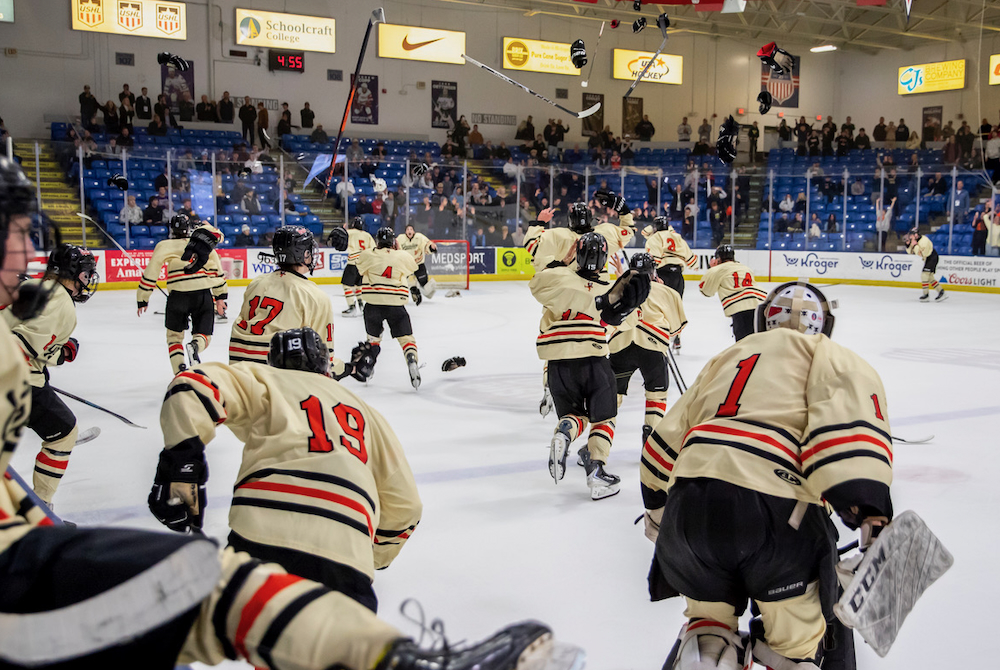
Indeed, as the Gremlins can finally once again call themselves Finals champions following a 5-2 triumph over Orchard Lake St. Mary’s in Saturday’s Division 3 championship game at USA Hockey Arena.
It’s difficult to fathom that one of the state’s premier programs had gone 44 years without a title, with its last championship the Class B-C-D crown in 1982.
Getting to the Final in recent years certainly wasn’t a problem for Houghton (25-6-1), as it was a runner-up in 2012, 2015 and 2019.
There just always was a downstate powerhouse it couldn’t overcome. But that wasn’t the case this time, thanks in large part to senior forward Jack Sayen.
Entering the game with 15 goals on the season, Sayen accounted for more than 25 percent of that total in the championship game, scoring four times for the Gremlins.
“I guess I was kind of in the right spot at the right time for some of them,” Sayen said. “I don’t care that I scored. I’m just happy our team won.”
Stipech said it was a slow start to the season, with his team breaking in a huge influx of underclassmen and losing six out of its first 10 games.
 “We were supposed to be down,” Stipech said. “We had 10 underclassmen. It wasn’t going to be our year. We only won four out of our first 10. We’re on a three-game skid and this group right here are like ‘We got this. We just need some time, and we’re going to be all right. They still believed.”
That self-belief really came to the forefront after St. Mary’s took a 2-1 lead with 14:27 remaining on a goal by senior Dominic Pizzo, who fired a shot from between the face-off circles into the net.
Houghton got only stronger at that point, blitzing St. Mary’s with a four-goal surge over the next 10:54.
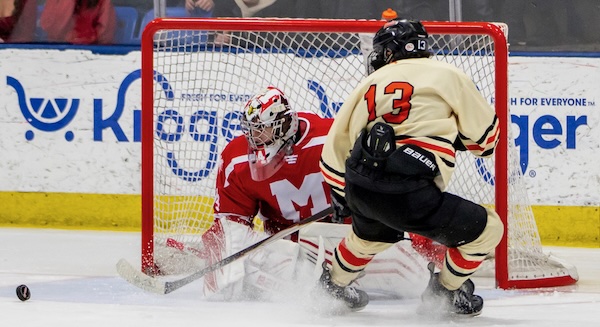
Sayen started the rally, tying the game at 2-2 when he stationed himself in front of the St. Mary’s goal, took a pass sent behind the net from senior Noah Maillette and buried the chance under the crossbar.
Sayen then gave Houghton a 3-2 lead with 11:16 remaining, charging the net and jamming the puck past the pads of the St. Mary’s goalie.
Just 1:23 later, Houghton took a 4-2 lead when senior Connor Arko took a neat pass from Maillette, skated in on the St. Mary’s goal and lifted a backhand below the cross bar.
Houghton kept the pressure on and added to its lead, going up 5-2 with 3:33 remaining when Sayen pounced on a rebound and fired the puck in.
From there, the final minutes were a happy skate for Houghton.
St. Mary’s was attempting to repeat as champion, but had to settle for a runner-up finish and a 25-5 record to close the season.
“We just got a little lax down low in front of our net,” St. Mary’s head coach Brian Klanow said. “They took advantage of some not-so-good positioning and they were able to get some shots off the line.”
Houghton opened the scoring on a power play with 12:53 remaining in the first period when Sayen charged toward a loose puck in front of the St. Mary’s goal and buried the chance underneath the crossbar to make it 1-0 Gremlins.
St. Mary’s tied the game with 1:59 remaining in the second period on a goal by junior Thaddeus Raynish, who found a loose puck to the left of the Houghton goal and placed a shot into a half-open net to make it 1-1.
PHOTOS (Top) Houghton players celebrate at the end of the Division 3 Final at USA Hockey Arena. (Middle) The Gremlins’ Noah Maillette (13) moves toward a loose puck in front of the St. Mary’s net and goalie Thomas Reeber. (Photos by Adam Sheehan/Hockey Weekly Action Photos.)