


Classes Still Create Hoosier Hysteria
July 27, 2017
By Rob Kaminski
MHSAA benchmarks editor
This is the fourth part in a series on MHSAA tournament classification, past and present, that will be published over the next two weeks. This series originally ran in this spring's edition of MHSAA benchmarks.
Twenty years ago, Bloomington North High School won the Indiana High School Athletic Association boys basketball championship, defeating Delta 75-54 at the RCA Dome in Indianapolis.
The date, March 22, 1997, is at the same time revered and disdained by traditionalists in the state who saw it as the last schoolboy championship game the state would ever host.
That’s how devout the game of basketball, particularly interscholastic basketball, had become in the Hoosier state during the 87 years a state champion – one state champion, to be precise – was crowned.
Following that 1997 season, the IHSAA moved to a four-class system for its roundball tournaments, like so many of its state association counterparts had done years earlier.
It would be shocking to find more than a small percentage of current high school basketball players around the country unfamiliar with the iconic movie Hoosiers, even though the film is now more than 30 years old.
And, the storyline for that blockbuster unfolded more than 30 years prior to its release, when small-town, undermanned Milan High School defeated Muncie Central High School 32-30 in the 1954 IHSAA title game.
Perhaps it’s because of the David vs Goliath notion, or the fame of the movie that replaced Milan with the fictional Hickory and real-life star Bobby Plump with Hollywood hero Jimmy Chitwood, or the simple fact that Indiana had something other states didn’t.
Whatever the reason, plenty of opposition remains to this day to basketball classification in the state.
The fact is, the small rural schools were regularly being beaten handily by the much larger suburban and city schools as the tournament progressed each season.
Small schools also were closing at a rapid rate following the state’s School Reorganization Act in 1959, as students converged on larger, centralized county schools. From 1960 to 2000, the number of schools entering the tournament dropped from 694 to 381, and in 1997 a total of 382 schools and 4,584 athletes began competition at the Sectional level (the first level of the IHSAA Basketball Tournament).
It was at the entry level of the tournament where school administrators felt the pain of the new class system, but not necessarily for the same nostalgic reasons as the fans who either attended or boycotted the tournament.
At the Sectional round of the tournament, the IHSAA was culling just 2 percent of the revenue, with the participating schools splitting the balance. So, when Sectional attendance dropped by 14 percent in that first year of class basketball, many schools realized a financial loss. It was money they had grown to count on in prior years to help fund various aspects of the department.
Schools cumulatively received more than $900,000 from Sectional competition in 1998, but that total was down from more than $1 million in the last year of the single-class tournament.
Yet, the current format provides a great deal more opportunity and realistic chances at championship runs for schools of all enrollments.
To date, 60 additional teams have championship or runner-up trophies on display in school trophy cases around Indiana.
That was the mission in front of then-IHSAA commissioner Bob Gardner (now National Federation executive director) once the board made its decision: to give thousands more student-athletes the opportunity for once-in-a-lifetime experiences.
As any statistician knows, figures can be manipulated to tell any side of a story. Declining attendance in year one of class basketball is such a number.
The truth is tournament attendance had been on a steady downward spiral since its peak of just over 1.5 million in 1962. By the last single-class event in 1997, the total attendance was half that.
The challenge then and today, as it is for all state associations, is to find that delicate balance for those holding onto tradition, those holding onto trophies, and the number of trophies to hand out.
Editor’s Note: Stories from the Fort Wayne Journal Gazette in 1998 and from a 2007 issue of Indianapolis Monthly provided facts in this article.
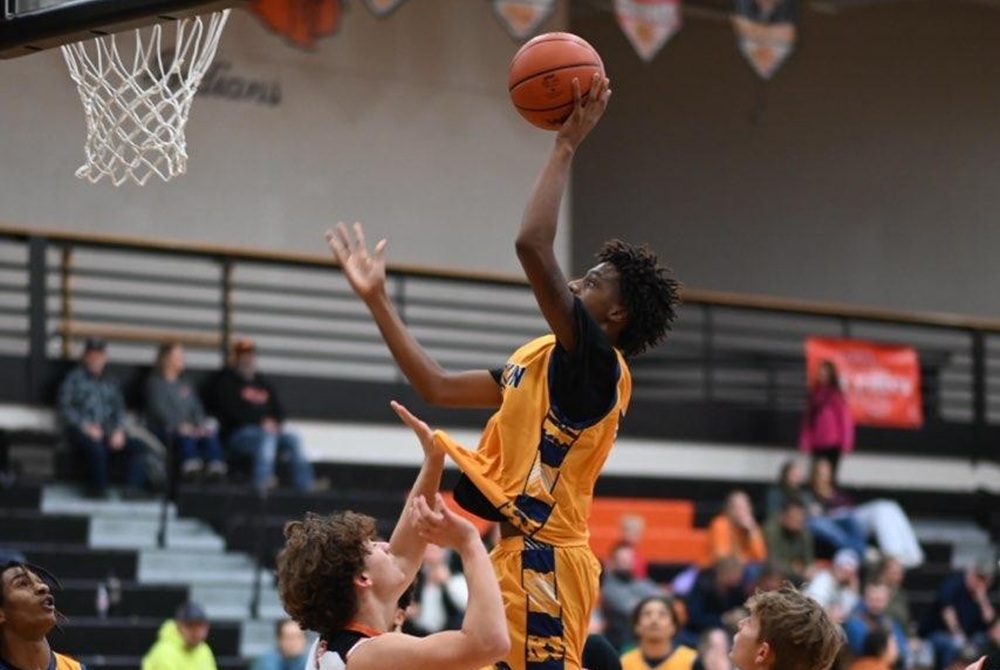
Baldwin's Back in Title Mix with High-Scoring Pair, Guided by Past Star Home Again
By
Tom Kendra
Special for MHSAA.com
January 14, 2026
BALDWIN – Baldwin’s basketball team is off to its best start in years, thanks to a 1-2 backcourt punch that most teams can’t handle.
 Senior Chase Dockery and junior Pierre “Pip” Johnson are lighting up the scoreboard for the Panthers, who are off to a 9-1 start at the regular-season halfway point and heading into Friday’s West Michigan D League showdown at Bear Lake.
“We realized this summer how special we could be,” said Dockery, a 6-foot-4 guard/forward who is averaging 19 points and 11 rebounds per game.
“Our secret is the way that we communicate and move the ball. We know that we can make a run this year.”
Baldwin, a small village in Lake County located on M-37, roughly between Grand Rapids and Traverse City, is known as a camping, fishing and hunting paradise for three seasons – with basketball taking center stage in the winter.
The community’s obsession with hoops is apparent when you check out the banners in Baldwin’s classic, old-school gym. One small section contains football, baseball and track banners, while the entire opposite wall is covered with boys basketball banners, highlighted by the Panthers’ Class D runner-up finish in 1959.
“Basketball is everything here; it’s all that we’ve got,” explained Johnson, the team’s leading scorer at 20 points per game.
Orchestrating the basketball resurgence is second-year coach Brandon Childress, one of the top athletes to ever come out of Baldwin and a first-team Class D all-state selection in both football and basketball during his senior year of 2014-2015. He also was named the state’s Division 4 Player of the Year in basketball as a senior.
Childress went on to play football, first at Central Michigan and later at Ferris State, then decided to return to his hometown to coach and also to work as Baldwin’s full-time college access and Promise Zone coordinator – helping kids prepare to go on to college and beyond.
“I come to school in the morning, and I’m a mentor and a coach to all of these kids all day long,” said Childress, 28, who also coaches baseball and football, the latter as an assistant to his younger brother, Braeden, the Panthers’ head varsity coach.
The old gym was rocking last Friday night, when Mesick rolled into town for a conference showdown.
Johnson, a lightning-quick, 6-0 point guard, was unstoppable driving to the basket, finishing with a game-high 28 points in the Panthers’ 61-50 win.
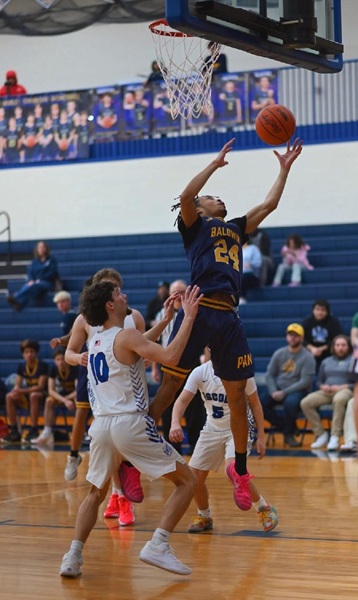 “My role is to be aggressive and to be able to go get a basket when we really need one,” said Johnson, who also averages six rebounds, three assists and three steals per game.
When Johnson does miss a shot, or is forced to give it up, Dockery is often there for a bucket.
The lanky lefty, who is equally comfortable shooting from behind the arc or battling inside, is a four-year varsity starter who leads the team in rebounding and also averages 2.7 steals and two assists per game. He was a key part of the Panthers’ conference and District championships as a freshman.
Baldwin finished 13-11 last year in its first under Childress, who took over from JJ Eads, who coached for five years and remains the school’s athletic director.
The Panthers returned all but one player from last year’s team, led by Johnson, a first-team all-conference choice, and Dockery, who was second-team all-league.
Childress said his team has already seen a variety of gimmick defenses designed to stop the Johnson and Dockery duo (with more to come), and he knows the key to his team making a postseason run will be the play of the supporting cast.
“With Pierre and Chance driving the basketball and drawing a lot of attention, our other guys will get open looks and we need them to knock those down,” said Childress, who made the Mid-American Conference all-academic team at CMU in 2016.
Junior Kyrce Cook (nine points) and sophomore Desafiar Lyons (eight points) both stepped up and took advantage of their opportunities against Mesick. Another key player is 6-4 senior Marcus Martin, who is returning from an injury and just getting back up to speed.
Baldwin’s only loss came against Blanchard Montabella (65-57) in the opening game of the Morley Stanwood Holiday Tournament on Jan. 2. The Panthers missed a staggering 13 free throws in the fourth quarter, but it was the team’s reaction to the loss which made an impression on their young coach.
“When we got back to Baldwin, they begged me to open the gym so that they could shoot free throws,” said Childress. “They shot free throws for two hours, then we went back the next day and played a much better game.”
Dockery and Johnson were the ringleaders of the night free-throw shooting session, and Childress said it’s their leadership and character which could push this team to the next level.
“Chance and Pip are both great individuals, nice kids and very good in the classroom,” said Childress. “They make my job a lot easier, because they hold everybody to a high standard.”
 Tom Kendra worked 23 years at The Muskegon Chronicle, including five as assistant sports editor and the final six as sports editor through 2011. E-mail him at [email protected] with story ideas for Muskegon, Oceana, Mason, Lake, Oceola, Mecosta and Newaygo counties.
PHOTOS (Top) Baldwin’s Chance Dockery elevates to put up a shot against White Cloud during a 63-41 win Dec. 2. (Middle) Pierre Johnson grabs a rebound against Oscoda during a 52-41 victory on Jan. 3. (Photos courtesy of the Baldwin boys basketball program.)