


Classes Still Create Hoosier Hysteria
July 27, 2017
By Rob Kaminski
MHSAA benchmarks editor
This is the fourth part in a series on MHSAA tournament classification, past and present, that will be published over the next two weeks. This series originally ran in this spring's edition of MHSAA benchmarks.
Twenty years ago, Bloomington North High School won the Indiana High School Athletic Association boys basketball championship, defeating Delta 75-54 at the RCA Dome in Indianapolis.
The date, March 22, 1997, is at the same time revered and disdained by traditionalists in the state who saw it as the last schoolboy championship game the state would ever host.
That’s how devout the game of basketball, particularly interscholastic basketball, had become in the Hoosier state during the 87 years a state champion – one state champion, to be precise – was crowned.
Following that 1997 season, the IHSAA moved to a four-class system for its roundball tournaments, like so many of its state association counterparts had done years earlier.
It would be shocking to find more than a small percentage of current high school basketball players around the country unfamiliar with the iconic movie Hoosiers, even though the film is now more than 30 years old.
And, the storyline for that blockbuster unfolded more than 30 years prior to its release, when small-town, undermanned Milan High School defeated Muncie Central High School 32-30 in the 1954 IHSAA title game.
Perhaps it’s because of the David vs Goliath notion, or the fame of the movie that replaced Milan with the fictional Hickory and real-life star Bobby Plump with Hollywood hero Jimmy Chitwood, or the simple fact that Indiana had something other states didn’t.
Whatever the reason, plenty of opposition remains to this day to basketball classification in the state.
The fact is, the small rural schools were regularly being beaten handily by the much larger suburban and city schools as the tournament progressed each season.
Small schools also were closing at a rapid rate following the state’s School Reorganization Act in 1959, as students converged on larger, centralized county schools. From 1960 to 2000, the number of schools entering the tournament dropped from 694 to 381, and in 1997 a total of 382 schools and 4,584 athletes began competition at the Sectional level (the first level of the IHSAA Basketball Tournament).
It was at the entry level of the tournament where school administrators felt the pain of the new class system, but not necessarily for the same nostalgic reasons as the fans who either attended or boycotted the tournament.
At the Sectional round of the tournament, the IHSAA was culling just 2 percent of the revenue, with the participating schools splitting the balance. So, when Sectional attendance dropped by 14 percent in that first year of class basketball, many schools realized a financial loss. It was money they had grown to count on in prior years to help fund various aspects of the department.
Schools cumulatively received more than $900,000 from Sectional competition in 1998, but that total was down from more than $1 million in the last year of the single-class tournament.
Yet, the current format provides a great deal more opportunity and realistic chances at championship runs for schools of all enrollments.
To date, 60 additional teams have championship or runner-up trophies on display in school trophy cases around Indiana.
That was the mission in front of then-IHSAA commissioner Bob Gardner (now National Federation executive director) once the board made its decision: to give thousands more student-athletes the opportunity for once-in-a-lifetime experiences.
As any statistician knows, figures can be manipulated to tell any side of a story. Declining attendance in year one of class basketball is such a number.
The truth is tournament attendance had been on a steady downward spiral since its peak of just over 1.5 million in 1962. By the last single-class event in 1997, the total attendance was half that.
The challenge then and today, as it is for all state associations, is to find that delicate balance for those holding onto tradition, those holding onto trophies, and the number of trophies to hand out.
Editor’s Note: Stories from the Fort Wayne Journal Gazette in 1998 and from a 2007 issue of Indianapolis Monthly provided facts in this article.
Niles' Arnold Remembered as Teacher & Leader, 'Doing Exactly What He was Meant To Do'
By
Scott Hassinger
Special for MHSAA.com
January 13, 2026
NILES – Throughout his 22-year career coaching varsity girls basketball at Niles High School, Jim Arnold required one thing from his players.
 Just have fun.
"Jim always stressed to his players that the one thing he wanted them to do when on the floor was to just have fun playing the game," said George Brawley, who served 15 seasons as one of Arnold's assistant coaches at various levels.
Arnold, 81, died Dec. 9 following an extended illness.
But throughout his career, Arnold's teams did much more than just enjoy themselves. The Benton Harbor native built a highly-successful program at Niles, where he achieved an overall win-loss record of 360-139 from 1986-2008, with 19 winning seasons. Under Arnold's watch, the Vikings captured seven conference titles, 10 District championships – including nine straight from 1997-2005 – and five Regional crowns.
Among Arnold's other accomplishments were being named Class B Coach of The Year by The Associated Press in 1998 and receiving honorable mention in 1997, along with selection by the Basketball Coaches Association of Michigan as Region 5 Coach of the Year in 2002 and 2004. He was also named conference Coach of the Year seven times and received the Herb Quade Memorial Sportsmanship Award for the 2002-2003 season.
Arnold also coached Niles to back-to-back District championships in softball in 1993 and 1994.
As young athlete himself, Arnold excelled on the baseball diamond. A successful player while at Benton Harbor, he also played on Twin City American Legion teams and was known as a team captain and a coach on the field. Arnold later had an invitation to try out at the professional level with the Baltimore Orioles, but an injury ended his pursuit of that dream.
Arnold later played third base for Bargain Center, a slow-pitch softball team that won a regional championship and went on to play in the national title game in St. Louis, Mo.
 His daughters Sonya and Allison were among the athletes that Arnold mentored during his coaching career. Sonya (Martinez), his oldest daughter, played for her father in eighth grade.
"He made the game fun, and you wanted to do your best because you didn't want to disappoint him. He poured his heart into each and every practice and game because preparation mattered to him. He demanded excellence, and every player became better because of his coaching ability," said Martinez, a 1986 Niles graduate.
Allison (Clay) his youngest daughter, played on the 1990 Niles varsity squad that finished 25-1, winning conference, District and Regional titles. She is a 1991 graduate.
"It was awesome playing for my dad. Some of my best memories in my life were during that time,” Clay said. “He had high standards and inspired others to be the best version of themselves. He put his heart and soul into what he did, and I had a front-row seat to that."
Linda Arnold has fond memories as a coach's wife.
"I loved watching my husband coach because of the joy it brought him. His passion, intensity and the love he had for his players was genuine,” she said. “It was more than a game. It was more about developing players in the area of discipline, teamwork and giving your all. Even in the busiest part of the season, he always made me feel like a priority. I didn't just watch a coach. I watched a man doing exactly what he was meant to do.
"My husband coached with passion, but he loved his family with intention. My girls would go to his practices and we all attended his games, and we had the team over for team dinners. His players were a part of our extended family. He made sure we felt a part. He was the best coach in the world, and he was mine."
Jim Arnold was highly respected by his coaching peers. He was kind and treated everyone with dignity. The community of Niles knew what he stood for and they knew his standards were high. He was admired for his preparation and understanding of the game as well as his commitment to doing things the right way. He was strict but fair and treated everyone the same, whether you were the star player or last one off the bench, Martinez explained.
"Developing his players' character was far more important to him than winning," she said. "Dad lived what he taught. He modeled humility, hard work and lived a life of integrity. He made people better by being a part of their lives."
When Jim Arnold first began his junior high teaching career in Niles, he also coached the boys junior high basketball team. There were no girls basketball teams at the time, so a girl tried out for the boys team. She was good enough to make the team, so Arnold kept her. The following school year, the principal asked Arnold to organize a girls team – and the rest was history.
Former Niles varsity girls basketball coach Jessica Johnson, a teammate of Clay’s, recalls the experience of playing for Coach Arnold.
 "Coach Arnold taught us discipline, resilience and always required 110 percent effort from you. He would instill confidence in you while still holding you accountable," said Johnson, now an assistant women’s basketball coach at Southwestern Michigan College.
Johnson recalls Arnold's use of comic strips as a teaching tool to help his players improve upon their mistakes.
"If you had a game where you didn't shoot very well or took questionable shots, he would place pictures of bricks in the gym the day following the game," Johnson said.
"Coach Arnold went out of his way to build that relationship and trust with his players. He gave us lessons that extended way beyond the court that made us better people."
Mark Haase, a Niles alumnus and the current Vikings head varsity boys basketball coach, also had the privilege of playing for Arnold.
"I played freshman basketball for Coach Arnold. It was one of the most disciplined and well-conditioned teams I ever played on. He ran a tight ship, but it was done out of love and concern for his players. He has a great family and is a Niles legend," Haase said.
Niles athletic director Matt Brawley referred to Arnold as an amazing teacher, coach and individual in the school and community.
"Coach Arnold would never ask you to do anything he wouldn't do. He was very structured and expected a lot out of his players, and he got results without excuses,” Brawley said. “He was a true leader of Niles athletics. He was an unbelievably kind and humble individual.”
 Scott Hassinger is a contributing sportswriter for Leader Publications and previously served as the sports editor for the Three Rivers Commercial-News from 1994-2022. He can be reached at [email protected] with story ideas for Berrien, Cass, St. Joseph and Branch counties.
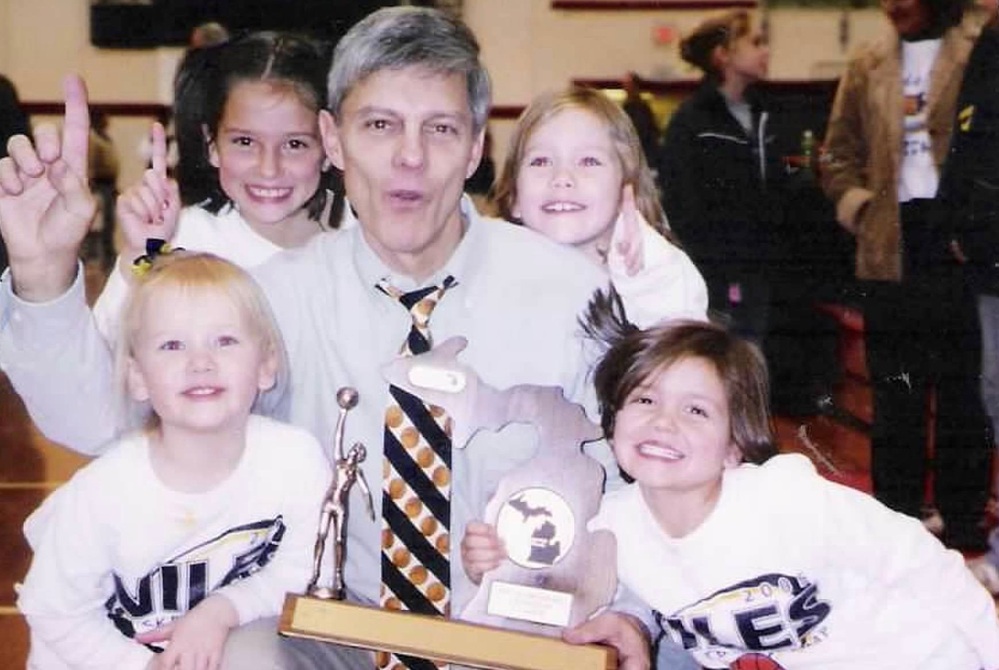
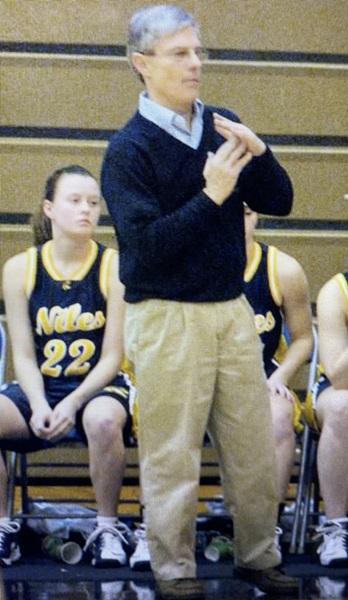
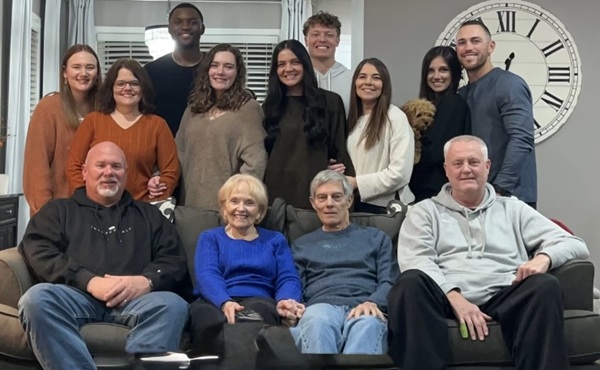
PHOTOS (Top) Jim Arnold poses for a photo with his granddaughters following a Niles girls basketball game. (Middle) Arnold signals for a timeout. (Below) Linda and Jim Arnold, seated (middle) take a photo with their daughters and their families. (Photos courtesy of the Niles athletic department and Arnold family.)