


Classes Still Create Hoosier Hysteria
July 27, 2017
By Rob Kaminski
MHSAA benchmarks editor
This is the fourth part in a series on MHSAA tournament classification, past and present, that will be published over the next two weeks. This series originally ran in this spring's edition of MHSAA benchmarks.
Twenty years ago, Bloomington North High School won the Indiana High School Athletic Association boys basketball championship, defeating Delta 75-54 at the RCA Dome in Indianapolis.
The date, March 22, 1997, is at the same time revered and disdained by traditionalists in the state who saw it as the last schoolboy championship game the state would ever host.
That’s how devout the game of basketball, particularly interscholastic basketball, had become in the Hoosier state during the 87 years a state champion – one state champion, to be precise – was crowned.
Following that 1997 season, the IHSAA moved to a four-class system for its roundball tournaments, like so many of its state association counterparts had done years earlier.
It would be shocking to find more than a small percentage of current high school basketball players around the country unfamiliar with the iconic movie Hoosiers, even though the film is now more than 30 years old.
And, the storyline for that blockbuster unfolded more than 30 years prior to its release, when small-town, undermanned Milan High School defeated Muncie Central High School 32-30 in the 1954 IHSAA title game.
Perhaps it’s because of the David vs Goliath notion, or the fame of the movie that replaced Milan with the fictional Hickory and real-life star Bobby Plump with Hollywood hero Jimmy Chitwood, or the simple fact that Indiana had something other states didn’t.
Whatever the reason, plenty of opposition remains to this day to basketball classification in the state.
The fact is, the small rural schools were regularly being beaten handily by the much larger suburban and city schools as the tournament progressed each season.
Small schools also were closing at a rapid rate following the state’s School Reorganization Act in 1959, as students converged on larger, centralized county schools. From 1960 to 2000, the number of schools entering the tournament dropped from 694 to 381, and in 1997 a total of 382 schools and 4,584 athletes began competition at the Sectional level (the first level of the IHSAA Basketball Tournament).
It was at the entry level of the tournament where school administrators felt the pain of the new class system, but not necessarily for the same nostalgic reasons as the fans who either attended or boycotted the tournament.
At the Sectional round of the tournament, the IHSAA was culling just 2 percent of the revenue, with the participating schools splitting the balance. So, when Sectional attendance dropped by 14 percent in that first year of class basketball, many schools realized a financial loss. It was money they had grown to count on in prior years to help fund various aspects of the department.
Schools cumulatively received more than $900,000 from Sectional competition in 1998, but that total was down from more than $1 million in the last year of the single-class tournament.
Yet, the current format provides a great deal more opportunity and realistic chances at championship runs for schools of all enrollments.
To date, 60 additional teams have championship or runner-up trophies on display in school trophy cases around Indiana.
That was the mission in front of then-IHSAA commissioner Bob Gardner (now National Federation executive director) once the board made its decision: to give thousands more student-athletes the opportunity for once-in-a-lifetime experiences.
As any statistician knows, figures can be manipulated to tell any side of a story. Declining attendance in year one of class basketball is such a number.
The truth is tournament attendance had been on a steady downward spiral since its peak of just over 1.5 million in 1962. By the last single-class event in 1997, the total attendance was half that.
The challenge then and today, as it is for all state associations, is to find that delicate balance for those holding onto tradition, those holding onto trophies, and the number of trophies to hand out.
Editor’s Note: Stories from the Fort Wayne Journal Gazette in 1998 and from a 2007 issue of Indianapolis Monthly provided facts in this article.
Hoopfest Returns to Jenison Field House
March 19, 2018
Second Half editor
March Magic Hoopfest will return to Jenison Field House for this weekend’s MHSAA Boys Basketball Finals, with extended hours and a Project UNIFY tournament highlighting the ninth championship weekend the event has run concurrent with the games being played at Michigan State University’s Breslin Center.
Up to 10 Special Olympics Project UNIFY teams will take part in a tournament played during the afternoons of March 22 and 23. Unified teams put special education students on the court participating in concert with their general education peers. Lineups must consist of three unified student athletes and two unified student partners on the floor at all times.
Games will be played on the two Hoopfest center courts. On March 24, the center courts will host a number of “JumpBall Jamboree” games made up of teams of boys and girls in grades 3-8.
A number of other favorite attractions will return including slam dunk (on lowered rims), 3-point shootout and half-court shot areas where fans can visit at any time and participate, and the festivities also will include a court for timed “Around the World” shooting games and another court featuring a skills challenge. Also returning is the Walk of History, showcasing championship games, life-size photos and display boards from throughout the MHSAA Finals’ near century-long run.
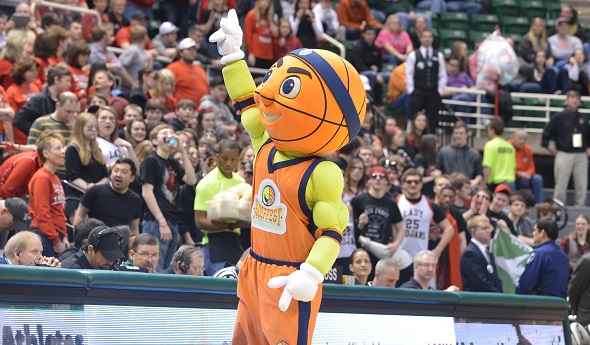
Hoopfest again also will be home to Hoopie, the event’s mascot who made his first public appearances during the 2014 MHSAA Finals.
Admission to the March Magic Hoopfest is $2 per person, and fans attending the MHSAA Boys Basketball Semifinals and Finals will be admitted free with their game tickets. Hours on March 22 and 23 will be 1 p.m. to 7 p.m.; the event is open from 10 a.m. to 6 p.m. on March 24. Jenison Field House, site of Hoopfest, also was the site of the MHSAA Boys Basketball Finals for 31 years. To find out general information about the event, visit the March Magic Hoopfest website.
The March Magic Hoopfest is conducted in partnership between the Greater Lansing Sports Authority (GLSA), a division of the Greater Lansing Convention and Visitors Bureau, and the MHSAA, with vital support coming from the Department of Intercollegiate Athletics at Michigan State University.
“Hoopfest is not just for kids, but the kid in all of us,” MHSAA Director of Brand Management Andy Frushour said. “The adults who stop in seem to love it as much as their children. There are basketball hoops everywhere, and with all of the different games to try it’s like being back on the playground.”
The Greater Lansing Sports Authority’s mission is to be the leading voice of sports tourism in the Greater Lansing area and to promote economic growth by attracting a diverse range of sporting events to the region. The GLSA strives to enhance the quality of life for area residents through the development of local sports and fitness programs for all ages, and supports the continued development and maintenance of safe, high-quality athletic facilities.
“Hoopfest has become the must-attend event for spectators of the MHSAA Tournament,” said Meghan Ziehmer, Associate Director of the Greater Lansing Sports Authority. “With games geared for all ages and abilities, the young and young-at-heart can play before, between and after sessions. With activities like the skills challenge, 3-point shooting contest and lowered rims to show off your athletic prowess, there is no shortage of fun activities.”