


Classes Still Create Hoosier Hysteria
July 27, 2017
By Rob Kaminski
MHSAA benchmarks editor
This is the fourth part in a series on MHSAA tournament classification, past and present, that will be published over the next two weeks. This series originally ran in this spring's edition of MHSAA benchmarks.
Twenty years ago, Bloomington North High School won the Indiana High School Athletic Association boys basketball championship, defeating Delta 75-54 at the RCA Dome in Indianapolis.
The date, March 22, 1997, is at the same time revered and disdained by traditionalists in the state who saw it as the last schoolboy championship game the state would ever host.
That’s how devout the game of basketball, particularly interscholastic basketball, had become in the Hoosier state during the 87 years a state champion – one state champion, to be precise – was crowned.
Following that 1997 season, the IHSAA moved to a four-class system for its roundball tournaments, like so many of its state association counterparts had done years earlier.
It would be shocking to find more than a small percentage of current high school basketball players around the country unfamiliar with the iconic movie Hoosiers, even though the film is now more than 30 years old.
And, the storyline for that blockbuster unfolded more than 30 years prior to its release, when small-town, undermanned Milan High School defeated Muncie Central High School 32-30 in the 1954 IHSAA title game.
Perhaps it’s because of the David vs Goliath notion, or the fame of the movie that replaced Milan with the fictional Hickory and real-life star Bobby Plump with Hollywood hero Jimmy Chitwood, or the simple fact that Indiana had something other states didn’t.
Whatever the reason, plenty of opposition remains to this day to basketball classification in the state.
The fact is, the small rural schools were regularly being beaten handily by the much larger suburban and city schools as the tournament progressed each season.
Small schools also were closing at a rapid rate following the state’s School Reorganization Act in 1959, as students converged on larger, centralized county schools. From 1960 to 2000, the number of schools entering the tournament dropped from 694 to 381, and in 1997 a total of 382 schools and 4,584 athletes began competition at the Sectional level (the first level of the IHSAA Basketball Tournament).
It was at the entry level of the tournament where school administrators felt the pain of the new class system, but not necessarily for the same nostalgic reasons as the fans who either attended or boycotted the tournament.
At the Sectional round of the tournament, the IHSAA was culling just 2 percent of the revenue, with the participating schools splitting the balance. So, when Sectional attendance dropped by 14 percent in that first year of class basketball, many schools realized a financial loss. It was money they had grown to count on in prior years to help fund various aspects of the department.
Schools cumulatively received more than $900,000 from Sectional competition in 1998, but that total was down from more than $1 million in the last year of the single-class tournament.
Yet, the current format provides a great deal more opportunity and realistic chances at championship runs for schools of all enrollments.
To date, 60 additional teams have championship or runner-up trophies on display in school trophy cases around Indiana.
That was the mission in front of then-IHSAA commissioner Bob Gardner (now National Federation executive director) once the board made its decision: to give thousands more student-athletes the opportunity for once-in-a-lifetime experiences.
As any statistician knows, figures can be manipulated to tell any side of a story. Declining attendance in year one of class basketball is such a number.
The truth is tournament attendance had been on a steady downward spiral since its peak of just over 1.5 million in 1962. By the last single-class event in 1997, the total attendance was half that.
The challenge then and today, as it is for all state associations, is to find that delicate balance for those holding onto tradition, those holding onto trophies, and the number of trophies to hand out.
Editor’s Note: Stories from the Fort Wayne Journal Gazette in 1998 and from a 2007 issue of Indianapolis Monthly provided facts in this article.
Esler Pilots DeLaSalle Back to Final Week
By
Tom Markowski
Special for Second Half
March 19, 2018
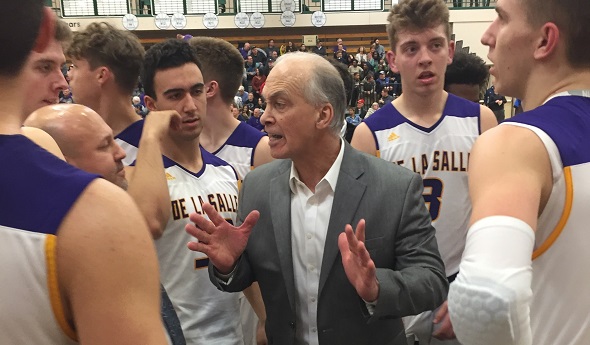
WARREN – There isn’t much that Greg Esler hasn’t seen or experienced as a coach and as a father.
 Through it all he’s learned to take nothing for granted, in life and as a coach.
Esler, 63, coached St. Clair Shores Lake Shore to its first and only MHSAA boys basketball title in 1994, in Class B. That team was led by Travis Conlan, who finished second in the voting for Mr. Basketball that season. Conlan would go on to play at University of Michigan, one of a number of Esler-coached players who went on to the college – and for some – professional ranks.
Esler is in his 31st season as a head coach, with the last 24 at Warren DeLaSalle. Twenty-one times the Pilots have won a District title with Esler on the bench. In 2007, DeLaSalle reached a Class A Semifinal for just the second time in school history, as it lost to Manny Harris and Detroit Redford 56-50. (Note: In addition to two Class A Semifinal appearances, DeLaSalle also reached a Class B Final in 1982).
Consistency has been a hallmark of Esler’s programs, and even after all these years a fire burns in his stomach. He’s retained a burning desire to compete and to win. As the years have piled up, Esler has become more appreciative of the success his program has achieved and the experiences gained.
So when DeLaSalle defeated Macomb Dakota, 56-51, in a Regional Final last Wednesday, there was reason to celebrate. As good as DeLaSalle has been recently, it hadn’t won a Regional title since 2010. The Pilots have been to the Detroit Catholic League final each of the last three seasons and have won five District titles since 2010 including the last three. But the end of last season stung more than most. DeLaSalle reached a Regional Final and then lost to Troy, 48-40, in an ugly game where the Pilots shot less than 30 percent from the field.
Most of that team is back as the Pilots head into the final week of this season. Esler has nine seniors including two of the top players in the league in point guard Justin Fischer and guard-forward Luke Pfromm, the starting quarterback on the Division 2 championship football team.
Esler started coaching at Warren St. Anne grade school in 1983, then went to DeLaSalle for three seasons beginning in 1985 under then-coach Gary Buslepp. Esler got his shot as a head coach in 1987 at Lake Shore and quickly made that program relevant. Lake Shore reached the Class B Semifinals in 1993 before losing to coach Norwaine Reed and Saginaw Buena Vista.
Esler took over the DeLaSalle program at the start of the 1994-95 season. His career record stands at 530-216 heading into tonight’s Class A Quarterfinal against Detroit U-D Jesuit.
“We instilled a system here,” he said. “The first thing is to have your players in condition. Second is defense. I’ve always stressed defense. And third, and maybe this should be first, is talent. We’ve always had really good players here. And the players we’ve had want to get better.”
What often goes unnoticed in a basketball program is the work of the assistant coaches. Esler has been blessed with loyal and knowledgeable assistants. His top assistant is Tom Mehl, who played for Esler for two seasons at Lake Shore. Mehl was on staff for Esler’s last four seasons at Lake Shore and has been with Esler every step of the way at DeLaSalle.
Jeff Becker is in his 13th season as an assistant, and another, Dave Grauzer, recently left the program and now is an assistant at Traverse City West.
 “Surrounding yourself with good people is at the top of the list,” Esler said. “One thing about Tom, there’s no one I’ve seen who can go to a game to scout and pick up something no one else would see. Like a player who takes two dribbles before driving to his right or left. For Becker, it’s organization. He works well with the kids, and he’s got the post players. Mehl has the guards.
“Over the years I’ve listened. Listened to other coaches. I don’t have all the answers. I talk to Steve Hall at (Detroit) Cass Tech all the time. He’s been a great friend over the years.”
This team has a closeness not always seen. The fact that there are nine seniors is one reason. Esler points out that he’s been with this group for more than 100 days this season, and when you’re around a group that long tempers can flare – so it’s important to keep the present in perspective and realize they all want to reach the same goal.
“We do a lot of things outside of basketball,” Esler said. “Last week four of my captains read to the students at (St. Clair Shores) St. Germaine grade school. My wife, Renee, is a fourth and fifth grade teacher there, and it’s way for the players to interact with the younger students.
“I read an article recently on (Michigan) coach (John) Beilein and how the game has changed. The kids have changed. We watch game film but not like we used to. Their attention span isn’t like it used to be. The technology now, with Facebook and texting, it’s unbelievable. We might watch film for 20 minutes where we used to watch for hours.
“My players will tell you, I love the practices much more than they do. Games are like taking a test. If you didn’t win, maybe you failed at some area that cost you. They love each other and they do a good job of listening. All five starters have scored 20 points or more in a game this season. And they don’t get rattled. We were down four to Dakota with four minutes to go and Pfromm came to me in the huddle and said, ‘Don’t worry coach. We got this.’ I can see why they won a state title in football.”
Fischer has matured significantly as a leader and force offensively. A three-year starter, he has signed with Lake Superior State.
Fischer came into the program as a skinny 5-foot-10 freshman. By the time he was a junior, he had grown five inches. Now he’s 6-4 and weighs 185 pounds.
“I was a pass-first guard as a sophomore,” he said. “I’ve worked on my shooting, just working on my total game.
“We were pumped up for that Dakota game. We got the crowd going crazy. We were down and Luke hit a couple of 3s. I had a dunk and hit four free throws late.”
DeLaSalle (18-7) will play Catholic League Central rival Detroit U-D Jesuit (22-3) next. The Class A Quarterfinal will be played Tuesday at 5 p.m. at Calihan Hall, the site of the Catholic League final. Jesuit won that game, 71-64. In fact, Fischer has lost nine consecutive games to U-D as a varsity player.
He shouldn’t feel alone. DeLaSalle hasn’t defeated U-D since 2014 when the teams tied for the Catholic League Central regular-season title – a streak of 14 straight defeats to the Cubs. U-D won this season’s meetings 64-45, 59-57 and 64-55.
Esler keeps U-D recent domination of his program on the light side.
“I’ve said I’d have to coach until 2031 to get to .500 against them,” he said.
 Tom Markowski is a columnist and directs website coverage for the State Champs! Sports Network. He previously covered primarily high school sports for the The Detroit News from 1984-2014, focusing on the Detroit area and contributing to statewide coverage of football and basketball. Contact him at [email protected] with story ideas for Oakland, Macomb and Wayne counties.
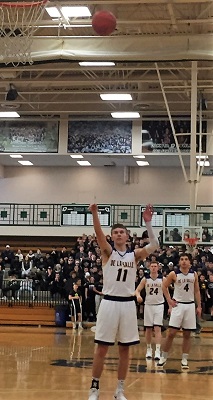
PHOTOS: (Top) Warren DeLaSalle coach Greg Esler talks things over during his team’s Regional Final win against Macomb Dakota. (Middle) Justin Fischer launches a free throw during the 56-51 victory.