

CAP Begins 2014-15 on Record Pace
By
Geoff Kimmerly
MHSAA.com senior editor
August 22, 2014
Gretchen Mohney has come to recognize coaches who think they already know it all.
Then she begins a Coaches Advancement Program lesson by describing an orange banging around inside a fishbowl – a metaphor to explain the brain inside an athlete’s skull when he or she suffers a concussion.
Her most powerful lessons have moved pupils to tears. And it’s always gratifying to witness the “Aha” moments that make the CAP educational experience so powerful.
“My favorite is when they admit that they’ve done something wrong, and they want to know how to do something better,” said Mohney, a highly-respected trainer and strength and conditioning coach who also serves as an instructor for the athletic training program at Western Michigan University. “It’s a pretty awesome moment when they realize there’s more to learn.”
More current and aspiring coaches than ever before are taking advantage of that opportunity as the 2014-15 school year kicks off.
Since this training year began July 25 at Battle Creek Lakeview, 273 current or aspiring coaches have completed CAP sessions – nearly twice as many coaches as this point a year ago and with the last session of August planned for Saturday at New Buffalo. That makes this the busiest start in CAP history, according to MHSAA assistant director Kathy Vruggink Westdorp, who joined the MHSAA staff in 2004, developed CAP for the 2004-05 school year and continues to oversee the program.
This first month’s total attendance also represents 33 percent of the 818 total CAP units completed at high schools and the MHSAA office during all of 2013-14.
“I think the big thing continues to be word of mouth that this is a quality program,” said Hamilton athletic director Jerry Haggerty, a CAP instructor for nine years. “It’s good for all coaches of all experience levels.”
Setting a standard
Since the program’s inception, nearly 6,300 coaches have completed at least the first-level unit. More than 1,000 have advanced through CAP 4.
The CAP program is broken into six levels, each addressing a set of topics:
- CAP 1: Coaches Make the Difference, The Coach as Teacher, Sports Medicine and First Aid.
- CAP 2: Effective Communication, Legal Responsibilities, Psychology of Coaching.
- CAP 3: Additional Coaching Responsibilities, Effectively Working with Parents, The Coach as Performer.
- CAP 4: Understanding Athletic Development, Strength and Conditioning, Preparing for Success.
- CAP 5: Healthy Living, Teaching Emotional Toughness, Resolving Conflicts in Athletics.
- CAP 6: Current Issues and Topics in Educational Athletics.
“Individuals who go through this have a better understanding of their philosophy, their school’s philosophy, their role and responsibility as well as the meaning behind MHSAA rules,” said Westdorp, a former principal, athletic director, teacher and coach in the Grand Rapids area who was named 2013 Coach Educator of the Year by the National Federation of State High School Associations (NFHS) for her work with the program.
She trains and evaluates all presenters and instructors, including those who last school year administered 1,238 CAP sessions at seven universities and colleges across both peninsulas.
The non-college CAP sessions are taught by 20 instructors who pride themselves on being available anywhere there’s interest. CAP has been presented at 10 Lower Peninsula schools over the last month, with Upper Peninsula sessions planned for this fall. August 9 was particularly busy – units were taught at Jonesville, Pontiac Notre Dame Prep and Riverview Gabriel Richard – but Westdorp sees the possibility of presenting at up to five sites on the same day.
Flexibility also is an option; a group of mostly non-school coaches took CAP 2 last week in Baldwin, and were able to complete the course over two days instead of one so they could do so without interrupting their fulltime jobs. For coaches working in schools, CAP units can qualify as continuing education credits with the State Department of Education.
Colleges and universities in Michigan are licensed to present up to five levels through their undergraduate or graduate studies, and the list of those who completed courses the last few years is filled with recognizable names of former high achievers on MHSAA courts and fields. Southwestern Michigan College in Dowagiac will offer courses for the first time this fall.
Certification in the program occurs after completion of CAP 1 and 2, and then after each subsequent unit, with those completing CAP 6 earning Masters Elite Certification.
The topics of CAP sessions “bleed” into each other, Mohney said, and come with plenty of first-person examples to make them relevant to coaches who then realize they aren’t alone facing issues most encounter.
“I talk to them because I’ve been there. … (I say,) ‘Now, let’s talk real.’ I place them in a real situation,” Mohney said. “’The biggest thing is you guys don’t have to know everything. You just need to coach, be aware of this, this and that. And these are some ideas to go about your plan so you can decrease your stress.’
“Any time a coach hears that, it’s a beautiful thing. Because I’m not sure what coach in high school is in coaching for the money.”
Raising the bar
Certainly, some of this month’s heightened CAP participation can be attributed to an MHSAA Representative Council action in March. Beginning Aug. 1, 2016, varsity head coaches hired for the first time at an MHSAA member school must have completed CAP 1 or CAP 2. Westdorp said some who wish to become head coaches in that near future are getting a jump by completing CAP courses now.
But that’s only a slice of the success story.
Haggerty has directed Hamilton’s athletic department for 15 years and said all of his coaches have taken either CAP 1 or 2. Many coaches take the courses on their own; others are required to do so by their athletic directors.
The Capital Area Activities Conference will offer CAP 1 three times this school year, with 100-150 coaches from their 20 member schools expected for each session. Others leagues and conferences are designing similar arrangements.
Michael Roy coached boys basketball at Lawton and girls hoops at Vicksburg and was certified under the predecessor to CAP – the MHSAA’s former Program for Athletic Coaches’ Education (PACE). He’s beginning his 13th year as Vicksburg’s athletic director, and after hosting several CAP classes over the years decided to begin the program himself this month.
“The need for knowledgeable and experienced coaches is greater than ever before. I thought if I was going to make it mandatory for my coaches to become CAP certified, that I needed to get CAP certified and lead by example,” Roy said. “The heart of any athletic team or program is its coaching staff. CAP is the surest way for coaches to access everything they need to know how to be a good coach. They learn the art of effective coaching through one of the best-designed coaches education programs in the country. CAP is second to none.”
Haggerty has spoken with athletic directors who have completed the program and then recognize when their coaches employ strategies learned at CAP sessions. An increasing pool of coaching candidates are heading into interviews with CAP certification in hand, and Westdorp has seen coaches bringing their CAP binders to practices to have those lessons available for quick reference. She’s also watched many CAP graduates using their skills at the highest level – the MHSAA Finals.
A comment by Duke men’s basketball coach Mike Krzyzewski sits at the front of those CAP binders: “A common mistake among those who work in sport is spending a disproportional amount of time on x’s and o’s as compared to time spent learning about people.”
Haggerty starts each session telling his pupils, “I do this for two reasons; one because I think it’s important to look at the non-x and o coaching realms; and two, because this is great fun for me.’”
And those coaches who come into CAP thinking they know enough? Mohney said most finish the first unit looking forward to beginning the next.
“CAP has a lot to do with understanding what you’re about, understanding your role and responsibility in athletics and your leadership role,” Westdorp said. “When I start programs, I talk about my work roles in life, and then (I tell coaches), ‘I want to tell you where I felt I was more influential, and that was as a coach.
“’And don’t ever forget it..’”
Click for more on the Coaches Advancement Program.
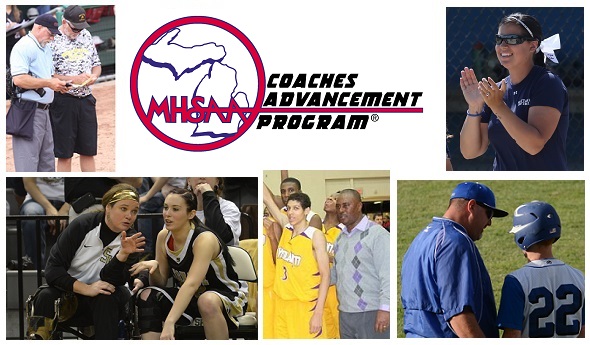
PHOTOS: These coaches, counter-clockwise from top left, all have completed at least one CAP unit: Bay City Western softball coach Rick Garlinghouse, St. Ignace girls basketball coach Dorene Ingalls, Ypsilanti Community boys basketball coach Steve Brooks, Beal City baseball coach Brad Antcliff and Mattawan softball coach Alicia Smith.
Next Play: Heart of the Matter
June 25, 2015
By Rob Kaminski
MHSAA benchmarks editor
From the retirement of NFL players in their mid-20s fearing long-term disability, to NASCAR drivers suffering injuries against concrete walls when alternative substances are available, to MLB outfielders running into barriers which place aesthetics and tradition over safety, the focus of highlight shows, apps and old-fashioned sports pages is shifting from action inside the lines to the sidelines.
As the reality of human vulnerability continues to invade our favorite escape from reality – athletics – protecting those in the spotlight needs to be Job 1.
While the quest for risk management protocols and health and safety provisions is a never-ending loop, the MHSAA bolted from the starting blocks with a 4H plan (Health Histories, Heads, Heat and Hearts) in the fall of 2009, a mission that enters the fourth turn for the 2015-16 school year.
And, as pulse quickens for the “Heart” stage in the fall, the MHSAA will continue to step up initiatives involving the other three initiatives during the next lap.Think of it as a continuous relay, where the baton is never dropped and fresh runners continue the race.
While organizations at other levels might be asking, “What to do,” the MHSAA is focusing on “What’s next?”
In this playbook the next plays are critical in allowing student-athletes to continue providing their communities with inexpensive and entertaining breaks from reality.
The Heart of the Matter
The 2015-16 school year brings with it an ambitious but paramount stage in the MHSAA’s mission to protect and promote the well being of student-athletes across the state.
Beginning in the fall, all high school varsity coaches will need to have Cardiopulmonary Resuscitation (CPR) certification by established deadlines which correspond to rules meetings.
The requirement is new, and the volume of personnel affected is vast. Yet, plans have been in place during the past few years, and schools in many communities are ahead of the curve.
“We’ve fielded some questions regarding the requirement, but I think that many of our schools already have similar protocols in place,” said MHSAA assistant director Kathy Vruggink Westdorp. “Increasingly, schools have become more prudent with regards to health and safety, and programs which emphasize these initiatives have been well received.”
Pete Ryan, MHSAA Representative Council member and athletic director for Saginaw Township Community Schools, concurs.
“The CPR requirement will not be a change for Heritage, as we have required CPR for eight years,” Ryan said. “We offer certification through our district nurse at no charge to the coaches and train about 20-30 coaches per year.”
The training vehicle might vary from district to district, but so long as the end result is certification, the coaches are free to take course by any means possible, whether online or in person.
“I think we’ll see a blend of online and classroom delivery,” Westdorp said. “And, I don’t think it will be just the coaches. At the MIAAA Conference (in March), school leaders were proactive in terms of certification for athletic directors, too.”
Mike Bakker, President of the Michigan Interscholastic Athletic Administrators Association and athletic director at Fenton High School, says CPR certification is a must in the risk management plans for all school settings.
“As an educator who has been a CPR and first aid instructor for the American Heart Association for a number of years, I am excited that the MHSAA will require CPR training for varsity coaches,” Bakker said.
“I certainly hope that in the future we will see that all coaches are trained in CPR. There might be a bit of a challenge at first to get our coaches trained, as schools look for the most economical as well as timely way to accomplish this mandate. The biggest hurdle that I can foresee is trying to find qualified trainers in all areas of the state that have multiple training dates available to fit the needs of such diverse coaching staffs.”
Ryan believes there is no substitute for the personal touch.
“We are doing in-person training which I feel is better because the individuals have to perform the procedure on the practice dummy," he said. "It’s simply more hands-on training.”
School nurses and trainers will play a substantial role in the certification process, as will community health organizations in many locales.
“In many of our schools, the health educators are certified to conduct CPR courses,” Westdorp said. “We’ve also had numerous calls from non-school entities alerting us to their availability to provide training, such as fire departments and local medical centers.”
Fenton is one such school with the luxury of on-site personnel to train its staff.
“We are fortunate in Fenton that our athletic trainer and athletic director are certified trainers so we can accomplish our training in-house, but I know that not all schools are as fortunate,” Bakker said.
Which is exactly why it’s necessary for coaches to become certified, and ideally not just the head coaches.
“It should be encouraged that all coaching staff become CPR certified so that they are able to take action, especially for schools which do not have an athletic trainer on staff and if the head coach is unavailable or present, in the unfortunate event that a potential cardiac emergency and/or sudden-death incident occurs,” said certified athletic trainer Gretchen Mohney, the Clinical Coordinator and Instructor for Western Michigan University Undergraduate Athletic Training Program.
Mark Mattson, athletic director at Traverse City Central, indicated that while not previously a requirement, the district has been proactive in prepping the coaches.
“From the moment the requirement was announced, we've been out in front of it,” Mattson said. “What’s great is, even though it hasn’t been a requirement for Traverse City Area Public Schools, many coaches are indeed already certified. The district also offers training sessions once a month and those dates are passed on to our coaches. Jason Carmien (AD at Traverse City West) and I have also had conversations about providing training at our preseason coaches meeting for those still in need prior to the start of the fall season.”
Coaches can also count on a familiar training source to come through for certification: the MHSAA Coaches Advancement Program. Westdorp, who heads up the expansive continuing education program for the state’s coaches, envisions coursework at select sites which will build CPR training into the session, giving attendees more added incentive and training opportunities.
CAP has also served as a siren to inform and remind the MHSAA’s constituents about the upcoming regulation.
“In all CAP courses this school year, we’ve been educating the coaches about the CPR requirement,” Westdorp said. “We also can format the courses to include a two-hour block for CPR certification within the CAP training. We could even do it with a league and conference group where we set up rotations, and the CPR aspect would be one of the rotations.”
Westdorp added that many athletic directors currently schedule coaches meetings and additional coursework around CAP training. It’s a perfect fit to deliver pertinent messages while all parties are in one location.
Such gatherings could also provide the opportunity for athletic leaders to share emergency action plans.
Along with the CPR component of the MHSAA’s health mission for the coming school year, schools will be asked to have in place and rehearse emergency action plans involving cardiac and other health-related emergencies.
To assist, schools will receive this summer the “Anyone Can Save a Life” program developed by the Minnesota State High School League and endorsed and delivered nationally by the National Federation of State High School Associations (check back for more on this program later this week).
“The ‘Anyone Can Save A Life’ initiative promotes the need to have and to practice planning for different kinds of emergencies; it involves students as well as adults; and it invites schools to include their previously existing plans,” said MHSAA Executive Director Jack Roberts.
“The result can be a fresh, comprehensive emphasis on preparing for emergencies well before they occur and then responding with more confidence when those emergencies inevitably happen. It is the perfect link between the last two years when we focused on heat illness and the next two years when we focus on sudden cardiac arrest,” Roberts added.
It will also be of primary concern to place automated external defibrillators (AEDs) in all schools and provide training for use of the devices.
The reasoning behind such a full-court press can be backed by simple facts.
- At any one time, an estimated 20 percent of the U.S. population congregates on school grounds, increasing the likelihood of school-based cardiac emergencies.
- Victims of SCA can be brought back to life by providing chest compressions and early defibrillation with an AED.
- Every second counts. When SCA occurs, chest compressions and the use of an AED need to start immediately.
- The AED can only help and will only deliver a shock if it is needed.
- The AED is very easy to use. Just turn it on and follow the voice prompts.
The best way to combat such situations is to create an atmosphere of preparedness; making sure all people in close proximity to potential victims can respond with quickness, confidence and precision to help reduce fatalities.
“In order for best practices to be achieved, it will require coordinated efforts to establish a quality emergency action plan among the entire athletic department staff, which should be practiced annually. This should be viewed as the first line of preparedness and defense in sports safety,” said James Lioy, an adjunct professor in athletic training at WMU who was named Michigan High School Athletic Trainer of the year in 2000-01.
That’s the goal of action plans such as those included in MHSAA CAP Levels and the Anyone Can Save A Life program.
“We've taken the ‘know-how’ out of it. You don't have to know how to perform the medical procedures to be trained and prepared as part of an effective emergency response team,” said Jody Redman, associate director of the Minnesota State High School League and one of the authors of the Anyone Can Save a Life program.
A common refrain in athletics to assign perspective on sport in society is, “It’s just a game; it’s not life or death.”
However, in the most dire of circumstances, participants indeed can be faced with life or death. Knowing how to respond can make all the difference.